Weaving Insertion Tension Control in Air Jet Core Spun Fabrics
Air-jet core-spun tension control balances main and relay air profiles with electronic braking to prevent sheath strip-back and terminal recoil defects.

Plume
Aerodynamic Drag on Elastomeric Weft Structures
Air-jet weaving relies on kinetic energy transfer from compressed air to propel the weft yarn across the reed channel. Standard staple yarns present a predictable surface profile, with fiber ends generating friction against the moving air stream. Core-spun yarns ~ an elastomeric core wrapped in a cotton or synthetic fiber sheath ~ introduce complex physical responses under high-velocity air propulsion.
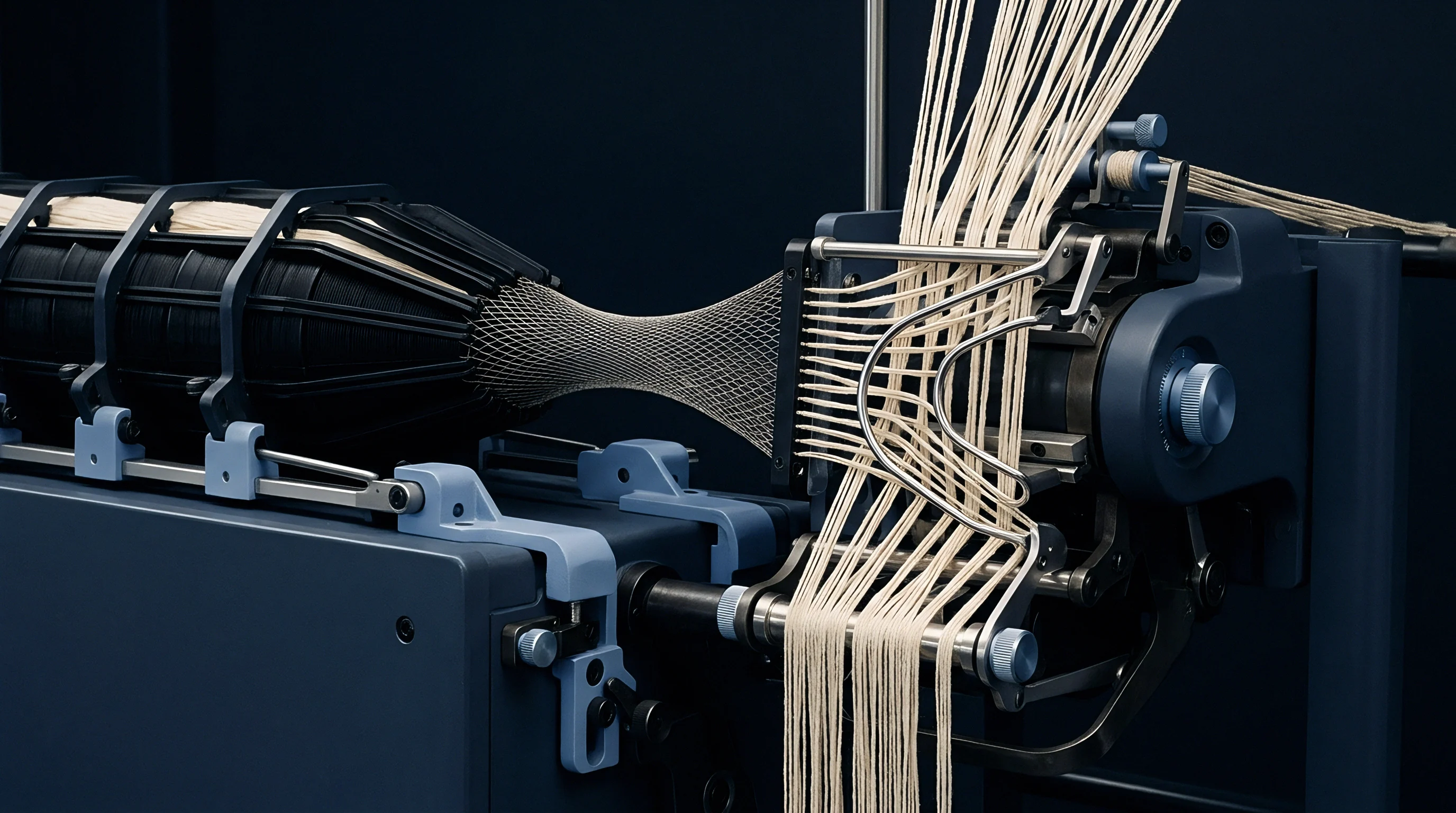
Surface hairiness on the staple sheath increases the aerodynamic drag coefficient, while the internal elastic filament adds longitudinal compliance. During initial propulsion, air issuing from the main nozzle reaches supersonic speeds near the nozzle exit before dropping to subsonic transport velocity inside the profile reed channel.
Propulsion energy scales with the surface area of the sheath fibers. Because core-spun yarns show greater diameter variance and higher bulk than equivalent ring-spun cotton yarns, initial acceleration inside the main nozzle generates higher drag forces. When compressed air acts upon the yarn tip, stretching in the internal elastic component absorbs part of the kinetic energy, delaying the speed at which the yarn tip traverses the shed.
This axial elasticity alters the velocity profile of the pick across the loom width.
| Yarn Structure | Nominal Count (Ne) | Air Drag Coefficient (Cd) | Main Nozzle Pressure (bar) | Peak Insertion Velocity (m/s) |
|---|---|---|---|---|
| 100% Ring Spun Cotton | 30/1 | 1.15 to 1.22 | 3.8 to 4.2 | 65 to 72 |
| Cotton / Elastane Core-Spun (40D) | 30/1 | 1.34 to 1.45 | 4.5 to 5.2 | 58 to 64 |
| Polyester / Elastane Core-Spun (70D) | 20/1 | 1.28 to 1.38 | 4.2 to 4.8 | 60 to 66 |
| Rigid Filament Core-Spun (Glass/Polyester) | 15/1 | 1.08 to 1.14 | 3.5 to 4.0 | 70 to 78 |
Relay Nozzle Wave Synchronization
Maintaining pick velocity across reed widths exceeding 190 centimeters requires a series of relay nozzles firing in synchronized banks. Each relay nozzle group discharges compressed air into the profile reed channel at precise angular increments relative to main shaft rotation. Core-spun yarns require tighter relay nozzle spacing and longer valve blowing angles than non-elastic yarns.
If the air jet wave lags behind the yarn tip, the front end of the pick loses momentum, causing the elastic core to retract slightly while still in flight as sheath fibers slip under drag.
Relay nozzle blowing timing governs axial tension distribution along the pick length. Over-blowing by extending the valve opening duration increases compressed air consumption without increasing pick velocity, creating localized air turbulence that strips outer sheath fibers from the elastomeric core. Under-blowing allows the yarn tail to decelerate rapidly inside the channel, resulting in loop formation, buckled picks, or short insertions that trigger automatic loom stops.
At a main nozzle pressure of 5.0 bar, elastomeric core-spun yarn of count Ne 30/1 exhibits a 15 percent increase in aerodynamic drag compared to standard ring-spun cotton of identical linear density.
Incorrect main nozzle pressure settings directly compromise fabric quality. Setting propulsion air pressure above the structural integrity limit of the yarn sheath forces outer fibers to slide backward along the smooth elastane core, accumulating as slubs at the right-hand selvedge or causing total yarn severance inside the profile reed channel.


Brake
Deceleration Mechanics and Peak Tension Spikes
When the yarn tip arrives at the right-hand selvedge, insertion momentum must dissipate instantly before the shed closes. In traditional air-jet weaving, this rapid deceleration creates a sharp tension spike known as the terminal impact peak. Core-spun yarns containing elastomeric cores react to this peak with high elastic deformation followed by immediate mechanical recoil.
Uncontrolled recoil pulls the yarn back into the shed, distorting the right-hand selvedge and causing uneven pick density across the fabric width.
Programmable electronic yarn brakes mitigate this terminal impact by applying friction to the yarn bundle shortly before arrival. Brake actuation timing must align with the pick arrival window. Applying the brake too early decelerates the yarn inside the profile reed channel, leading to short pick errors; applying it too late allows the peak tension spike to exceed the yield strength of the sheath-core bond, initiating core separation.

Sequential Setup for Insertion Deceleration Profiles
- Establish arrival window by configuring the optical arrival sensor on the right-hand selvedge to detect the yarn tip between 220 degrees and 230 degrees of main shaft rotation.
- Calculate deceleration distance using the fixed loom width and the yarn transport speed to determine the precise brake engagement angle.
- Set pre-braking force on the electronic leaf brake or magnetic disc brake to reduce yarn speed by 25 percent prior to terminal arrival.
- Synchronize relay nozzle cut-off so the final bank of relay nozzles terminates airflow exactly 5 degrees before the braking force reaches maximum intensity.
- Tune terminal braking pressure to damp residual yarn kinetic energy without triggering elastic recoil or core displacement.
- Verify tension peak values using an inline piezoelectric yarn tension transducer mounted between the main nozzle and the yarn feeder package.
Profile reed design also influences friction forces during deceleration. Sub-channel dimensions and reed wire surface roughness create secondary drag during the final phase of pick insertion. A polished profile reed channel reduces surface abrasion on delicate core-spun yarns, keeping sheath fibers locked in position surrounding the inner filament.
Braking profile adjustments must prioritize smooth deceleration over rapid stopping to preserve core attachment.
Cohesion
Sheath-to-Core Slippage and Draft Ratio Impact
Structural integrity in core-spun yarn relies on the radial force exerted by sheath fibers around the stretched inner core. During core-spinning, the elastomeric core undergoes pre-drafting, typically between 3.0x and 4.2x its relaxed length, before outer staple fibers cover it in the spinning triangle. Higher draft ratios produce greater elastic recovery in the finished fabric, but they increase internal shear stress at the interface between the core filament and the fiber sheath.
High tension spikes during air-jet insertion can overcome the static friction holding the sheath in place.
When sheath slip occurs during insertion, outer staple fibers push back along the yarn axis while the elastomeric core remains exposed under tension. This phenomenon, termed strip-back, creates visible thick-and-thin defects in the greige fabric and causes severe dye variance during wet processing. Exposed elastane responds differently to reactive and disperse dyes than the surrounding cotton sheath fibers, creating recurring light spots or barre defects in finished cloth.
Yarn Selection and Structural Qualification Criteria
- Minimum twist factor required for core-spun air-jet filling must exceed Alpha English 4.2 to ensure adequate radial locking pressure over the elastomeric core.
- Core centering precision verified via cross-sectional microscopic analysis, ensuring the inner filament does not drift toward the yarn perimeter where air drag can peel sheath fibers away.
- Roving quality standards demand uniform fiber length distribution with a short fiber content below 8 percent measured by numerical fiber length analysis.
- Elastane draft stability maintained within a tolerance of plus or minus 0.05 units across the entire supply package to prevent local tension variations during weaving.
- Siro-spinning configuration preferred over single-roving core spinning due to twin-roving sheath coverage creating superior mechanical interlocking against insertion drag.
Testing yarn for cohesion before loading warp beams or filling creels prevents mill floor losses. Laboratory evaluations using dynamic friction testers determine the critical tension threshold at which sheath slip begins for a given yarn lot.
ISO 20932 mandates testing elastic yarn structural retention under dynamic cycling to verify core coverage durability under repeated mechanical strain.
Strip-back defects on air-jet equipment are frequently attributed to loom setup, though high insertion air pressure can strip the sheath from the core regardless of yarn twist or wrapping quality.
Pulse
Why Does Peak Tension Spike during Air Jet Insertion?
Peak tension spikes during air-jet insertion stem from the sudden conversion of kinetic energy into static strain when the pick reaches the mechanical stop at the right-hand selvedge. As the yarn tip strikes the edge-cutter or clamp, the momentum of the remaining trailing yarn sends a high-frequency shockwave backward toward the main nozzle. In rigid yarns, this shockwave dissipates rapidly as heat and structural stress.
In core-spun elastomeric yarns, it triggers a violent longitudinal expansion and contraction pulse inside the shed.
Real-time monitoring systems utilize optical sensors and piezoelectric tension sensors to track the tension pulse profile of every pick inserted. Sensor signals feed directly into the loom microprocessor, adjusting the main nozzle pressure valve and electronic yarn brake parameters automatically on a pick-by-pick basis.
| Yarn Count and Core Specification | Loom Speed (PPM) | Arrival Target Angle (deg) | Arrival Window Variance (deg) | Peak Tension (cN) |
|---|---|---|---|---|
| Ne 40/1 Cotton + 40D Elastane | 850 | 225 | +/- 3.2 | 145 to 160 |
| Ne 30/1 Cotton + 40D Elastane | 800 | 230 | +/- 2.8 | 175 to 195 |
| Ne 20/1 Cotton + 70D Elastane | 750 | 232 | +/- 2.5 | 210 to 235 |
| Ne 16/1 Cotton + 70D Elastane | 700 | 235 | +/- 2.1 | 255 to 280 |
Real-Time Sensor Integration and Closed-Loop Control
Closed-loop tension management relies on immediate detection of arrival timing shifts. If environmental humidity inside the weave room changes, fiber friction increases, retarding arrival angles. The automated control system responds by increasing main nozzle firing pressure slightly or advancing relay nozzle firing timing to bring the pick tip back into the target window.
Dynamic adjustment prevents filling-wise structural fabric defects. When arrival angles fluctuate beyond allowable limits, the loom microprocessor logs a warning before initiating a controlled stop. Continuous monitoring of insertion tension curves allows weave room managers to identify deteriorating package unwinding conditions, such as sloughing or tension variations on the creel stand, before mass yarn breakage occurs.
Dynamic tension variations across unwinding packages account for the majority of unaccounted pick arrival failures on high-speed air-jet frames.
How far can adaptive closed-loop tension algorithms compensate for poor yarn package building without sacrificing overall loom insertion efficiency?

Damage
Off-Loom Structural Defects and Wet-Processing Failures
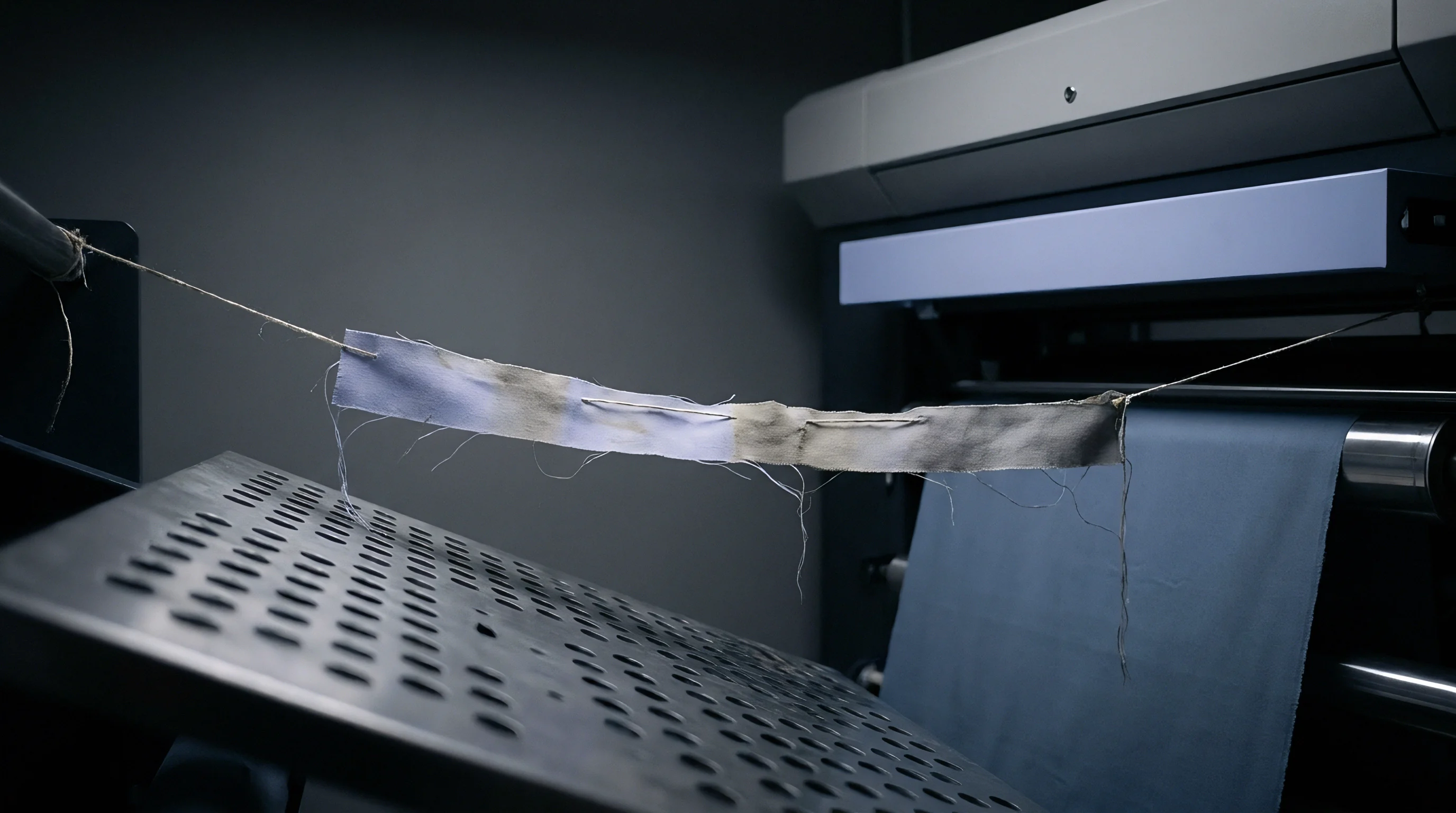
Improper insertion tension settings leave permanent structural flaws in core-spun fabrics that remain invisible until finishing. Excess insertion tension stretches the internal elastomeric core beyond its elastic limit within specific pick zones. When the fabric undergoes desizing, scouring, and heat-setting, these over-stretched sections recoil excessively, creating localized fabric puckering, puckered selvedges, or filling-wise bands of uneven fabric weight.
Snapback ruptures represent the most severe manifestation of tension failure. When insertion tension exceeds the ultimate tensile strength of the inner elastane core, the core breaks internally while the surrounding staple fiber sheath remains visually intact. The severed core ends retract inside the sheath, creating a section of yarn completely devoid of elasticity.
Upon piece-dyeing, these core-pop zones appear as light-colored horizontal streaks due to the absence of stretched elastane density and altered light scattering across the hollow sheath.
Defect Manifestation and Quality Assessment Guidelines
- Core-pop frequency evaluated under backlight inspection tables, counting severed internal filaments per 100 square meters of finished cloth.
- Filling-wise shade banding measured via spectrophotometer across left, center, and right cut widths to detect local dye pick-up variations caused by sheath displacement.
- Dimensional stability after washing evaluated according to ISO 5077 after five standard domestic wash cycles at 40 degrees Celsius.
- Woven fabric stretch and recovery tested under ASTM D3107, recording total fabric stretch percentage, tension growth, and residual static growth after relaxation.
- Puckering severity rating assigned using visual comparison standards under low-angle illumination to quantify tension-induced relaxation distortion.
Uncontrolled weft insertion tension compromises performance specifications agreed upon in fabric procurement contracts. Finisher processing plants cannot correct physical stretch variations caused by uneven weaving tension through stenter overfeed or chemical finishing agents alone.
ASTM D3107 specifies that fabric growth after 2 hours of relaxation must not exceed 3.0 percent for stretch woven fabrics intended for performance apparel applications.
Standard purchase contracts stipulate that any fabric lot exhibiting filling-way stretch variation greater than 4.0 percentage points across the roll width fails quality compliance, transferring full liability for garment remakes back to the weaving mill.
Outlay
Compressed Air Generation Costs versus Loom Productivity
Air-jet weaving mills operate on narrow margin bands dominated by electrical energy costs required to generate compressed air. Main nozzle pressure, relay nozzle pressure, and total air volume directly govern insertion capability, but electrical power consumption increases non-linearly with line pressure. Running high main nozzle pressures to stabilize core-spun yarn transport significantly raises the landed cost per woven meter.
Loom speed optimization requires balancing insertion velocity against stop-rate financial penalties. Running a weave room at 850 picks per minute with an average filling stop rate of 2.5 stops per 100,000 picks consumes less energy and generates less scrap fabric than running at 950 picks per minute with a stop rate of 6.0 stops per 100,000 picks. Stop rates dictate mill margin.
| Loom Velocity (PPM) | Main Pressure (bar) | Air Volumetric Flow (Nm3/h) | Filling Stop Rate (Stops/10^5 picks) | Scrap Rate (%) | Air Cost per Meter ($/m) |
|---|---|---|---|---|---|
| 700 | 4.2 | 22.5 | 0.8 | 0.4 | 0.042 |
| 800 | 4.6 | 26.8 | 1.5 | 0.8 | 0.051 |
| 850 | 5.0 | 30.2 | 2.4 | 1.5 | 0.058 |
| 900 | 5.5 | 35.4 | 5.2 | 3.2 | 0.069 |
Landed Cost Calculations and Operational Optimization
To quantify the true landed cost per finished meter, weaving engineers combine direct energy expenses, yarn scrap losses, machine downtime labor, and quality claim allowances. Consider a typical operational scenario involving an order of 50,000 meters of cotton-elastane stretch twill woven on 220-centimeter air-jet looms. Operating at 850 picks per minute at 5.0 bar air pressure consumes 30.2 normal cubic meters of compressed air per hour per loom.
At an electricity tariff of 0.12 dollars per kilowatt-hour, compressed air generation contributes 0.058 dollars directly to the cost of every meter produced.
Increasing insertion pressure to 5.5 bar to force unstable core-spun yarn through the shed at 900 picks per minute raises volumetric air consumption to 35.4 normal cubic meters per hour, pushing compressed air cost to 0.069 dollars per meter. However, the higher insertion stress elevates the filling stop rate from 2.4 to 5.2 stops per 100,000 picks. Each filling stop leaves an off-loom stop mark that requires manual inspection or fabric cutting during rolling, increasing second-quality scrap generation from 1.5 percent to 3.2 percent.
Because pressure drops create mispicks, the financial loss incurred from generating 850 additional meters of second-quality cloth at a 50 percent price markdown outweighs the minor revenue gain realized by higher loom speed output. Lowering insertion tension to the minimum threshold required for clean shed clearance maximizes first-quality yields while reducing air compressor loading.
Targeting minimum stable nozzle pressure maximizes long-term profitability by preserving yarn sheath integrity and reducing energy demands.
Correct alignment of yarn twist parameters, programmable electronic braking profiles, and precise relay nozzle timing allows weaving mills to run core-spun stretch yarns efficiently without compromising finished fabric performance or incurring unnecessary utility overhead.