Specimen Tensioning Impact on Ring Spun Woven Weight Audits
Specimen tensioning decrimps ring spun yarns prior to cutting, causing excised discs to contract and register artificially elevated areal weights during audits.

Mass
Cutting circular test specimens from a taut, unconditioned roll face distorts areal density readings, often triggering false failures during port-of-entry intake audits. When inspecting incoming containers of ring spun cotton twill, technicians routinely smooth out roll wrinkles by pulling the fabric taut across an inspection table. That manual stretch pulls the crimp out of interlaced ring spun yarns.
Stamping out a specimen under tension captures fewer warp and weft ends than would sit inside an equivalent relaxed area. Once the cut hundred-square-centimetre disc drops clear of the die, internal elastic forces snap the perimeter inward, leaving a relaxed disc with far less surface area than the cutter’s nominal boundary.
Weighing that contracted disc on an analytical balance calibrated to four decimal places naturally yields an inflated mass per unit area. Standard commercial practice simply multiplies the disc’s gram weight by one hundred to report grams per square metre. But because the retracted circle packs more yarn mass into a smaller footprint than an unstressed hundred-square-centimetre patch of the parent fabric, the laboratory calculation overstates actual roll weight.
A mill delivering a target 240 GSM bottom-weight twill can see an entire lot rejected when third-party intake testing reads 249 GSM ~ an error caused entirely by the technician pulling the fabric taut before dropping the die.
Fabric relaxation shrinkage directly alters measured areal density.
Mechanics of Tensioned Areal Measurement
Standard laboratory cutters conforming to ASTM D3776 Option C and ISO 3801 Method 5 define a circle 112.8 millimetres in diameter. The operator bears down on the rotary handle, turning four internal razor blades through a quarter-sweep under spring compression. If the fabric beneath the head is pulled along either the warp or weft axis, yarn spacing opens up as the blades bite.
Ring spun yarns behave differently here than open-end rotor or air-jet yarns, presenting a higher initial modulus under tensile strain before the interlacing crimp begins to yield.
Longitudinal tension narrows fabric width through lateral contraction.
Even two newtons of manual pull across a thirty-centimetre swatch stretches the warp while drawing picks closer together through Poisson contraction. The resulting cut disc holds an unbalanced structure: pick density per linear centimetre drops inside the stretched area, while warp density edges upward. Once released, the disc recovers unevenly on the balance pan, relaxing into an oval rather than a true circle.
An auditor who records the weight without checking the disc’s perpendicular diameters misses this geometric distortion completely, mistaking cutting error for non-compliant fabric.

Relaxation Contraction across Cut Specimens
Pulling rolls straight from shipping pallets brings out residual strain locked in during industrial slitting and inspection winding. Ring spun wovens hold this viscoelastic memory through transit, especially when wound tight around cores and sealed in polyethylene film. Cutting swatches without giving the fabric time to relax locks that winding tension right into the sample.
ISO 139 requires twenty hours of conditioning on open perforated racks at twenty degrees Celsius and sixty-five percent relative humidity, which gives these stored winding stresses time to dissipate before cutting.
Intake audit laboratories cutting specimens directly from unconditioned roll packages record areal weight variances exceeding four percent against relaxed mill master samples.
Bypassing ambient conditioning skews the entire weight audit. Dry fibers stay locked in an extended state, and the die fixes that artificially wide perimeter. As the cellulosic structure picks up moisture during subsequent handling, the fibers swell, forcing the helical yarn path to shorten and thicken.
The cut disc picks up physical weight from moisture regain while its surface area shrinks, compounding the balance error from both directions.
Crimp
Yarn curvature dictates how a woven fabric responds to tensile load during sample preparation. In ring spun weaves, warp ends travel over and under weft picks in continuous waves. This displacement, measured as crimp percentage, accounts for the extra yarn length needed to span a given planar distance.
Systems with high crimp take up initial handling loads by straightening out long before the fibers themselves stretch. Decrimping takes very little force; simply smoothing a swatch flat by hand on an inspection bench pulls the crimp right out of the weave.
Crimp interchange governs how yarns displace under load.
Pulling the warp flat forces crimp into the crossing weft yarns. The picks must bend more sharply around the straightened warp ends, drawing the edges inward and tightening the transverse sett. In ring spun cotton, where fibers lie in cohesive concentric helices formed by genuine ring twisting, this structural shift shows pronounced hysteresis.
Once pulled flat under cutting clamps, warp yarns will not regain their natural crimp balance without mechanical agitation or steam conditioning.

Ring Spun Helical Twist Geometry
True ring spinning distributes twist continuously across the entire yarn cross-section, establishing strong inter-fiber friction. With twist multipliers typically between 4.0 and 4.6 for warp-grade weaving, the resulting strand resists internal fiber slip under tension. When pulled inside a woven matrix, the yarn straightens along its macroscopic path rather than stretching individual cotton fibers.
That response is distinctly different from open-end rotor yarns, where surface wrapper fibers form local pinch points that trap crimp in irregular pockets.
Ring spinning produces a coherent, dense twist structure.
Because a ring spun yarn acts much like a solid elastic rod, preparation tension spreads evenly across the entire swatch. Even modest handling pulls out crimp waves across all active ends, altering fabric dimensions before the blade even makes contact. Technicians working without fixed mounting templates inevitably decrimp identical fabric lots to different degrees.
An operator who presses heavily against the cutting mat pulls warp yarns significantly flatter than one who uses a lighter touch, injecting personal technique into an audit intended to settle contractual compliance.
Is Greige Crimp Distortion Erroneously Measured as Mass?
The gap in structural relaxation between loom-state greige goods and wet-finished cloth changes how severely tension skews test results. Greige goods retain warp sizing, loom take-up stresses, and winding tension, leaving yarns heavily loaded internally. Wet processing ~ continuous scouring, pad-steam dyeing, and stenter drying ~ relieves those weaving strains while applying finishing chemicals.
If a stenter runs without sufficient overfeed, however, longitudinal tension remains trapped in the finished roll, only to snap back the moment a swatch is stamped out.
Specimen slippage during mounting ruins test repeatability.
When a sample is punched from goods that left the stenter under heavy longitudinal draft, the cut disc snaps back along the warp. The drop in surface area tracks directly with the residual strain left by the finishing frame. Because the balance weighs a contracted disc, it reports an artificially high mass per unit area.
Finishing mills that push line speeds without adequate overfeed control effectively lock intake audit failures into their fabric, since destination laboratories will cut discs that relax and weigh in well above specification.
- Mounting clamp alignment fixes the warp axis strictly parallel to the cutting bed to prevent asymmetrical diagonal skewing during excision.
- Deadweight tensioning verification applies a precise, non-elastic load of fifty centinewtons across the specimen width to establish planar contact without initiating decrimping.
- Rotary cutter downward actuation completes the circular excision within three seconds using hardened tungsten carbide blades rotated through a single complete sweep.
- Gravimetric balance transfer places the excised disc into an enclosed draft shield within ten seconds to prevent ambient moisture loss or air current disturbance.
- Dimensional axis measurement records warp and weft diameters across the excised circle using an optical reticle to calculate real relaxed surface area prior to weight calculation.
| Construction Specification | Yarn Twist Multiplier | Warp Crimp Percentage | Decrimping Force (cN) | Relaxed Area Loss After Cut (%) | GSM Distortion Bias |
|---|---|---|---|---|---|
| Ne 20/1 x Ne 20/1 Plain 60×52 | 4.2 alpha | 9.8% | 12 cN | 3.6% | +8.8 GSM |
| Ne 30/1 x Ne 30/1 Plain 78×68 | 4.4 alpha | 8.4% | 16 cN | 2.9% | +4.2 GSM |
| Ne 16/1 x Ne 12/1 Twill 3/1 96×48 | 4.0 alpha | 12.2% | 9 cN | 5.1% | +13.4 GSM |
| Ne 40/1 x Ne 40/1 Satin 4/1 130×70 | 4.5 alpha | 6.2% | 22 cN | 1.8% | +2.4 GSM |
Fabrics with high crimp decrimp under the lightest handling, making twills and plain weaves acutely sensitive to how a technician mounts the swatch. Satin weaves, with their long floats and fewer interlacing points per square centimetre, hold up better against light lateral pull. Longer floats concentrate crimp into fewer, sharper bends that require noticeably more force to pull flat.
As a result, satins show little area distortion under casual handling, while bottom-weight twills react sharply to mounting pressure during intake audits.
Loose interlacing cushions internal yarn displacement, whereas a dense sett transfers tension directly across adjacent ends.
Clamp
Clamping plates and cutter heads exert both downward compression and outward lateral push before the blades ever finish their pass. Standard circular cutters use a central pad of cork, rubber, or foam to hold the fabric flat. When the operator bears down on the handle, this pad crushes the yarn crowns against the cutting mat.
If friction against the pad exceeds the fabric’s grip on the cutting mat below, that downward thrust squeezes the yarn matrix outward, creating radial tension right along the cutting perimeter.
Rotary cutter plates compress exposed yarn crowns.
This outward spread pushes the cut line past the die’s nominal boundary. Once the cut is made and the head lifts, the flattened yarns rebound in thickness, pulling the sheared edges inward. A worn cutter pad with patchy surface friction makes matters worse by twisting the fabric unevenly during blade rotation.
Dull blades compound the problem: instead of shearing yarns cleanly, they snag and drag fiber loops across the cut line, pulling outside material into the disc and artificially raising its mass.
Rotary Cutter Compression Mechanics
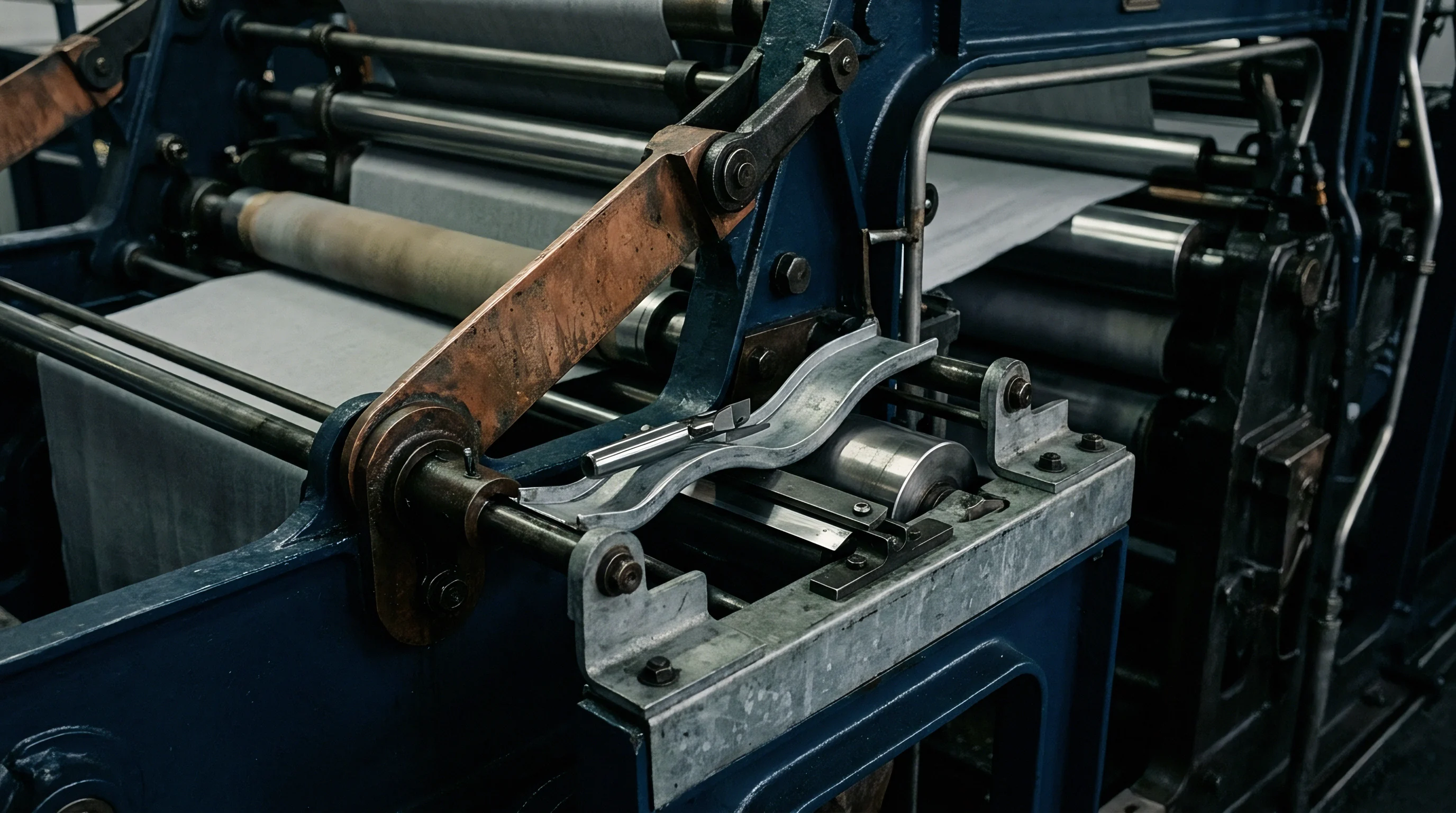
Standard rotary cutters carry four reversible razor blades spaced at ninety-degree intervals around an annular frame. Operation requires downward force to drive the blades through the cloth and into the rubber mat, followed by a quarter-turn sweep of the handle. Pushing down too hard crushes the circular profile of ring spun yarns, expelling air from the fiber core and flattening yarn crowns against the mat.
That local flattening reduces fabric thickness and forces fibers outward across the cutting perimeter.
Rotating cutter blades induce lateral shear.
Technicians often throw their weight onto the cutter handle to guarantee clean separation through heavy twill or canvas. On dense goods, that downward force frequently exceeds forty newtons. Under that load, soft rubber cutting mats give way, forming a bowl-shaped depression that draws the fabric down with it.
The blades then cut the cloth while it is dished into this recess. Once the sample is lifted out and laid flat on a balance pan, its actual planar area is much smaller than the curved surface the blades cut through, skewing the recorded mass sharply upward.
Inspection Frame Longitudinal Draft
Verifying linear weight on full-width inspection frames introduces systematic tension errors down the length of the roll. These inspection stations draw fabric across tilted, back-lit tables using motorized pull rollers. On older or lower-cost frames, tension control amounts to simple mechanical friction brakes on the unwind arbor paired with constant-speed rollers at the rewinder.
As the supply roll shrinks in diameter, constant braking torque exerts progressively higher tension on the running web.
Inspection frames pulling textiles under uncontrolled arbor braking stretch the running web up to three percent, artificially reducing the recorded linear weight per running metre.
When a frame measures weight per running metre through an electronic load cell bar while the fabric is stretched two percent lengthwise, the calculated linear mass drops accordingly. The running web is stretched thin, spreading a fixed mass over an inflated length tally. But when technicians cut full-width master swatches on the inspection dock, that tension disappears.
Subsequent static bench testing shows the fabric to be noticeably heavier per linear metre than the automated frame sensor indicated.
- Excessive arbor back-tension stretches the longitudinal warp axis across the lighted viewing apron, creating artificial width necking and lowering running linear weight readings.
- Uneven draw roller grip pressure produces lateral shear across the fabric plane, causing skewed pick alignment and localized areal density variations.
- Blunt circular cutting blades snag ring spun warp ends, dragging adjacent fibrous mass into the excised sample boundary before complete shear occurs.
- Degraded backing cutting mats allow localized trough deformation under the cutter head, forcing specimens into concave geometries during blade penetration.
- Manual smoothing on inspection tables imparts uncontrolled operator-dependent decrimping that alters pick counts within the cut zone.
| Preparation Method | Clamping Force (N) | Substrate State | Actual Specimen Area (cm²) | Recorded Weight Bias (%) | Audit Status |
|---|---|---|---|---|---|
| Free Relaxation Die Press | 0 N (Inert) | Fully conditioned 24h | 100.0 cm² | 0.0% (Benchmark) | Compliant |
| Hand-smoothed Rotary Cutter | 15 N vertical | Direct from plastic wrap | 96.8 cm² | +3.3% | Marginal Breach |
| Heavy Manual Compression Cutter | 45 N vertical | Direct from plastic wrap | 94.2 cm² | +6.1% | Lot Rejection |
| Tensioned Frame Inline Cutter | 25 N lateral | Under winding draw | 95.4 cm² | +4.8% | Lot Rejection |
| Pneumatic Template Clamp | 10 N constant | Conditioned 4h | 99.1 cm² | +0.9% | Compliant |
The data shows how consistently preparation flaws push circular-cutter weight audits upward. The underlying mechanic never changes: stretching or dishing the fabric during excision causes the cut sample to snap back into a smaller footprint, concentrating mass into fewer square centimetres. Measuring continuous running weight on an inspection frame does the exact opposite, understating mass through lengthwise draft.
These conflicting error directions cause ongoing friction between weaving mills verifying yardage on continuous frames and garment plants testing stamped discs on lab benches.
The yardage met specified areal density during finishing, with discrepancies recorded in destination testing originating from improper sample preparation.
Dispute
Bulk textile contracts specify mass per unit area within tight boundaries, typically plus or minus three or five percent. When an intake audit at an apparel plant flags an out-of-spec lot, buyers issue debit notes, stop spreaders, or reject containers outright. With a shipment of fifty thousand linear metres of heavy cotton twill, substantial capital is on the line.
Determining whether a three-and-a-half percent weight discrepancy stems from sizing add-on, excessive picks, or technician error during swatch cutting demands careful technical analysis.
A two percent measurement error triggers contractual penalties.
Debit notes generated by flawed cutting methods penalize mills that delivered compliant fabric. At the same time, garment manufacturers relying on inflated test weights plan yields against bad data, cutting fewer garments per roll than their markers require and running short before finishing the order. When yardage fails to deliver planned garment yields because the actual fabric was lighter and narrower than the distorted test disc suggested, the factory absorbs the loss directly.
Could Mounting Clamps Alter Area Density Calculations?
Disputes escalate quickly when buyer laboratories omit specimen preparation details from their intake audit reports. Standards such as ASTM D3776 permit several test options, from weighing full rolls to cutting small swatches. Facilities using handheld circular cutters routinely omit the fabric’s relaxation history, the backing board hardness, and the clamping force applied during the cut.
Without fixed mounting templates to eliminate manual pulling, test results lack the reproducibility required to hold up under legal scrutiny.
Moisture regain directly shifts measured sample weight.
A South Asian mill may dispatch fabric certified at 215 GSM under ISO 3801 Method 5 after twenty-four hours in a conditioned room. Rushed intake technicians in North America or Europe often cut discs within ten minutes of cracking open a roll in an unconditioned warehouse. If the warehouse air is dry, the cut sample relaxes inward; if humid, the cotton absorbs ambient moisture.
Paired with manual stretching across the cutting board, the recorded density can easily drift eight to twelve grams per square metre off baseline, pushing the fabric outside contractual tolerances.
Commercial Settlement and Tolerance Breaches
Resolving commercial claims requires checking structural construction against the audit method itself. The clearest tell of tension distortion is an inconsistency between thread count and measured areal density. In woven cloth, mass per unit area tracks directly with ends and picks per centimetre alongside yarn linear density.
If an intake lab logs a high GSM reading but optical thread counts match the specification, the extra mass is almost certainly an artifact of specimen contraction after cutting.
A construction matching certified warp and weft sett counts cannot possess excessive mass unless yarn counts have coarsened or sizing chemistry remains unwashed.
Testing the linear density of yarns pulled from the contested sample quickly settles whether yarn numbers match the contract. An analyst strips twenty warp and twenty weft threads, straightens their crimp under standard tension per ISO 7211-5, and determines actual yarn count in tex or cotton count. If those linear densities align with approved technical specifications, the elevated sample weight is mathematically verified as an error caused by tensioned cutting.
- Ends and picks verification counts yarn density across five distinct zones under ten-times optical magnification to confirm structural interlacing parameters.
- Yarn count decrimp testing extracts yarns to measure relaxed linear density under specified millinewton tension weights per standard length.
- Specimen diameter audit verifies whether excised circular discs maintain true 112.8 millimetre dimensions across multiple angular axes.
- Desizing and wash extraction removes non-fibrous starches, lubricants, and finishing resins to isolate base fiber mass from chemical add-ons.
- Differential conditioning analysis compares specimen weight immediately upon roll unsealing against weight after twenty-four hours in standard atmosphere.
| Container Volume (Linear Metres) | Nominal Value (USD) | Reported Weight Error | Contractual Consequence | Financial Penalty Exposure | Resolution Pathway |
|---|---|---|---|---|---|
| 45,000 m (1 Container) | $157,500 | +2.1% (Tensioned Cut) | Within 3% Commercial Tolerance | $0 (Accepted) | Direct intake clearance |
| 45,000 m (1 Container) | $157,500 | +3.8% (Tensioned Cut) | Minor Tolerance Breach | $7,875 (5% Debit Note) | Third-party referee testing |
| 45,000 m (1 Container) | $157,500 | +5.4% (Tension + Dry) | Major Tolerance Breach | $23,625 (15% Penalty) | Joint laboratory audit |
| 90,000 m (2 Containers) | $315,000 | +6.8% (Crushed Mat Cut) | Full Shipment Rejection | $315,000 (Goods Returned) | On-site forensic testing |
The financial stakes in the table illustrate why testing procedures leave no room for sloppy handling. A four percent distortion introduced by improper clamping can turn a routine shipment into an expensive legal and commercial dispute burdened by demurrage, re-testing fees, and plant delays. When technical managers grasp the physical mechanics behind tension distortion, commercial teams are equipped to challenge unfounded debit notes.
Failing to standardize cutting protocols leads to repeated financial hits through unjustified price renegotiations, arbitration costs, and cancelled supply contracts.
Remedy
Preventing tension-induced weight errors requires disciplined specimen preparation alongside tight contractual testing clauses. Vague laboratory instructions leave too much to technician habit. Stamping out a test disc is a precision mechanical operation: preparation procedures must isolate the fabric from external lateral, longitudinal, and compressive loads before, during, and after the blades penetrate the cloth.
Releasing stored tension causes immediate specimen contraction.
Mills and sourcing teams establish common ground by using zero-tension cutting jigs. These fixtures feature rigid acrylic clamping rings that rest on the fabric under calibrated deadweight rather than operator force. Lined with low-friction PTFE or fine velvet, the contact face keeps the fabric from bunching during blade travel without dragging yarn crowns outward.
Isolating the cutting perimeter from manual smoothing lets the swatch maintain its natural geometry while the die cuts through.
Zero Tension Specimen Preparation Standards
A reliable testing protocol requires swatches cut from parent rolls to relax completely on open screens before die cutting. Technicians should cut a thirty by thirty centimetre square from the roll, keeping at least one hundred millimetres away from selvedges to avoid edge distortion. That swatch then rests horizontally on a perforated aluminum tray in the conditioning room, exposing both faces to circulating air for at least sixteen hours.
Standard testing atmospheres demand twenty hours of conditioning.
Drafts and air currents distort delicate cuts.
After conditioning, the relaxed square is placed on a high-density, self-healing polyurethane cutting mat with a Shore A durometer hardness between 85 and 95. A mat that is too soft dips under blade pressure, while an overly hard base quickly blunts the cutting edges. The circular cutter is placed centrally on the swatch without dragging.
The technician then operates the cutter using a pneumatic or mechanical lever press calibrated to exactly twenty-five newtons of downward force, eliminating the variable weight of human hands.
Purchase Order Weight Verification Provisions
Commercial protection starts when drafting the contract, where purchase orders should specify exact test methods, options, and dispute protocols. Blanket clauses like ‘weight must be 200 GSM ±3%’ invite friction. Contracts need to name ASTM D3776 Option C or ISO 3801 Method 5 explicitly, backed by conditioning rules and an agreed referee lab.
The technical sheet must also specify whether areal mass applies on a conditioned dry basis or an as-received commercial moisture regain basis.
Full rolls retain substantial internal winding strain.
Purchase agreements should establish thread count and yarn linear density as the governing standards in any weight dispute. If the sett and yarn tex align with certified production limits, the fabric is contractually compliant regardless of minor variance in cut-disc weight. This provision protects mills from flawed testing at destination ports, while giving garment manufacturers the yarn density and structure required for their finished products.
Section 8.4 of the master supply agreement specifies that all areal mass audits must be performed on samples conditioned for twenty-four hours under ISO 139 and cut with a mechanical die press calibrated to twenty-five newtons downward force, excluding rejection claims based on manual rotary cuts taken straight from container packaging.