Quantifying Microplastic Baling Contamination Detection Limits in Combed Cotton Ring Spinning Operations
Optical blowroom sorters fail to detect transparent polyolefin baling fragments under 0.5 mm², leaving mechanical combing as the final physical barrier.


Twine
Synthetic polymer packaging elements introduced during harvesting, ginning, and pressing create significant quality vulnerabilities in fine cotton spinning. Polypropylene agricultural strapping, extruded tie cords, high-density polyethylene film wrappers, and nonwoven bale covers shred under mechanical pressure during transport and opening. When raw lint encounters automated opening machinery, these synthetic packaging components break apart into thousands of discrete, fine plastic filaments.
Fine ring spinning mills processing combed cotton between Ne 30s and Ne 80s face severe fabric defects when synthetic fragments pass undetected through carding and combing preparation sequences.
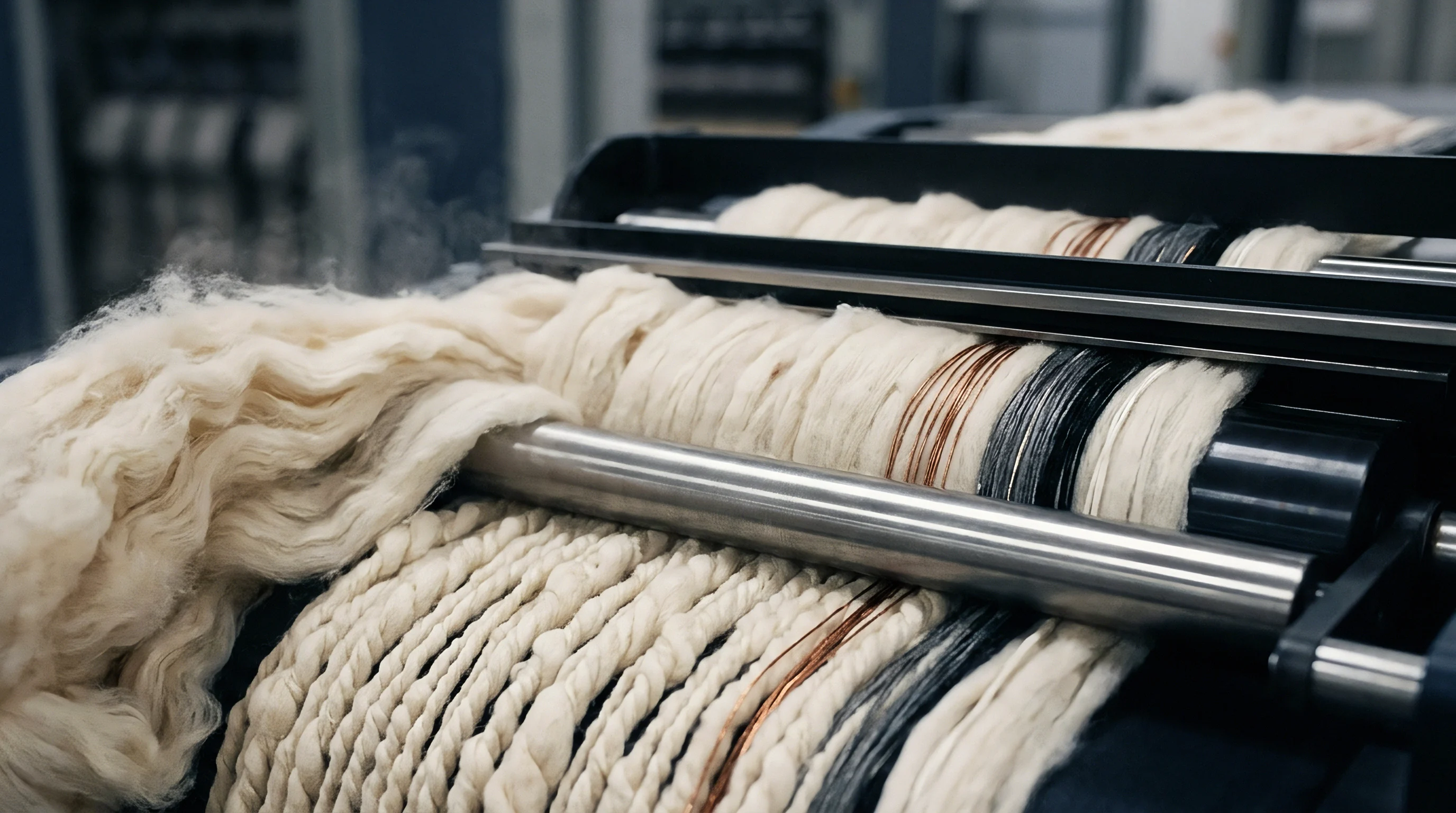
Polymer Contamination Pathways in Raw Cotton Bales
Raw lint arriving at the bale opening line carries diverse non-cellulosic inclusions originating from harvest field debris and logistics packaging. Automated baling presses operate at hydraulic pressures reaching 300 to 500 bar, compressing raw cotton to densities exceeding 450 kilograms per cubic meter. Under this pressure, exterior polyolefin wrapping material cuts directly into the outer layers of the cotton block.
Manual bale opening operators using knives routinely sever polypropylene strapping, leaving trailing fibers embedded within the compressed lint. Coarse ties rupture early.
Fraying generates thousands of micro-fibrils. Frictional contact between synthetic straps and coarse cotton fibers during transit fractures brittle plastic surfaces. Microscopic examination of unopened cotton blocks reveals synthetic fiber bundle counts ranging from 12 to 140 foreign particles per 225-kilogram bale.
Polypropylene filaments exhibit linear densities between 1.5 dtex and 15 dtex, closely matching the physical dimensions of natural cotton fibers, which typically range from 1.1 dtex to 1.8 dtex. This physical dimension parity prevents gravitational dropping during initial pneumatic cleaning phases.
Polypropylene strapping fragments matching natural cotton fiber linear density between 1.1 dtex and 1.8 dtex bypass gravitational dropping screens in primary pneumatic opening.
Bale Packaging Degradation Mechanics during Mechanical Opening
High-speed rotating teeth on automatic pluckers exert severe shear forces against incoming raw fiber blocks. Plucker rollers operating at tip speeds between 12 and 18 meters per second shred rigid plastic fragments into microscopic lengths. As plucker teeth bite into compressed lint, single synthetic filaments fracture transversely and split longitudinally into thin micro-fibrils measuring 50 to 500 micrometers in diameter.
Mechanical opening reduces larger foreign plastic pieces into microplastic particles scattered across dozens of individual fiber tufts.
- Polypropylene Extruded Strapping enters opening lines as high-tenacity fibrillated tape, breaking under mechanical plucking into rigid elongated spicules that migrate parallel to cotton fibers.
- High-Density Polyethylene Film Wrappers crumble under mechanical impact into thin transparent flakes with low flexural rigidity, allowing them to wrap tightly around cotton fiber tufts.
- Polyethylene Terephthalate Baling Wire Covers split into high-density, sharp-edged particles that resist carding cylinder extraction and cause mechanical pin damage on comb nipper plates.
- Jute and Polyolefin Hybrid Cords degrade into multi-filament clusters that untwist during fine opening, generating vast numbers of single micro-fibers.
Micro-plastic particles generated at the plucker stage pass directly into coarse opening machinery. Beatres, peg drums, and saw-toothed rollers subject the fiber mass to acceleration forces exceeding 1,000 g. These mechanical impacts drive rigid synthetic particles deeper into individual cotton tufts, creating tight mechanical entanglements.
Contamination alters dye uptake. Undetected micro-film creates fabric holes. The cost of failing to isolate microplastics at the bale opener scales exponentially down the spinning line, resulting in rejected yarn lots, downtime on winding machinery, and full order cancellations at the dye house.


Vision
Modern blowroom lines integrate multi-sensor optical sorting hardware directly after coarse opening to intercept foreign matter. Automatic optical sorters utilize high-speed optical array cameras, ultraviolet fluorescence detectors, and polarized light reflection sensors to identify non-cellulosic particles within high-velocity airborne fiber streams. The physical velocity of cotton tufts inside pneumatic transport ducts ranges between 15 and 25 meters per second, restricting the available optical exposure window for individual synthetic particles to under 0.5 milliseconds.

Blowroom Optical Sorter Detection Thresholds and Resolution Limits
High-resolution charge-coupled device cameras process passing fiber tuft streams under intense light-emitting diode arrays. Optical sorters achieve full spatial detection for opaque color-contrasting foreign matter down to a particle area of 0.1 square millimeters. Standard color reflection detection efficiency drops dramatically when foreign particles exhibit high transparency or match the natural cream-white color profile of combed cotton raw stock.
White polypropylene and transparent polyethylene film fragments generate optical contrast differentials under 3 percent against natural cotton under standard white LED illumination.
Machine speed reduces dwell time. Standard cameras miss clear films. Advanced optical sorters employ ultraviolet excitation lamps operating at wavelengths between 365 nm and 395 nm to detect synthetic polymers containing optical brighteners or residual processing catalysts.
Polyolefin materials lacking fluorescent additives remain invisible under standard UV exposure. Polarized light reflection systems measure changes in light polarization states caused by the crystalline structure of synthetic polymers. Highly oriented polypropylene tape fragments alter polarization angles, allowing detection down to 0.3 millimeter particle lengths under optimal duct presentation conditions.
Optical sorters operating under standard visible LED arrays miss over 82 percent of transparent polyethylene film fragments smaller than 0.5 square millimeters due to insufficient color contrast against cotton.
| Polymer Type | Physical Contaminant Form | Primary Detection Spectrum | Minimum Particle Area (mm²) | Detection Efficiency (%) |
|---|---|---|---|---|
| Pigmented Polypropylene | Colored Fibrillated Tape | Visible RGB Color Reflection | 0.08 | 96.5 |
| Unpigmented Polypropylene | White Extruded Filament | Polarized Light Reflection | 0.25 | 71.0 |
| High-Density Polyethylene | Transparent Thin Film | Near Infrared Absorption (1650 nm) | 0.40 | 58.5 |
| Polyethylene Terephthalate | Rigid Strap Fragment | UV Fluorescence (380 nm) | 0.12 | 89.0 |
| Low-Density Polyethylene | Clear Stretch Packaging | Polarized Refractive Index | 0.50 | 44.0 |

Polarized and near Infrared Sensor Limitations on Transparent Microplastics
Polyolefin film fragments and clear extruded ribbons present severe detection hurdles for standard color reflection systems. Near-infrared (NIR) spectroscopic sensors evaluate specific chemical absorption bands, targeting the C-H stretching vibrations of synthetic polymers at 1200 nm, 1400 nm, and 1650 nm wavelength bands. Natural cellulose exhibits strong hydroxyl absorption peaks at 1450 nm and 1940 nm due to bound moisture regain.
NIR camera systems resolve chemical composition differences regardless of particle color or optical transparency.
NIR sensor array resolution limits restrict practical industrial detection performance on fast-moving duct lines. Standard commercial NIR sorters employ pixel resolutions ranging from 1.0 mm to 2.5 mm per pixel across a 1200 mm duct width. A microplastic fragment measuring 0.3 mm by 0.8 mm falls below the single-pixel spatial threshold of high-speed NIR arrays.
The signal averaging effect across adjacent pixels dilutes the polymer chemical absorption signature into the background cellulosic signal. Microplastic particles smaller than 1.0 square millimeter routinely pass through blowroom optical sorting stages without triggering pneumatic rejection nozzles.
- Calibrate baseline spectroradiometers using unbleached combed cotton sliver to set background cellulosic absorption levels across 1000 nm to 1700 nm wavelengths.
- Adjust pneumatic ejection nozzle pulse duration to 4 milliseconds to prevent excessive good cotton waste carryover during rejection events.
- Verify UV lamp radiant intensity using a calibrated radiometer to maintain minimum UV irradiance levels of 15 milliwatts per square centimeter at the camera window.
- Set polarization filter angles to 90-degree cross-polarization alignment relative to the illumination plane to maximize birefringence contrast on crystalline synthetic tapes.
- Perform hourly glass window cleaning routines using antistatic wipes to remove fine cellulosic dust accumulations that degrade NIR sensor signal-to-noise ratios.
Suppliers often state that optical blowroom sorters catch all foreign synthetic materials down to micro-fiber dimensions under standard plant running conditions. Sorter performance claims rely on ideal laboratory conditions using bright red polypropylene cords suspended in clean, low-density tuft clouds. Industrial line performance drops as tuft density increases beyond 150 grams per cubic meter of air, where overlapping cotton fibers physically obscure micro-scale synthetic debris from optical view.

Comb
Mechanical cleaning sequences downstream of opening rely on density differential, air currents, and targeted combing action. High-production carding machines process cotton tufts into parallel single fibers, forming a thin web that condenses into card sliver. The aggressive action of cylinder wire operating against stationary and revolving flats subjects the fiber mass to intense mechanical carding.
Card wire clothing density ranging from 800 to 1000 points per square inch mechanically traps rigid plastic fragments, breaking long synthetic filaments into shorter fragments.

Where Do Polypropylene Microfibers Concentrate during High Speed Combing?
Frictional drag across carding wire arrays breaks rigid plastic contaminants into thousands of hair-like synthetic fragments. Card clothing traps longer synthetics. Micro-fibers pass into the web.
Synthetic particle counts increase by 200 to 400 percent between card chute feed and card sliver web formation due to mechanical shredding. While heavy trash, sand, and large nep structures are expelled into card waste collection chambers beneath the licker-in roll, fine flexible synthetic micro-fibers align parallel with natural cotton fibers, passing directly into the carded sliver.
Combing removes larger rigid specks. Fine micro-fibers bypass top combs. Fine combed yarn spinning requires high-efficiency lap preparation and combing to remove short fibers, residual neps, and fine trash.
During combing, fiber laps pass through nipper assemblies before circular combs and top combs process the trailing and leading ends of the fiber fringe. Circular comb wire needles operating at 350 to 500 nips per minute penetrate the fiber mass, extracting short cotton fibers and rigid non-cellulosic impurities into the comb waste, known as noil.
Combing sequences configured for 16 percent noil extraction eliminate up to 92 percent of rigid plastic specks larger than 0.5 mm, but allow up to 68 percent of flexible micro-filaments under 3.0 mm length to remain in the combed sliver.
| Process Stage | Mean Particle Mass (µg) | Mean Filament Length (mm) | Particle Count per 100g Fiber | Stage Extraction Efficiency (%) |
|---|---|---|---|---|
| Bale Opening Chute | 125.0 | 18.50 | 45 | 0.0 |
| Blowroom Optical Sorter | 95.0 | 12.20 | 38 | 32.5 |
| Card Cylinder Web | 18.2 | 3.10 | 142 | 18.0 |
| Comb Lap Preparation | 17.5 | 3.05 | 138 | 4.2 |
| High-Speed Comber Sliver | 4.8 | 1.15 | 62 | 61.5 |
| Finished Ring Spun Yarn | 4.6 | 1.10 | 58 | 0.0 |
Carding and Combing Neps Extraction Mechanical Efficiency
Precision adjustment of the nip distance between top nippers and the detaching roller dictates waste extraction rates. When top comb pin density is increased from 26 pins per centimeter to 30 pins per centimeter, the mechanical interception of fine synthetic filaments improves significantly. Flexible polyolefin micro-fibers bend under comb needle impact, sliding between adjacent needles without being pulled into the noil collector.
Flexible synthetic microplastics act like long, elastic cotton fibers during detaching roller drafting cycles.
- Top Comb Pin Density determines the spatial gap through which micro-fibers pass, with densities exceeding 28 pins per centimeter required to capture sub-millimeter synthetic spicules.
- Circular Comb Segment Angle controls the total duration of needle penetration, where extended 90-degree needle segments increase micro-particle extraction into comb noils.
- Nipper Distance Setting dictates the gauge between detaching rollers and nipper jaws, directly influencing the length threshold of synthetic fragments dragged into the combed web.
- Drafting Zone Roller Pressure establishes friction forces in drawframe drafting zones, where excessive pressure flattens hollow synthetic micro-tubes and prevents subsequent optical detection.
According to standard commercial cotton yarn quality specifications governed by RIETER and USTER benchmarks, total foreign fiber content in combed sliver intended for Ne 50s ring spinning must remain below 2 particles per 100 grams of processed sliver. Combing lines failing to maintain top comb pin alignment allow microplastic contamination to double inside finished drawframe slivers. Increased particle frequency creates uncorrectable yarn strength variations and end-down spikes during ring spinning draft operations.

Penalty
Quality specifications for high-count ring spun yarns impose strict upper limits on allowable foreign fiber counts per unit mass. Ring spinning frames draft combed slivers by total draft ratios between 20 and 50, attenuating the fiber strand to its final yarn linear density. Synthetic microplastics passing into the main drafting zone disrupt fiber cohesion.
Because synthetic polyolefins possess different friction coefficients than natural cotton, plastic fragments cause localized drafting waves, generating thin places, thick places, and severe yarn strength loss.
Yarn Clearing Optical Thresholds and Commercial Defect Schedules
Winding machinery equipped with dual-sensor optical and capacitive clearers evaluates spinning defects in real time. Modern yarn clearers utilize optical reflection channels combined with high-frequency capacitive mass channels to identify foreign matter. Capacitive sensors detect mass variations based on dielectric constant differences.
Cotton possesses a dielectric constant between 3.5 and 5.0 at ambient moisture regain, whereas polypropylene exhibits a lower dielectric constant around 2.2. Capacitive clearers flag thick plastic pieces as mass faults, triggering automatic yarn cutting blades.
Clearer cuts stop machine production. Fine micro-fibers matching yarn diameter pass capacitive sensors without triggering mass limits. Dual optical clearers evaluate color contrast variations against background yarn body shade.
Clear or white polypropylene fragments remain completely undetected by standard optical clearing channels. Specialized infrared optical clearers measure light transmission absorption differences between cellulose and synthetic polymers, successfully detecting transparent polypropylene micro-fibers down to 0.2 mm length and 20 micrometer diameter at winding speeds up to 1500 meters per minute.
Capacitive yarn clearers fail to detect synthetic micro-filaments whose physical cross-section matches the target yarn diameter due to baseline dielectric signal averaging across high-speed winding zones.
| Contaminant Count (per 100g Yarn) | Defect Classification | Yarn Clearing Cut Frequency (per 100km) | Commercial Price Deduction (%) | Claim Action Trigger |
|---|---|---|---|---|
| 0 to 2 | Grade A Excellent | Under 1.5 | 0.0 | Full Invoice Payment |
| 3 to 5 | Grade B Acceptable | 1.5 to 3.5 | 2.5 | Standard Delivery Acceptance |
| 6 to 10 | Grade C Defective | 3.6 to 8.0 | 8.0 | Mandatory Retest and Rejection Option |
| 11 to 20 | Grade D Off-Spec | 8.1 to 15.0 | 18.0 | Immediate Shipment Rejection |
| Over 20 | Reject Level | Over 15.0 | 35.0 | Full Lot Rejection and Freight Claim |
Defect density dictates contract claims. Excess synthetic cuts on high-speed winders increase knotter cycle times, reducing mill winding efficiency by up to 12 percent. Excessive clear cuts alter machine economics.
When foreign plastic particle counts exceed 10 items per 100 grams of combed yarn, yarn buyers enforce immediate contract price deductions or reject entire spinning lots at the port of entry.


Claim
Dispute resolution over synthetic foreign matter density requires absolute analytical proof regarding chemical species and physical origin. Commercial arbitration cannot proceed on visual inspection alone, as cellulosic trash, core-shell neps, and bleached botanical skin fragments frequently mimic synthetic film specks under optical magnification. Accredited testing laboratories isolate microplastic fragments from bulk yarn samples through chemical solvent dissolution, thermal characterization, and infrared microscopy.

Quantitative Laboratory Verification via Thermo-Analytical and Spectroscopic Separation
Standard gravimetric extraction methods fail when foreign polymer fragments fall below one milligram in mass. Chemical separation protocols according to ISO 1833 utilize concentrated zinc chloride or cupriethylenediamine solutions to selectively dissolve cellulosic cotton fibers while leaving synthetic polyolefins, polyamides, and polyesters fully intact as insoluble residues. Laboratory technicians filter the resulting liquid suspension through pre-weighed polytetrafluoroethylene membrane filters featuring 0.45 micrometer pore sizes to collect insoluble microplastic debris.
Thermal analysis confirms polymer species. Differential Scanning Calorimetry (DSC) measures endothermic melting phase transitions of isolated polymer residues. Polyethylene displays sharp melting peaks between 120 degrees Celsius and 135 degrees Celsius, while isotactic polypropylene exhibits characteristic melting endotherms between 160 degrees Celsius and 168 degrees Celsius.
DSC testing quantifies target polymer mass down to 0.1 micrograms, confirming exact polymer identity regardless of particle oxidation state or mechanical deformation.
Fourier-Transform Infrared (FTIR) attenuated total reflectance microscopy provides spatial chemical imaging of isolated microplastics directly on filtration membranes. FTIR focal plane array detectors analyze spatial areas down to 10 micrometers by 10 micrometers, generating infrared absorption spectra across 4000 cm⁻¹ to 600 cm⁻¹ spectral ranges. Spectrometers detect trace plastic mass.
Automated spectral library searching matches unknown sample spectra against reference databases, confirming whether retrieved fragments originated from polypropylene baling twine, polyethylene packaging film, or polyester core threads.
Laboratory test reports issued under ISO 17025 accreditation attach definitive quantitative proof to commercial claims, establishing precise particle count distributions per 100 grams of combed yarn alongside total contaminant weight percentages. When chemical analysis proves foreign polyolefin mass exceeds 0.005 percent of total shipment weight, standard International Cotton Association arbitration rules permit buyers to bill suppliers for full retesting costs, winding production losses, and freight return costs.