Combed Cotton Yarn Staple Specifications in Knitting Orders
Combed cotton knitting orders demand upper half mean lengths above 28.5 millimeters and short fiber content below eight percent to prevent circular machine fly.


Length
An Advanced Fiber Information System report displaying an 11.2 percent short fiber content on a 30s Ne combed knitting delivery marks an uncombed lot passing under a combed contract. Combing exists to alter the fiber length distribution of raw cotton by mechanically extracting hooked, broken, and immature fiber fragments before the sliver reaches roving and ring spinning. Knitting yarns operate under mechanical constraints distinct from weaving yarns: circular knitting needles pull individual yarn loops through existing stitches at rates exceeding thirty feeds per second, demanding exceptional loop-forming flexibility, low torsional liveliness, and minimal surface hairiness.
While warp yarns rely on sizing chemicals and high twist multiples to resist abrasive reed friction, single jersey and interlock knit structures expose every yarn defect directly on the finished cloth surface. A single cluster of short fibers slipping through the drafting rollers creates a thin place followed by an untwisted slub, which severs the yarn during stitch formation or manifests as an unremovable defect in finished garments.
Upper Half Mean Distributions
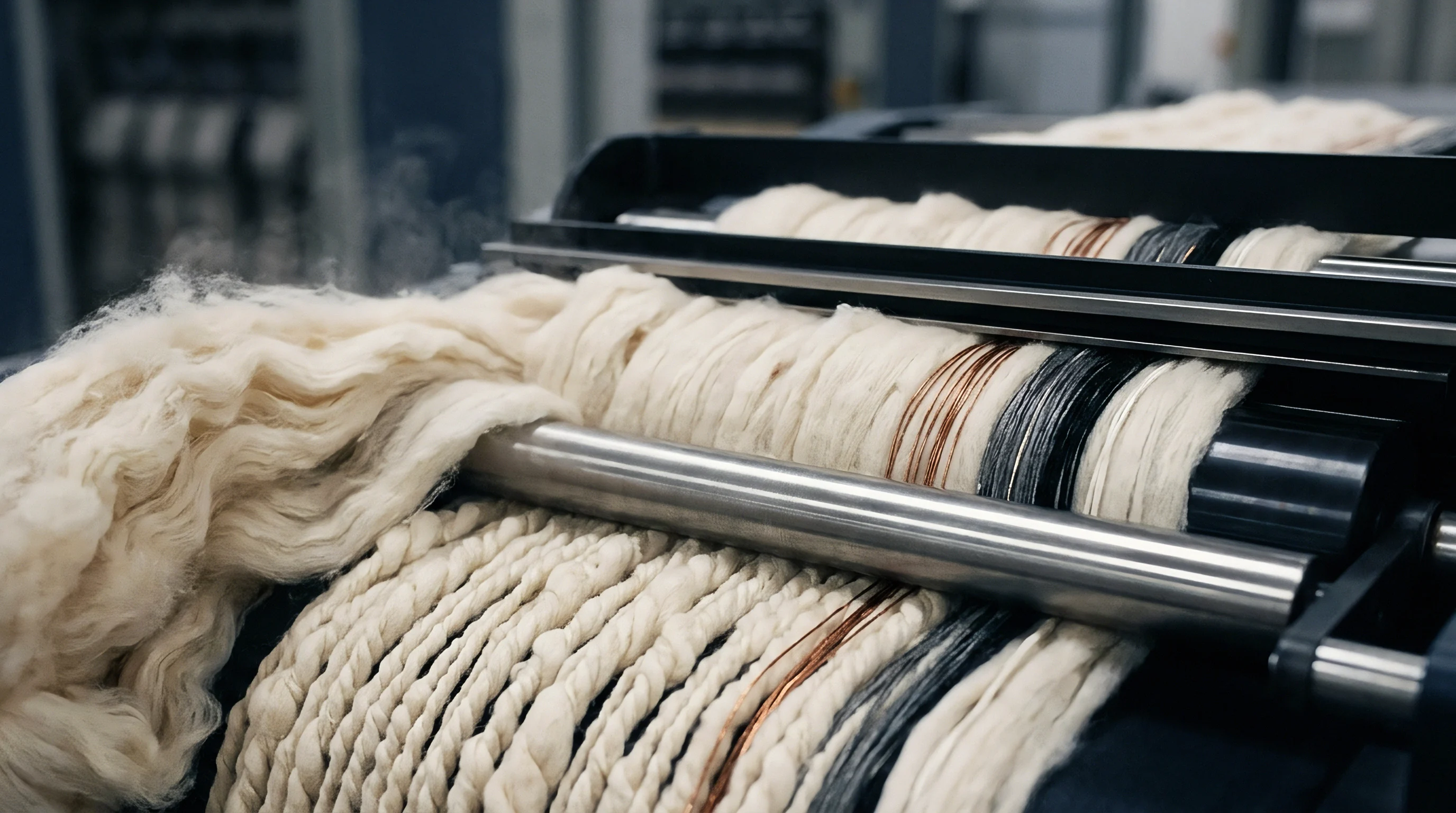
Spinning mills select raw upland cotton bales displaying high volume instrument readings between 28.5 and 30.5 millimeters to spin 30s Ne hosiery yarns. Upper half mean length, abbreviated as UHML, denotes the average length of the longer half of the fibers contained within a test beard. Premium circular knitting programs specifying combed 40s Ne counts mandate extra long staple cottons or long staple upland varieties exceeding 32.0 millimeters.
Shorter base staples limit the drafting draft ratio on modern high-speed ring frames, leading to uneven mass distribution across the yarn strand. When raw stock displays a UHML below 27.0 millimeters, ring frames generate excessive floating fibers inside the drafting zone, producing cyclic mass variations known as drafting waves. Carded lots break needles during knitting.
Ring spindles amplify twist displacement.
Cotton fibers measuring below 12.7 millimeters generate disproportionate needle friction whenever their mass fraction exceeds eight percent in ring-spun knitting counts.
The relationship between staple length and yarn hairiness dictates knitting performance on modern high-speed circular machines. Longer cotton fibers wrap more securely into the core of the yarn during twist insertion, burying their ends beneath outer helical wrappings. Shorter fibers lack the physical length required to bridge adjacent twist nodes, leaving both root and tip ends protruding outward from the yarn body.
These protruding ends constitute yarn hairiness, measured by optical sensors as the Uster hairiness value H and the Zweigle S3 metric. High Zweigle S3 values, representing fibers longer than three millimeters protruding from the yarn core, correlate directly with lint accumulation inside knitting machine cams and needle tricks.

Short Fiber Index Thresholds
Fractions measuring below half an inch impair spinning stability when their proportion exceeds eight percent by weight. The short fiber index, denoted as SFI in high volume instrument reports and SFC in advanced fiber information systems, measures the percentage of fibers shorter than 12.7 millimeters present in a sliver or yarn specimen. In raw cotton bales, short fiber content ranges from six percent in carefully harvested Australian upland crops to sixteen percent in mechanically stripped, aggressively ginned crops.
The combing operation targets this specific fraction, selectively extracting short fragments into comber waste, known commercially as noil.
- Upper half mean length governs the spinning limit of the raw cotton lot, setting the maximum yarn count that a mill can spin without experiencing chronic ends-down during ring drafting.
- Uniformity index measures the ratio between the mean length and the upper half mean length of the fiber bundle, where values above eighty-three percent indicate uniform fiber arrays capable of producing smooth knitting yarns.
- Short fiber index quantifies the mass percentage of cotton fragments measuring under half an inch, with knitting specifications restricting this parameter to values below 7.5 percent after combing.
- Noil extraction percentage defines the mass fraction of waste removed by the combing machine, directly dictating raw material cost per kilogram of combed sliver and the resulting yarn hairiness.
Uniformity index figures below eighty percent signal high variations in fiber length, indicating excessive mechanical breakage during saw ginning or lint cleaning. When mills process low-uniformity cotton through high-speed ring frames, the drafting rollers lose control over short fibers, generating severe count variations across consecutive yarn packages. In circular knitting, count variations produce horizontal bands across finished knitted tubes, a defect termed barré that ruins single jersey piece goods.
Combing removes defective short fiber fragments.
| Yarn Count (Ne) | Minimum UHML (mm) | Minimum Uniformity (%) | Maximum SFI (%) | Comber Noil Target (%) |
|---|---|---|---|---|
| 20s Ne Combed | 27.5 | 81.5 | 8.5 | 12.0 |
| 30s Ne Combed | 29.0 | 82.5 | 7.2 | 15.0 |
| 40s Ne Combed | 31.5 | 84.0 | 6.0 | 18.0 |
| 50s Ne Combed | 34.0 | 86.0 | 4.8 | 22.0 |
Knitting mills purchasing combed yarn with high short fiber indexes absorb elevated needle breakage costs, excess lint cleaning downtime, and severe surface pilling claims on finished garments.

Nip
The mechanical comber separates short lint from long spinnable fibers through periodic grasping and combing sequences. Before cotton reaches the comber nipper mechanism, carded slivers pass through pre-comb drawing frames and lap formers that assemble twenty-four slivers into a flat sheet wound onto a lap spool. Parallel alignment of individual cotton hooks constitutes the mechanical prerequisite for efficient combing.
Carding leaves over fifty percent of cotton fibers with trailing hooks and approximately fifteen percent with leading hooks. The combing cylinder can comb out leading hooks when cotton feeds into the machine tail-first. Pre-comb draw frames reverse hook direction, delivering straightened, oriented cotton sheets to the nipper jaws.
Comber Cylinder Half Lap Penetration
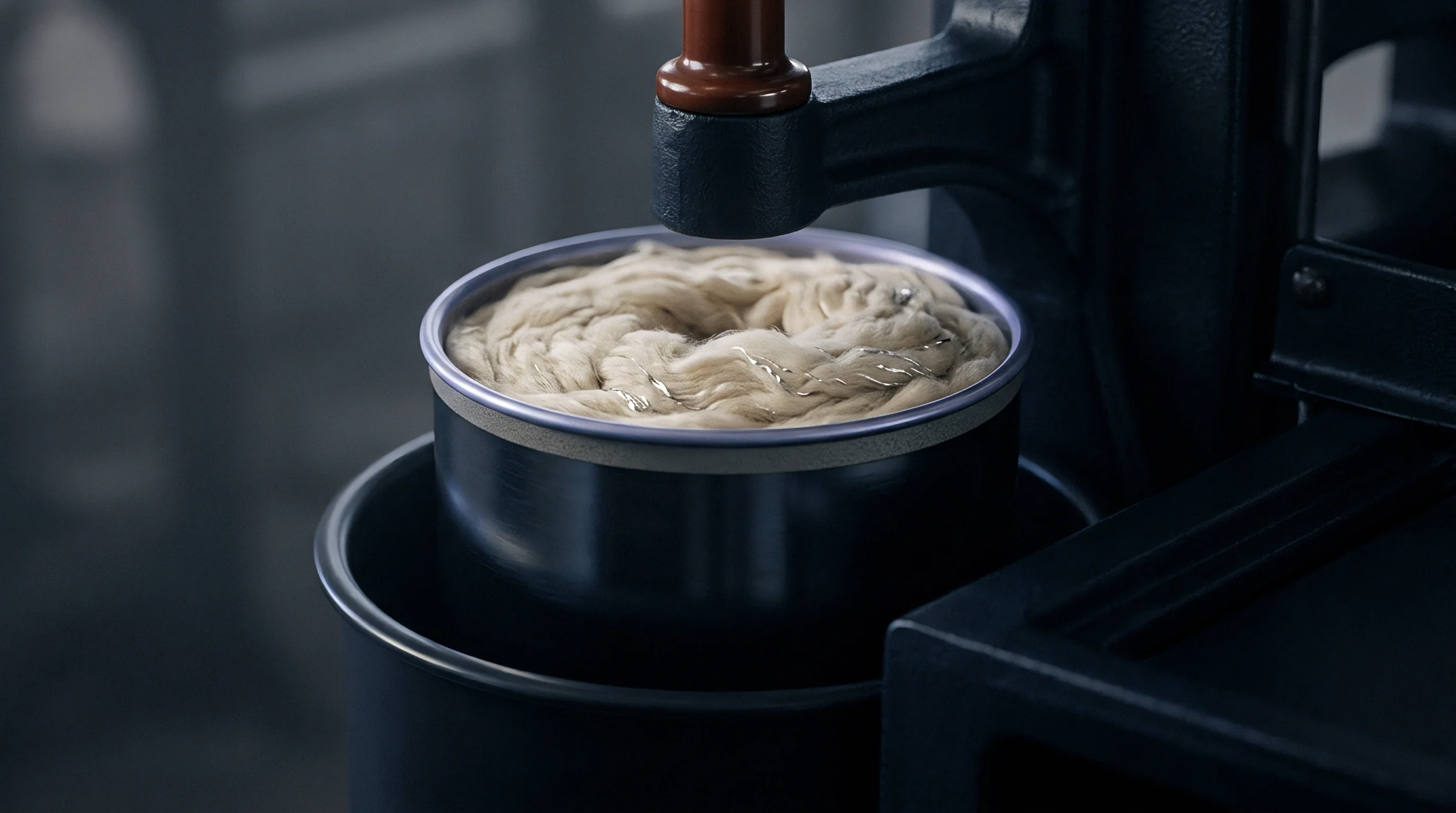
Wire clothing needles mounted on revolving segments pass through the suspended cotton fringe to strip unoriented lint and entanglements. The nipper assembly grips the cotton lap firmly while the rotating half lap cylinder combs the projecting fringe. Needle density on the half lap increases progressively across consecutive rows, beginning with coarse needles that penetrate tangled tufts without fiber breakage and concluding with dense wire points that comb out neps and microscopic seed coat fragments.
As the cylinder needles comb through the gripped fringe, short fibers lacking sufficient clamping length inside the nipper jaws are carried away by airflow and circular brush rolls into the waste collection duct.
Backward feed comber geometry pulls long staple into the waste box when timing drifts past the index mark.
Forward feeding increases production tonnage. Backward feeding improves drafting uniformity. In forward feed mode, the feed roller advances the cotton lap while the nippers move forward toward the detaching rollers.
In backward feed mode, the feed roller rotates only when the nippers swing backward away from the detaching rollers. Backward feed Combers produce superior fiber fraction elimination because the cylinder half lap combs a longer portion of the newly fed sheet, extracting higher noil percentages at identical gauge settings. For circular knitting yarns in fine counts between 32s Ne and 40s Ne, backward feed combing delivers the strict short fiber suppression demanded by multi-feeder single jersey machines.
Detaching Roller Distance Adjustments
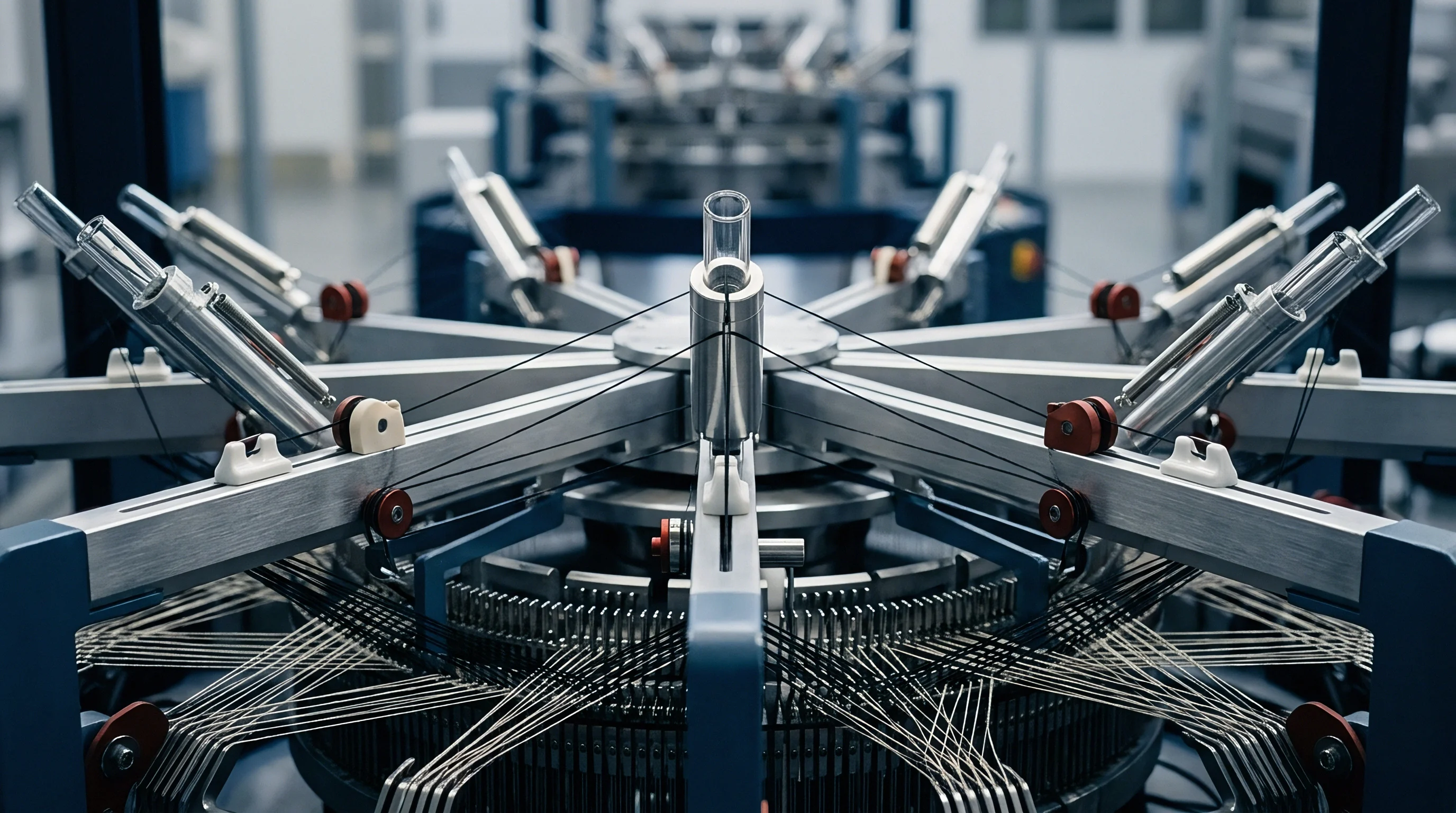
Gauging the separation between the steel fluted segments determines the exact cut-off boundary for eliminated waste. The detaching distance represents the physical gap between the clamping line of the closed nipper jaws and the nip line of the forward detaching rollers at their closest approach. Expanding this distance forces the detaching rollers to grip only the longest fiber tips protruding from the fringe, causing borderline length fractions to fall into the comber waste compartment.
A two-millimeter increase in detaching distance elevates noil extraction by approximately three to four percent by weight, shifting the entire fiber distribution curve toward higher values.
| Feed Mechanism | Detaching Distance (mm) | Noil Extraction (%) | Mean Length Gain (mm) | SFC Reduction (%) |
|---|---|---|---|---|
| Forward Feed | 8.5 | 11.5 | +1.8 | -3.5 |
| Forward Feed | 9.5 | 13.8 | +2.4 | -4.8 |
| Backward Feed | 9.0 | 15.2 | +2.9 | -5.6 |
| Backward Feed | 10.0 | 18.5 | +3.7 | -7.2 |
| Backward Feed | 11.0 | 21.8 | +4.4 | -8.9 |
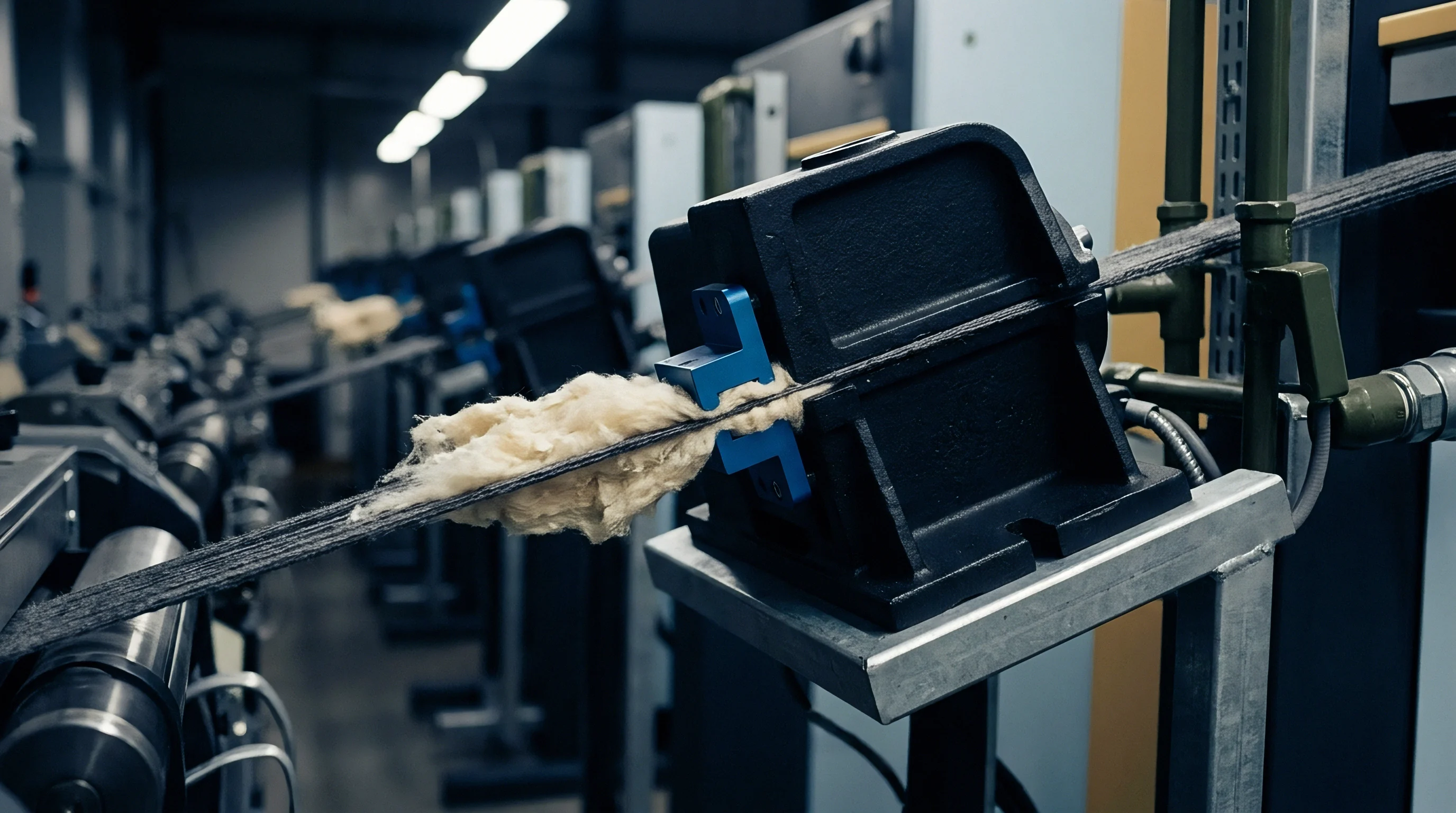
Top comb insertion depth complements detaching distance adjustments. As the nipper jaws open and the detaching rollers grasp the combed fringe, a stationary top comb drops into the moving fiber web. The detaching rollers pull long fibers forward through the fine teeth of the top comb, which arrests trailing short fibers and prevents uncombed tail hooks from entering the combed sliver web.
If the top comb penetrates too deeply into the web, excessive friction breaks long fibers, creating new short fragments inside the combed sliver. Insufficient penetration allows hooked short fibers to bypass the combing zone entirely, contaminating the delivery with unwanted lint fractions.
Spinning plant managers routinely explain excessive short fiber counts by citing unseasonal rain on the seed cotton crop that forced gentler combing settings to maintain contract delivery weights.
Fly
Unbound fiber ends protrude from the yarn core when ring spindles insert low twist levels for jersey knitting. Weaving yarns feature twist multipliers between 4.2 and 4.8 alpha metric to withstand high shedding tension on air-jet looms. Knitting yarns demand lower twist multipliers between 3.2 and 3.6 alpha metric to maintain soft tactile drape and prevent fabric torque.
High twist creates fabric torque. Low twist triggers surface pilling. Because knitting yarns carry lower rotational twist, short fibers are gripped with less normal radial force inside the yarn structure.
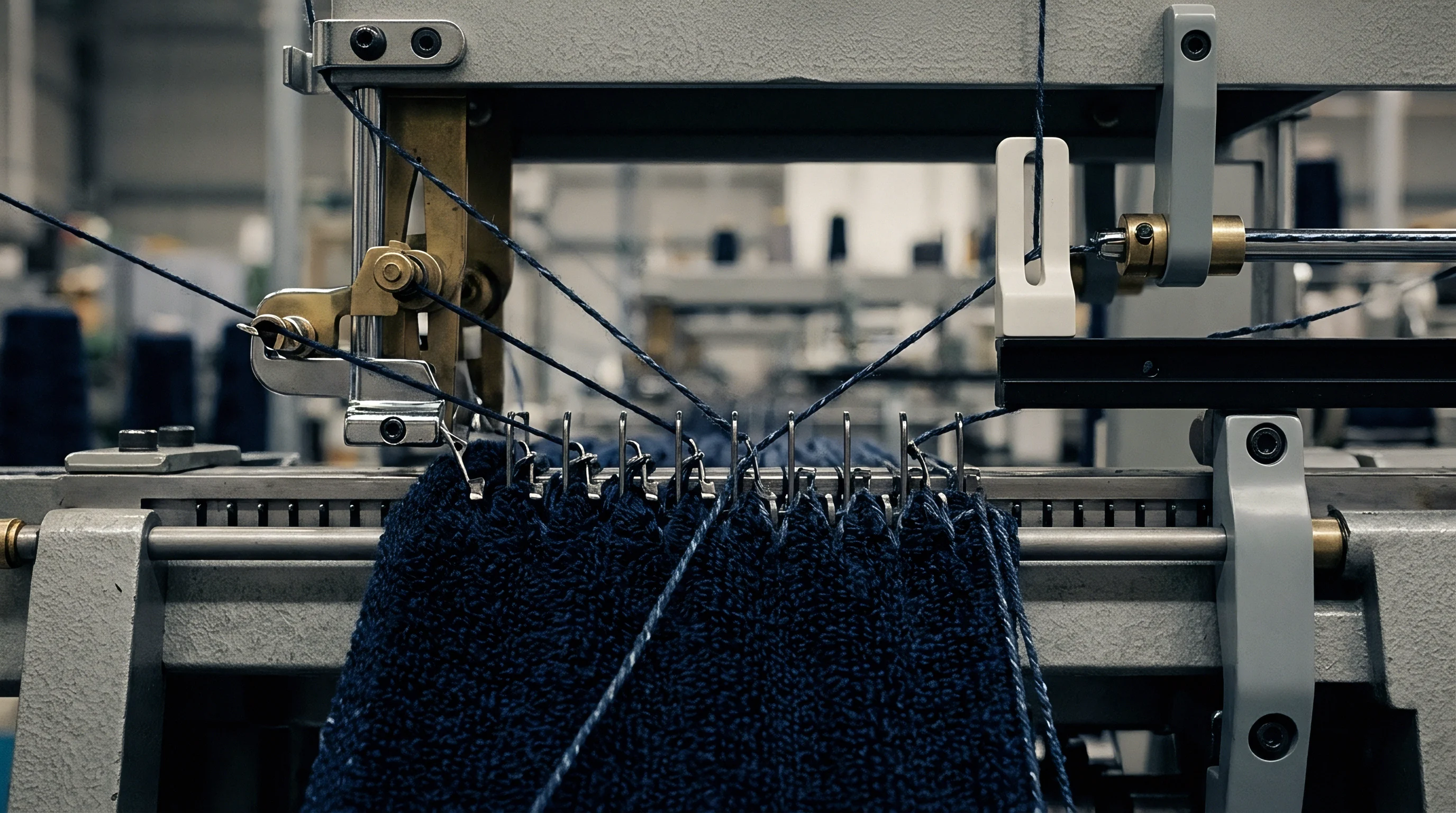
When running across yarn guides, positive storage feeders, and ceramic stop motions, mechanical friction dislodges poorly anchored fiber fragments, releasing clouds of loose lint into the atmosphere around the knitting machine creel.
Short fiber accumulation inside the needle trick creates tension spikes that sever knitting filaments during stitch formation.
Which Hairiness Thresholds Cause Needle Loading?
Circular jersey equipment running at thirty revolutions per minute sheds short lint directly into the latch guides whenever the Zweigle S3 metric climbs past six hundred per thousand meters. The Zweigle S3 value tallies all fiber ends extending three millimeters or farther from the central yarn core. High S3 values correlate with short fiber index numbers above nine percent.
In combed knitting yarns, an S3 count under four hundred per thousand meters represents the benchmark for trouble-free operation on thirty-inch diameter circular knitting cylinders equipped with ninety-six feeders.
- Latch needle accumulation occurs when dislodged short fibers compress into dense felts behind the needle hook, impeding free latch swinging and causing dropped stitches or needle hook fracture.
- Yarn guide chokes develop as paraffin wax deposits blend with circulating cotton dust, creating abrasive paste coatings that elevate running yarn tension beyond the elastic recovery limit.
- Interlooping tension spikes arise when yarn surfaces with high hairiness pass through sinker loops, causing stitch distortion that surfaces as cloudy streaks across dyed single jersey panels.
- Fabric surface nepping results from short fiber clusters rolling across knitting needles during stitch clearing, embedding uncombed fiber knots directly into the knit face.
Latch needles accumulate compacted fiber lint. Needle tricks clogged with packed cotton lint restrict smooth downward slider movement, forcing machine cams to exert excessive upward force against needle butts. Metal fatigue accelerates under these conditions, resulting in sheared needle butts and broken cylinder walls.
Slower speeds prevent thermal fusion.
Creel Friction and Wax Application
Package winding units deposit paraffin coatings onto the spinning surface to stabilize dynamic yarn tension through the ceramic eyelets. Raw cotton possesses a natural kinetic coefficient of friction between 0.35 and 0.45 against polished chrome or ceramic surfaces. Paraffin wax application during cone winding lowers this friction coefficient to values between 0.12 and 0.18.
Paraffin wax lowers friction values. Combed yarns require precise wax pickup rates between 1.2 and 2.0 grams per kilogram of yarn. If a winding department applies insufficient wax, dry cotton fibers abrade against knitting feeders, multiplying lint shedding by a factor of four.
Excess wax transfers directly into knitting needles, mixing with loose short fibers to form sticky residues that seize needle sliders inside cylinder tricks.
Properly combed cotton feels cool and smooth against the hand, running through the yarn guides without trailing a snowstorm of white dust.
Bench
Testing laboratories evaluate incoming cotton yarn shipments against standard physical benchmarks before cones move to knitting machine creels. Fiber testing operates across two distinct instrumental platforms: High Volume Instrument systems, known as HVI, and the Advanced Fiber Information System, known as AFIS. HVI systems test bulk fiber bundles at rapid rates to determine commercial classing parameters for bale purchasing.
AFIS instruments aerodynamically individualize single fibers, passing thousands of separate entities through laser optical sensors to measure individual fiber dimensions, maturity distributions, nep diameters, and dust content. Evaluating raw materials through both platforms exposes discrepancies between nominal bale grades and actual spinning performance.
Where Does High Volume Testing Miss Short Fibers?
Optical sensor arrays in automated classing lines measure bundle spans without counting individual broken fragments hidden behind the beard. HVI instruments generate an optical attenuation curve from a clamped fiber beard, estimating short fiber index through mathematical regression algorithms based on bundle taper. These algorithms assume standard Gaussian length distributions characteristic of virgin seed cotton.
When cotton undergoes aggressive saw ginning, carding drafts, or combing extraction, the length distribution deviates sharply from Gaussian symmetry. HVI algorithms frequently underestimate true short fiber content by two to four absolute percentage points in heavily worked slivers.
- Bale core sampling requires extracting physical tufts from ten percent of bales across a delivery lot using mechanical coring tools according to ASTM D1441 specifications.
- Conditioning chamber equilibration exposes fiber specimens to standard atmospheric conditions of twenty degrees Celsius and sixty-five percent relative humidity for twenty-four hours before testing.
- Individual fiber separation utilizes the AFIS fiber individualizer rotor to disentangle sliver tufts into isolated filaments without introducing mechanical fiber fragmentation.
- Optoelectronic beard scanning records individual transit times across dual infrared beams to calculate exact fiber length by number and length by weight distributions.
- Statistical distribution validation compares the resulting short fiber content, upper quartile length, and nep count against pre-established contract tolerances to generate lot clearance reports.
Laboratories prioritize AFIS length-by-number data over length-by-weight data when analyzing circular knitting yarns. Length-by-weight distributions obscure short fiber numbers because small fragments contribute minimal mass despite their high numerical population. A combed yarn lot displaying an acceptable 6.5 percent short fiber content by weight can simultaneously contain over twenty-two percent short fibers by numerical count.
Numerical fiber quantities govern needle friction, as every individual loose fiber tip represents an independent contact point capable of snagging against sinker edges during loop formation.
| Test Parameter | Test Instrument | Acceptance Threshold | Rejection Tolerance Limit |
|---|---|---|---|
| Short Fiber Content by Weight | AFIS PRO 2 | Maximum 7.0% | Greater than 8.5% |
| Upper Quartile Length | AFIS PRO 2 | Minimum 30.5 mm | Less than 29.5 mm |
| Fiber Nep Count | AFIS PRO 2 | Maximum 45 per gram | Greater than 75 per gram |
| Yarn Hairiness H | Uster Tester 6 | Maximum 4.80 | Greater than 5.30 |
| Zweigle S3 Hairiness | Zweigle G567 | Maximum 450 per 1000m | Greater than 650 per 1000m |
| Total Imperfections (IPI) | Uster Tester 6 | Maximum 120 per 1000m | Greater than 180 per 1000m |
| Methods note: Length parameters measured via AFIS PRO 2; yarn physical properties determined on Uster Tester 6 at 400 meters per minute. | |||
Baling presses compress humid cotton. Arbitrators rely on calibrated data. Whether high-speed circular knitting plants can justify the operating expense of running full AFIS length-by-number sweeps across every delivered yarn lot remains an open operational dilemma in competitive garment programs.

Contract
Technical procurement specifications for circular knitting yarns convert laboratory parameters into binding commercial commitments. Commercial buyers specifying 100 percent combed cotton knitting yarns must establish enforceable physical limits rather than relying on qualitative trade designations. Terms like super combed, semi-combed, or combed hosiery carry zero legal meaning in trade disputes unless accompanied by explicit numerical thresholds for UHML, SFI, and Uster statistical percentiles.
Mill invoices reflect true yield. Reject lots incur demurrage charges.
Specification Boundaries for Circular Knitting
Purchase orders establish absolute rejection thresholds for short fiber content, imperfection counts, and hairiness indexes. A comprehensive yarn purchase order stipulates that delivered lots adhere to Uster Statistics fifty-percentile standards for combed ring-spun hosiery counts, with critical parameters like Zweigle S3 hairiness restricted to the twenty-five-percentile tier. When spinning mills bid on combed contracts, quoting a lower price per kilogram often correlates with reduced comber noil extraction at the mill floor.
A spinner dropping noil extraction from eighteen percent to twelve percent saves approximately five to eight cents per kilogram in raw cotton consumption. That material saving transfers directly to the knitting mill in the form of elevated knitting machine downtime, needle replacement invoices, and garment seconds.
ASTM D2255 appearance grades dropping below class B trigger automatic lot rejections prior to creel loading.
Worked procurement cost scenarios demonstrate the economic impact of comber noil settings on delivered yarn value. Assume an order of forty metric tons of 30s Ne combed cotton knitting yarn priced at 3.80 dollars per kilogram based on sixteen percent comber noil extraction. If the spinning mill covertly reduces comber noil extraction to eleven percent, the mill recovers two thousand kilograms of fiber that should have entered the waste house as noil priced at 1.40 dollars per kilogram.
This five percent reduction in noil extraction increases the short fiber content in the delivered yarn from 6.8 percent to 9.6 percent. When the knitting factory loads this yarn onto twenty-eight-cut single jersey circular machines, knitting efficiency drops from ninety-two percent to eighty-four percent due to repeated lint-induced yarn breaks, costing the garment manufacturer approximately 12,800 dollars in lost knitting production and degraded cloth grading.
Arbitration Clauses and Retesting Rules
Settlement protocols specify independent laboratory verification whenever delivered yarn lots fail inbound quality audits at the receiving dock. Standard commercial contracts incorporate International Cotton Association or CIRCOT arbitration frameworks to handle technical non-compliance. When inbound testing indicates an SFI or hairiness value exceeding agreed contractual limits, the buyer issues a formal notice of dispute within ten calendar days of delivery, preserving the lot intact in original container packaging.
An accredited referee laboratory tests representative samples drawn from ten percent of the disputed pallet shipment under standard conditioning protocols.
Commercial discount tables dictate monetary settlements when off-quality yarn is conditionally accepted for non-critical knit programs. If delivered yarn displays an SFI between 8.0 percent and 9.5 percent against a contract specification of 7.0 percent maximum, the settlement table enforces an automatic three percent invoice deduction to offset projected knitting floor yield losses. If the SFI exceeds 9.5 percent, or if the Zweigle S3 hairiness climbs past seven hundred per thousand meters, the buyer retains the unilateral legal right to reject the lot outright, returning the shipment at the spinner’s expense including all incurred freight, customs duties, and warehouse handling charges.
Inserting the standard International Cotton Association yarn arbitration clause into purchase contracts transfers testing authority to accredited independent laboratories, eliminating unilateral price deductions by knitting mills.