Quantifying Microscopic Dye Migration Coefficients in High Twist Plied Ring Spun Yarns during Alkaline Fixation
High-twist plied yarn core shade levelness requires metered alkali dosing to suppress Damköhler numbers below unity during early reactive dye migration.


Strand
In high-twist plied ring-spun cotton yarns, mechanical geometry sets physical limits on dye mass transfer long before liquid ever enters the vessel. Ring spinning lays staple cotton fibers along concentric helical paths, wrapping outer fibers tightly around inner core bundles under constant spindle tension. Plying single yarns drives inter-ply compression, forcing individual fibers into dense contact zones.
This tight packing reduces void space and restricts fluid pathways. In combed cotton plies, twist multipliers from 4.2 to 5.5 yield compact cross sections with packing densities above 0.72 ~ well beyond the 0.55 typical of standard knitting yarns. That density compresses inter-fiber space into narrow, tortuous channels through which liquid dye must pass to reach the core.
Core density depends directly on the twist multiplier. As ply twist increases, outer fibers tilt at steeper angles to the yarn axis, directing radial compressive forces toward the center during tensioning. This compression hinders both capillary wicking and microscopic diffusion.
While liquid wicks rapidly along the yarn axis through surface channels, radial movement into the core encounters a firm physical barrier. Outer fibers absorb incoming dye chemistry almost instantly, leaving the dense core dry upon initial contact. In fine plied constructions like 2/80s or 3/100s Ne combed cotton, these inter-ply boundary zones function as mechanical shields.
Internal void structure also varies radially: larger inter-ply gaps remain open near the perimeter, whereas microscopic inter-fiber voids dominate the core of each single ply.
| Yarn Structure | Twist Multiplier (TM) | Packing Factor (phi) | Mean Pore Radius (microns) | Core Tortuosity Factor |
|---|---|---|---|---|
| 2/40s Ne Combed Cotton (Z/S) | 3.6 | 0.58 | 4.2 | 1.35 |
| 2/60s Ne Combed Cotton (Z/S) | 4.2 | 0.66 | 2.8 | 1.62 |
| 2/80s Ne Combed Cotton (Z/S) | 4.8 | 0.73 | 1.9 | 2.05 |
| 3/100s Ne Combed Cotton (Z/S) | 5.4 | 0.78 | 1.2 | 2.58 |
Fluid transport through the yarn depends fundamentally on pore architecture. Overall porosity drops predictably as the twist multiplier rises, with mean pore radii shrinking from over four micrometers in low-twist singles down to nearly one micrometer in ultra-high-twist plies. Meanwhile, the core tortuosity factor ~ the ratio of actual microscopic flow path length to straight radial distance ~ exceeds two point five in 3/100s Ne yarns.
The dye solution cannot move in a straight line; it must navigate tightly packed, twisted cellulose walls. This bottleneck dictates transport rates long before alkaline fixation initiates covalent bonding with cellulose hydroxyl groups.
Twist multipliers above four point five compress inter-ply micro-channels, restricting radial fluid movement to less than half the rate observed in single yarns of equivalent linear density.
Plying setup establishes these structural conditions. Single yarns spun with Z-twist and plied in S-twist loosen slightly at the surface during plying, opening outer capillaries even while the plies compress the core. Conversely, a Z/Z arrangement generates higher total torque, producing dense surface layers over tight core packing.
High twist levels constrain yarn swelling in aqueous liquor. Air trapped in dense core zones resists displacement, leaving dry pockets during short liquor exposure. Rapid pad-batch or continuous dyeing systems often fail to purge this air without aggressive wetting agents and adequate dwell time.
Mechanical pretreatment of raw grey yarn further alters internal pathways. Mercerization under tension swells cotton fibers, rounding their natural kidney-bean cross sections into cylinders. This change reduces overall inter-fiber void volume while expanding internal pore volume within each fiber.
Mercerizing high-twist plied yarns prior to dyeing pulls the overall yarn diameter inward, increasing core packing density even as intra-fiber nanopores open. Dye molecules face a dual transport hurdle: navigating micro-capillary spaces between tightly packed fibers, then penetrating intra-fiber nanopores inside the swollen cellulose wall. The physical layout established during spinning and plying sets these boundaries.
High twist inherently restricts deep chemical penetration, making shade unlevelness appear as an inescapable tradeoff of working with fine plied yarns.
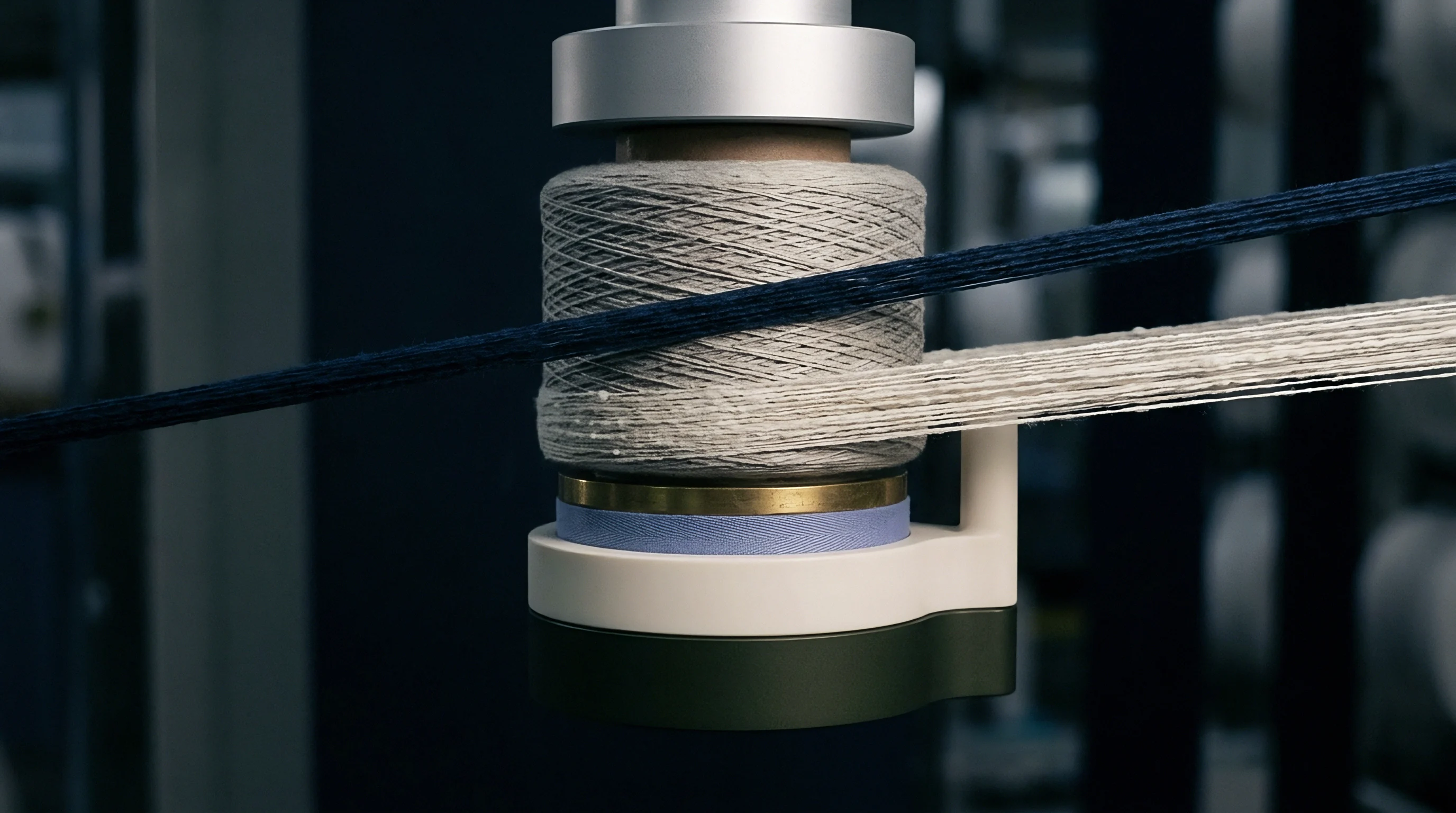
Pore
Adding alkali during reactive dyeing alters the geometry of cellulosic micro-capillaries. Introductions of sodium carbonate or sodium hydroxide raise bath pH above 10.5, ionizing cellulose hydroxyl groups. As cotton fibers absorb water and alkali ions, cell walls expand laterally by up to twenty-five percent while growing less than two percent axially.
Inside tight, high-twist plied yarn, this lateral expansion presses neighboring fiber walls against each other, collapsing internal void space. Capillary channels that previously allowed convective fluid flow shrink into narrow passages where mass transport occurs almost entirely by diffusion.
Cellulose swells rapidly in alkali. As cell walls expand into internal voids, yarn porosity drops sharply. Channels with initial hydraulic radii around three micrometers shrink below zero point five micrometers within seconds of contact.
Liquid trapped in the yarn core becomes stagnant, as convective movement from bath circulation or yarn motion ceases inside these compressed zones. From then on, dye molecules in core liquor advance solely by molecular diffusion through narrow paths. Alkaline swelling locks the physical structure, converting inter-fiber space into a dense matrix constrained by expanding cell walls.
Fluid transport proceeds through distinct phases during fixation. Early in the cycle, neutral salt additions promote dye adsorption onto outer fiber surfaces without altering micro-capillary dimensions. Introducing alkali triggers immediate fiber swelling and chemical activation of the dye.
The boundary layer between moving bath liquor and static internal liquor thickens rapidly. High-affinity dyes bind to outer sheath fibers almost immediately, depleting local dye concentration in the boundary fluid before molecules can diffuse toward the core.
- Capillary Pore Collapse Lateral fiber swelling in alkali squeezes inter-fiber channel diameters below critical flow thresholds.
- Liquor Stagnation Convective flow shuts down inside intra-ply core voids, forcing transport into pure molecular diffusion.
- Boundary Layer Depletion Rapid surface fixation starves local dye concentration, flattening the gradient required for core penetration.
- Intra-Fibre Pore Swelling Cell wall pores expand to between two and five nanometers, allowing dye molecules to reach crystallite regions.
Core penetration depth depends on the balance between capillary wicking and alkaline swelling. Adding wetting agents lowers surface tension, drawing liquor into dense plied cores before alkali introduction. If alkali enters the bath before the core wets out completely, rapid surface swelling seals the structure and traps internal air.
Swelling behavior varies with alkali type and bath temperature: sodium hydroxide causes aggressive swelling that rapidly closes inter-fiber pores, whereas sodium carbonate produces more gradual swelling, leaving capillary channels open longer during initial migration.
Intra-fiber nanopores within the cell wall reconfigure under alkaline conditions. Non-crystalline regions in the cellulose matrix absorb hydrated sodium ions, forcing hydrogen bonds to break and rearrange. Nanopore diameters expand from an unswollen baseline of roughly one point five nanometers up to four nanometers.
Reactive dye molecules ~ typically bearing three to four sulfonic acid groups with molecular weights from 600 to 1200 Daltons ~ fit into these enlarged pores. High twist levels prevent outward yarn expansion, directing swelling forces inward and restricting internal nanopores compared to unconstrained single fibers.
Slowing initial alkali dosing maintains radial flow channels into dense yarn cores before cross-linking locks the dye in place.

Gradient
Measuring microscopic dye distribution across plied yarn cross sections requires micro-spectrophotometry and precise sample preparation. Standard visual inspection and surface colorimetry fail to evaluate internal shade depth. Yarns are first embedded in a low-viscosity synthetic resin, such as methyl methacrylate or epoxy, locking physical geometry in place without disturbing fixed dye.
Cured blocks are then sectioned on a rotary microtome with a glass or diamond knife into optical slices three to five micrometers thick. This thin-sectioning avoids light scatter overlap, allowing light to pass cleanly through individual fibers.
High-resolution optical micro-spectrophotometry measures light absorbance at target wavelengths across yarn cross sections. Scanning from the outer perimeter of a ply inward to its central axis yields radial concentration profiles that plot concentration C against radius r. Absorbance values map to local dye concentrations using calibration curves from known dye standards.
High-twist plied yarns fixed rapidly under alkaline conditions display steep radial gradients, with heavy dye concentration in outer sheath fibers and almost none in the core. Quantitative analysis expresses this through the radial penetration ratio: core concentration divided by surface concentration.

How Does Microtomy Sample Preparation Distort Radial Intensity Profiles?
Sample preparation can distort results if resin curing or sectioning alters dye distribution. Resin monomers must fill the yarn structure without dissolving fixed or unfixed dye; non-polar systems prevent unfixed reactive dye from bleeding during embedding. Friction from sectioning can also compress circular fiber cross sections into ellipses.
Micro-spectrophotometers compensate by calculating normalized radial distances, mapping measured intensity along radial vectors from each fiber’s geometric centroid to its boundary.
| Fixation Dwell Time (min) | Sheath Concentration Cs (g/kg) | Core Concentration Cc (g/kg) | Penetration Ratio (Cc/Cs) | Measured Radial Gradient Slope |
|---|---|---|---|---|
| 2.0 | 18.4 | 1.2 | 0.065 | -4.82 |
| 5.0 | 17.1 | 4.8 | 0.281 | -3.15 |
| 10.0 | 15.8 | 9.2 | 0.582 | -1.64 |
| 20.0 | 14.2 | 13.1 | 0.923 | -0.28 |
Radial gradients reveal structural boundary limits. Digital image processing divides yarn cross sections into concentric annular rings of equal area, with mean optical density measured across these zones to generate quantitative profiles. Under poor fixation conditions, a sharp boundary forms where dye concentration drops precipitously over less than five micrometers.
In a 2/60s Ne yarn with a ply radius near sixty micrometers, rapid alkaline shock can stall dye penetration just fifteen micrometers inward ~ leaving forty-five percent of internal volume uncolored. That raw core eventually exposes itself as fabric undergoes mechanical wear.
At a fixation dwell time of five minutes, the measured penetration ratio across a 2/60s Ne plied cotton yarn reaches zero point two eight one under standard alkaline bath conditions.
Spectral imaging employs digital CCD detectors and monochromatic light to map spatial absorbance across multiple wavelength bands. Scanning individual fibers reveals intra-fiber concentration gradients: the outer secondary wall of a cotton fiber often holds substantially more dye than the region surrounding the lumen. In high-twist plied structures, these intra-fiber gradients combine with the broader intra-yarn gradient, creating a multi-scale diffusion profile.
Quantitative image analysis isolates these effects by averaging intra-fiber intensity values within concentric rings across the yarn.
Extracting migration profiles mathematically relies on optical resolution. Systems require a spatial resolution of at least zero point five micrometers per pixel to distinguish inter-fiber dye deposits from dye bound inside the cell wall. Unfixed dye remaining in capillary spaces skews absorbance readings if washing fails to remove soluble molecules before embedding.
Standard protocols require thorough cold and hot rinses prior to resin embedding, ensuring measurements include only dye that is covalently bound or trapped within swollen nanopores.
Whether non-destructive laser confocal Raman spectroscopy can replace physical microtomy for real-time tracking of reactive dye fronts inside swollen plied cores remains unproven at commercial dyehouse liquor velocities.

Kinetics
Mass transport during alkaline fixation involves simultaneous diffusion and chemical reaction. Driven by concentration gradients, dye molecules diffuse through liquid-filled pores while undergoing nucleophilic addition or substitution with ionized cellulose hydroxyl groups. Alkali exposure also triggers a competing side reaction: hydrolysis, where reactive groups react with hydroxyl ions in the water and lose their ability to bond with cellulose.
Modeling this behavior relies on Fick’s second law, adapted with sink terms for both fixation and hydrolysis.
Mass transport dictates core shade depth. The differential equation governing radial dye transport in a cylindrical plied yarn is:
∂C/∂t = (1/r) ∂/∂r – k_f C – k_h C
where C is free dye concentration in internal liquor, r is radial distance from the ply axis, t is time, D_app is the apparent dye migration coefficient, k_f is the pseudo-first-order fixation rate constant, and k_h is the hydrolysis rate constant. The coefficient D_app accounts for both spatial tortuosity and fluid viscosity inside swollen micro-channels. In high-twist plied yarns, D_app drops far below the diffusivity observed in open dye baths.
Apparent diffusion coefficients in bulk aqueous liquor sit near 10 to the power of minus 6 centimeters squared per second at 60 degrees Celsius. Inside the dense core of a high-twist plied ring-spun yarn under alkaline conditions, D_app drops to between 10 to the power of minus 11 and 10 to the power of minus 9 centimeters squared per second. High twist multipliers increase path tortuosity while alkaline swelling chokes off capillary cross sections, creating severe resistance to molecular motion.
As higher pH accelerates the fixation rate k_f, dye molecules bind rapidly to outer fibers upon entry, depleting the pool of mobile dye available to reach the core.
| Dye Chemistry Class | Alkali Type / pH | D_app (cm²/s) | Fixation Rate k_f (min⁻¹) | Damköhler Number (Da) |
|---|---|---|---|---|
| Monomer Vinyl Sulfone | Na2CO3 (pH 11.0) | 4.2 x 10⁻¹⁰ | 0.12 | 0.85 |
| Bis-Monochlorotriazine | Na2CO3/NaOH (pH 11.8) | 1.8 x 10⁻¹⁰ | 0.28 | 2.84 |
| Hetero-Bifunctional (MCT/VS) | Na2CO3 (pH 11.2) | 3.1 x 10⁻¹⁰ | 0.18 | 1.64 |
| Fluorochloropyrimidine | Na2CO3 (pH 10.8) | 5.5 x 10⁻¹⁰ | 0.09 | 0.49 |
The dimensionless Damköhler number (Da) expresses the ratio of chemical reaction rate to radial diffusion rate: Da equals k_f multiplied by the square of the ply radius, divided by D_app. When Da is much greater than one, fixation far outpaces radial diffusion. Dye molecules bind to outer sheath fibers before penetrating the interior, creating ring-dyed yarns.
When Da stays below one, diffusion proceeds quickly relative to reaction, allowing dye to distribute evenly across the cross section before extensive covalent bonding takes place.
Fixation rate locks the dye in place. High pH spikes k_f, driving Da upward and worsening pale cores in high-twist yarns. Bifunctional dyes pairing vinyl sulfone and monochlorotriazine groups carry high exhaustion and fixation rates; their bulky molecular structure reduces D_app while high reactivity boosts k_f, pushing Damköhler numbers even higher.
Getting level penetration in fine plied yarns requires strict control over temperature and alkali dosing to keep Da near or below unity during early fixation.
Early alkali shock halting dye migration three micrometers short of the yarn core has forced the write-off of forty thousand metres of high-twist plied shirting fabric.
Temperature control directly influences the balance between diffusion and reaction rates. The activation energy for diffusion differs from that of chemical fixation. Diffusion coefficients increase by roughly two to three percent per degree Celsius, whereas fixation reaction rates jump much faster ~ often doubling with an eight to ten degree Celsius rise.
Heating the dye bath without managing pH accelerates reaction far faster than diffusion, inflating Da and pinching core penetration. Ramping temperature progressively while metering alkali keeps these competing kinetic factors in balance.
Calculating D_app relies on experimental concentration profiles measured across multiple fixation intervals. Numerically inverting Fickian transport equations with finite-difference algorithms lets researchers map local migration coefficients against radial position r and swelling time t. The data shows D_app is far from constant across the yarn radius: it drops continuously from the outer edge to the center as internal compaction and swelling resistance compound during alkaline processing.
Standard purchasing specifications incorporating ISO 105 fastness requirements mandate minimum core penetration ratios of zero point eight five for all plied cotton yarns with twist multipliers exceeding four point two.

Disruption
Poor dye penetration into high-twist plied yarns causes severe quality failures in finished garments. The main defect is ring dyeing, where dye sits almost entirely in outer sheath fibers while the core stays pale or white. When fabrics suffer friction from wear or laundering, those outer fibers abrade away, exposing raw inner filaments.
That exposure leaves white streaks, a frosted surface look, and premature color loss along seams and high-wear areas.
Yield drops when diffusion fails. Martindale abrasion testing under ISO 12947 shows how fast ring-dyed plied fabrics lose shade depth. Fabrics with penetration ratios below zero point three zero show clear surface whitening before five thousand cycles.
By contrast, fabrics with thorough core penetration endure over twenty thousand cycles before shade shifts appear. Ring dyeing also destroys wet rubbing fastness under ISO 105-X12: unfixed dye trapped in outer channels rub off easily, pulling wet crocking scores down to grade 2.0 or worse.
| Penetration Ratio (Cc/Cs) | Martindale Whitening Onset (Cycles) | ISO 105-X12 Wet Rubbing Rating | ISO 105-C06 Wash Fastness Change | Field Return Rate (%) |
|---|---|---|---|---|
| 0.10 to 0.25 | 2,500 | 1.5 to 2.0 | Grade 3.0 | 8.4 |
| 0.26 to 0.50 | 6,000 | 2.5 to 3.0 | Grade 3.5 | 3.1 |
| 0.51 to 0.75 | 14,000 | 3.5 to 4.0 | Grade 4.0 | 0.6 |
| 0.76 to 0.95 | 22,000 | 4.5 | Grade 4.5+ | 0.1 |
Inter-ply twist variations across bulk production runs cause barré defects. Minor shifts in spindle speed or plying tension alter the local twist multiplier and packing density. When the yarn hits continuous pad dyeing lines, high-twist zones resist dye migration far more than lower-twist sections.
Once fixed, these structural variations turn into light and dark horizontal bands across the fabric. Shade variations across a batch often pass initial inspection on rolls, only to show severe banding after garments are cut and assembled.
Core unlevelness frequently sparks commercial disputes between converters and dyehouses. Routine quality control relies on surface reflectance spectrophotometry, which measures only the outer fiber layers. Surface readings can show a perfect match to an approved lab dip even if the core is completely white.
Once garments hit industrial washing or stone-washing, surface fibers strip away, revealing pale interiors and causing sudden color shifts. Audits of bulk production runs show entire shipments rejected for hidden core unlevelness that surface colorimeters completely missed.
ISO 105-C06 wash fastness testing exposes similar flaws in poorly penetrated yarns. During laundering, water and detergent swell the fibers, releasing unfixed dye trapped in internal capillary voids. This dye bleeds onto adjacent white test strips and degrades overall shade depth.
Internal dye deposits that never fixed due to local alkali depletion act as a persistent source of bleeding over repeated wash cycles.
Standard contracts using international wet processing benchmarks specify that deliveries with core penetration ratios below zero point seven zero fail quality compliance, placing full financial liability for re-dyeing or garment replacement squarely on the processor.

Dossier
Achieving uniform dye penetration in high-twist plied yarns demands strict procurement controls and tight dyehouse parameters. Specs sent to spinning mills must tighten twist multiplier tolerances, capping variance at plus or minus zero point one units across a lot. Uncontrolled twist swings ruin dyehouse dosing curves.
Purchase orders should also specify minimum core penetration ratios measured by micro-spectrophotometry, establishing clear quality thresholds before cutting and sewing.
Dosing rate changes everything. Alkali dosing must follow progressive logarithmic curves rather than single-shot dumps. Feeding alkali over twenty to thirty minutes keeps bath pH under 11.0 during initial migration, holding the Damköhler number below unity.
That lower starting pH gives dye time to diffuse into dense cores before fast fixation seals outer sheath layers. Temperature control must follow suit: holding the bath at 50 degrees Celsius through early migration, then ramping to 60 or 80 degrees Celsius only after the dye has penetrated the core.
- Formulate Raw Material Limits Specify a combed cotton fiber length uniformity index above eighty-three percent and set tight ply twist multiplier limits to prevent localized compaction.
- Mandate Pre-Treatment Standards Require full caustic mercerization under tension to round out fiber cross sections and equalize capillary dimensions before dyeing.
- Implement Metered Alkali Dosing Program dyeing equipment for progressive linear or logarithmic alkali delivery, keeping initial pH low to lengthen the active migration window.
- Verify Core Penetration Ratios Require microtome cross-sectional micro-spectrophotometry on batch end-outs, confirming penetration ratios exceed zero point eight zero before releasing lots.
Dye selection is just as critical. Formulators should pick reactive dyes with low substantivity under neutral salt conditions combined with high diffusion coefficients. Dyes built around small, compact chromophores migrate through swollen cellulosic capillaries much better than bulky poly-azo structures.
Lower-reactivity monochlorotriazine or fluorochloropyrimidine dyes extend migration time, allowing molecules to travel deep into dense core channels before forming permanent covalent bonds.
Preventing pale cores requires longer migration times. Dyehouse cost models need to account for extended dwell times and specialized auxiliaries. Extending the migration phase adds machine time, raising processing costs per kilogram.
Auxiliary suppliers offer targeted migration accelerants and non-foaming wetting agents that lower surface tension without triggering premature swelling. While these extra steps increase landed fabric cost by three to five percent, they prevent far larger losses from rejected garment lots and customer returns.
Dyehouse audits should verify machinery capabilities before placing orders for fine plied fabrics. Jet and package dyeing machines must handle strict flow reversal cycles, forcing liquor through dense packages at differential pressures above two point five bar. Package density needs to stay tightly controlled between zero point3 five and zero point three8 kilograms per liter.
Overdense packages on underpowered pumps create uneven radial pressure drops, causing core shade variations across package layers even with an optimized chemical dosing profile.
Building these technical checks into supply chain contracts ensures consistent quality in bulk production. Sourcing teams that define micro-structural migration limits alongside physical strength metrics protect their lines against unexpected shade shifts, fastness failures, and costly commercial disputes.