Dynamic Aerodynamic Interaction Modeling for Complex Multi-Fibre Tuft Matrices in High-Speed Sorters
Dynamic aerodynamic tuft models couple internal porous media flow with wake turbulence to eliminate pneumatic sorting errors and customs blend misclassification.

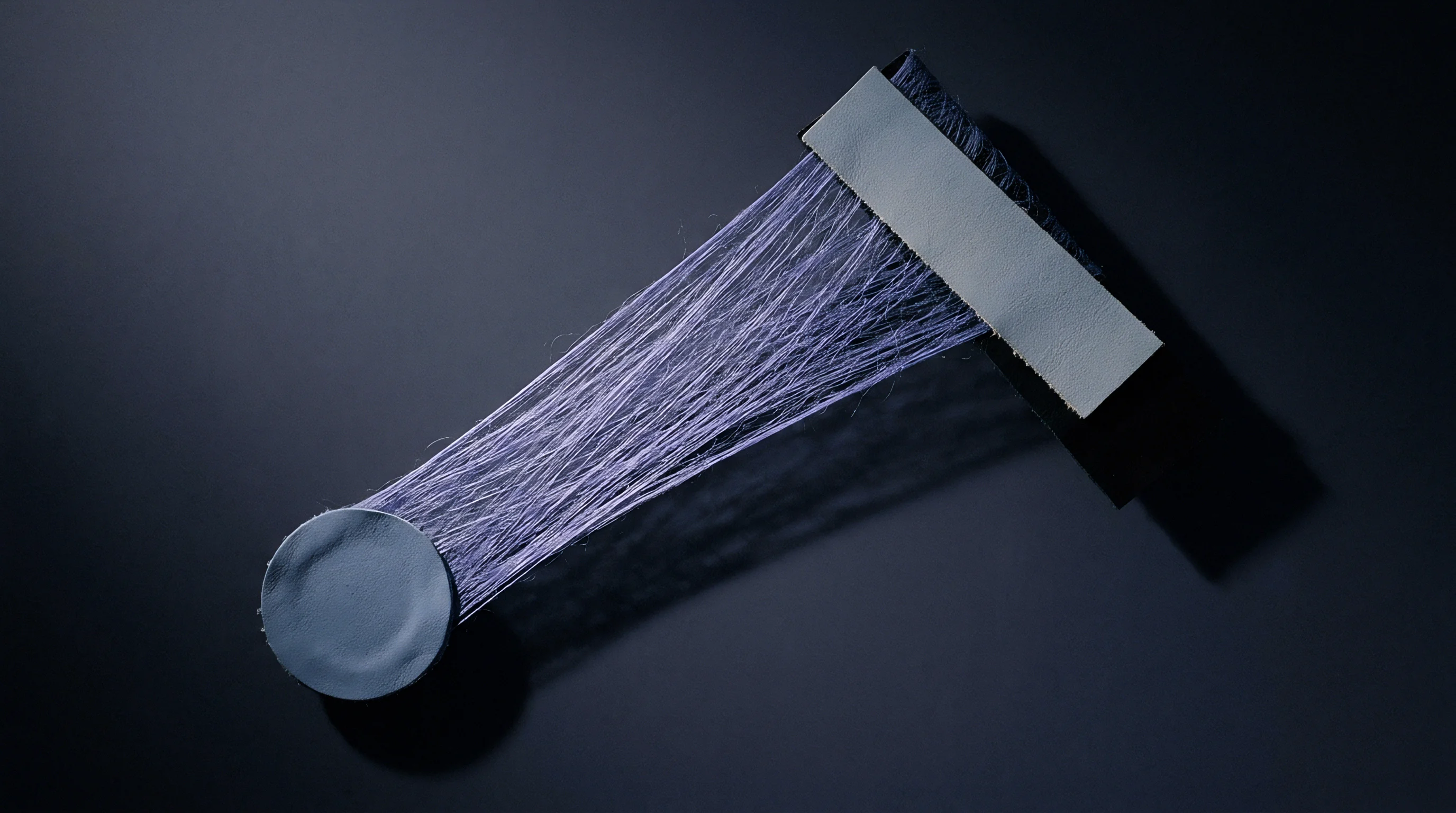
Drag
Free-stream air moving at 24 to 28 metres per second across optical inspection chutes exerts aerodynamic forces that deform porous multi-fibre aggregates before ejection actuators can fire. In raw textile recycling and blowroom lines, heterogeneous tufts containing natural seed cotton, polyester staple, and elastane fragments accelerate down inclined slides where boundary layer separation induces chaotic tumbling at Reynolds numbers exceeding 4200. Traditional aerodynamic sorting algorithms treat discrete clumps as rigid, impermeable spheres, calculating flight paths with standard Newtonian drag coefficients ~ an assumption that breaks down when loose fibres expand into diffuse clouds whose internal flow resistance alters their trajectory.
Determining aerodynamic drag on a mixed tuft matrix requires coupling boundary-layer shear stress with internal Darcy-Brinkman flow through porous media. Viscous dissipation within the intra-fibre void network slows air passing through the core, creating a pressure differential between the upstream face and the wake behind it. Coarse 3.3 dtex synthetic filaments remain stiff enough to hold the tuft envelope open, while 1.2 dtex combed cotton fibres yield to aerodynamic shear, flattening into compact discs.
As a result, the effective drag coefficient shifts between 0.62 and 1.48 within 12 milliseconds of entering the air stream.
Coarser synthetic fibres pull the multi-component matrix forward while fine lint trails behind in the turbulent boundary layer.
Terminal sinking speeds govern whether optical sensors can accurately forecast when each particle reaches downstream pneumatic valves. When mechanical pre-openers shred post-consumer apparel waste containing 38-millimeter synthetic staple, the irregular tuft shapes generate substantial transverse lift. Asymmetric drag across ragged fibre tails induces rotational speeds exceeding 1200 revolutions per minute, triggering Magnus forces.
If trajectory calculations ignore this transient expansion, particles drift by up to 18 millimetres over an 800-millimetre free fall, leading high-speed air knives to miss non-target synthetics or inadvertently discharge clean spinning stock.
| Tuft Composition | Mean Mass (mg) | Envelope Volume (cm³) | Drag Coefficient (Cd) | Terminal Velocity (m/s) | Transverse Lift Ratio (Cl/Cd) |
|---|---|---|---|---|---|
| 100% Combed Cotton (1.3 dtex, 28 mm) | 4.2 | 0.31 | 1.38 | 4.15 | 0.08 |
| 65% Cotton / 35% Recycled Polyester (1.7 dtex) | 5.8 | 0.54 | 1.12 | 5.42 | 0.24 |
| 50% Cotton / 50% Viscose (1.4 dtex) | 4.9 | 0.38 | 1.26 | 4.88 | 0.14 |
| 80% Polyester / 20% Elastane Shredded Scrap | 8.4 | 1.15 | 0.74 | 7.65 | 0.41 |
| 100% Bleached Secondary Viscose Scrap | 3.6 | 0.26 | 1.44 | 3.92 | 0.06 |
In mixed tufts, coarser synthetic filaments pull the matrix forward, leaving finer natural lint to trail behind within the turbulent boundary layer.
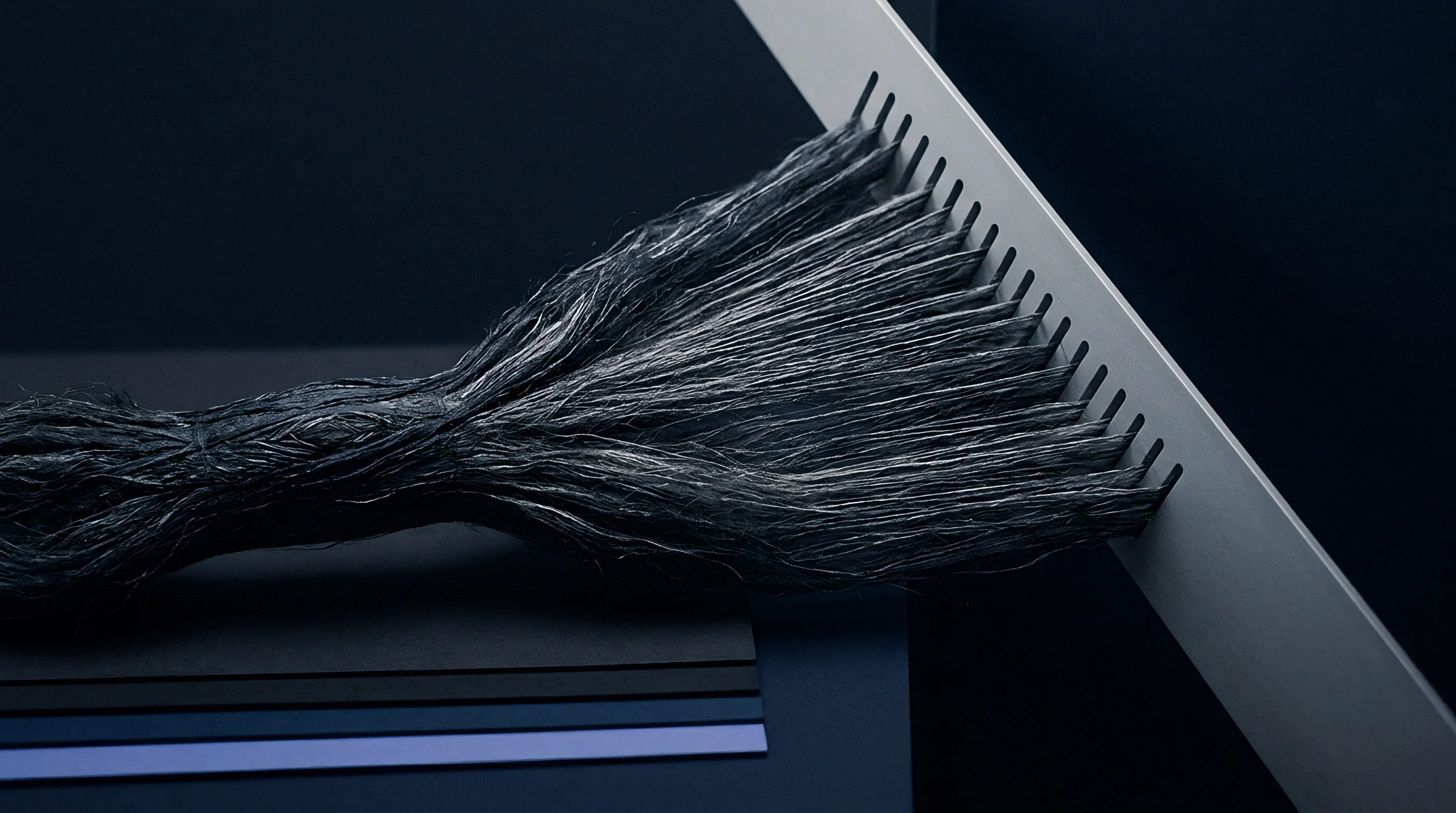

Porosity
Internal void distribution dictates how quickly conveying gas penetrates the outer boundaries of an accelerating fibrous cluster. High-speed cameras capture rapid volumetric expansion as tufts of 4.2 micronaire virgin cotton drop from mechanical card-wire feeders into low-pressure sorting chutes. An uncompressed tuft has an internal void fraction between 0.88 and 0.97, meaning the matrix consists almost entirely of air trapped between interlocking staple strands.
As air flows through these internal channels, skin friction along individual filaments dominates overall hydrodynamic resistance during initial transport.

Can Permeability Discrepancies Distort Matrix Aerodynamics?
Different polymers exhibit distinct surface chemistries and moisture regain levels that alter how individual fibres cling together during mechanical opening. Standard cotton carries an official moisture regain of 8.5 percent under standard conditions, compared to 0.4 percent for polyester and 13.0 percent for secondary viscose. In dry sorting environments, static charges build rapidly across synthetic filaments, pushing strands apart through Coulomb repulsion.
This electrostatic expansion swells the tuft cross-section and drives the internal void fraction toward 0.98, whereas compressed natural cotton clumps, held compact by natural waxes and higher moisture regain, remain dense and resist air penetration.
Unverified fibre content declarations trigger shipment rejection under standard commercial arbitration terms when foreign synthetics exceed two percent of clean uncarded mass.
Filament diameter and packing orientation establish the permeability tensor of the tuft matrix under coupled Navier-Stokes transport. Air forced through an irregular mass of varying staple lengths undergoes localized pressure loss governed by modified Kozeny-Carman relationships where hydraulic radius depends on the weighted specific surface area of each constituent polymer. Sorters running mixed reclamation lines encounter sharp shifts in tuft compaction within sub-millisecond intervals:
- Inter-fibre Friction Lock prevents internal rearrangement of combed cotton fibres during high-velocity shear, maintaining a rigid profile that maximizes aerodynamic drag.
- Hydrophobic Electrostatic Repulsion pushes synthetic filaments apart, generating wide, low-density tuft profiles that drift off the center flight axis.
- Localized Moisture Desorption lightens hygroscopic regenerated cellulosic fibres inside heated sorting channels, destabilizing predicted free-fall acceleration.
- Elastomeric Necking Elasticity causes fragments containing polyurethane yarn to rebound aggressively off chute duct walls, altering post-impact aerodynamic alignment.
Uneven opening cylinder teeth and unconditioned bale moisture contribute directly to these optical misidentifications.

Wake
Downstream velocity deficits behind accelerating fibre masses create unsteady draft zones that pull trailing particles off their assigned trajectories. With optical cameras sampling at 12 kilohertz on industrial lines processing 1500 to 3000 kilograms of raw or recycled stock per hour, spatial tuft concentration reaches levels where independent particle assumptions collapse. Velocity slip between conveying air and moving tufts creates localized recirculation bubbles, shedding vortices at frequencies tied directly to the Strouhal number of the leading tuft.
Trailing tufts entering this slipstream experience sudden drops in relative fluid velocity, reducing drag force and accelerating them toward the particle ahead.
Aerodynamic interaction becomes non-linear when tufts of divergent composition travel within three to five envelope diameters of one another. High-density cotton clumps generate narrow, turbulent wakes with rapid kinetic energy decay, whereas bulky synthetic clusters shed wide vortex streets that destabilize parallel flight lanes across the sorting chute. These wake interactions alter both the pitch and yaw angles of non-spherical clusters, changing the surface area presented to overhead charge-coupled device cameras and line-scan near-infrared sensors.
A tuft showing a wide lateral aspect during optical inspection can rotate 90 degrees after wake ingestion, presenting a minimal profile to downstream air ejectors.
Eulerian-Lagrangian fluid models demonstrate that wake-induced drafting groups particles together, aerodynamically masking fine synthetic contaminants behind larger virgin cotton tufts. The smaller particles ride inside the recirculation zone of the larger mass, passing sensors at identical linear velocities before diverging sharply when the primary tuft hits the stagnation zone of the extraction hood. Sorting software calibrated for isolated particle dynamics assigns uniform timing offsets based solely on the visual centroid measured at the inspection line, ignoring trailing wake velocity gradients.
| Leading Tuft Type | Trailing Tuft Type | Separation Distance (mm) | Velocity Deficit (%) | Vortex Shedding Frequency (Hz) | Trajectory Offset at 600 mm (mm) |
|---|---|---|---|---|---|
| Dense Combed Cotton | Dense Combed Cotton | 25 | 14.2 | 310 | 3.4 |
| Bulky Recycled Polyester | Dense Combed Cotton | 20 | 28.6 | 185 | 8.9 |
| Bulky Recycled Polyester | Fine Polyester Fluff | 15 | 42.1 | 160 | 14.2 |
| Viscose Rag Scrap | Cotton Nep Matrix | 30 | 9.8 | 380 | 2.1 |
| Shredded Denim Matrix | Elastane Fragment | 18 | 34.5 | 220 | 11.6 |
Staggered aerodynamic boundary conditions across high-speed optical inspection zones produce recognizable physical changes in the mass flow:
- Streamwise Drafting Acceleration draws trailing lightweight tufts into the low-pressure pocket of leading particles, compressing arrival time intervals below the valve response threshold.
- Cross-stream Wake Deflection pushes adjacent low-density synthetics sideways into neighboring inspection channels, generating erroneous positional coordinates.
- Vortex-induced Tuft Disaggregation pulls loose surface fibres away from friable recycled clumps, filling the optical sorting tunnel with floating dust screens.
- Rotational Magnus Realignment spins asymmetrical tuft geometries, presenting false color and NIR signatures to overhead line-scan spectrometers.
Whether micro-scale turbulence damping within porous multi-component clusters can be calculated analytically without empirical wind-tunnel pressure calibration remains unresolved in industrial sorting line design.


Deflection
Pneumatic separation nozzles positioned downstream from the imaging line fire short air bursts at 6 bar to knock undesirable contaminants into reject hoppers. The actuation mechanism relies on an uninterrupted linear relationship between the optical coordinate measurement and the spatial position of the target at the ejection plane. Conveying ducts operating at commercial velocities give a tuft less than 25 milliseconds to cover the distance between spectral identification and the pneumatic nozzle manifold.
When aerodynamic wake forces and internal permeability variations distort particle trajectory, the center of mass arrives out of sync with the pneumatic blast.

Is Differential Sinking Speed Distorting Air Separation?
Variations in polymer composition create massive disparities in the momentum of similarly sized tufts. A dense, moisture-laden cotton aggregate carries sufficient forward momentum to resist cross-drafts within the duct. A diffuse synthetic clump of identical envelope diameter, possessing half the physical mass and twice the projected surface area, experiences immediate deceleration upon entering quiescent boundary layers near duct walls.
When the air manifold triggers, the pneumatic blast either strikes the air gap ahead of the delayed synthetic particle or impacts only its trailing edge, imparting an erratic spin rather than a clean downward deflection into the reject chute.
Pneumatic valves actuated with an 18-millisecond delay miss low-density synthetic tufts whose aerodynamic deceleration exceeds 3.2 m/s² inside the unconfined sorting zone.
With ejection delays spanning 1.8 milliseconds, nozzle spacing across modern high-speed sorting manifolds measures between 4.0 and 10.0 millimetres, operated by high-frequency solenoid valves capable of open-and-close cycles under two milliseconds. The valve pitch equals 6.35 millimeters. Pressurized air pulses exiting 1.5-millimetre orifices generate turbulent jets that spread at half-angles of roughly 11 degrees.
If an aerodynamically deflected tuft drifts by just five millimetres laterally, the air jet strikes its peripheral edge, spinning the contaminant back into the accepted fibre stream while knocking adjacent virgin lint into the waste hopper.
- Spectral Position Registration records the centroid of the multi-fibre tuft using visible and near-infrared line-scan sensors operating across high-speed conveyor belts.
- Aerodynamic Path Projection applies empirical drag and slip coefficients to calculate the millisecond timestamp when the tuft arrives directly opposite target nozzles.
- Solenoid Actuator Energization routes 24-volt pulses to high-speed electromagnetic valves, releasing compressed air bursts at 0.6 to 0.8 megapascals.
- Jet Core Impingement delivers localized kinetic energy to overcome forward tuft momentum, pushing foreign material across the separation splitter plate into the collection duct.
- Boundary Layer Re-entrainment vents residual jet turbulence through baffled exhaust ports, preventing secondary deflection of adjacent clean fibre clusters.
Incorrectly timed valve pulses shear the leading edge of the fibrous clump, ejecting pure virgin lint while sending the dense synthetic core straight into the carding room feed.
Settlement
Reclaiming secondary textile waste into commercial spinning operations carries direct contractual exposure governed by clean lint yield and verifiable composition percentages, where customs duties jump to 12 percent. Post-industrial clips and post-consumer garnetted stocks trade on mass balances verified against quantitative chemical dissolution standards like ISO 1833. When aerodynamic sorting systems fail to isolate synthetic tufts due to boundary layer wake errors, the landed lot carries non-target polymer fractions that exceed spinning mill purchase specifications.
Unseparated polyester or elastane fragments surviving the blowroom create structural faults during open-end and ring spinning, causing high yarn break rates on spinning frames.
Landed costs escalate rapidly when mis-ejection forces sorting operators to re-run accepted lint streams or adjust valve blast durations to over-eject ambiguous particles. Tare weights drop by 3 percent while clean yield falls below 84 percent. Over-ejecting tufts to guarantee zero synthetic contamination throws high percentages of spinnable natural lint into the waste bin.
If an opening and sorting line processes secondary denim waste at 2000 kilograms per hour, losing an extra three percent of premium long-staple cotton to the reject cyclone erodes processing margins across high-volume production runs.
Consider a 20-tonne shipment of mechanically opened post-consumer cotton-rich waste purchased under contract at 1.45 US dollars per kilogram, specified at 95 percent cotton and 5 percent polyester. Assume sorting line air jet misalignments discard 4.5 percent clean cotton along with synthetics, while letting 1.8 percent unseparated polyester slip into the accepted stock. Clean cotton yield drops from 90.5 percent to 86.0 percent.
The actual accepted output yields 17,200 kilograms of spinnable stock instead of 18,100 kilograms. Factoring the lost fibre mass against fixed machine operational costs of 0.38 US dollars per kilogram raises the effective raw material cost from 1.60 to 1.69 US dollars per clean spinnable kilogram.
| Declared Blend Spec | Sorting Ejection Error Rate (%) | Clean Spinnable Yield (%) | Post-Sort Synthetic Purity (%) | Customs HS Tariff Heading | Net Landed Cost ($/kg clean) |
|---|---|---|---|---|---|
| 95% Cotton / 5% Polyester | 1.2 | 89.3 | 98.8% Cotton | HS 5202.99 (Cotton Waste) | 1.62 |
| 95% Cotton / 5% Polyester | 5.8 | 83.7 | 94.2% Cotton | HS 5505.10 (Synthetic Waste) | 1.84 |
| 70% Cotton / 30% Polyester | 2.4 | 86.5 | 68.5% Cotton | HS 5202.99 (Cotton Waste) | 1.48 |
| 70% Cotton / 30% Polyester | 8.6 | 78.2 | 61.2% Cotton | HS 5505.10 (Synthetic Waste) | 1.73 |
| 60% Cotton / 40% Viscose | 3.1 | 88.0 | 59.1% Cotton | HS 5202.99 (Cotton Waste) | 1.56 |
Regulatory trade classifications hinge precisely on chief weight determinations under World Customs Organization Chapter 52 and Chapter 55 rules. If unseparated synthetic tufts leave a secondary cotton lot with over 15 percent synthetic fibre by weight, customs authorities in major importing ports reclassify the entire consignment from HS heading 5202 for cotton waste, typically assessed at lower tariff rates, into HS heading 5505 for synthetic waste, attracting higher import duties and mandatory local laboratory audits.
A misclassified customs declaration generates storage demurrage charges that compound daily while independent laboratory analyses arbitrate the actual polymer content of the consignment.
Buyers protecting manufacturing margins insert explicit tolerance bands into supply letters of credit. When unseparated multi-fibre tufts slip past sorting ejectors because fluid wakes deflect their trajectory, the resulting spinning yarn displays catastrophic pilling behavior and uneven dye uptake across finished knit goods. Discarding whole finished lots because elastane streaks resist reactive dyes destroys customer relationships and locks capital in unsellable stock.
Incorporating the commercial mass determination rules of ISO 6741 into the purchase agreement obligates the seller to absorb customs reclassification surcharges when unseparated synthetic tufts shift the declared composition percentage over customs tolerance boundaries.