Multi-Scale Aerodynamic and Tribological Simulation Frameworks for Off-Spec Binary Fiber Blend Drift Elimination
Coupling multi-scale drag and tribological simulations stabilizes binary fiber ratios across chute and drafting zones, eliminating costly customs misdeclarations.


Flock
Pneumatic transport lines move raw fiber tufts at velocities exceeding fifteen meters per second through duct networks where air turbulence and centrifugal turns strip lighter components away from heavier stock. In an intimate mixture of polyester and combed cotton, aerodynamic drag acts unevenly on the constituent fibers. Polyester filaments possess uniform cylindrical cross-sections, consistent cut lengths of thirty-eight millimeters, and predictable linear densities of 1.3 dtex.
Upland cotton displays convoluted ribbon geometry, variable micronaire values between 3.8 and 4.5, and staple distributions with high short-fiber content. Differential mass alters trajectory. When pneumatic ducts execute ninety-degree turns, centrifugal forces drive heavier, moisture-dense cotton clumps toward the outer duct wall, while lighter, low-friction synthetic tufts concentrate along the inner radius.
The separation accelerates across mechanical blowroom beaters. Coarse opening rollers impart kinetic energy based on tuft mass and fiber-to-pin engagement. Cotton tufts yield higher frictional resistance against steel worker pins due to natural pectin waxes and surface convolutions, causing delayed release.
Polyester tufts shed rapidly from opening points under high rotational velocity. Fiber diameter governs drag. As opened stock enters the chute feed above the carding machine, laminar air extraction draws finer synthetic fibers toward exhaust screens, while denser natural fibers settle directly into the consolidation column.
Air velocity gradients inside chute feeds produce a 2.8 percent mass separation across the delivery width under standard atmospheric conditions of twenty degrees Celsius and sixty-five percent relative humidity.
Chute feed geometry amplifies pneumatic sorting. Static pressure variations across the width of the card feed trunk create preferential air paths. Polyester fibers carry lower specific gravity and higher electrostatic susceptibility, causing them to bridge across perforated air-relief plates.
Cotton fibers fall directly onto the feed roll nip. Over an eight-hour spinning shift, this aerodynamic sorting shifts the delivery ratio from a nominal 65/35 polyester-cotton recipe to local concentrations fluctuating between 61/39 and 69/31 across adjacent card slivers.
Carding machinery converts tufts into individual filaments, introducing extreme shear gradients. Revolving flat cards generate intense aerodynamic boundaries between the cylinder wire and stationary card flats. Peripheral cylinder speeds exceeding thirty meters per second generate circumferential air currents that strip free fibers from the main cylinder.
Polyester fibers display higher bending rigidity than cotton, resisting aerodynamic deflection into the flat strips, whereas immature cotton fibers divert into waste collectors. The resulting sliver exhibits continuous composition drift along its linear run.
Suppliers routinely dismiss these sliver ratio variations as transient opening fluctuations that will even out downstream in the draw frame autoleveller.

Nip
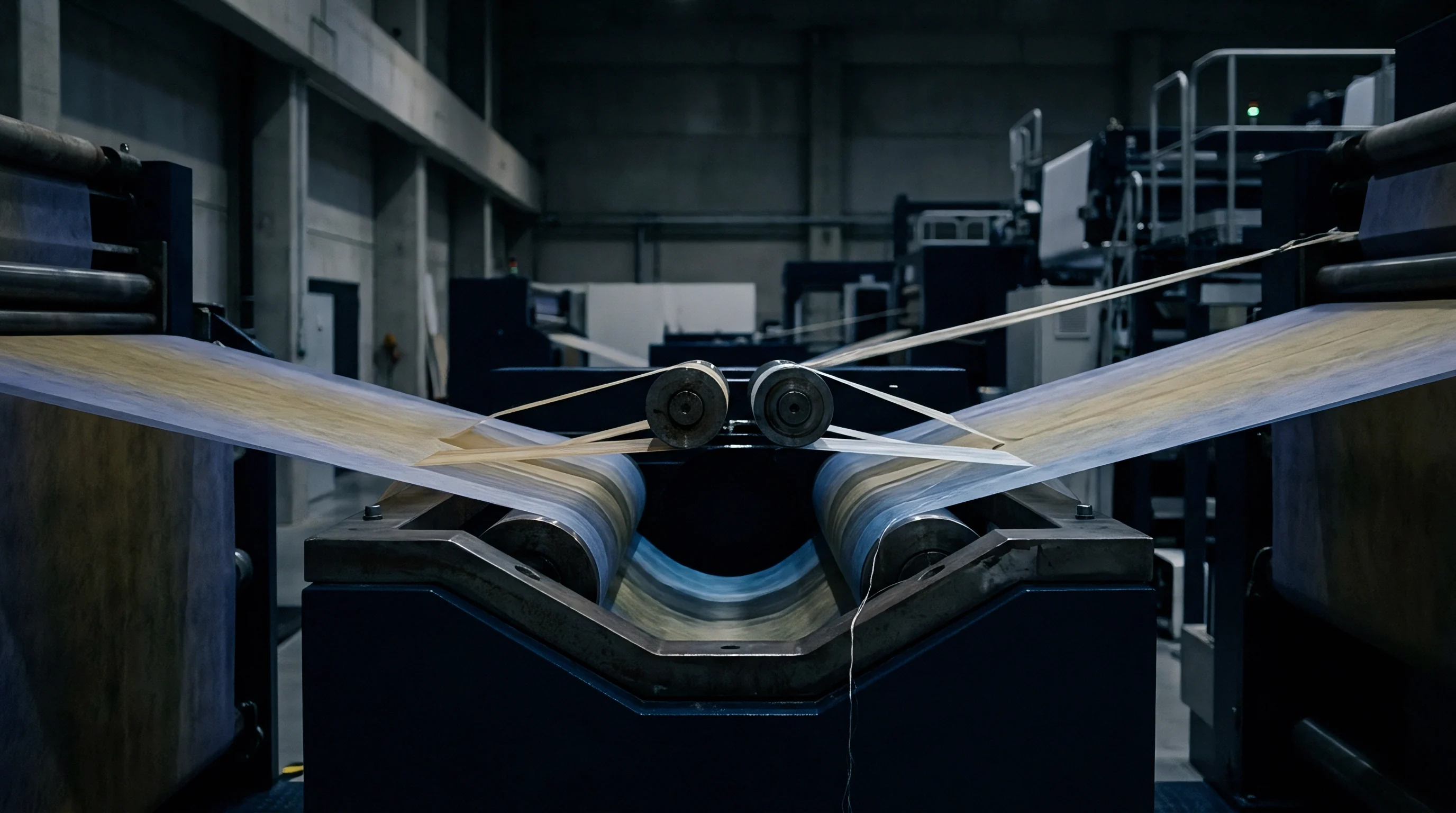
Drafting zones subject parallel fiber assemblies to high normal pressures between synthetic rubber cots and fluted steel rollers. Friction governs fiber control during drafting. Between the back and front rolls of a draw frame, fibers accelerate from the speed of the trailing nip to the velocity of the delivering nip.
This acceleration demands precise frictional contact. Cotton fibers present a static friction coefficient of 0.48 against steel and 0.52 against synthetic acrylonitrile-butadiene cots. Polyester filaments coated with spin finish exhibit boundary friction coefficients ranging between 0.22 and 0.31 under matching normal loads.
Boundary friction dictates slippage. When the drafting wave passes through the fiber strand, the synthetic component slips ahead of the natural fiber matrix.

Why Do Binary Fiber Blends Segregate during Drafting?
Normal drafting forces compress dissimilar polymers against mechanical guiding surfaces, inducing unequal lateral displacement. As the roller cot deflects elastomeric energy into the strand, synthetic filaments slide toward the strand margins where frictional restraint reaches its minimum. Spin finish migration exacerbates the divergence.
Under repeated mechanical shearing, liquid ester and ethoxylated lubricants migrate from the synthetic fiber surface onto adjacent cotton walls. This surface transfer alters the tribological equilibrium of the entire cross-section. The natural fiber absorbs hydrophobic finishing oils, altering its inter-fiber stick-slip behavior, while the synthetic fiber loses boundary lubrication, elevating its tribological resistance against the front drafting apron.
| Fiber Component Pairing | Linear Density (dtex) | Static Friction Against Steel | Dynamic Inter-Fiber Friction | Terminal Velocity (m/s) |
|---|---|---|---|---|
| Combed Upland Cotton | 1.65 | 0.48 | 0.38 | 3.12 |
| Semi-Dull Polyester Staple | 1.30 | 0.26 | 0.24 | 2.45 |
| Fine Merino Wool (19.5 Micron) | 3.85 | 0.54 | 0.42 | 4.20 |
| Polyamide 6,6 Staple | 3.30 | 0.32 | 0.28 | 3.65 |
| Bright Viscose Rayon | 1.70 | 0.39 | 0.31 | 2.95 |
| Mechanical Recycled Polyester | 1.55 | 0.35 | 0.33 | 2.78 |
Fiber crimp differences introduce another tribological barrier. Cotton possesses natural three-dimensional convolutions averaging fifty to eighty twists per centimeter, creating random mechanical interlocks. Synthetic fibers rely on heat-set two-dimensional planar or gear crimp averaging four to seven crimps per centimeter.
Under tension in the drafting zone, synthetic crimp pulls out at low tensile loads, reducing the effective cross-sectional diameter of the synthetic strand. Cotton convolutions resist uncrimping, maintaining high inter-fiber contact area. The synthetic fibers pull free from the moving bundle prematurely, leading to periodic accumulation at the front roller nip followed by cyclic ejection into the main strand.
A drafting apron shore hardness shift from 65 to 75 Duro increases synthetic fiber forward slippage by four percent across five roving delivery positions.
Rotor spinning units subject this drafted strand to pneumatic centrifugal consolidation. In open-end spinning, an opening roller clad with saw-tooth wire combs the input sliver into individual floating fibers. The teeth accelerate fibers into an air transport channel leading directly into the spinning rotor groove.
Fiber separation occurs instantly inside the duct. Polyester filaments experience higher centrifugal acceleration against the rotor collecting wall, seating directly into the core of the yarn, while cotton fibers form the outer sheath. In ring spinning, ballooning tension and traveler friction create radial migration where softer, lower-friction fibers migrate toward the yarn exterior.
Tighter drafting nip settings reduce bulk divergence only when the roll distance matches the longest constituent fiber span exactly.

Mesh
Resolving fluid boundary layers around individual flexible filaments demands spatial discretization across three distinct physical scales. At the macro-scale, three-dimensional Reynolds-Averaged Navier-Stokes equations compute airflow fields through blowroom pipelines and carding ducts using structured finite-volume cells. Air velocities and pressure gradients establish the continuous phase.
At the meso-scale, the Discrete Element Method treats fiber tufts as agglomerations of bonded spherical particles that deform, compress, and rupture under pneumatic turbulence. At the micro-scale, flexible rod formulations solve for individual filament kinematics, coupling elastic beam deformation to local boundary layer drag and surface contact forces.

Multi-Scale Numerical Coupling Schemes
Accurate prediction of binary separation relies on two-way momentum exchange between the fluid and solid phases. The Eulerian continuous phase passes velocity vectors and aerodynamic pressure gradients to the Lagrangian particle tracking module. The discrete solid phase feeds back volumetric displacement and momentum sink terms into the Navier-Stokes momentum equations.
When fiber volume fraction exceeds 0.5 percent in consolidation zones, four-way coupling activates, calculating fiber-fiber collisions and sustained contact friction using contact detection algorithms and non-linear spring-dashpot contact laws.
The aerodynamic drag computation accounts for non-spherical filament morphology. Standard drag laws for spherical particles fail entirely when applied to textile fibers. The framework deploys an empirical cross-flow drag formulation based on local cylinder inclination angles relative to the air streamline:
F_drag = 0.5 rho_air C_d A_proj |v_rel| v_rel
In this expression, rho_air denotes the atmospheric air density, C_d represents the drag coefficient calculated separately for parallel and perpendicular flow regimes, A_proj defines the projected filament area normal to relative flow, and v_rel is the relative velocity vector between the fiber centroid and the local air parcel. Cotton fibers demand an amplified drag coefficient correcting for ribbon twist and surface roughness. Polyester demands a lower, Reynolds-dependent smooth cylinder coefficient.
Drag coefficients diverge immediately.
| Physical Domain Scale | Governing Equations | Cell Resolution / Element Size | Contact and Drag Mechanics |
|---|---|---|---|
| Macro-Scale Duct Flow | Incompressible Navier-Stokes (RANS k-omega SST) | 0.5 mm to 2.0 mm Hexahedral Volume Cells | Eulerian continuous phase, pneumatic pressure boundaries |
| Meso-Scale Tuft Agglomeration | Discrete Element Method (DEM) Solid Phase | 1.0 mm to 5.0 mm Bonded Spherical Clusters | Viscoelastic inter-particle bonds, aerodynamic pressure integration |
| Micro-Scale Single Filament | Nonlinear Cosserat Rod / Euler-Bernoulli Beams | 10 to 30 Segmented Cylindrical Nodes per Fiber | Boundary lubrication contact, Capstan friction, anisotropic drag |
| Rotor Groove Consolidation | Centrifugal Granular Contact Dynamics | 0.1 mm Surface Wire Grid Resolution | Coulomb sliding, normal elastoplastic restitution, wall adhesion |
Tribological contact mechanics integrate Coulomb friction modified by lubricant boundary dynamics. When two modeled filaments intersect within the numerical domain, contact detection algorithms evaluate penetration depth and relative tangential velocity. The normal contact force follows Hertzian contact theory for intersecting cylinders, while the tangential sliding force obeys an elastoplastic yield threshold governed by the local friction coefficient.
Static charges accumulate on polyester. The computational architecture incorporates electrostatic body forces, calculating local charge accumulation on synthetic surfaces and applying Coulomb attraction toward grounded metal duct walls.
Eliminating drift along industrial transport lines requires predictive feed-forward optimization. By simulating the precise aerodynamic drag differentials across variable duct radii, the framework computes the exact pneumatic compensation needed in the chute feed air-exhaust chambers. Divergent fiber settling can be countered by modulating localized extraction damper angles, equalizing the spatial deposition of cotton and synthetic fibers across the carding lap.
The unresolved question remains whether high-speed electrostatic field variations caused by fluctuating shop-floor humidity can ever be calculated rapidly enough to adjust mechanical air dampers in real time.

Assay
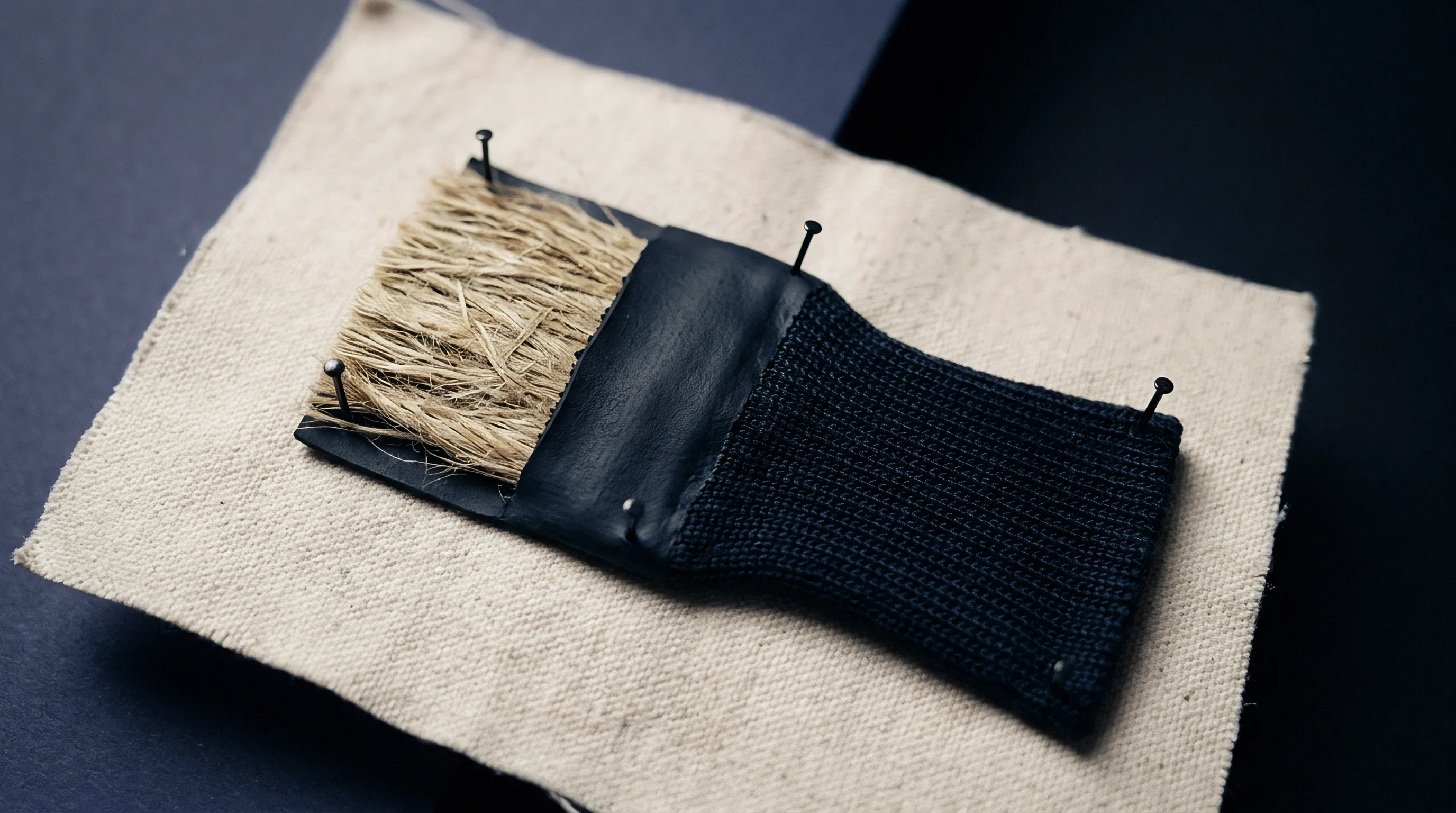
Quantitative chemical dissolution determines the true mass fraction of binary fiber components according to ISO 1833 standard test methods. A declared composition ratio on a commercial purchase contract provides zero guarantee of actual roll-to-roll consistency. When verifying a 65/35 polyester and cotton delivery, testing technicians extract representative test specimens from combed sliver, roving bobbins, and ring-spun yarn packages.
Sampling follows strict statistical rules across the entire production lot.

Chemical Separation Mechanics and Commercial Mass Correction
Testing laboratories dry the composite specimen to constant mass in a ventilated drying oven at one hundred and five degrees Celsius to eliminate volatile moisture regain. The dry mass represents the initial analytical baseline. In a polyester-cotton binary pairing, seventy-five percent sulfuric acid dissolves the cellulose fraction at room temperature over sixty minutes, leaving the polyester residue intact.
Technicians vacuum-filter the suspension through a sintered glass crucible, wash the insoluble polyester residue with dilute ammonia and deionized water, dry the residue at one hundred and five degrees Celsius, and weigh it on an analytical balance to four decimal places.
Calculating the true commercial mass demands applying standardized commercial moisture regains specified in ISO 6741. Cotton carries an official commercial moisture allowance of 8.50 percent, while polyester carries a standardized regain of only 1.50 percent. Failing to apply these official regain multipliers to clean dry weights distorts the calculated commercial blend ratio by over two full percentage points.
Laboratory separation confirms the ratio under ISO 1833 Part 11 with an allowable analytical tolerance of plus or minus one full percentage point on clean dry fibers.
The sequence below defines the verification and control procedure executed across incoming spinning lots to detect aerodynamic and drafting drift before yarn winding commences:
- Drawing position sampling extracts twenty-meter sliver specimens across eight delivery heads per drawing frame at four-hour intervals.
- Moisture stabilization conditions all drawn sliver test bundles in standard atmosphere for twenty-four hours to eliminate electrostatic bias.
- Spectroscopic ratio screening scans specimen slivers using calibrated near-infrared spectroscopy to identify rapid cross-sectional drift before conducting wet chemistry.
- Quantitative solvent separation dissolves cellulosic mass in sulfuric acid under ISO 1833-11 protocols to arbitrate borderline near-infrared readings.
- Drafting zone recalibration alters roller nip distances and front roll cot durometer when sliver mass fractions deviate by more than 1.5 percent from declared target.
Physical separation failure modes emerge when processing non-standard binary mixes. In wool and polyester mixtures evaluated under ISO 1833 Part 4, warm alkaline sodium hypochlorite dissolves the keratinous wool fiber. If the hypochlorite concentration drops below theoretical activity or if processing temperatures exceed forty degrees Celsius, partial polymer degradation of the synthetic component occurs, artificially inflating the apparent wool percentage.
In polyamide and cotton mixes evaluated under ISO 1833 Part 7, eighty percent formic acid extracts the nylon component. Incomplete rinsing leaves residual formic acid crystals within the dried cellulose matrix, generating false gravimetric readings that fail customs verification audits.
Commercial sales agreements governed by standard international textile arbitration clauses enforce chemical mass verification against declared blend tolerances, rejecting any shipment exceeding a three percent divergence from contractual target specifications.
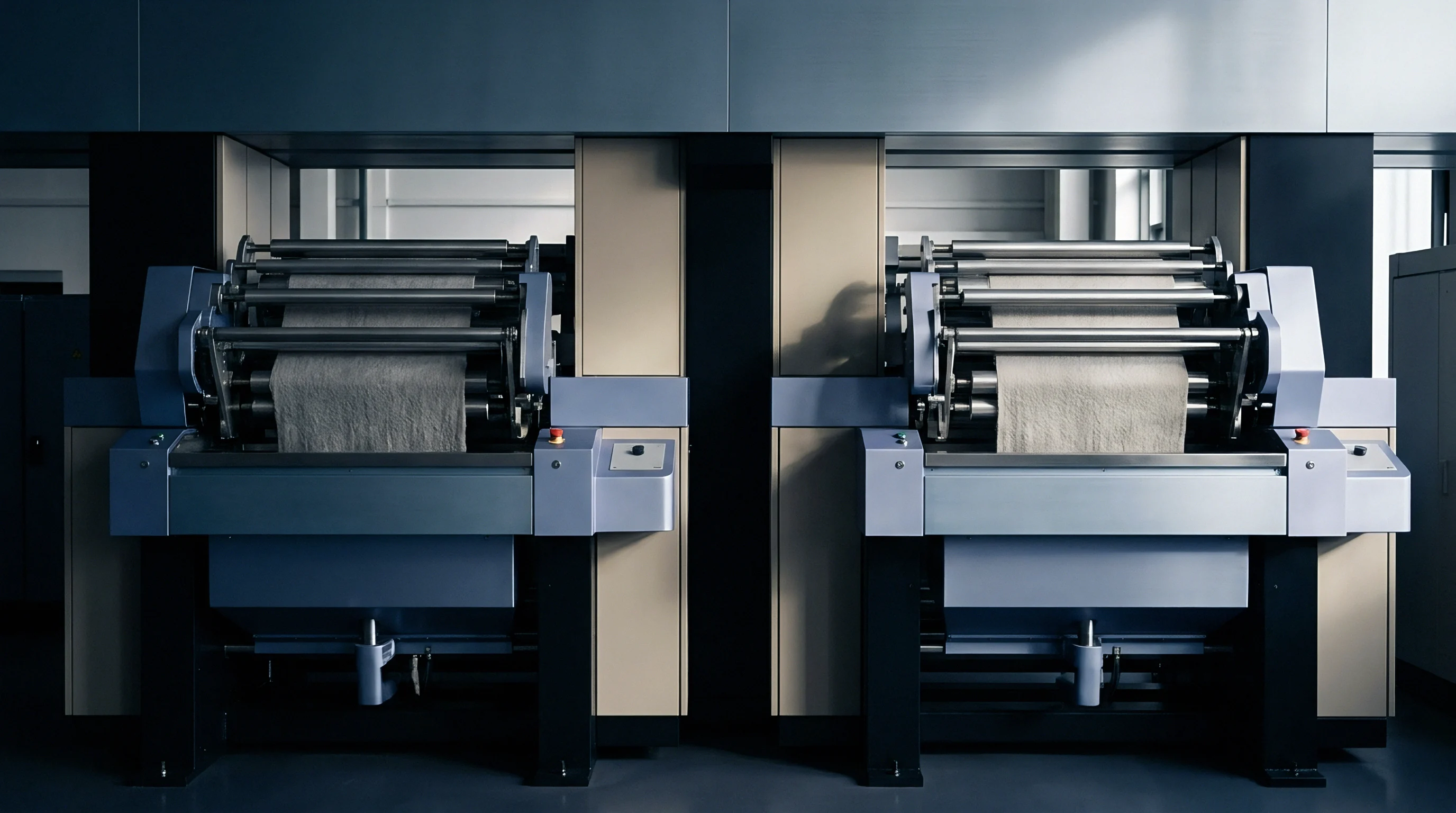
Tariff
Customs classification under the Harmonized System turns entirely on the single fiber component predominating by weight. Under General Rule of Interpretation 3(b) and Chapter 55 legal notes, a woven or knitted textile containing sixty-five percent polyester staple fibers and thirty-five percent cotton by weight enters customs under Heading 5515 as an article of synthetic staple fibers mixed mainly with cotton. If aerodynamic drift, uncorrected chute distribution, or drafting slippage shifts the blend ratio down to forty-nine percent polyester and fifty-one percent cotton, the legal character of the merchandise changes completely.
The identical finished roll crosses the border under Heading 5210 as a cotton textile containing less than eighty-five percent cotton by weight, mixed mainly with man-made fibers.

Financial Exposure and Duty Arbitrage Mechanics
Tariff shifts erase mill profits. Customs duty schedules penalize classification errors through wide rate spreads between natural fiber chapters and synthetic categories. Under United States Harmonized Tariff Schedule guidelines, plain-weave synthetic staple cloth classified under 5515.11.00 carries an import tariff of twelve percent ad valorem.
That same cloth misclassified under 5210.11.00 as cotton cloth carries an import duty of 6.5 percent. When customs authorities pull roll swatches from an ocean container, laboratory dissolution testing that reveals cotton predominated by weight triggers reclassification, demand for back duties, and severe civil fraud penalties.
| Nominal Contract Ratio | Delivered Roll Ratio | HS Code Classification | Import Duty Rate | Duty on 280,000 USD Value |
|---|---|---|---|---|
| 65% Polyester / 35% Cotton | 65.2% PET / 34.8% Cotton | 5515.11.00 (Synthetic Dominant) | 12.0% | 33,600 USD |
| 55% Polyester / 45% Cotton | 51.4% PET / 48.6% Cotton | 5515.11.00 (Synthetic Dominant) | 12.0% | 33,600 USD |
| 52% Polyester / 48% Cotton | 48.2% PET / 51.8% Cotton (Drifted) | 5210.11.00 (Cotton Dominant) | 6.5% | 18,200 USD |
| 60% Cotton / 40% Polyester | 58.5% Cotton / 41.5% PET | 5210.11.00 (Cotton Dominant) | 6.5% | 18,200 USD |
| 51% Wool / 49% Polyamide | 47.8% Wool / 52.2% PA (Drifted) | 5407.72.00 (Synthetic Filament/Staple) | 14.9% | 41,720 USD |
Take a commercial purchase order covering forty metric tons of plain-dyed shirting fabric valued at seven dollars per kilogram, yielding a baseline transaction value of two hundred and eighty thousand dollars. Assume the procurement contract specifies a 52/48 polyester-cotton blend engineered to claim synthetic classification under Heading 5515 while maintaining high natural handfeel. If blowroom air sorting and drafting segregation shift the bulk delivery by five percentage points toward cotton, customs testing returns a 47/53 ratio.
Customs authorities reclassify the goods under Chapter 52. The importer faces an unexpected duty adjustment of fifteen thousand four hundred dollars, port storage demurrage charges exceeding six thousand dollars during re-testing, and mandatory testing fees.
Rules of origin introduce further financial jeopardy. Preferential trade agreements establish strict yarn-forward origin rules requiring specific component transformations within signatory territories. If an unmonitored fiber drift causes a garment fabric to cross below agreed fiber thresholds, the importer loses preferential duty-free status completely, facing standard most-favored-nation tariffs that add tens of thousands of dollars to landed costs.
The mill pays the retest invoice. Sourcing executives who fail to audit the aerodynamic and frictional stability of binary fiber blending systems face customs seizures, liquidated damage claims from apparel brands, and total forfeiture of border clearance margins.