Multispectral Sensor Baseline Drift Correction in High Velocity Cotton Cleaning
Real-time multispectral drift correction maintains foreign fiber rejection thresholds in cotton cleaning by decoupling emitter thermal decay from optical window dust accretion.


Lens
In automated blowrooms, aerodynamic transport ducts sweep cotton tufts through optical inspection zones at velocities ranging from 12 to 25 meters per second. Fine dust, micro-fibers, and volatile botanical lipids suspended in these high-speed air currents continuously strike protective quartz and sapphire optical windows. Over continuous operating shifts, this particulate flux builds up a dense microscopic film across the glass, progressively attenuating light transmission before it reaches the underlying sensor arrays.
This optical attenuation varies strongly by wavelength, shaped by particle size distribution and chemical absorption bands. Fine plant trash and soil silica scatter short ultraviolet wavelengths around 365 nanometers far more aggressively than infrared wavelengths at 1650 nanometers. At the same time, natural cotton wax deposited on the viewing window forms an absorbing substrate that alters reflectance profiles in shortwave infrared bands used for plastic detection.
When optical attenuation drops baseline illumination unevenly across the spectrum, foreign matter detection algorithms lose sensitivity ~ either missing contamination or falsely rejecting clean lint.
Window fouling progresses through three distinct physical phases during blowroom operation. Initial particulate impaction creates a uniform Rayleigh scattering layer that reduces light intensity across all spectral bands. Subsequent wax deposition causes Mie scattering and localized spectral absorption, creating non-uniform spatial gradients across the line-scan field of view.
Finally, macro-fiber aggregation produces sudden step changes in baseline light levels as tuft fragments temporarily cling to window surfaces before being dislodged by turbulent airflow.
At a duct air speed of 20 meters per second, fine cotton dust accretion reduces UV transmission at 365 nanometers by 14 percent over an eight-hour operating shift.
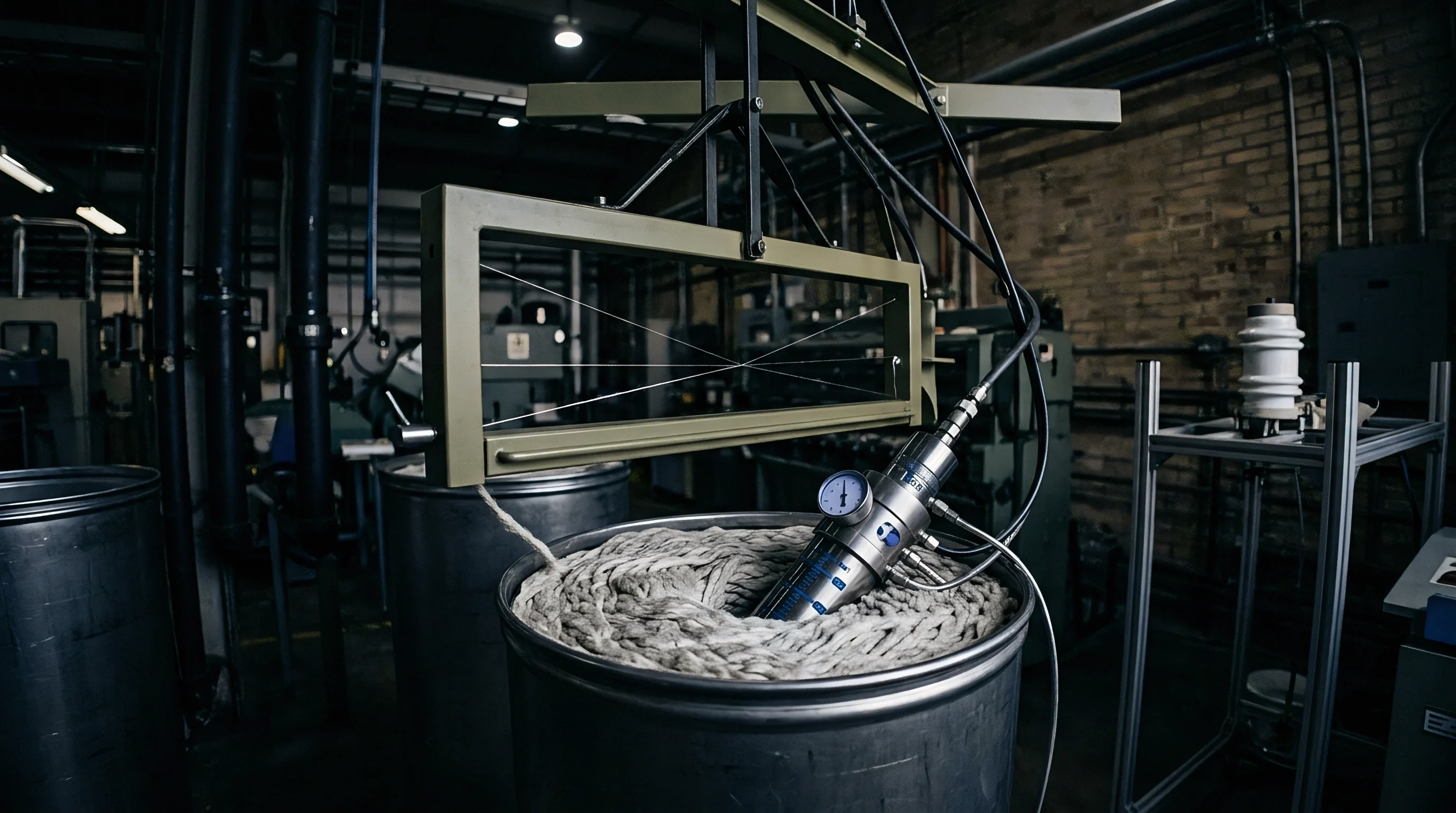
Photometric Degradation at High Duct Speeds
Continuous lint movement generates a static charge that attracts micro-particulate plant debris and residual pericarp fragments directly to optical surfaces. At air velocities exceeding 15 meters per second, boundary layer turbulence along sight glasses increases particle collision frequency. The resulting attenuation degrades signal-to-noise ratios across primary sensing bands, impairing the sorter’s ability to isolate semi-transparent polypropylene packaging film from surrounding cotton fibers.
| Spectral Band (nm) | Primary Target Contaminant | 4-Hour Transmission Loss (%) | 8-Hour Transmission Loss (%) | 12-Hour Transmission Loss (%) |
|---|---|---|---|---|
| 365 (UV) | White Polypropylene, Optical Brighteners | 8.2 | 14.1 | 21.5 |
| 550 (VIS) | Jute, Bark, Dark Leaf, Rubber | 3.1 | 5.8 | 9.4 |
| 850 (NIR) | Seed Coat Fragments, Honeydew | 2.4 | 4.2 | 6.9 |
| 1450 (SWIR) | Moisture Content, Organic Trash | 1.8 | 3.3 | 5.1 |
| 1650 (SWIR) | Synthetic Polymers (PE, PP, PET) | 1.5 | 2.9 | 4.6 |

Optical Window Accretion Profiles
Natural lipids and wax coatings on raw cotton fibers volatilize under mechanical friction, forming a sticky film on transparent sight glass. Fine soil particles and micro-dust adhere to this viscous layer, creating an organic-inorganic composite matrix. Standard automated mechanical wiper cycles often smear this wax layer rather than removing it, altering the spectral absorption profile of the window.
Mechanical wiper blades also induce micro-scratches over extended operating periods, permanently increasing background light scattering.
Whether ultra-high-pressure air nozzles can strip sticky botanical wax without degrading outer antireflective coatings remains an open operational question across spinning mills.


Noise
Multispectral sensor arrays deployed in cleaning lines require high signal stability to distinguish synthetic polymers from natural plant matter. Baseline noise stems both from environmental variations within the mill and internal optoelectronic physics. Solid-state light sources, silicon photodiodes, and indium gallium arsenide detectors operate inside sealed duct enclosures subject to ambient temperature swings from 20 to 55 degrees Celsius, causing emitters to lose intensity while dark current rises.
Thermal sensitivity causes solid-state light emitting diodes to shift both center wavelength and absolute radiant output during continuous operation. Ultraviolet light emitting diodes centered at 365 nanometers lose up to 0.3 percent radiant power per degree Celsius rise in junction temperature, with shortwave infrared emitters at 1650 nanometers showing similar thermal decay curves. As ambient temperatures inside the blowroom fluctuate across day and night shifts, uncompensated sensor baselines drift away from factory calibration points.
Dark current in indium gallium arsenide linear scan sensors doubles approximately every 7 to 8 degrees Celsius temperature rise. At continuous high frame rates between 10 kHz and 30 kHz, dark current accumulation reduces dynamic range and elevates floor noise. When background noise overlaps the weak reflectance signatures of clear or white plastic film, foreign matter ejectors misfire, causing unnecessary lint loss and degraded sorting accuracy.
Compliance with USDA cotton classing standards for foreign matter content requires sorter sensor stability within a two percent intensity band across entire processing lots.

Thermal Drift in Solid State Emitters
Light emitting diodes emitting at ultraviolet wavelengths of 365 nanometers experience forward voltage changes as operating temperatures rise within sealed industrial housings. Junction heating causes peak emission spectrum shifts toward longer wavelengths at approximately 0.1 nanometers per degree Celsius. This spectral drift moves the excitation output away from peak absorption bands of optical brighteners used in synthetic packaging twine, diminishing fluorescence emission from foreign contaminants.
- Ultraviolet Emitter Decay Shift in peak emission wavelength combined with junction output drop reduces fluorescence excitation efficiency on white polypropylene twines.
- Infrared Diode Instability Temperature-driven output drops across shortwave infrared arrays distort ratiometric calculations used to differentiate synthetic polymer film from cellulosic cotton lint.
- Indium Gallium Arsenide Dark Current Drift Thermal leakage current increases baseline voltage levels, masking faint spectral absorption dips caused by clear film fragments.
- Line-Scan Photodiode Non-Uniformity Individual pixels across line sensors respond unevenly to thermal stress, creating spatial gain variations across the duct width.

InGaAs Array Dark Current Behavior
Indium gallium arsenide linear sensors configured for shortwave infrared detection at 1450 and 1650 nanometers generate thermal leakage current proportional to substrate temperature. Industrial cleaning environments without active cooling circuits force photodiode arrays to operate at elevated ambient temperatures. Uncompensated dark noise reduces bit depth resolution, burying faint foreign matter signals beneath background electronic noise.
Uncompensated dark current shifts that remain uncorrected during long production runs inevitably lead to over-ejection of clean lint.


Lamp
Hardware mitigations address environmental drift before raw signals reach digital conversion circuitry. Stabilizing light source temperature and isolating optical contamination paths form the physical foundation of drift correction. Active thermal management uses Peltier thermoelectric coolers bonded directly to emitter submounts and detector packages, while closed-loop temperature controllers maintain internal semiconductor junctions at constant temperature regardless of external blowroom thermal swings.
Dual-path optical architectures decouple light source thermal decay from sight glass contamination. By routing an internal reference beam away from the duct environment to strike a dedicated reference photodiode, drive electronics continually measure absolute emitter output. Differences between reference channel intensity and primary inspection channel intensity isolate glass fouling from diode junction thermal decay.
Separating light source thermal decay from protective window contamination requires an independent internal reference photodiode path.

Is High Velocity Thermal Drift Correctable in Real Time?
Active thermal management circuits stabilized with Peltier elements maintain photodiode junctions within a narrow temperature envelope of plus or minus 0.5 degrees Celsius. Precise thermal stabilization suppresses dark current fluctuation and preserves fixed spectral responsiveness across all array channels. Integrating thermal stabilization hardware adds mechanical complexity, but removes thermal drift as a variable during full-capacity production runs.
- Peltier Junction Cooling Thermoelectric modules maintain fixed diode substrate temperatures, suppressing dark current elevation and output power decay during ambient mill heat spikes.
- Dual Beam Internal Ratiometry Secondary optical pathways monitor light output directly at the emitter source, enabling hardware circuits to adjust drive current as LEDs age.
- High Velocity Pneumatic Window Scrubbing Periodic ultra-high-pressure air knives sweep quartz sight glasses every sixty seconds, blowing away loose surface fibers and preventing thick dust cake accumulation.
- Integrated Reference Tiles Motorized internal ceramic reference standards deploy periodically into the optical path to perform baseline reset cycles without stopping cotton flow.
Internal Ratiometric Reference Paths
Dual-beam optical geometries split source light into a primary illumination beam and a secondary reference channel. The primary beam passes through the viewing window into the high-velocity cotton transport channel, while the secondary beam travels entirely within a sealed optical housing directly onto an auxiliary sensor. Calculating the ratio between primary and reference signals eliminates light source thermal fluctuation from the primary detection signal.
| Mitigation Strategy | Physical Mechanism | Baseline Stability Gain (%) | Maintenance Interval Impact | Capital Cost Addition |
|---|---|---|---|---|
| Thermoelectric Submount Cooling | Active Peltier junction temperature control | 35.0 | Zero change to routine cleanings | Moderate |
| Dual-Path Internal Reference | Split-beam ratiometric LED tracking | 28.0 | Extends sensor recalibration to 1,000 hrs | Low |
| Continuous Pulsed Air Knives | Boundary layer air velocity purge at 6 bar | 22.0 | Reduces manual glass wiping by 75% | Low |
| Motorized Internal Calibration Tiles | Automated physical zero-reference insertion | 12.0 | Requires annual mechanical servo replacement | High |
Failing to separate emitter output decay from window contamination leads directly to uncoordinated air ejector timing, causing high lint loss and unrejected polypropylene fragments.


Algorithm
Digital signal processing provides continuous correction when physical cleaning purges cannot maintain optical baseline stability. Raw digital values from linear sensor arrays undergo real-time mathematical normalization before foreign matter thresholds are evaluated. High-speed foreign matter sorters execute algorithms in field-programmable gate arrays capable of handling pixel data streams exceeding 50 megabytes per second.
Inter-tuft baseline tracking takes advantage of brief spatial gaps in the cotton duct stream. Cotton moving through high-velocity ducts at 18 meters per second flows as discrete tufts rather than a continuous solid sheet. Line-scan sensors sample background air reflectance during micro-millisecond gaps between tuft passes, establishing a dynamic moving background baseline.
Updating background values across a moving time window allows the software to adjust detection thresholds to account for slow window fouling.
Ratiometric spectral indexing provides intrinsic drift immunity by calculating ratios between spectral bands rather than relying on absolute intensity values. The Normalized Difference Plastic Index computes normalized difference ratios between synthetic absorption wavelengths and reference wavelengths. Because dust buildup attenuates adjacent shortwave infrared wavelengths almost identically, normalized ratio values remain stable even as raw light intensity falls by 20 percent or more.
Ratiometric spectral indices cancel common-mode optical attenuation caused by uniform dust buildup on inspection windows.

Adaptive Inter Tuft Baseline Tracking
High-speed line scan cameras sample background air stream reflectance during brief gaps between passing cotton clusters. Software algorithms record spatial pixel minima over rolling time intervals spanning 100 to 500 milliseconds. Tracking these minimum values generates a dynamic baseline profile that updates in real time, absorbing steady photometric attenuation caused by gradual optical window fouling.
- Sample line scan pixel intensity values across all spectral channels at frame rates between 10 kHz and 30 kHz.
- Apply a median filter over a moving 50-millisecond frame window to eliminate isolated transient peaks caused by passing lint tufts.
- Extract the minimum intensity value for each individual pixel channel to isolate background air-duct reflectance from cotton fiber signal.
- Compute exponential moving average baseline values for each pixel using an update coefficient calibrated to match observed dust accretion rates.
- Subtract the dynamic baseline array from raw frame data to generate normalized intensity profiles free from static window attenuation.
- Calculate normalized ratiometric spectral index values using shortwave infrared absorption bands to identify synthetic polymers.
- Compare normalized index values against calibrated rejection thresholds to drive high-speed pneumatic ejection valves.

Worked Calibration Drift Corrective Index
To evaluate mathematical drift compensation on bulk cleaning throughput, assume a processing line handling 2,000 kilograms of raw cotton per hour at 18 meters per second duct air speed. Operating uncorrected over a 12-hour shift, progressive window fouling and LED thermal decay drop average UV signal intensity by 21.5 percent and SWIR intensity by 4.6 percent. Without mathematical drift correction, fixed detection thresholds shift relative to actual background intensity, altering contaminant detection efficiency and clean lint ejection rates.
Consider a baseline UV reflectance intensity initial value of 800 digital counts on clean window glass. Dust accretion reduces background reading to 628 counts over 12 hours. A foreign matter contaminant producing a 100-count drop yields a target signal of 700 counts initially, comfortably crossing a fixed ejection threshold set at 720 counts.
After 12 hours of drift, the clean background level of 628 counts sits permanently below the fixed 720-count threshold, triggering continuous false pneumatic ejections that blow clean cotton into waste bins.
Applying adaptive inter-tuft baseline tracking recalculates the local background value dynamically. When background intensity drops to 628 counts, the algorithm shifts the ejection threshold proportionally down to 548 counts, preserving a fixed 80-count delta requirement. Applying the Normalized Difference Plastic Index further stabilizes synthetic detection.
Taking shortwave infrared intensity at 1650 nanometers and reference intensity at 1450 nanometers, the index equation computes:
NDPI = (Intensity_1650 – Intensity_1450) / (Intensity_1650 + Intensity_1450)
Assume initial clean readings of 1000 counts at 1650 nm and 950 counts at 1450 nm for cotton lint, yielding a baseline NDPI of (1000 – 950) / (1000 + 950) = 0.0256. Polypropylene contamination causes absorption at 1650 nm, dropping that channel reading to 600 counts while 1450 nm remains at 920 counts, yielding a contaminant NDPI of (600 – 920) / (600 + 920) = -0.2105.
After 12 hours of optical window dust accretion, clean background readings drop by 4.6 percent at 1650 nm (to 954 counts) and 5.1 percent at 1450 nm (to 901 counts). Recomputing the clean cotton NDPI gives (954 – 901) / (954 + 901) = 0.0285. The background spectral index drifts by only 0.0029 index units despite a significant absolute photometric light drop.
Polypropylene contamination under dirty window conditions drops 1650 nm intensity to 572 counts and 1450 nm intensity to 873 counts, yielding a dirty contaminant NDPI of (572 – 873) / (572 + 873) = -0.2083. The delta between clean cotton and polypropylene remains at 0.2368 index units, preserving foreign matter isolation accuracy without continuous manual recalibration.
| Correction Method Applied | 12-Hour False Ejection Rate (%) | 12-Hour Plastic Pass-Through (%) | Lint Yield Loss Rate (%) | Recalibration Downtime (Min/Shift) |
|---|---|---|---|---|
| Uncorrected Fixed Threshold | 14.8 | 18.2 | 4.2 | 45 |
| Static Manual Baseline Reset | 6.2 | 11.5 | 2.1 | 30 |
| Adaptive Inter-Tuft Tracking | 1.1 | 3.4 | 0.6 | 0 |
| Ratiometric NDPI + Adaptive Baseline | 0.3 | 0.8 | 0.2 | 0 |
| Data modeled on 2,000 kg/hr blowroom line processing US Upland cotton with 1.8% raw trash content under continuous 12-hour production runs. | ||||
Baseline drift is frequently framed as a temporary atmospheric variation manageable through routine manual window cleaning.


Claim
Foreign fiber contamination that survives optical sorting in the blowroom generates downstream yarn defects that trigger commercial disputes. Spun cotton yarn contracts bound for export weaving and knitting mills specify strict foreign matter limits based on ITMF contamination survey classifications. Undetected white polypropylene packaging fragments shredded during ginning break down into thousands of clear micro-fibers that fail to absorb direct dyes, showing up as bright white streaks only after finished fabric emerges from dye houses.
Commercial exposure compounds as cotton travels from spinning ring frames to finished garments. A single bale containing 220 kilograms of lint contaminated with 5 grams of unrejected polypropylene film can ruin 10,000 meters of dyed circular knit fabric. Fabric rejections result in full landed-cost debit notes against the spinning mill, encompassing carding, combing, spinning, knitting, and dyeing charges.
Establishing sensor baseline stability in primary blowroom cleaning line specifications provides documented proof of due diligence against downstream contamination claims.

Commercial Exposure from Contamination Pass Through
Yarn spinners selling combed cotton on international contracts face immediate financial penalties when synthetic packaging material appears in finished knitted rolls. Downstream buyers audit yarn quality using high-speed optical clearers on winding machines, where foreign matter cuts force mill stoppages. High foreign fiber cut rates reduce winding machine efficiency, increasing labor overhead per kilogram of yarn produced.
- Document Baseline Drift Verification Protocols Machinery acquisition contracts ought to mandate automated baseline logging with immutable time stamps to verify drift limits during processing.
- Define Rejection Sensitivity Bands Sourcing specifications must state maximum allowable sensitivity degradation across 24-hour continuous operating cycles.
- Incorporate Waste Lint Ratios Contracts should bound clean lint ejection losses to prevent sorter operators from detuning baseline drift algorithms to save yield.
- Specify Hardware Thermal Bounds Machinery supply agreements ought to define maximum emitter submount temperature rise under maximum ambient mill operating conditions.

Quality Specifications and Settlement Clauses
Procurement documents for high-speed foreign matter sorters should incorporate explicit baseline stability tolerances measured over uninterrupted operating cycles. Specifying maximum drift limits in equipment purchases protects spinning mills against performance degradation caused by sensor component decay. When machinery fails to maintain baseline stability within contractually agreed limits, machinery suppliers face warranty liability for downstream yarn quality claims.
Standard arbitration provisions under International Cotton Association rules dictate that yarn contamination claims require physical retain samples verified by independent quantitative laboratory analysis.