Polymeric Plasticizer Thermal Degradation Kinetics and Mass Spectrometric Interference in Matrix Screening
Polymeric plasticizers degrade thermally into volatile monomer fragments during screening, requiring GPC clean-up and tandem MS to prevent false positive phthalate detentions.


Kinetics
Polymer-bound ester plasticizers utilized in poly(vinyl chloride) coatings, polyurethane matrixes, and elastomeric screen-printing pastes display complex decomposition pathways when exposed to elevated thermal zones. Unlike low-molecular-weight monomeric phthalates such as bis(2-ethylhexyl) phthalate or dibutyl phthalate, polyadipates and polyphthalates possess molecular weights ranging from 1,000 to 8,000 Da. Thermal strain initiates bond cleavage along the polymer backbone well below complete combustion temperatures. The primary degradation mechanisms operate through thermal ester cleavage, β-elimination, intramolecular transesterification, and unzipping reactions.
In thermal desorption inlets and high-temperature extraction units, these reactions generate a distribution of volatile oligomers, monomeric anhydrides, and alkyl diene fragments.
Thermal degradation rates follow first-order kinetic behavior governed by the Arrhenius equation. Activation energies for thermal ester cleavage in linear aliphatic polyesters range between 180 and 240 kJ/mol. The rate constant k(T) accelerates rapidly above 200°C, a temperature threshold frequently encountered in heated GC injection ports, thermal desorption tubes, and accelerated solvent extractions.
As the polymer chain breaks down, cyclic esters and monomeric anhydride residues evolve off the sample matrix. The formation of phthalic anhydride from polymeric phthalate backbones or adipic anhydride from polyadipates creates volatile compounds that enter the analytical column alongside target low-molecular-weight plasticizers.
Thermal ester cleavage in polymeric plasticizers generates volatile monomeric residues at temperatures above 200°C with activation energies between 180 and 240 kJ/mol.
Thermogravimetric kinetic parameters demonstrate that the thermal history of a coated textile alters the degradation threshold. Repeated thermal cycles during fabric curing, calendering, or heat-setting induce pre-cleavage oxidation, lowering the onset temperature of thermal fragmentation by as much as 35°C. When a laboratory places a coated swatch directly into a thermal desorption pyrolysis chamber at 280°C or higher, thermal degradation and physical vaporization occur concurrently. The resulting pyrogram exhibits sharp monomer peaks alongside broad oligomeric humps, complicating chromatographic separation.
| Plasticizer Polymer Backstructure | Thermal Onset (°C) | Activation Energy (kJ/mol) | Primary Thermal Degradants | Interfering Fragment Ions (m/z) |
|---|---|---|---|---|
| Poly(1,3-butanediol adipate) | 215 | 192 | Adipic anhydride, 1,3-butadiene, cyclopentanone | 55, 85, 111, 129 |
| Poly(diethylene glycol adipate) | 205 | 185 | 1,4-dioxane, adipic acid, cyclic ethylene adipate | 45, 87, 111, 129 |
| Poly(1,2-propylene phthalate) | 230 | 210 | Phthalic anhydride, propylene glycol esters | 76, 104, 149, 167 |
| Poly(hexamethylene sebacate) | 240 | 225 | Sebacic anhydride, 1,5-hexadiene, cyclic sebacates | 55, 69, 129, 185 |
Converters and chemical suppliers routinely argue that high-molecular-weight polymeric additives are completely stable under standard gas chromatography inlet conditions, asserting that observed low-molecular-weight fragments originate entirely from unreacted monomer impurities within the raw material batch.


Ionization
Electron ionization at standard 70 eV energetic conditions fragments volatile plasticizer species aggressively. In single-quadrupole gas chromatography-mass spectrometry, ortho-phthalates characteristically yield a dominant protonated phthalic anhydride fragment at m/z 149. This ion represents the primary quantitative signal for regulated phthalates including DEHP, DBP, BBP, DIBP, DINP, and DIDP under standards such as CPSC-CH-C1001-09.4 and EN ISO 14362.
When polymeric phthalate or adipate additives undergo thermal breakdown inside the injection port, the pyrolytic cleavage products enter the ion source and undergo identical 70 eV electron impact fragmentation. Phthalic anhydride derived from polymeric degradation produces the m/z 149 acylium ion, alongside secondary confirmation ions at m/z 167 and m/z 76.
Co-elution of polymeric degradation fragments with target monomeric phthalates creates substantial spectral distortion. When a high-molecular-weight polyphthalate degrades, its oligomeric fragments exit the chromatographic column across a wide retention time window, creating an elevated baseline, commonly referred to as an unresolved complex mixture halo. If a target analyte elutes within this halo, the mass spectrum extracted from the chromatographic peak combines the electron impact fragmentation of the true target compound with the background fragmentation of the polymeric degradant.
The abundance ratio of the target’s confirmation ions to its primary quantification ion shifts outside the 20 percent tolerance window defined by official regulatory screening protocols.

How Do Thermal Degradation Fragments Distort Target Phthalate Spectra?
Distortion occurs when thermal degradants generate isobaric or identical fragment ions that artificially inflate the quantification ion response. In electron ionization, aliphatic ester fragments from polyadipates generate m/z 55, 85, and 129, while polyphthalate fragments generate m/z 149 and 167. When screening matrices containing both polymeric plasticizers and low-molecular-weight phthalate trace contaminants, the overlapping mass fragments disrupt both qualitative identification and quantitative calibration.
The instrument software misinterprets the combined ion count at m/z 149 as a positive match for monomeric DEHP or DBP, registering a false positive that exceeds regulatory limits.
In electron ionization mass spectrometry, thermal breakdown of polymeric phthalates generates the m/z 149 acylium ion, driving false-positive quantification for monomeric phthalate limits.
Matrix-induced suppression and enhancement further complicate liquid chromatography-tandem mass spectrometry and atmospheric pressure chemical ionization procedures. In soft ionization modes, polymeric oligomers do not undergo extensive fragmentation; instead, they form protonated molecules, sodium adducts, or ammonium adducts. High concentration levels of polymeric plasticizer extractables entering the LC-MS spray chamber deplete available charge carriers, suppressing the ionization yield of trace monomeric contaminants by 30 to 70 percent.
Conversely, when oligomeric adducts fragment in collision cells via collision-induced dissociation, they yield product ions matching regulated monomeric phthalates or bisphenols, producing false positive signals on multiple reaction monitoring transitions.
Analytical laboratories that rely solely on single-quadrupole m/z 149 SIM channels misidentify harmless polymeric ester additives as restricted monomeric phthalates, leading to unjustified cargo detentions, lot rejections, and expensive third-party re-testing disputes.

Resolution
Overcoming thermal degradation artifacts and mass spectrometric spectral overlap demands structural modifications to both sample preparation protocols and mass spectrometer configurations. Conventional solvent extraction using tetrahydrofuran followed by hexane precipitation isolates high-molecular-weight polymers, yet low-molecular-weight oligomers below 1,000 Da frequently remain in the liquid phase. Gel permeation chromatography clean-up effectively separates polymeric additives from monomeric target compounds based on hydrodynamic volume prior to chromatographic injection.
Passing the extract through a size-exclusion column packed with styrene-divinylbenzene gel diverts species with molecular weights above 700 Da to waste, eliminating thermal degradant precursors before they reach the gas chromatograph inlet.
- Gel permeation chromatography fraction collection removes polymeric molecules above 700 Da prior to GC injection, eliminating matrix-borne thermal degradation precursors.
- Cold-on-column injection technique deposits the liquid extract directly into the analytical column at ambient temperatures, bypassing hot inlet pyrolysis and preventing thermally induced ester cleavage.
- Gas chromatography-tandem mass spectrometry operating in electron ionization or chemical ionization mode monitors specific precursor-to-product ion transitions such as m/z 279 to m/z 149 for DEHP, effectively filtering out isobaric m/z 149 background interference.
- High-resolution accurate mass spectrometry utilizing Q-TOF technology resolves isobaric interferences by measuring mass-to-charge ratios to four decimal places, distinguishing target phthalate ions from polymeric degradant fragments.
Adjusting the ionization technique directly mitigates thermal fragmentation. Soft chemical ionization using methane, isobutane, or ammonia as reagent gases minimizes excessive molecular breakdown in the ion source, preserving quasi-molecular ions such as protonated adducts. Chemical ionization shifts the primary quantification channel away from the ubiquitous m/z 149 fragment to the intact protonated molecule ion, such as m/z 391 for DEHP or m/z 279 for DBP.
High-resolution Q-TOF systems achieve accurate mass resolution exceeding 20,000 FWHM, allowing the instrument to separate the exact mass of target fragments from background polymer matrix ions possessing identical nominal masses.
| Instrument Configuration | Sample Introduction Method | Limit of Detection (mg/kg) | Selectivity vs Polymeric Degradants | Run Time per Sample (min) |
|---|---|---|---|---|
| GC-MS (Single Quad, EI) | Split/Splitless Hot Inlet (280°C) | 50 | Low (High False Positive Risk) | 25 |
| GC-MS/MS (Triple Quad, EI) | Programmed Temperature Vaporizer | 5 | High (MRM Transition Specificity) | 18 |
| GC-CI-MS (Single Quad, CI) | Split/Splitless Inlet (220°C) | 10 | Moderate (Preserves Molecular Ion) | 22 |
| LC-MS/MS (Triple Quad, ESI) | Liquid Injection (Room Temp) | 1 | High (No Thermal Degradation) | 12 |
| Py-GC-MS (Pyrolysis, 600°C) | Direct Thermal Pyrolysis | 100 | Very Low (Thermal Cleavage Dominates) | 35 |
When selecting chromatographic separation parameters, matching column stationary phase polarity to target analyte functional groups ensures adequate separation between low-molecular-weight phthalates and residual polymeric oligomers.
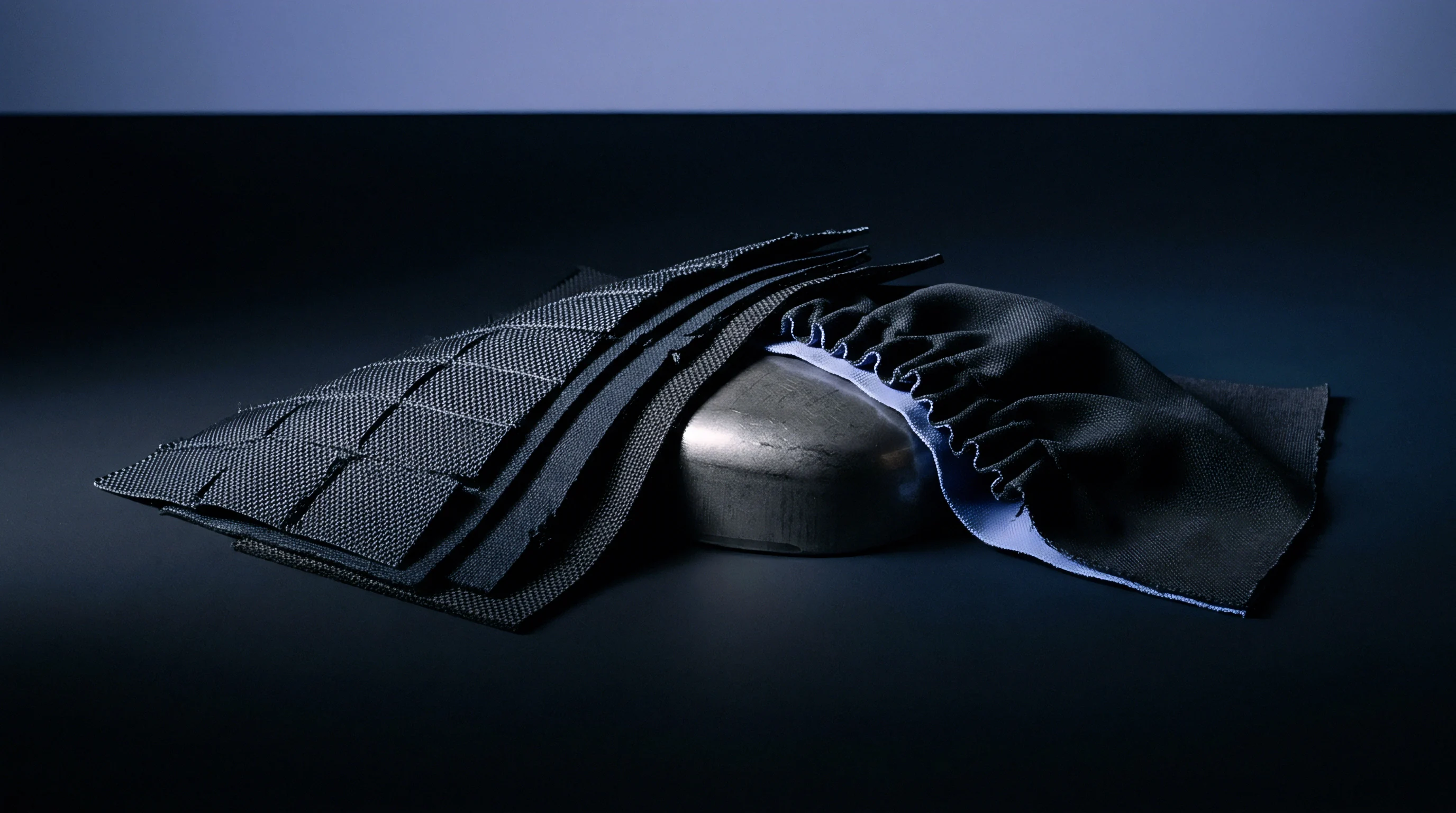
Swatch
Obtaining reliable screening data requires disciplined physical sampling and extraction procedures at the factory floor and laboratory bench. Sampling personnel cut fabric swatches from multiple locations across a production roll, avoiding selvage edges where tension and chemical coating pick-up vary. The operator slices the sample into 2 mm by 2 mm squares using clean stainless-steel shears, ensuring a high surface area for solvent penetration while preventing localized frictional heating during reduction.
Solvent choice governs the extraction efficiency and matrix co-extraction balance. Direct Soxhlet extraction using dichloromethane or tetrahydrofuran aggressively dissolves both the target monomeric plasticizers and the underlying polymer matrix. A targeted ultrasonic solvent extraction using a mixture of cyclohexane and propan-2-ol at 60°C for 60 minutes selectively dissolves low-molecular-weight phthalates while leaving high-molecular-weight polymeric adipates and polyurethanes largely intact within the textile matrix.
Under ISO 14362 and CPSC testing guidelines, sample extraction temperatures exceeding 80°C accelerate the leaching of polymeric plasticizer oligomers into the extraction solvent.
- Sample cutting protocol requires slicing coated textiles into 2 mm squares using clean stainless tools without mechanical grinding to prevent frictional thermal degradation.
- Selective solvent extraction utilizes a 1:1 mixture of cyclohexane and propan-2-ol at 60°C to extract target monomers while minimizing high-molecular-weight polymer dissolution.
- Extract filtration step passes the liquid extract through a 0.22-micrometer PTFE membrane filter to remove suspended polymeric microparticles prior to chromatographic injection.
- Extract concentration control uses a gentle stream of nitrogen gas at 40°C, preventing thermal evaporation losses of volatile target phthalates like DIBP and DBP.
Laboratory technicians must verify extract purity using blank spikes and matrix spikes for every batch of twenty samples. Injecting a matrix spike containing known concentrations of DEHP alongside an unspiked polymeric-coated extract reveals matrix enhancement or suppression factors. If the recovery of the matrix spike falls outside the 80 to 120 percent range, the analytical method requires immediate recalibration or additional gel permeation chromatography clean-up steps.
Whether standardized automated thermal desorption screening can completely replace liquid solvent extraction for heavily plasticized synthetic leather without triggering false positive alerts remains an unresolved question across commercial test houses.

Scope
Regulatory frameworks globally restrict specific low-molecular-weight phthalates while permitting or favoring polymeric plasticizers as safer alternatives. Annex XVII Entry 51 and Entry 52 of the European Union REACH Regulation (EC 1907/2006) limit the sum of DEHP, DBP, BBP, DIBP, DINP, DIDP, and DNOP to less than 0.1 percent by weight (1,000 mg/kg) in plasticized materials of toys, childcare articles, and general consumer goods. Similarly, the United States Consumer Product Safety Improvement Act (CPSIA) under 16 CFR Part 1307 permanently prohibits eight specific phthalates at concentrations above 0.1 percent in children’s toys and child care articles.
Voluntary certification standards establish parallel and often stricter threshold limits across broader product classifications. OEKO-TEX Standard 100 Annex 4 and Annex 6 mandate an aggregate ceiling of 0.1 percent for all listed ortho-phthalates, while simultaneously extending prohibitions to alternative monomeric plasticizers such as di-isobutyl phthalate and di-n-hexyl phthalate. The Global Organic Textile Standard (GOTS) Version 7.0 completely bans all synthetic plasticizers in organic textile processing, prohibiting both monomeric phthalates and polymeric polyesters in screen prints, laminates, and functional coatings.
| Standard / Regulation | Scope / Article Coverage | Restricted Substance List | Aggregate Concentration Limit | Status of Polymeric Plasticizers |
|---|---|---|---|---|
| REACH Annex XVII Entry 51/52 | All plasticized consumer articles | DEHP, DBP, BBP, DIBP, DINP, DIDP, DNOP | 0.1% w/w (1,000 mg/kg) aggregate | Exempt (Non-restricted polymer class) |
| CPSIA 16 CFR Part 1307 | Children’s toys and childcare items | DEHP, DBP, BBP, DINP, DIBP, DPENP, DHEXP, DCHP | 0.1% w/w (1,000 mg/kg) per phthalate | Exempt if molecular weight exceeds 1,000 Da |
| OEKO-TEX Standard 100 (Class I) | Baby articles and textiles in direct skin contact | All ortho-phthalates plus selected esters | 0.1% w/w (1,000 mg/kg) aggregate | Permitted if free from monomeric impurities |
| GOTS Version 7.0 | Certified organic textile products | All synthetic plasticizers and phthalates | Detection limit (100 mg/kg) | Prohibited in chemical inputs and inks |
Compliance evaluation hinges on demonstrating that a material containing polymeric plasticizers does not contain residual monomeric contaminants exceeding the 1,000 mg/kg legal threshold. A certificate of compliance citing total phthalate content via high-temperature screening without clean-up fails to prove compliance if thermal degradation generated the reported phthalate signal.
REACH Annex XVII Entry 51 enforces a strictly binding 0.1 percent aggregate limit on restricted ortho-phthalates in plasticized textile coatings.
Under REACH Annex XVII rules, a scope certificate covering a polymeric plasticizer additive guarantees product safety only when accompanied by raw material transaction certificates confirming that residual monomeric phthalates fall below detection limits prior to compound compounding.

Settlement
False positive matrix interferences create commercial liability across cross-border textile supply chains. When a customs authority or brand auditor screens a shipment of polyurethane-coated apparel using thermal desorption GC-MS and registers an erroneous m/z 149 signal, the container faces immediate detention at the border. Retesting, demurrage fees, port storage charges, and delayed delivery penalties quickly accumulate, often exceeding the total margin of the fabric order.
Assigning financial responsibility for these costs depends on the precision of the chemical specification clauses in purchase agreements.
Purchase orders must specify both the regulatory limit and the exact test method required for lot release. Relying on generic statements such as product must comply with REACH Annex XVII creates contractual ambiguity when testing laboratories employ differing analytical configurations. Brands and converters protect their commercial exposure by inserting explicit analytical dispute resolution clauses into chemical specification agreements.
A structured commercial verification workflow prevents false positive detentions before goods exit the finishing mill. When an initial rapid screening method indicates a phthalate concentration exceeding 500 mg/kg in a polymeric-coated textile, the mill protocol triggers an automatic confirmatory re-test using liquid extraction combined with gel permeation chromatography clean-up and GC-MS/MS quantification. The secondary test report overrides the preliminary thermal screening result, establishing definitive lot conformity.
Contractual risk allocation requires chemical suppliers to indemnify converters against false positive testing failures caused by unannounced reformulations or unreacted monomer impurities in polymeric plasticizer batches. When a brand audit identifies a non-compliant fabric batch, the chemical supplier carries financial liability for the re-test costs, fabric replacement, and associated shipping delays, provided the converter maintained verified lot traceability logs and validated sample swatches from the affected production run.
Establishing clear batch-level document chains connecting raw material safety data sheets, accredited laboratory test reports, and transaction certificates ensures that synthetic leather and coated textile shipments clear customs surveillance without incurring detention costs or commercial default claims.