Post-Consumer Textile Waste Feedstock Sorting and Contamination Limits
Automated post-consumer textile sorting requires sub-one-percent elastane limits and strict halogen screening to prevent chemical recycling batch rejection.


Bale
Incoming post-consumer textiles arrive at sorting facilities as compressed blocks weighing between four hundred and five hundred kilograms, bound by galvanized steel wire. Processors evaluate these lots against strict purity baselines determined by the intended recycling pathway. Mechanical shredders tolerate minor blend variations, yet chemical recyclers demand narrow feed compositions to prevent catalyst poisoning, filter blinding, and batch degradation during thermal or solvent dissolution.

Feedstock Purity Benchmarks by Recycling Technology
Dissolution pulping installations targeting circular cellulosic fibers establish a ninety-five percent pure cotton threshold by net dry mass. Non-target synthetics degrade process liquor, leaving unreacted particulate matter in the viscose or lyocell spinning dopes. Polyester depolymerization plants running glycolysis or methanolysis operate under different chemical limitations, rejecting lots containing more than two percent foreign polymers.
Polyamide 6 depolymerization facilities enforce even tighter input controls, setting ninety-eight percent nylon purity limits to protect caprolactam recovery yields.
Moisture content compounds these analytical balances. Garments collected from outdoor municipal collection bins retain ambient humidity, condensation, and rain infiltration. Incoming moisture levels above twelve percent distort weighbridge receipts, accelerate microbial cellulose degradation, and generate acidic vapors inside high-heat extrusion machinery.
Sorters test moisture gravimetrically with calibrated halogen drying analyzers across five randomized core penetrations before breaking binder wires.
Feedstock destined for chemical polyester depolymerization triggers reactor shutdown when polyvinyl chloride content exceeds fifty parts per million at operating temperatures above two hundred degrees Celsius.

Tolerance Thresholds for Common Fiber Blends
Polyurethane elastane presents the most severe barrier to scaled textile fiber regeneration. Modern stretch denim, circular knits, and activewear contain elastane concentrations ranging from one percent to twenty-two percent. In mechanical garnet machines, elastomeric filaments melt under friction, adhering to carding wires and generating fiber neps.
In chemical dissolution reactors, elastane decomposes into diamines and cyclic polyols, discolouring the recovered polymer solution and clogging spinneret pack filters. The commercial dissolution standard caps elastane at zero point five percent by mass.
Cellulose dissolves under precise conditions. Sourcing specifications published by cellulosic chemical pulp mills indicate zero point five percent elastane as the maximum upper boundary. This limit rests on commercial dissolution trials using fifty-kilogram validation charges; higher elastane fractions block capillary orifices during wet spinning unless the pre-treatment sequence incorporates an aggressive solvent wash to strip urethane bonds, which would raise the working limit to one point five percent if solvent recovery costs fall.
Sorters separate pure monomaterial knits from blended elastane yarns using automated short-wave infrared detection, ejecting mixed articles into downgrade chutes.
| Recycling Route | Target Polymer Minimum (wt %) | Elastane Upper Limit (wt %) | Polyolefin Ceiling (wt %) | Moisture Limit (wt %) | Hardware Allowance (wt %) |
|---|---|---|---|---|---|
| Mechanical Tearing | 80.0 | 3.0 | 5.0 | 12.0 | 0.5 |
| Cellulose Dissolution | 95.0 | 0.5 | 0.5 | 8.0 | 0.0 |
| Polyester Glycolysis | 90.0 | 1.0 | 1.0 | 5.0 | 0.0 |
| Polyester Methanolysis | 85.0 | 2.0 | 2.0 | 5.0 | 0.1 |
| Nylon Depolymerization | 98.0 | 0.2 | 0.5 | 6.0 | 0.0 |
| Data compiled across commercial intake specifications for European and North American industrial recyclers. Quantities measured by dry mass fraction. | |||||
Animal fibers, silicone finishes, and acrylic coatings introduce secondary process hazards. Keratin proteins in wool release volatile sulfur compounds when exposed to polyester glycolysis temperatures above two hundred forty degrees Celsius, corroding stainless steel reactor linings. Acrylic fibers cross-link under dry heat, forming hard black specks in remelted thermoplastic pellets.
Standard supply contracts under the circular raw material trade framework specify explicit deductions when non-target fiber fractions exceed two percent of billed lot mass.
Supply agreements incorporate European Standard EN 15347 Clause 4.2 to govern contamination allowances, shifting freight liabilities and testing expenses to the seller when delivered non-target polymer mass fractions exceed contracted inspection bands.


Trim
Zippers, sliders, snaps, shank buttons, rivets, and metallic eyelets represent dense physical obstructions. Garment tear-down operators cut away non-textile components before feeding shredded materials into high-velocity rotary cutters. Rotary knives dull rapidly against brass teeth, and unseparated iron studs chip tungsten-carbide granulator blades, introducing metal shards into downstream fiber matrices.
Hardware Removal and Mechanical Disassembly
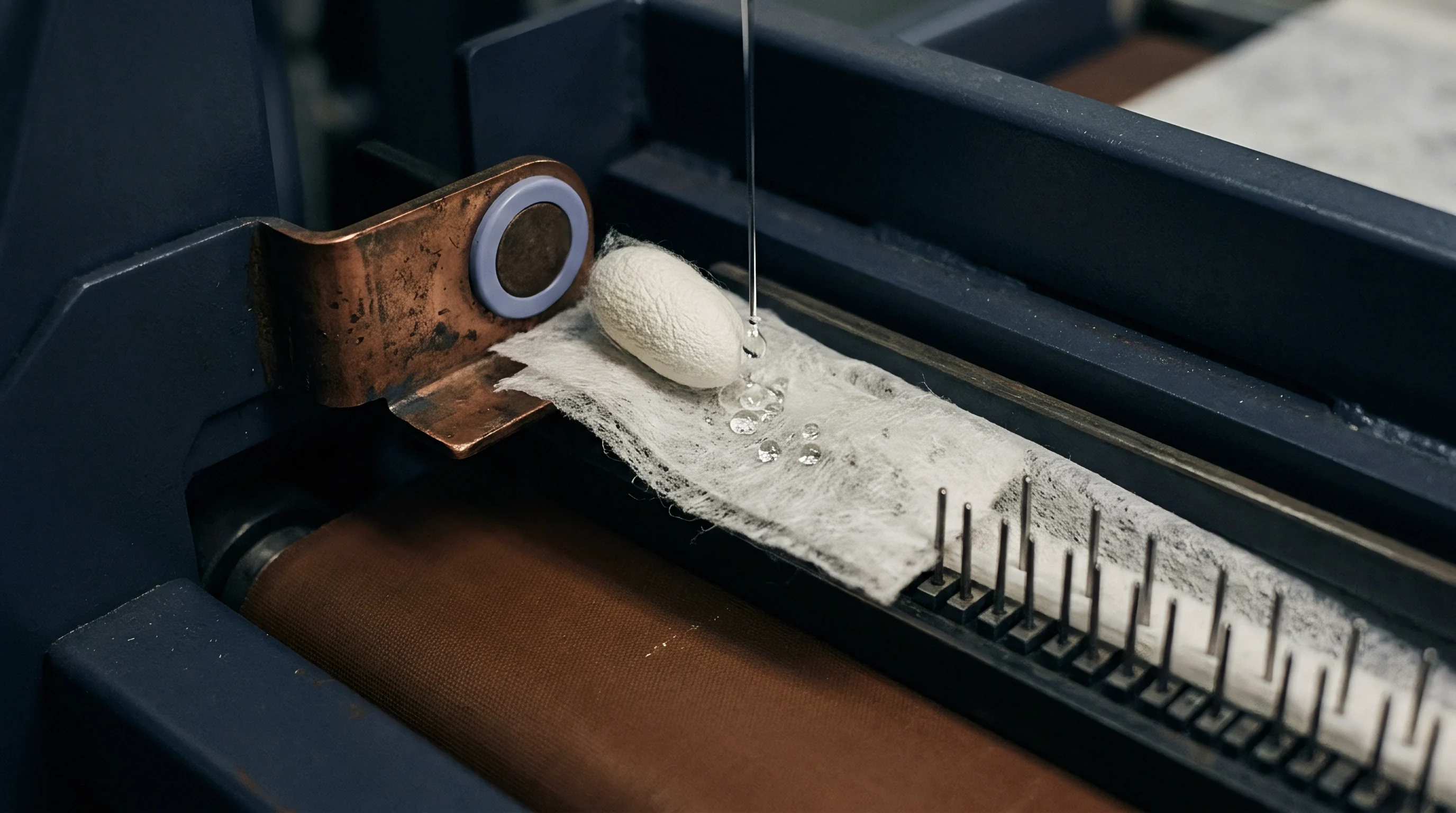
Automated de-trimming operations employ circular saws, ultrasonic slitters, and mechanical tearing arms to shear waistbands, pocket bags, and plackets. A standard pair of five-pocket denim jeans carries forty to sixty grams of metal hardware, heavy polyester core-spun sewing yarns, and leather or polyurethane back patches. Leaving the waistband intact introduces three discrete contaminants: the metal button, the electroplated zinc rivets, and the heavy interlining stiffener.
Metal fragments destroy cutting blades. Industrial sorting operations run shredded streams across high-gradient neodymium magnetic cross-belt separators, extracting ferrous particles down to zero point five millimeters. Non-ferrous metallic debris, such as cast zinc sliders and aluminum zipper stops, passes through magnetic zones unaffected.
Facilities deploy inductive eddy-current separators and high-frequency sensor-based air rejectors to isolate these non-magnetic metallic items from the falling flake stream.
Under standard secondary raw material specifications, unseparated copper zippers or zinc sliders shift whole shipping units from premium shredding stock into municipal solid waste classifications.

Elastomeric Components and Interlining Separation
Undergarments, activewear bands, and tailored suiting jackets present internal assemblies that resist surface-level visual identification. Fusible interlinings utilize low-melt polyamide, high-density polyethylene, or ethylene-vinyl acetate adhesives coated onto woven or non-woven backings. These thermal adhesive resins fail to dissolve in standard alcohol depolymerization mediums, creating gel particles that block extrusion melt filters during synthetic fiber spinning.
- Fusible adhesive resins foul extrusion screens and lower recycled thermoplastic melt flow rates.
- High-stretch silicone grippers deposit elastomeric debris into recovered pulp tanks, creating optical defects in thin regenerated cellulose films.
- Metallic lurex threads introduce aluminum foils and polyester laminate films into monomaterial batches, driving up furnace slag formation.
- Thermoplastic polyurethane seam tapes generate localized acetic acid release during thermal recovery, accelerating hydrolytic polymer chain cleavage.
Manual pickers miss clear threads. Sorters inspect sheared edges using ultraviolet inspection lamps to identify residual hot-melt adhesives, which fluoresce under three hundred sixty-five nanometer wavelengths. Passing contaminated trims through mechanical decorticators damages downstream spinning rotors and leads to immediate container detention at the spinning mill gate.


Sensor
Optical systems determine automated sorting throughput. Modern industrial conveyor lines transport individual garments at velocities up to three meters per second beneath high-speed analytical sensor arrays. The primary instrument array pairs near-infrared spectroscopy with short-wave infrared line-scan cameras, measuring diffuse reflectance spectra between nine hundred and seventeen hundred nanometers to classify base fiber chemistry within ten milliseconds per item.

Spectroscopic Identification across Automated Conveyor Belts
Near-infrared reflection signatures depend on characteristic overtone and combination vibrational bands of chemical bonds, such as carbon-hydrogen, oxygen-hydrogen, and nitrogen-hydrogen. Cotton exhibits distinct cellulose absorption peaks at fourteen hundred ninety nanometers and nineteen hundred forty nanometers, while polyethylene terephthalate displays signature polyester aromatic carbon-hydrogen overtones at sixteen hundred sixty nanometers. When a garment passes beneath the illumination lamp, reflected photons enter the spectrometer via an optical fiber bundle, and an InGaAs linear photodiode array resolves the spectral curve.
Sorting speed determines unit cost. Once the classification software matches the observed curve against a reference library of pure polymer standards, it transmits positional coordinates to an air-ejection manifold. Downstream pneumatic valves fire micro-pulses of compressed air at six bar, deflecting the identified garment from the main conveyor trajectory into its target sorting bin.
Garments containing dark dyes present a major classification barrier. Carbon black pigment absorbs near-infrared radiation across the entire working spectrum, extinguishing reflected signals and leaving the detector with insufficient photon counts to resolve absorption bands.

Can Hyperspectral Imaging Detect Buried Elastane Filaments?
Hyperspectral line-scan cameras register spatial and spectral data simultaneously across hundreds of contiguous narrow wavelength channels. Core-spun yarns shield internal elastane strands inside an exterior sheath of combed cotton or wool fibers. Short-wave infrared light penetrates textile structures to depths of two hundred to five hundred micrometers, depending on yarn density, twist multiplier, and fabric aerial weight.
When surface fiber packing exceeds zero point six grams per cubic centimeter, outer cellulose chains attenuate incoming photons, preventing radiant energy from reaching the elastomeric core.
- Primary conveyor singularization spaces mixed garments across a high-friction metering belt to prevent item overlap beneath optical inspection heads.
- Broadband quartz-tungsten halogen illumination exposes the moving textile surface to uniform infrared radiation without causing localized thermal scorch marks.
- Spectral data acquisition records five hundred spatial pixels across two hundred twenty-four spectral bands at frame rates exceeding three hundred hertz.
- Algorithmic match processing cross-references the spectral signature against chemometric partial least squares regression models to calculate blend ratios.
- Targeted pneumatic ejection triggers high-speed solenoid valves to launch the classified item over a split-stream separator baffle into the receiving hopper.
Coatings skew near-infrared reflectance. Sorters handle black garments by routing them through mid-infrared or Raman spectroscopic inspection loops, though slower acquisition speeds limit conveyor throughput to one meter per second. Plant managers frequently assert that incoming optical sorters deliver ninety-five percent pure fractions regardless of coloration, though their operators acknowledge off the record that black stretch garments consistently bypass pneumatic rejection nozzles due to weak signal reflection.

Residue
Chemicals applied during textile manufacture, garment wet processing, and consumer laundering linger within post-consumer textile matrices. Recyclers face legal compliance limits established by the European REACH Regulation Annex XVII, the POPs Regulation, and brand-level restricted substance lists. Heavy metal dyestuffs, brominated flame retardants, per- and polyfluoroalkyl substances, and alkylphenol ethoxylates do not volatilize during ambient mechanical sorting, persisting through mechanical tearing and concentrating within chemical recycling process liquors.

Restricted Substances Inherited from Consumer Use
Garments manufactured prior to international phase-outs carry legacy chemical burdens. Waterproof outerwear produced before 2020 contains long-chain perfluorooctanoic acid and related fluorotelomer alcohols applied as durable water repellent finishes. Under Commission Regulation EU 2020/784 amending the POPs Regulation, textile raw materials entering the European Union must not contain perfluorooctanoic acid or its salts at concentrations exceeding twenty-five parts per billion, or perfluorooctanoic acid-related compounds exceeding one thousand parts per billion.
Extractable metals concentrate during digestion. Acid dyes and metal-complex dyes applied to wool and nylon incorporate trivalent chromium, cobalt, and copper to achieve lightfastness. When processors digest these fibers in chemical recycling liquors, metal ions leach into the acid or alkaline solutions.
In polyester glycolysis, antimony trioxide residues, present at two hundred to three hundred parts per million as an original polycondensation catalyst, dissolve directly into bis-hydroxyethyl terephthalate intermediates, deactivating transesterification catalysts during repolymerization.
Post-consumer cotton dyed before historic biocide prohibitions carries chemical liability that wet washing cannot extract.

Persistent Chemistry and Regulatory Interception Points
Sorting plants screen post-consumer synthetic garments for total organic fluorine using combustion ion chromatography under test standard EN 14582. A total fluorine reading exceeding fifty parts per million indicates fluorinated durable water repellent chemistry, prompting the immediate diversion of the lot away from circular apparel recycling into non-woven insulation or sound-dampening panels. This fifty parts per million total fluorine screening threshold rests on test runs across twenty-gram composite samples; if regulatory authorities enforce targeted liquid chromatography tandem mass spectrometry screening down to twenty-five parts per billion for all individual per- and polyfluoroalkyl substances under universal restriction proposals, composite combustion testing becomes inadequate.
Similar restrictions govern chlorinated flame retardants, polybrominated diphenyl ethers, and short-chain chlorinated paraffins in post-consumer workwear, bedding, and drapery. The physical accumulation of persistent halogenated additives across textile sorting lines mirrors historical difficulties in the automotive shredder residue sector, where recycling operators faced unexpected regulatory interdictions when scrap smelting streams accumulated high concentrations of polychlorinated biphenyls and polybrominated diphenyl ethers from vintage seating foam. Textile chemical recycling reactors experience identical catalytic poisoning when chlorinated polymers enter high-temperature zones.
| Substance Group | Regulatory Reference | Test Method | Action Limit | Recycling Risk |
|---|---|---|---|---|
| Perfluorooctanoic Acid (PFOA) | Regulation EU 2019/1021 | CEN/TS 15968 / LC-MS | 25 ppb | Product market withdrawal |
| Total Organic Fluorine (Screen) | Brand RSL Baseline | EN 14582 (Combustion IC) | 50 ppm | Fluorochemical persistence |
| Polyvinyl Chloride (PVC) | Chemical Recycler Spec | FTIR / Beilstein Probe | 50 ppm | Hydrochloric acid corrosion |
| Polybrominated Diphenyl Ethers | REACH Annex XVII | EN ISO 17881-1 (GC-MS) | 10 ppm | Toxic dioxin formation |
| Extractable Hexavalent Chromium | REACH Annex XVII | EN ISO 17075-1 | 1 ppm | Effluent discharge violation |
| Alkylphenol Ethoxylates | REACH Annex XVII | EN ISO 18254-1 | 100 ppm | Surfactant foaming in pulp |
Chlorinated polymers poison catalytic converters. A single polyvinyl chloride raincoat or high-build plastisol screen print provides enough organochlorine mass to contaminate five metric tons of polyester feedstock. At glycolysis processing temperatures exceeding two hundred degrees Celsius, polyvinyl chloride undergoes thermal dehydrochlorination, releasing gaseous hydrochloric acid.
This acidic byproduct drops reaction pH, corrodes titanium autoclave linings, and causes uncontrolled side reactions that convert ethylene glycol into diethylene glycol, lowering the melting point and tensile strength of the resulting recycled polyester chips.
Regulatory authorities continually revise acceptable contamination floors for legacy articles, leaving sorting operators to determine whether mixed post-consumer blends can ever reliably clear evolving border-level restricted substance surveillance.


Assay
Verification of compressed textile waste requires statistically sound sampling plans. Heterogeneity inside post-consumer lots exceeds that of virgin fiber bales or uniform pre-consumer industrial fabric cut-waste. Garments from different eras, yarn constructions, color treatments, and geographical origins distribute unevenly throughout a single pallet, preventing simple surface visual examinations from delivering representative compositional data.

Core Sampling Protocols for Dense Garment Bundles
Auditors apply ISO 2859-1 acceptance sampling principles to incoming shipments, establishing an Acceptable Quality Limit of one point zero for foreign polymer contamination. Technicians deploy pneumatic coring augers, fitted with hardened stainless steel cutting teeth, to drill deep cores from eight randomized locations per four-hundred-kilogram bale. The coring tool extracts continuous plug cylinders measuring fifty millimeters in diameter from the outside surface to the geometrical center of the compressed block.
Core samples expose internal variance. Operators combine the extracted core plugs into a primary composite sample weighing not less than five kilograms. Technicians run this bulk composite through a secondary lab-scale rotary granulator equipped with a six-millimeter perforated discharge screen, reducing the heterogenous garments into a uniform flock.
The granulator blades cut through heavy denims, knits, interlinings, and sewing threads, yielding a homogenous fiber mixture ready for analytical sample splitting using a rotary riffler.
Bale core core-drilling uncovers foreign polyolefin linings that exterior surface optical sweeps miss entirely.

Laboratory Extraction and Quantitative Fiber Analysis
Laboratories analyze the prepared flock using chemical dissolution methods defined in the ISO 1833 standards series. Technicians dry three sub-samples weighing two grams each inside a conditioning oven at one hundred five degrees Celsius until reaching constant mass. Sorters determine fiber fractions through selective chemical dissolution, sequentially removing specific polymer classes while filtering and weighing insoluble residues.
- Acetone dissolution under ISO 1833-3 separates secondary acetate fibers from cotton, wool, and synthetic polymers at room temperature within thirty minutes.
- Seventy-five percent sulfuric acid dissolution under ISO 1833-11 eliminates cellulosic fibers from polyester, polyamide, and acrylic matrices over twelve hours of constant agitation.
- Hot formic acid dissolution under ISO 1833-7 dissolves Polyamide 6 and Polyamide 6-6 fibers from polyester, acrylic, and polyolefin matrices at ninety degrees Celsius.
- Dimethylformamide dissolution under ISO 1833-12 isolates elastane and modacrylic fractions at ninety-five degrees Celsius without attacking surrounding cotton backbones.
Equipment suppliers claim automated near-infrared sorting systems eliminate commercial risk by operating at eighty-five percent blend separation efficiency. This desk cannot fully defend that eighty-five percent metric across varied post-consumer garment densities and layered linings; a buyer hedges that uncertainty by writing a mandatory ten-bale manual tear-down audit into the supply contract rather than trusting optical conveyor telemetry. Manual pickers cross-verify flock assays against physical tear-down audits to validate baseline composition.
A composite sample derived from less than five independent core penetrations fails to reflect internal bale contamination.


Settlement
Commercial transactions for post-consumer textile raw materials resolve on net dry mass adjusted for measured contamination fractions. Standard raw material procurement contracts specify penalty deduction grids tied to analytical assay findings. Buyers deduct costs directly from supplier invoices when foreign polymers, moisture, or non-textile hardware exceed agreed contract tolerances, adjusting payments to protect processing margins.

Financial Deductions and Rejection Gateways
When an analytical report reveals a non-target fiber concentration above the specification limit, deduction schedules trigger automatically. For chemical recycling feedstock, contamination margins translate directly into chemical yield losses, increased catalyst consumption, and elevated hazardous waste disposal costs. In mechanical recycling, non-target synthetic fibers reduce yarn tenacity and cause uneven dye uptake in secondary spinning operations.
Moisture adds unbilled dead weight. Contract terms dictate that if delivered moisture levels register at twelve percent against an eight percent baseline specification, the billing weight automatically drops by four percent across the entire invoice line. If non-textile hardware fractions exceed zero point five percent by mass, the buyer applies a processing surcharge of forty-five dollars per metric ton to cover manual waistband sorting and magnetic separator maintenance.
Polyvinyl chloride contamination exceeding fifty parts per million triggers an outright rejection gateway, requiring the seller to remove the entire lot from the receiving dock within forty-eight hours at their own expense.
| Contaminant Class | Contract Tolerance | Secondary Band (Penalty) | Rejection Gateway | Financial Consequence |
|---|---|---|---|---|
| Elastane Content | < 0.5 wt % | 0.5 wt % to 1.5 wt % | > 1.5 wt % | $80 per ton penalty or total rejection |
| Non-Target Polymers | < 2.0 wt % | 2.0 wt % to 5.0 wt % | > 5.0 wt % | Pro-rata net weight mass reduction |
| Moisture Content | < 8.0 wt % | 8.0 wt % to 12.0 wt % | > 12.0 wt % | Invoice dry-weight adjustment deduction |
| Non-Textile Hardware | < 0.1 wt % | 0.1 wt % to 0.5 wt % | > 0.5 wt % | $45 per ton manual separation surcharge |
| Polyvinyl Chloride | < 50 ppm | Not applicable | > 50 ppm | Immediate rejection and dock return |
| Total Fluorine | < 50 ppm | 50 ppm to 100 ppm | > 100 ppm | Downgrade to thermal recovery class |
Discounts accrue per percentage point. Sorters and buyers arbitrate disputed testing results by commissioning a split-sample assay from an accredited third-party laboratory operating under ISO/IEC 17025 certification. The costs of this third-party retest fall entirely on the party whose internal laboratory measurement diverged furthest from the third-party finding.

Contract Specifications for Secondary Raw Material Deliveries
Procurement documents incorporate delivery conditions explicitly detailing physical bale integrity, maximum allowable wire gauge, core sampling access, and chemical documentation. The purchase order functions as an assurance instrument, tying payment disbursements to the provision of an accredited laboratory test dossier covering quantitative fiber composition, total fluorine, and heavy metal concentrations.
Buyers structure purchase orders with clear non-conformity provisions that define title transfer conditions, demurrage liabilities, and alternative disposal protocols. When a delivery fails chemical intake criteria, the buyer holds the shipment in quarantine, shifts storage and handling fees to the supplier ledger, and cancels open letters of credit tied to the non-conforming batch.