Verifying Transaction Certificates against Bulk Fabric Shipments in Global Ports
Verify transaction certificates against bulk broadcloth shipments by checking live digital registries, mass loss ratios, container seals, and roll tags.


Cargo
Cross-border customs release hinges on the alignment between commercial bills of lading, customs declarations, and transaction certificates issued by accredited certification bodies. When a container arrives at a destination terminal, port authorities and import compliance teams examine transaction certificates to confirm that the chain of custody for certified materials remains unbroken. Discrepancies between declared gross container weight and the net certified weight recorded on the transaction document immediately trigger documentary holds.
A transaction certificate documents the specific movement of goods from a certified seller to a certified buyer, specifying standard classifications, certified component percentages, commercial invoice numbers, and physical roll counts.
Auditors cross-reference the certified seller named in Box 1 of standard transaction templates against the actual entity issuing the commercial invoice. A mismatch indicates an intermediary trader without valid chain of custody certification, which invalidates the certificate for customs duty preference or brand sustainability claims. Box 10 of a Global Organic Textile Standard or Textile Exchange transaction certificate records the declared net weight alongside the commercial product description.
Inspectors at clearing terminals measure the landed net weight against this figure, allowing standard moisture regain variations established by international commercial tolerances.
A net weight variation exceeding two percent between the packing list and the transaction certificate triggers mandatory container detention at European Union entry terminals.
The table below summarizes primary document fields reviewed during customs qualification, detailing the specific reconciliation points and standard discrepancy allowances observed across global container clearance hubs.
| Document Field | Primary Reference Document | Reconciliation Target | Allowable Clearance Tolerance |
|---|---|---|---|
| Certified Net Mass | Transaction Certificate Box 10 | Bill of Lading and Packing List | Plus or minus one percent commercial mass |
| Raw Material Composition | Scope Certificate Annex 2 | Laboratory Fiber Composition Report | Zero variance on certified fiber type |
| Consignee Identity | Commercial Invoice Box 2 | Import Declaration Importer of Record | Identical corporate legal entity |
| Transport Document Number | Sea Waybill or House Ocean Bill | Transaction Certificate Box 8 Transport | Exact alpha-numeric matching string |
Discrepancies frequently emerge in the transport reference fields. If a freight forwarder issues a revised house bill of lading after vessel transshipment, the transaction certificate generated at the port of origin retains the original booking reference. Clearing agents resolve this by presenting the unbroken forwarder manifest chain linking the booking reference to the final arrival container seal.
Without this documentation, import authorities classify the consignment as conventional non-certified stock.
The clearing agent presents an explanation that the documentation reflects a split container booking handled through an intermediate consolidator.
Mass
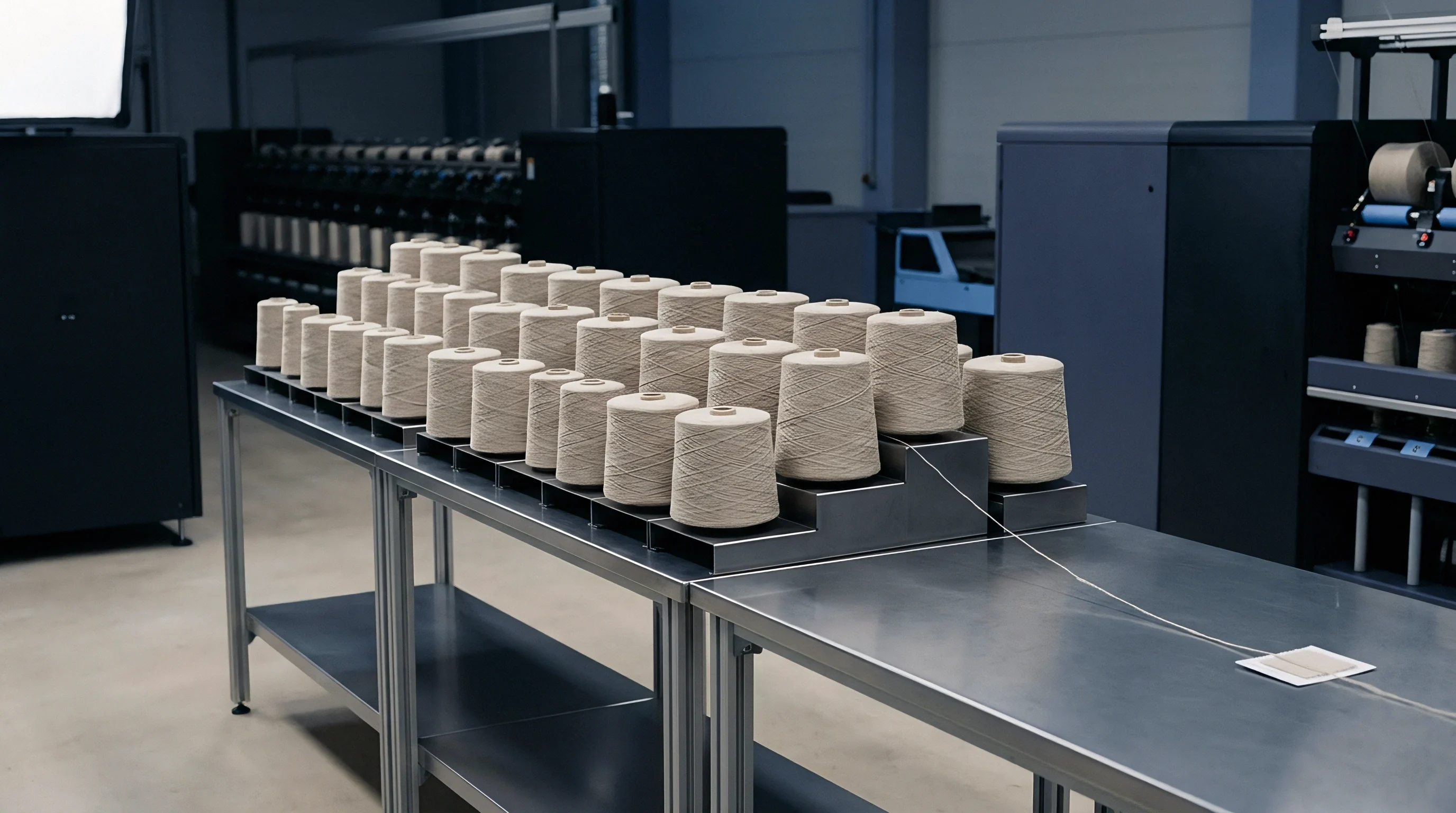
Chain-of-custody verification requires strict mass balance auditing across every mechanical conversion step. Certified fibers lose volume during spinning, weaving, scouring, bleaching, and finishing. Verification officers evaluate input-to-output ratios against recognized yield loss factors to determine if the volume of finished piece goods corresponds to the volume of raw certified stock listed on upstream transaction certificates.
A standard cotton carding and combing line generates waste rates between twelve and eighteen percent. If a mill claims a ninety-eight percent conversion efficiency from raw organic lint to finished ring-spun yarn, the transaction certificate reflects an unverified physical volume.
Wet processing introduces further mass variance through desizing, scouring, chemical additions, and moisture adjustments. Finishing mills apply sizing agents, functional finishes, or synthetic resins that artificially inflate finished broadcloth weight. Auditors calculate clean dry weight by removing chemical add-ons and standardizing moisture regain values according to ISO 1833 test standards.
When verifying synthetic recycled polyester yardage, processing losses in bottle flake extrusion and filament drawing run between three and five percent.
- Raw Fiber Intake Volume dictates the theoretical ceiling for finished yardage output after accounting for opening line short fiber drop.
- Spinning Loss Ratios establish true yarn delivery volumes based on ring versus open-end mechanical processing constraints.
- Greige Weaving Efficiencies determine total substrate square meters generated per metric ton of certified yarn lot.
- Finishing Chemical Extractables alter final linear mass calculations during standard solvent wash verification testing.
The mathematical proof of lot integrity appears below. Consider a finished shipment of 10,000 kilograms of certified 100 percent organic cotton plain weave cloth at 150 grams per square meter. The calculation walks back through the production loss chain to determine the minimum required input volume on the preceding transaction certificate.
Assume a five percent wet finishing loss, a six percent weaving preparation and loom waste factor, and a fourteen percent combing and spinning waste factor. The intermediate yarn volume equals the finished piece weight divided by the finishing retention rate: 10,000 divided by 0.95 yields 10,526.3 kilograms of dyed yarn. Accounting for weaving losses, the greige yarn requirement equals 10,526.3 divided by 0.94, which yields 11,198.2 kilograms.
Incorporating the spinning waste factor, the raw fiber input on the origin transaction certificate equals 11,198.2 divided by 0.86, producing an absolute baseline of 13,021.2 kilograms of certified raw fiber.
A transaction certificate showing only 11,000 kilograms of raw lint input for that 10,000-kilogram finished consignment reveals an impossible conversion yield. Port authorities equipped with mass-balance auditing guidelines reject the volume claim based on this quantitative failure.
Standard mechanical conversion loss factors define the minimum certified input required to justify declared finished container weight.
Customs officers apply this mass audit systematically across multi-component blended piece goods where certified organic cotton combines with conventional elastane or recycled synthetic yarns.


Vault
Electronic verification systems maintain the authoritative record of authentic transaction certificates. Accredited certification bodies deposit validated certificates directly into centralized digital repositories such as the Textile Exchange Trackit platform or the GOTS Central Database. Port auditors bypass physical paper certificates to authenticate electronic records directly through secure server queries using the unique certificate licensing code.
Paper documents carry significant vulnerability to unauthorized text modifications, manipulated weight values, and forged signature stamps.

Are Digital Registries Sufficient for Border Verification?
Digital registries provide direct proof of certificate issuance, but they do not eliminate physical container substitution risks between port gates. A valid digital certificate confirms that a certified mill completed a transaction. It does not prove that the specific rolls packed into container MSKU8923411 correspond to the lot tested and entered into the database.
Border enforcement officers inspect the container bolt seals, matching the alphanumeric seal imprint against the physical bill of lading and the electronic shipping manifest.
- Cryptographic QR Links connect physical roll labels directly to central registry transaction records through tamper-evident barcodes.
- Accreditation Body Status Audits confirm that the issuing certification agency held an active ISO 17065 scope during the entire production run.
- Electronic Watermark Hash Checks identify local PDF file edits made to commercial descriptions or shipment kilogram weights.
- Transaction Serial Sequences follow strict registry numbering conventions preventing retroactively generated transaction records.
The table below presents the primary electronic authentication points across major textile certification programs, identifying specific registry tools and data integrity verification methods.
| Standard System | Central Registry Interface | Primary Data Key | Electronic Verification Method |
|---|---|---|---|
| Global Organic Textile Standard | GOTS Public Database | License Number and Lot Code | Direct API certificate authenticity query |
| Textile Exchange Standards | dTrackit Central System | TC Reference Number | Cryptographic hash and issuer digital signature |
| OEKO-TEX Standard 100 | OEKO-TEX Label Check | Certificate and Test Number | Online validity and product class matching |
| Global Recycled Standard | Accredited Body Portal | Facility ID and Batch Ref | Multi-tier transaction ledger reconciliation |
Registry systems expose expired or suspended suppliers. When a dyehouse loses certification mid-season due to chemical management infractions under ZDHC protocols, certification bodies revoke the facility scope certificate. Any transaction certificate generated with a transaction date following the suspension date appears as invalid in the registry system, even if the paper certificate appears genuine.
Importers relying on paper copies face immediate shipment seizure when electronic validation fails.
An administrative failure occurs when a buyer accepts paper scans without cross-referencing live central registry databases.

Dock
Terminal yard verification requires physical sampling directly from the shipping container. Port clearance protocols mandate physical swatch extraction from the center of selected rolls to verify material claims through analytical chemistry and mechanical testing. Inspectors cut samples fifty centimeters inward from the roll header to avoid contaminated or degraded exterior broadcloth.
The sampling frequency follows ISO 2859-1 single sampling plans at general inspection level II, establishing strict statistical confidence for large commercial shipments.
The inspection team examines roll packaging for tamper-evident seals and traceable lot tags. Each roll inside the container carries a label indicating the weaver mill, dye batch number, gross weight, net linear meters, and the certification identification number matching the transaction certificate. Missing or handwritten labels void lot traceability immediately.
Inspectors inspect roll cores for secondary labels or conflicting manufacturer markings that indicate re-rolled clearance goods.
Physical swatches cut from internal roll wraps provide the definitive laboratory material for chemical and genetic claim verification.
Laboratory testing verifies qualitative claims made on transaction certificates. For organic cotton claims, laboratories perform qualitative genetically modified organism screening via ISO IWA 32 real-time polymerase chain reaction testing to detect transgenic markers. For recycled polyester broadcloth, testing facilities utilize differential scanning calorimetry and trace element analysis to identify characteristic antimony catalysts and isophthalic acid ratios specific to recycled polyethylene terephthalate flakes.
Analytical results showing unauthorized pesticide residues or synthetic marker profiles invalidates the accompanying transaction certificate, resulting in border rejection.
- The inspection team breaks the customs container bolt seal and verifies the seal number against the ocean carrier manifest.
- Inspectors check the internal container environment for mold, water ingress, and unauthorized chemical fumigation residues.
- The team tallies total physical roll counts against the certified packing list and transaction certificate declarations.
- Officers select random rolls across top, middle, and bottom container tiers according to ISO 2859-1 sampling tables.
- Technicians extract core broadcloth swatches and seal them in tamper-evident sample bags for laboratory dispatch.
Testing delays at congested import terminals extend container dwell times significantly. Demurrage and port storage fees accrue rapidly while analytical laboratories complete sixteen-day PCR screenings or heavy metal extractions via inductively coupled plasma mass spectrometry. Importers minimize hold intervals by maintaining pre-cleared test reports from ISO 17025 accredited laboratories tied directly to the specific roll numbers documented on the arrival manifest.
Standard purchase agreements stipulate that the vendor assumes all testing fees, port storage surcharges, and return shipping costs in the event of laboratory failure.

Exposure
Commercial exposure arising from invalid or fraudulent transaction certificates extends beyond immediate cargo loss. Customs authorities enforce civil and criminal penalties for false import declarations under statutory frameworks including United States 19 U.S.C. Section 1592 and the European Union Union Customs Code. Penalties scale from domestic duty forfeiture to four times the commercial value of the consignment for gross negligence or intentional fraud.
When an importer declares goods as duty-exempt organic broadcloth using an unverified transaction certificate, customs agencies assess back duties, anti-dumping penalties, and compound interest across all historical shipments from that supplier over a five-year statutory audit window.
Retail brands face brand equity damage and legal action under consumer protection legislation when mislabeled broadcloth reaches store shelves. Environmental marketing claims require rigorous substantiation under the US Federal Trade Commission Green Guides and the EU Green Claims Directive. Retailers prosecuted for unverified organic or recycled claims pass financial liability back to the importing entity through contractual indemnification clauses.
Letter of credit terms represent a critical financial control point. Commercial banks reject supplier payment presentations containing discrepancy-laden transaction certificates or certificates showing dates after the ocean bill of lading. Smart procurement contracts tie final supplier payment disbursements to successful physical terminal sampling and electronic registry validation rather than initial document presentation.
Contractual protection requires explicit warranty language within raw material supply agreements. Sourcing contracts define supplier obligations regarding chain of custody continuity, mass balance audits, and regulatory penalty reimbursement. The commercial clause fixes financial exposure onto the primary manufacturer when documentation fails port verification checks.
How the industry handles mass balance reconciliation across chemically recycled synthetics where physical markers disappear remains an unresolved challenge.