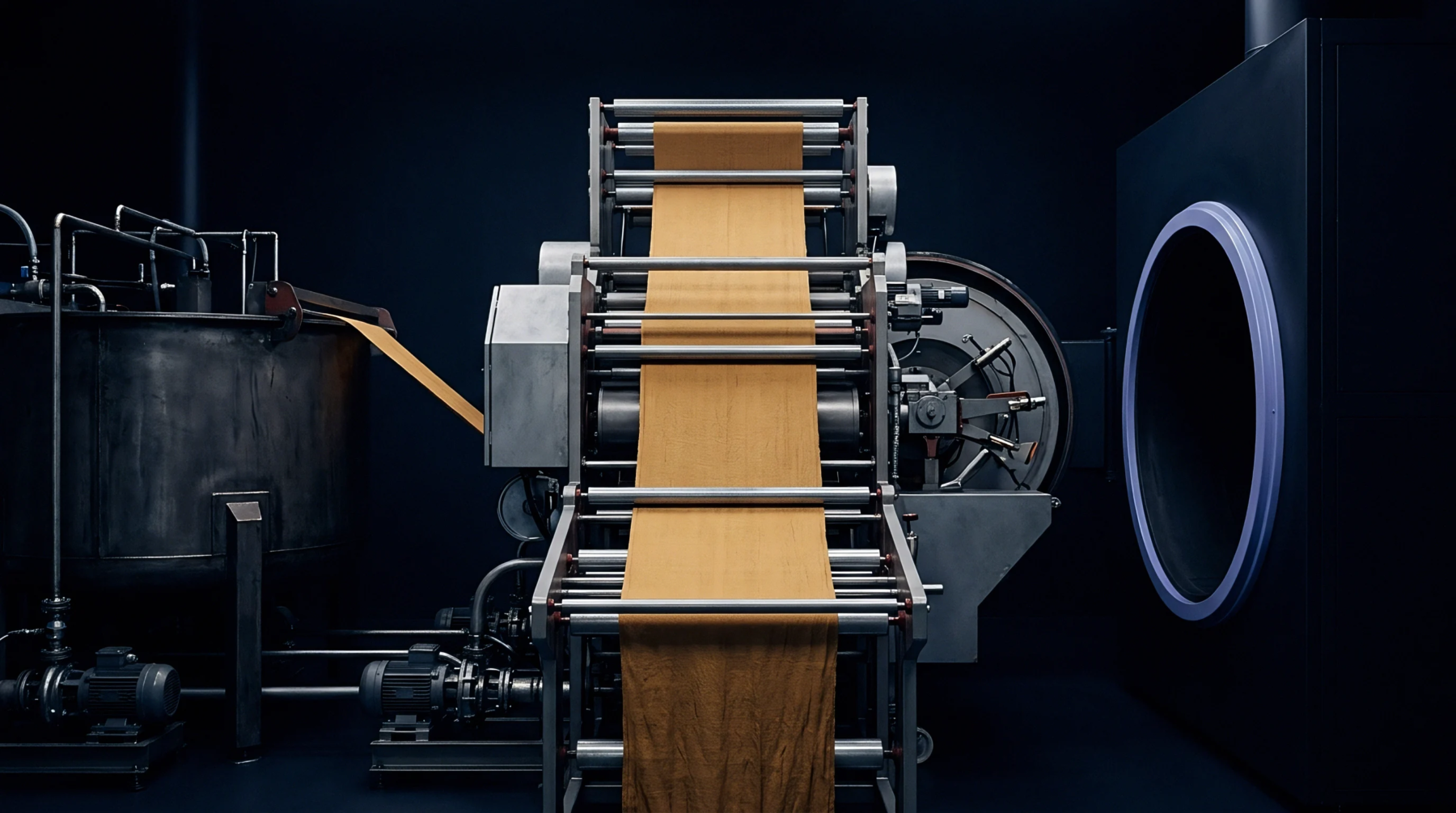
Controlling Continuous Dyeing Particulate Migration across Thermal Intermediate Dryers
Intermediate drying needs balanced radiative heat, controlled convection air speed, and pseudoplastic antimigrants to eliminate dye migration across woven fabric.
Air nozzle velocity is the kinetic speed of a fluid stream discharged from a compressed fluid aperture during industrial processing. Compressed air supply networks drive this discharge mechanism across specialized drying chambers and finishing equipment inside high speed textile mills. Production engineers calculate cubic meters per minute against the cross sectional area of the outlet orifice to establish exact operational parameters.
Fluid dynamics dictate that ambient resistance slows the stream immediately beyond the exit plane, creating a precise decay gradient that technicians measure with hot wire anemometers at fixed distances. This discharge metric governs moisture evaporation rates from woven fabric surfaces and dictates fiber orientation inside pneumatic transport tubes. Exact pressure regulators maintain the input force required to prevent turbulence anomalies that would otherwise distort delicate yarn arrangements during continuous wet processing stages.
Operational limits apply strictly to pneumatic drying modules and pneumatic yarn handling machinery, meaning the parameter ceases to hold relevance where thermal conduction or mechanical nip rollers provide the primary moisture removal vector.
Mill operators adjust internal manifold pressures to secure uniform moisture removal across wide synthetic fabric widths without inducing fiber displacement. Proper calibration prevents excessive fluttering inside the drying chamber, an issue that causes uneven dye penetration and permanent crease marks in lightweight polyester taffeta goods. Compressed air headers feed multiple orifices simultaneously, demanding precise balancing valves to eliminate pressure drops along the span of the distribution pipe.
Lower kinetic speeds leave residual moisture trapped within dense cotton weaves, while excessive force damages staple fibers by abrading yarn surfaces against surrounding metal guides. Technical managers monitor differential gauges constantly to identify partial clogging inside individual ports caused by microscopic lint accumulation from previous processing runs.
Quality assurance inspectors verify discharge speeds prior to initiating commercial production batches to ensure compliance with mill standard operating procedures. Calibrated pitot tubes traverse the outlet path at predetermined intervals while environmental sensors record ambient temperature and relative humidity levels inside the finishing hall. Technicians document observed values in permanent logbooks before signing off on equipment readiness for export grade shipments.
Discrepancies between targeted design figures and measured output demand immediate cleaning of the upstream filtration units or replacement of worn regulator diaphragms.
Finished textile integrity depends directly upon uniform fluid discharge dynamics maintained throughout continuous thermal treatment operations. Inconsistent kinetic force produces localized shade variations across dyed fabrics due to uneven drying speeds during resin cross linking stages. Commercial buyers reject consignments exhibiting structural distortion or surface fuzzing caused by turbulent air impingement during final finishing passes.
Precise control over fluid momentum ensures that bulk deliveries match approved laboratory handfeel and dimensional stability benchmarks established during initial sample trials.
Intermediate drying needs balanced radiative heat, controlled convection air speed, and pseudoplastic antimigrants to eliminate dye migration across woven fabric.
Expertise is a utility, not a secret. sentiention™ publishes its working knowledge as open reference: intelligence layer covering the materials it sources, the markets it enters, and the reference that serves both.