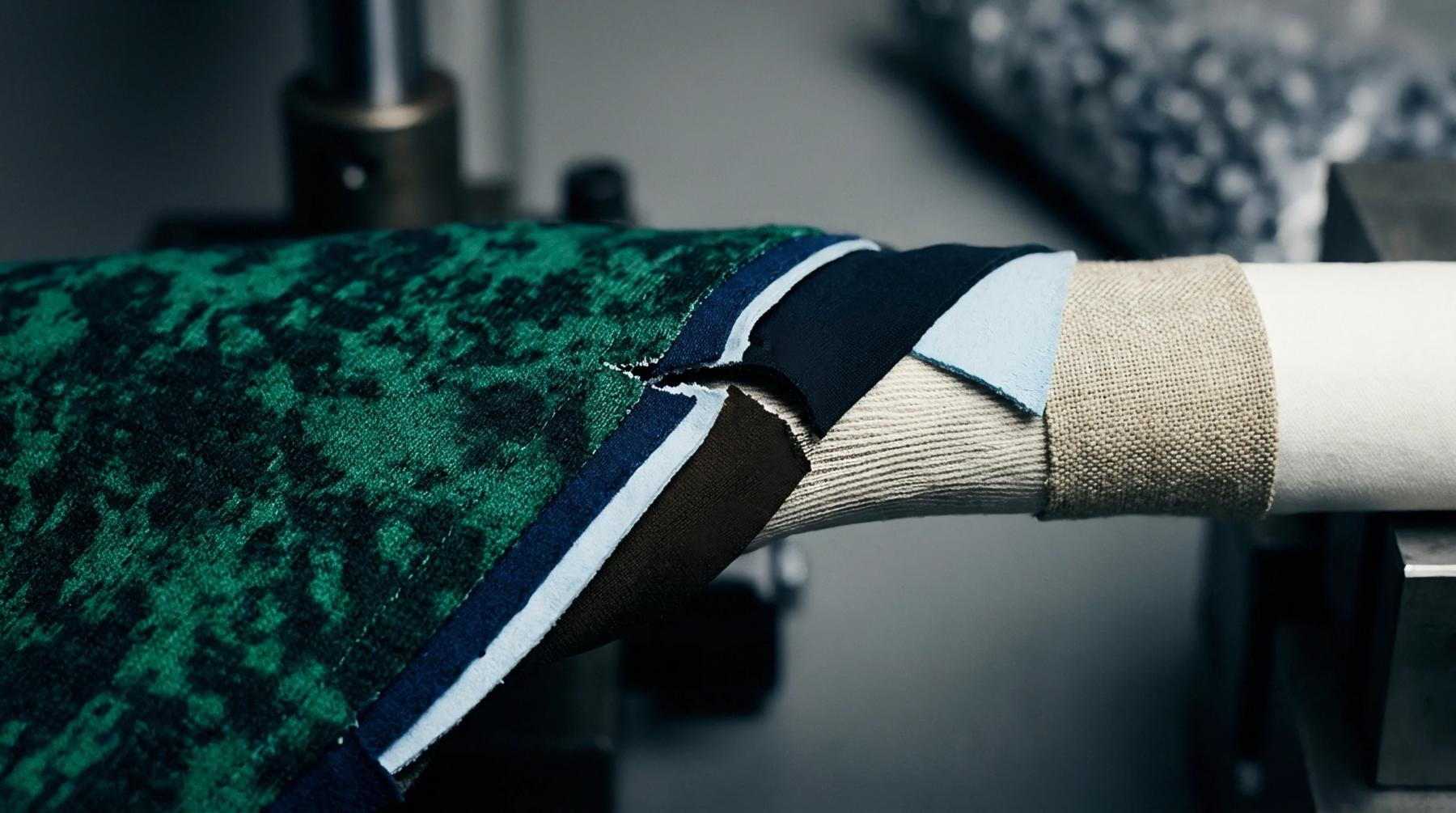
Visual Irregularity
Continuous horizontal stripes of varying shade or luster disrupt the uniform appearance of knitted or woven fabrics. These barré defects occur most frequently in circular knit goods where multiple yarn packages feed the needles simultaneously.
Physical Origin
Mechanical variations in the manufacturing equipment represent a major source of yarn patterning. Yarn feeder tension that fluctuates across different positions on a circular knitting machine generates a periodic difference in loop length, which creates a visible band. Additionally, heat-setting temperatures that vary by even a few degrees during yarn texturing alter the crystallinity of synthetic fibers.
This change in crystalline structure directly produces barré defects by creating bands that absorb dyes at different rates.
Diagnostic Method
Identifying the root cause requires systematic laboratory analysis of the affected fabric. Fabric analysis involves using a scan method or stitch-density measurements to separate mechanical issues from chemical variations. Chemical dye testing can determine if the band has different dye affinities, while optical microscopy measures the yarn crimp and diameter.
When the issue is purely mechanical, the bands vanish when the fabric is unraveled and the courses are analyzed for stitch length.
Process Control
Preventative maintenance of production machinery reduces the risk of fabric degradation. Monitoring and calibrating the yarn feeding systems ensures uniform tension across all positions. In yarn extrusion, precise control of drawing and heat-setting temperatures minimizes dye-absorption discrepancies.
Strict yarn lot segregation remains necessary because mixing different production runs of yarn almost always triggers these issues.