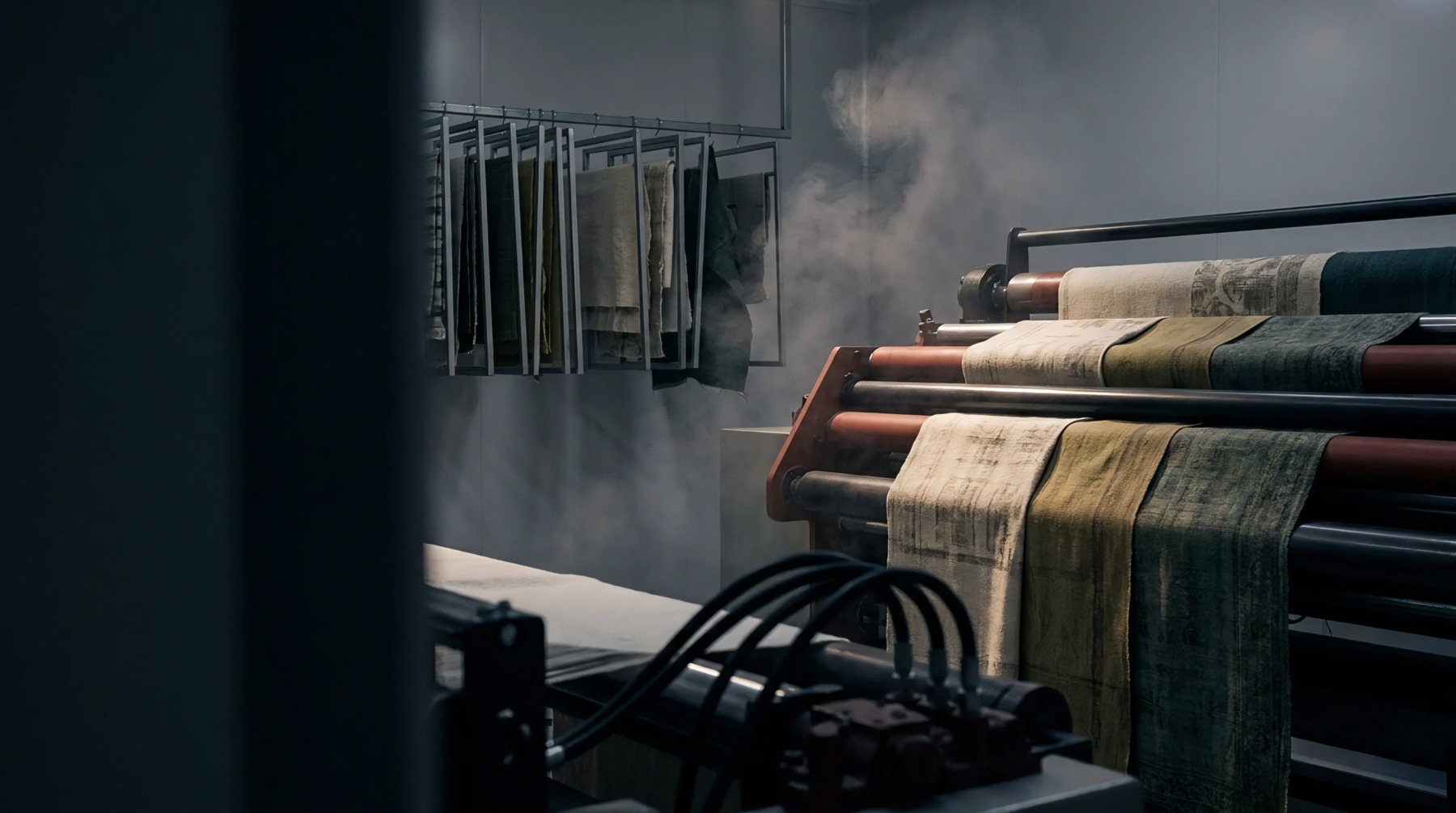
Angular Distortion
Lateral displacement of weft yarns or knitted courses so they meet the selvedge at an angle other than ninety degrees. Fabric skewing turns a rectangular grain into a parallelogram during the finishing or winding process at the mill. This condition is also frequently known as torque or spirality in circular knits used for jersey production.
Processing Cause
Unequal tension on the left and right sides of the processing line pulls one side of the web faster than the other. Tenter frames with misaligned chains or uneven heat distribution frequently introduce this slant. Heavy denim is particularly prone to this effect due to the directional nature of the twill weave.
Correction Technique
Automatic weft straighteners use optical sensors to detect the angle of the yarns and adjust the roller speeds accordingly. Passing the material through a series of differential rollers pulls the lagging side forward. Achieving a perfectly square grain is a primary objective of the final finishing pass.
Garment Failure
Leg twist in trousers occurs when the front and back panels are cut from skewed material. The side seams migrate toward the front of the leg as the internal stresses of the fabric relax. This rotation is a permanent defect that pressing cannot remove.