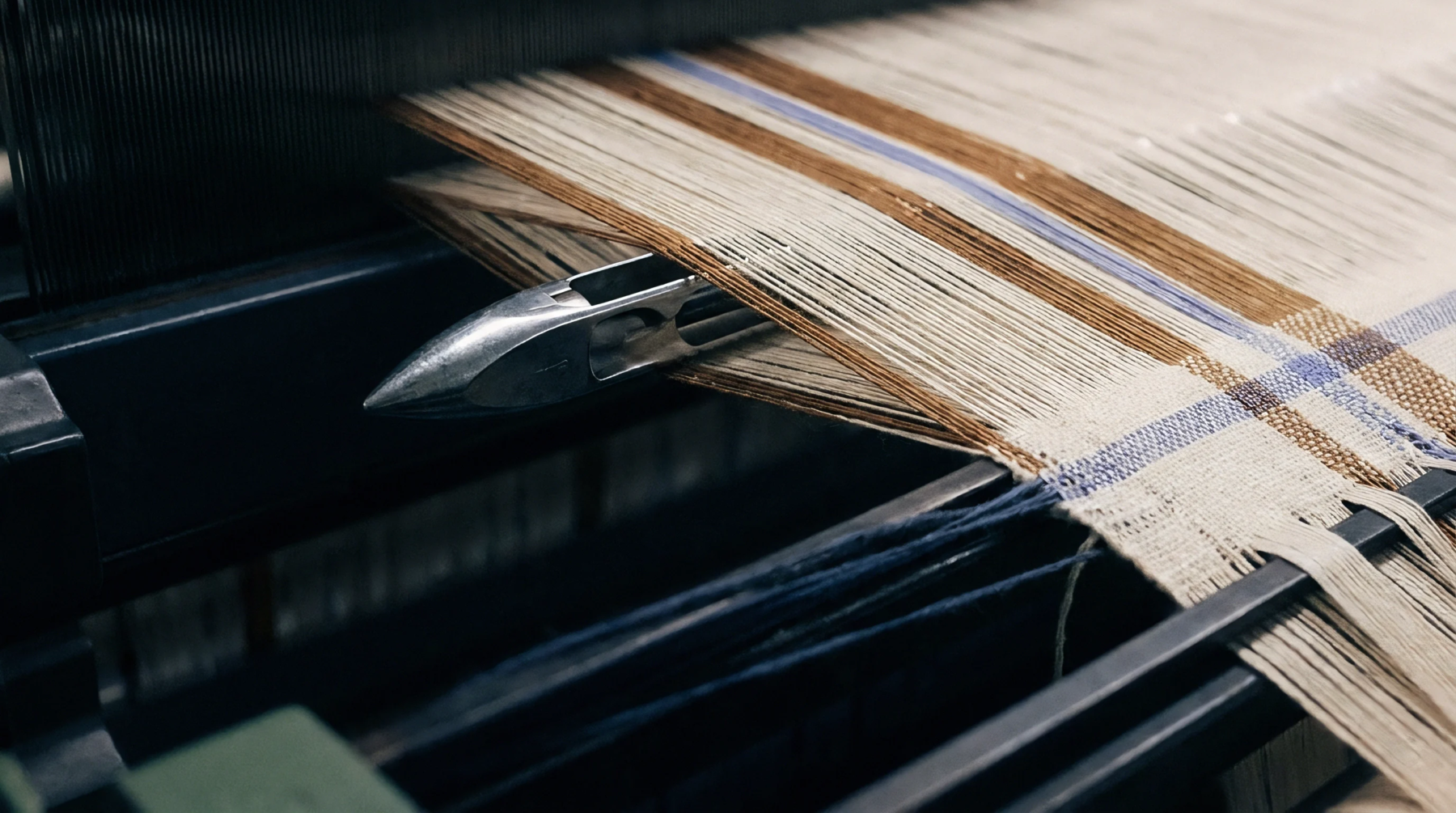
Basic Minimum Warp Set Calculation Principles for Greige Weaving
Greige warp set calculations must integrate reed width contraction, warp crimp, sizing stretch, and setup waste to establish accurate yarn purchase masses.
Dimensional reduction quantifies the loss of lateral span occurring when textiles transition from a tensioned loom state to a relaxed finish or garment assembly condition. Fabric width contraction identifies the delta between the reed width at the machine setting and the final usable span of the bolt. Mills monitor this discrepancy to ensure yield calculations hold across distinct processing stages.
High tension levels during beam let off or take up motions prevent immediate shrinking, yet the internal stresses release once the cloth leaves the delivery system. Heat setting processes within a stenter frame often lock these dimensions into a stable form, yet moisture absorption or mechanical washing can trigger latent recovery in hydrophilic fibres. This variance determines the pattern grading efficiency for manufacturers, as unexpected shrinkage forces a redesign of marker layouts to maintain alignment.
Production cycles incorporate constant tension settings that mask the inherent elastic potential of natural or synthetic fibres. The term fabric width contraction becomes visible only when internal yarn constraints subside following the release of mechanical pull. Weavers record the reed width versus the greige output to map the natural draw in of the weave structure itself.
Calibrating the feed rollers requires precise accounting for how the material pulls inward during high speed processing. Failure to accommodate this tightening leads to narrow bolt ends that fall below the minimum width specifications requested by garment houses. Each delivery of yardage undergoes inspection where inspectors measure the total span at ten distinct points to verify that the deviation stays within accepted tolerances.
Technicians utilize a standardised steel rule or calibrated optical scanner to capture the edge to edge distance on a flat surface without applying additional stretch. Measuring fabric width contraction demands that the sample remains conditioned in a climate controlled environment for a period sufficient to permit moisture equilibrium. Cold water immersion or steam pressing trials provide the data points necessary to predict how the material behaves under end use cleaning cycles.
Analysts subtract the final relaxed dimension from the initial greige span to obtain the numerical loss. Recording these values in a ledger establishes a performance profile for every batch of goods leaving the finishing plant. Accuracy depends on selecting representative samples from both the centre and the ends of the roll.
Mechanical processing at extreme speeds increases the likelihood of uneven tension distribution across the warp yarns. When the shedding mechanism exerts excessive pull on the edge fibres, the resulting fabric width contraction shows a bias toward the selvedge areas. Tensioning devices regulate the forward motion but rarely address the lateral inward force acting on the loose fibres.
Controlling the rate of cooling after heat setting acts as a dampener for these forces, preventing rapid dimensional shifts. Consistent output relies on the maintenance of guide rollers to ensure the cloth maintains a flat profile throughout the journey toward the inspection station. Stable dimensions remain a fundamental requirement for automated cutting tables to function without error.
Greige warp set calculations must integrate reed width contraction, warp crimp, sizing stretch, and setup waste to establish accurate yarn purchase masses.
Expertise is a utility, not a secret. sentiention™ publishes its working knowledge as open reference: intelligence layer covering the materials it sources, the markets it enters, and the reference that serves both.