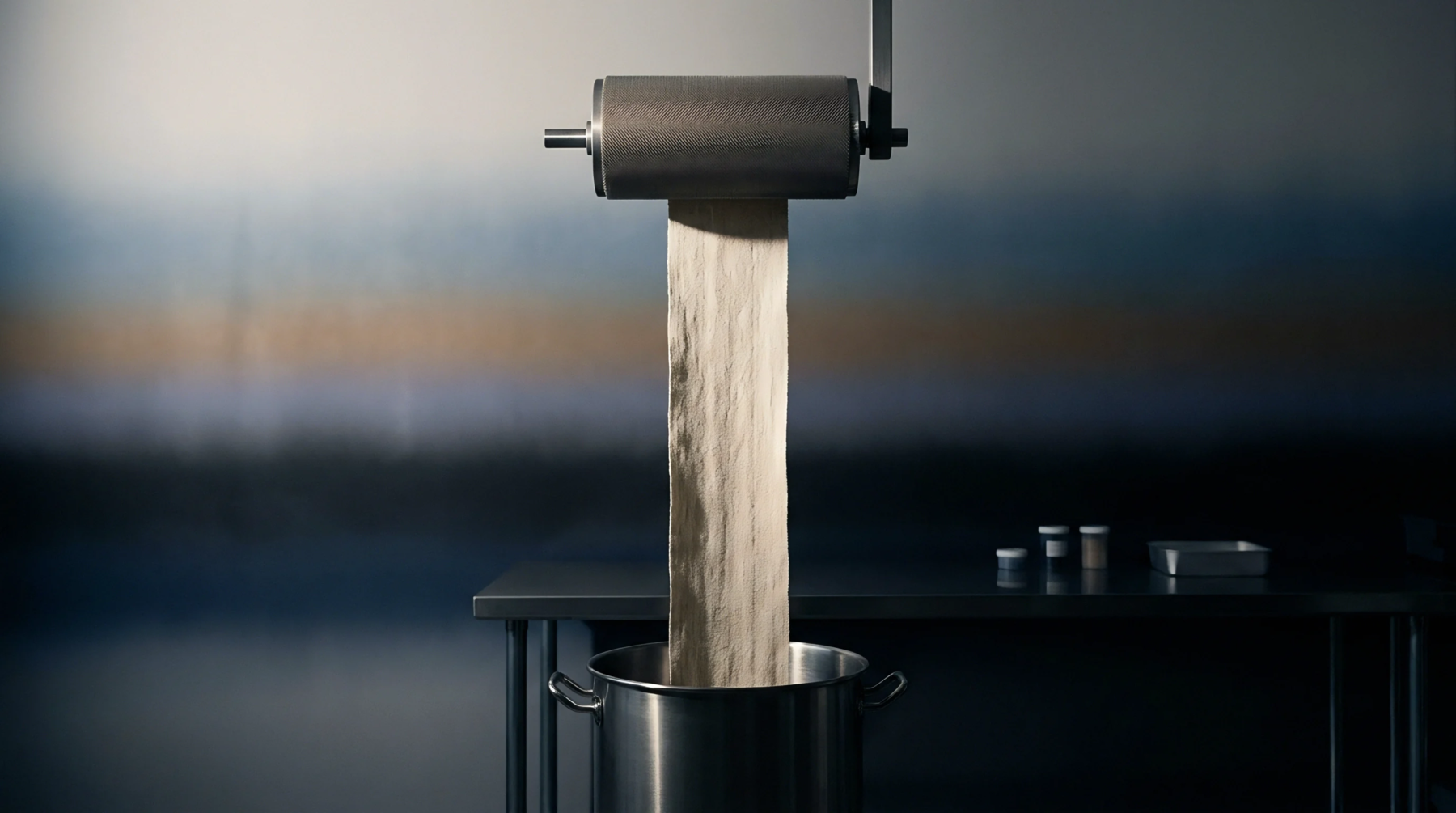
Continuous Drift
Systematic drift in color or finish concentration occurring along the length of a fabric roll during continuous wet processing. Longitudinal tailing happens when the chemical bath in a padder is depleted or enriched at a different rate than the fabric absorbs the solution. It results in a gradual shade change from the beginning of a lot to the end.
Equilibrium Shift
Dyeing kinetics and the affinity of the substrate for the liquor govern the stability of the process. If the dye has a high affinity, the concentration in the trough drops quickly, leading to longitudinal tailing where the tail of the roll is lighter than the head. Continuous dosing systems attempt to counteract this by injecting fresh concentrate at a calculated rate.
Monitoring the absorbance of the bath ensures the replenishment matches the consumption.
Production Impact
Garment manufacturers face technical challenges when trying to match panels cut from different ends of a single roll.
Quality Assurance
Laboratory spectrophotometers verify the consistency of the shade at ten-meter intervals to detect any drift early. The presence of longitudinal tailing indicates a failure in the liquor management system of the dyeing machine. Consistency along the entire length is a prerequisite for high-volume automated apparel assembly.