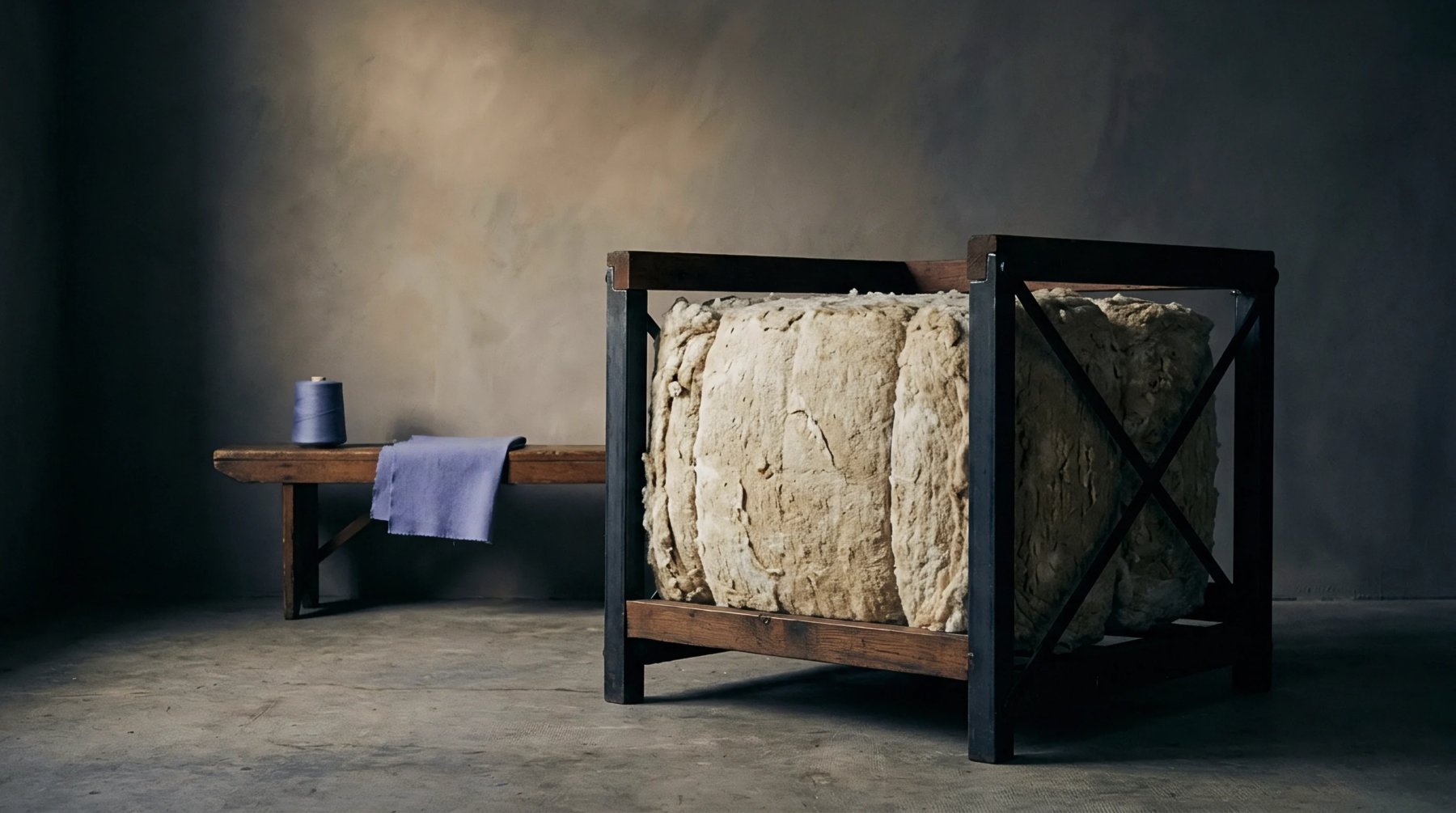
Determining Raw Cashmere Micron Profiles and Dehairing Yields
Determining raw cashmere value requires combined OFDA micron profiling and oven-dry yield mass balance testing to calculate true clean dehaired cost.
A microtome snippet consists of a thin transverse slice taken from a textile fibre to examine internal structural integrity under high magnification. Technicians prepare this microtome snippet by embedding a bundle of filaments into a wax or resin block before a steel blade cuts the material into sections of five to ten micrometres in thickness. Such preparation allows laboratory staff to observe the orientation of skin and core components within a synthetic fibre or the distribution of lumen spaces inside natural cotton.
Microscopic analysis confirms whether internal delamination exists or if dye particles penetrated the polymer matrix during the finishing cycle. Accurate readings depend upon the flatness of the cut and the clarity of the mounting medium used to hold the fibre in place.
The physical adjustment of the cutting edge determines the success of the sample collection. A dull blade deforms the cross section of a microtome snippet by compressing the outer boundary of the fibre during the stroke. Proper clearance angles prevent the instrument from tearing the surface of the specimen or creating grooves that distort the optical data during the imaging phase.
Adjusting the lateral feed mechanism in precise increments ensures that each slice maintains a consistent thickness across the entire batch of samples. Workers document the angle and speed of the blade stroke as variables that affect the geometric shape of the resulting image. When the machine vibrates during operation, the quality of the section suffers and the data becomes unreliable for forensic comparison of fibre origins.
Measurement of these samples provides evidence of variations in the cross sectional area that occur during the extrusion process. An irregular microtome snippet indicates a fault in the spinneret hole geometry or a blockage in the filtration system feeding the extrusion line. Quality control managers compare the observed shape to the theoretical cross section specified in the original engineering schematic to verify that the fibre maintains its required structural profile.
If the shape deviates from the standard circular or trilobal design, the fibre performance in terms of tensile strength and light reflectance falls below the target specification. Periodic checks on production line output require multiple samples to account for variance between individual nozzle positions within the equipment.
Validation of the fiber cross section represents the final arbiter for material disputes between suppliers and purchasers. A clean microtome snippet showing no evidence of core voids or foreign particle inclusion confirms that the manufacturing process met the quality parameters set in the purchase contract. Buyers reject batches where the internal structure shows inconsistent density or uneven polymer distribution because these faults create weak points that fail during high speed knitting operations.
The visual data obtained from the slice serves as the baseline for assessing the impact of chemical additives on the internal morphology of the fibre. Precise internal structures remain the hallmark of stable production output.
Determining raw cashmere value requires combined OFDA micron profiling and oven-dry yield mass balance testing to calculate true clean dehaired cost.
Expertise is a utility, not a secret. sentiention™ publishes its working knowledge as open reference: intelligence layer covering the materials it sources, the markets it enters, and the reference that serves both.