Chemical Interactions between Modern Synthetic Spin Finishes and Standard Soxhlet Pretreatment Solvents in Blend Analysis
Chlorinated Soxhlet solvents remove hydrophilic polyether spin finishes completely but risk co-extracting polymer oligomers, shifting baseline dry fiber mass.
Scour
Filament extrusion and high-speed synthetic yarn texturing rely on chemical surface treatments far more complex than traditional paraffin oil emulsions. Applied to polyester, polyamide, elastane, and acrylic fibers, modern spin formulations use active compounds engineered to withstand temperatures above 200 °C during draw-texturing while holding surface friction within a narrow 0.18 to 0.22 coefficient window. Standard blend separation methods under ISO 1833 and AATCC 20A require extracting non-fibrous matter with organic solvents before selective dissolution begins.
Standard protocols specify refluxing test specimens in a Soxhlet apparatus with light petroleum or diethyl ether. These classical solvents work well when non-fibrous mass consists of straight-chain mineral oils or fatty acid esters. They fail, however, on modern spin chemistries containing ethoxylated silicone polyethers, polyoxyethylene-polyoxypropylene (EO/PO) block copolymers, and alkoxylated alkyl phosphate salts.
This mismatch in chemical structure directly reduces extraction efficiency, introducing systematic analytical errors before selective dissolution even starts.
Synthetic Lubricant Formulations and Solvent Affinity
High-speed spinning relies on amphiphilic polymers to handle lubricity, anti-static dispersion, and thermal cohesion simultaneously. Polyoxyethylene-polyoxypropylene block polymers form a primary lubricant class in partially oriented yarn processing. Here, ethylene oxide blocks deliver water emulsibility and anti-static dispersion, while propylene oxide blocks supply oxidative stability at heater temperatures.
Fatty alcohol ethoxylates and ethoxylated polydimethylsiloxanes act as surface leveling agents and dynamic boundary lubricants. Molecular weights for these synthetic polyethers range from 1,000 to over 8,000 Daltons. Standardized testing procedures specify light petroleum solvents composed of non-polar aliphatic alkanes ~ mainly pentane and hexane isomers boiling between 40 °C and 60 °C or 60 °C and 80 °C. While aliphatics readily dissolve non-ionic hydrocarbon oils, they lack the polarity needed to break hydrogen bonding networks between polyoxyethylene chains and synthetic fiber surfaces.
Ethoxylated siloxanes and high-EO block copolymers dissolve poorly in non-polar alkanes, leaving un-extracted surface residues on the specimen thimble.
| Finish Component Class | Dominant Chemical Structure | Hildebrand Parameter (MPa^1/2) | Petroleum Ether Solubilisation (%) | Dichloromethane Solubilisation (%) |
|---|---|---|---|---|
| Mineral Oil Base | C15-C30 Paraffinic Hydrocarbons | 14.3 to 15.6 | 99.4 | 99.8 |
| Fatty Acid Ester | Butyl Stearate / Isocetyl Stearate | 16.2 to 17.1 | 98.1 | 99.5 |
| EO/PO Block Copolymer | Polyoxyethylene-Polyoxypropylene Ether | 18.8 to 20.5 | 64.2 | 99.1 |
| Silicone Polyether | Ethoxylated Polydimethylsiloxane | 17.5 to 19.2 | 51.8 | 98.7 |
| Alkoxylated Phosphate | Potassium Lauryl Phosphate Ethoxylate | 21.0 to 23.4 | 38.5 | 97.6 |

Solvent Polarity Indexes and Extraction Kinetics
Thermodynamic solubility parameters govern the equilibrium between surface-active agents and boiling extraction solvents. Light petroleum has a Hildebrand solubility parameter of 14.3 MPa^1/2. By contrast, chlorinated solvents such as dichloromethane feature a Hildebrand parameter of 20.2 MPa^1/2 and a dielectric constant of 8.93.
The polar and dispersive forces of dichloromethane closely match the cohesive energy density of alkoxylated synthetic lubricants. Standard Soxhlet extraction runs 10 to 12 siphoning cycles per hour across 4 hours or 16 hours. Refluxing a textured polyester filament yarn carrying 0.85% by weight of a polyether-modified silicone finish in light petroleum results in incomplete extraction.
Gravimetric measurements show that light petroleum leaves up to 0.42% mass fraction of un-extracted finish bound to the fiber matrix. Swapping in dichloromethane under identical reflux conditions drops residual finish on the fiber surface to under 0.02% mass fraction.
Light petroleum reflux leaves 0.42% mass fraction of synthetic silicone finish bound to polyester yarn surfaces.
Chemical interactions between extraction solvents and modern finishes alter the test sample’s baseline dry mass. If un-extracted finish stays on a specimen, that extra weight carries directly into subsequent selective dissolution steps. In a binary polyester and cotton blend, residual finish on the polyester increases the weighed mass of the insoluble residue, leading to an artificially inflated polyester content and a matching deficit in cotton.
Interference
Choosing an aggressive organic solvent to force complete lubricant extraction creates physical and chemical problems inside the synthetic polymer substrate. Chlorinated hydrocarbons, ketones, and cyclic ethers penetrate the amorphous domains of synthetic fibers during hot Soxhlet reflux. Polyamide 6, polyamide 66, polyethylene terephthalate, and elastomeric polyurethanes respond differently to solvents depending on their crystallinity, orientation, and thermal history.
As solvent molecules diffuse into inter-fibrillar spaces, they disrupt weak intermolecular bonds and swell the polymer chains. This swelling increases free volume in amorphous regions, letting low molecular weight polymer fractions, residual monomers, cyclic oligomers, and internal additives leach into the boiling solvent. Co-extracting base fiber material introduces a negative gravimetric bias that skews blend calculations.
Polymer Swelling and Low Molecular Weight Extraction
Polyamide 6 fibers produced by ring-opening polymerization of caprolactam retain 1.5% to 2.8% unreacted caprolactam monomer, along with cyclic oligomers from dimers up to hexamers. Standard spinning washes the bulk fiber, but commercial polyamide staple and filament yarns still retain 0.6% to 1.2% extractable oligomeric species inside their matrix. Dichloromethane boiling at 39.8 °C diffuses into polyamide 6, pulling cyclic caprolactam trimers and tetramers from the fiber core into the Soxhlet flask.
Similarly, polyethylene terephthalate fibers contain 1.0% to 1.4% cyclic PET oligomers, mostly the cyclic PET trimer. Prolonged Soxhlet extraction using dichloromethane or tetrahydrofuran leaches up to 0.55% by weight of cyclic trimers from high-tenacity polyester filament yarns.
Elastane fibers are especially vulnerable to co-extraction during quantitative pretreatment. Polyurethane elastomers pair flexible polyether or polyester soft segments with rigid aromatic urea hard segments, and chlorinated solvents swell those soft segments quickly. Refluxing elastane-containing knit fabric in dichloromethane for 4 hours leaches unreacted macro-glycols, light stabilizers, thermal antioxidants, and low molecular weight polyurethane oligomers.
Clean, unfinished elastane loses between 1.10% and 2.35% of its original dry fiber mass under dichloromethane reflux. When lab technicians record total mass loss during pretreatment, they often misattribute this dissolved polymer to surface finish removal, establishing a flawed baseline dry weight for subsequent chemical separation.
Chlorinated solvents extract low molecular weight oligomers directly from synthetic fiber matrices during Soxhlet reflux.
Standardized Laboratory Washing Sequence
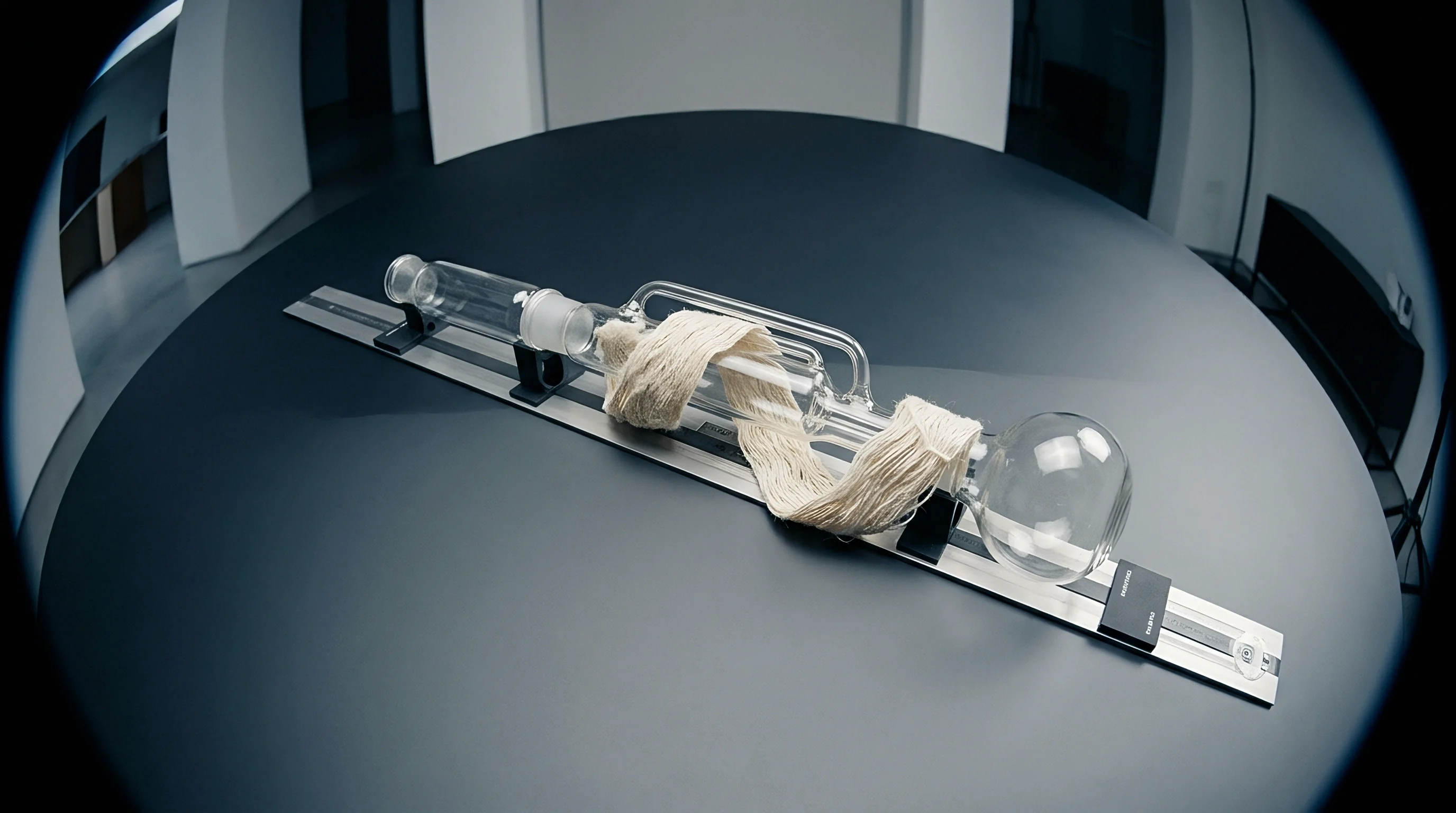
Quantifying surface finish mass without leaching structural polymer oligomers requires a controlled multi-stage extraction protocol to isolate surface contaminants while maintaining matrix mass stability:
- Dry the glass Soxhlet extraction thimble at 105 °C for 60 minutes, cool it in a glass desiccator over activated silica gel for 45 minutes, and record the tare mass to 0.0001 grams.
- Condition the test sample at 20 °C and 65% relative humidity for 4 hours, select a representative 5.000-gram specimen, and record its initial conditioned mass.
- Place the specimen in the prepared thimble, insert it into the Soxhlet extractor, and attach a round-bottom flask filled with 150 milliliters of analytical grade iso-hexane.
- Heat to maintain 10 to 12 siphoning cycles per hour, refluxing continuously for 120 minutes to extract non-polar hydrocarbon lubricants and fatty esters.
- Turn off the heating mantle, allow the apparatus to cool below boiling, swap the flask for a clean vessel containing analytical grade ethyl acetate, and reflux for another 60 minutes to extract polar polyether silicones.
- Remove the thimble, evaporate residual solvent under a chemical fume hood for 30 minutes, dry the extracted fiber specimen at 105 °C to constant mass, and calculate total extracted surface matter.
Balancing surface solubility against polymer matrix preservation gives consistent gravimetric baselines across comparative test rounds. Light petroleum removes surface fats effectively without penetrating crystalline polymer domains.

Hydrolysis
Long extraction cycles in a boiling solvent flask can trigger chemical reactions that alter both the dissolved finish and the fiber surface itself. Commercial technical-grade solvents often carry trace water, peroxides, free acids, or alcohol stabilizers. During extended Soxhlet reflux at high temperatures, these impurities initiate solvolysis and thermal degradation.
Moisture in boiling solvent mixtures hydrolyzes ester linkages in fatty acid lubricants and alkoxylated phosphate surfactants, breaking ester bonds to yield free fatty acids, phosphoric acid species, and volatile short-chain alcohols. These volatile products escape during oven drying at 105 °C, artificially inflating measured pretreatment losses.

Thermal Desiccation Degradation and Solvolysis Mechanisms
Drying extracted fiber thimbles in forced-air ovens at 105 °C poses thermal oxidation risks for residual synthetic finishes. Ethoxylated siloxanes and polyoxyethylene polymers remaining on fiber surfaces react with atmospheric oxygen at high temperatures, forming hydroperoxides along the polyether backbone that drive chain scission and cross-linking. These cross-linked silicone resins create an insoluble, non-reactive shell around the fiber.
When the specimen is later treated with 75% sulfuric acid or cold formic acid for blend separation, the silicone film blocks acid penetration into the fiber core, slowing dissolution and leaving un-dissolved fiber fragments in the residue.
Refluxing alcohol solvents such as methanol or ethanol against polybutylene terephthalate (PBT) or polyurethane fibers induces transesterification and alcoholysis. Boiling methanol attacks urethane linkages in elastane, breaking polymer chains down into soluble methyl carbamates. This chemical degradation alters the final mass of the insoluble residue, invalidating standard blend correction factors in ISO 1833-1 Annex A.
Which Solvent Prevents Oligomer Extraction during Reflux?
Selecting an optimal solvent system requires balancing ester solubility against matrix stability across different organic liquids. Modern testing frequently compares iso-hexane, tert-butyl methyl ether (TBME), cyclohexane, and ethyl acetate against standard dichloromethane. Iso-hexane causes zero matrix swelling in polyamide and polyester, keeping oligomer leaching below 0.01% mass fraction; however, it fails to fully dissolve high-EO block copolymers.
Ethyl acetate provides a practical middle ground, efficiently dissolving ethoxylated silicone polyethers and alkoxylated phosphates while keeping PET cyclic trimer leaching under 0.06% and elastane soft-segment leaching under 0.18% mass fraction.
| Blend Composition & Nominal Ratio | Pretreatment Solvent Regime | Extracted Surface Finish (%) | Co-Extracted Polymer Oligomers (%) | Gravimetric Blend Bias (Percentage Points) |
|---|---|---|---|---|
| 85% PET / 15% Elastane (Knitted) | Light Petroleum (40-60 °C) | 0.31 | 0.02 | +0.54 (PET Overstated) |
| 85% PET / 15% Elastane (Knitted) | Dichloromethane (DCM) | 0.88 | 1.65 | -1.22 (PET Understated) |
| 85% PET / 15% Elastane (Knitted) | Ethyl Acetate (EtOAc) | 0.84 | 0.14 | +0.08 (Within Tolerance) |
| 65% PA66 / 35% Cotton (Woven) | Light Petroleum (60-80 °C) | 0.22 | 0.01 | +0.48 (PA Overstated) |
| 65% PA66 / 35% Cotton (Woven) | Dichloromethane (DCM) | 0.68 | 0.92 | -0.64 (PA Understated) |
| 65% PA66 / 35% Cotton (Woven) | Ethyl Acetate (EtOAc) | 0.65 | 0.08 | +0.05 (Within Tolerance) |
| 50% Wool / 50% Acrylic (Yarn) | Diethyl Ether | 0.75 | 0.03 | -0.12 (Wool Understated) |
| 50% Wool / 50% Acrylic (Yarn) | Dichloromethane (DCM) | 0.92 | 0.45 | -0.42 (Acrylic Understated) |
The quantitative errors introduced during chemical blend separation are easily illustrated by an 85.0% Polyethylene Terephthalate (PET) / 15.0% Elastane knitted fabric finished with 0.90% by weight of a silicone-polyether lubricant mixture. A 5.0000-gram dry specimen undergoes pretreatment before the PET component is selectively dissolved in boiling 75% v/v sulfuric acid per ISO 1833-11.
In Case A, the laboratory uses light petroleum (boiling range 40 °C to 60 °C) for Soxhlet pretreatment. Light petroleum extracts only 0.28% finish mass (0.0140 g), leaving 0.62% finish mass (0.0310 g) bound to the fiber surface. The pretreated dry specimen mass totals 4.9860 grams.
During sulfuric acid treatment, PET dissolves completely, but the un-extracted 0.0310 grams of silicone finish remains attached to the insoluble elastane residue. The dry elastane residue then weighs 0.7810 grams (0.7500 g elastane + 0.0310 g residual finish). Applying standard commercial regain adjustments yields a calculated blend composition of 84.38% PET / 15.62% Elastane.
As a result, the lab reports an incorrect elastane content elevated by 0.62 percentage points.
In Case B, the laboratory uses dichloromethane (DCM) for Soxhlet pretreatment. DCM extracts all 0.0450 grams of surface finish (0.90%). However, DCM reflux swells the elastane matrix, co-extracting 0.0138 grams of polyurethane soft-segment oligomers (1.84% of total elastane mass) along with 0.0035 grams of PET cyclic trimers.
Total gravimetric mass loss during pretreatment reaches 0.0623 grams (1.25% of total specimen mass), leaving a pretreated dry specimen mass of 4.9377 grams. Following sulfuric acid dissolution of the PET, the washed and dried elastane residue weighs 0.7362 grams (0.7500 g original elastane – 0.0138 g leached oligomers). Applying commercial regain adjustments yields a calculated blend composition of 86.25% PET / 13.75% Elastane, overstating PET content by 1.25 percentage points.
Chemical degradation during quantitative pretreatment can occur through several distinct mechanisms:
- Transesterification of Polyester Matrices occurs when boiling primary alcohols react with PET chain terminals, generating low molecular weight esters that dissolve into the solvent.
- Siloxane Condensation Reactions occur during oven drying at 105 °C, transforming residual ethoxylated siloxanes into insoluble silica-silicone surface films.
- Hydrolytic Cleavage of Phosphate Antistats releases free phosphoric acid species during water-solvent wash cycles, corroding metal extraction hardware and attacking acid-sensitive fibers such as viscose.
- Urethane Segment Leaching happens when polar chlorinated solvents penetrate amorphous polyurethane domains, dissolving macro-glycols and short-chain diisocyanates.
Failing to account for solvent-induced oligomer leaching or finish retention during Soxhlet pretreatment distorts baseline fiber mass measurements. This leads directly to shipment rejections when official blend declarations fall outside statutory tolerances.


Residue
Determining quantitative fiber composition requires converting raw dry mass measurements into declared commercial masses using standardized moisture regain allowances. Customs authorities, trade regulations, and retail labeling laws rely on equations in ISO 1833-1 to verify fiber percentages. Systemic errors introduced during solvent pretreatment shift clean dry fiber masses, corrupting commercial mass calculations used for tariff classification and entry valuation.
If pretreatment leaves surface coatings behind or leaches base polymer material, downstream gravimetric correction factors cannot restore analytical accuracy.

Gravimetric Correction Equations and Regain Allowance Shifts
The standard formula for calculating the clean dry mass percentage of the insoluble fiber component (P1) under ISO 1833-1 incorporates commercial moisture regains and binary correction factors:
P1 = 100 m1 (1 + a1 / 100) /
In this equation, m1 is the dry mass of the insoluble residue after selective dissolution, and m2 is the dry mass of the soluble fiber component (calculated by subtracting m1 from the pretreated dry specimen mass). The variables a1 and a2 represent commercial moisture regain allowances for insoluble and soluble fibers, respectively. Correction factors d1 and d2 account for any mass loss of the insoluble fiber during chemical dissolution.
Un-extracted surface finish inflates m1 directly whenever residue remains on the insoluble fiber. Conversely, when solvent pretreatment leaches polymer oligomers from the soluble fiber component, m2 is reduced before chemical separation even begins. Because commercial moisture regain allowances differ sharply between natural and synthetic fibers ~ wool carries an allowance of 17.00%, viscose 13.00%, cotton 8.50%, polyamide 62 6.25%, and polyester 1.50% ~ a 1.00% shift in dry mass balance produces a magnified divergence in declared commercial percentages.
| Fiber Type | ISO 1833 Regain Allowance (%) | HS Tariff Chapter | Chief Weight Threshold (%) | Blend Ratio Sensitivity per 1.0% Dry Mass Bias (%) |
|---|---|---|---|---|
| Wool | 17.00 | Chapter 51 | > 50.0 Wool by Weight | 1.17 Shift in Declared Mass |
| Viscose / Rayon | 13.00 | Chapter 55 | > 85.0 Artificial Fiber | 1.13 Shift in Declared Mass |
| Cotton | 8.50 | Chapter 52 | > 50.0 Cotton by Weight | 1.08 Shift in Declared Mass |
| Polyamide 66 | 6.25 | Chapter 54 / 55 | > 85.0 Synthetic Fiber | 1.06 Shift in Declared Mass |
| Polyester (PET) | 1.50 | Chapter 54 / 55 | > 50.0 Synthetic Fiber | 1.01 Shift in Declared Mass |
Customs Classification and Chief Weight Threshold Disputes
Harmonized System (HS) tariff schedules distinguish textile categories using chief weight thresholds, with customs agencies assessing duty rates based on whichever fiber predominates by weight. For instance, a woven fabric declared as 52.0% Polyethylene Terephthalate / 48.0% Cotton enters under HS Code 5515.11 at a specific duty rate. But if a customs laboratory runs blend analysis using dichloromethane pretreatment, DCM extracts 0.90% cotton wax while leaching 1.10% PET oligomers ~ reducing measured PET dry mass fraction to 49.3%.
The customs authority then reclassifies the shipment under HS Code 5211.42 as cotton-predominant, exposing the importer to higher tariff rates, back-duty assessments, and penalties for misdeclaration.
Evaluating commercial laboratory performance requires checking for specific failure modes in quantitative testing reports:
- Unspecified Solvent Pretreatment Protocols occur when test reports omit the identity, boiling range, and extraction duration of the solvent used prior to chemical separation.
- Omission of Blank Extraction Controls happens when laboratories fail to run pure reference fibers through extraction to measure baseline polymer mass loss.
- Uncorrected Moisture Regain Calculations arise when technicians apply dry mass percentages directly without incorporating statutory regain allowances specified in ISO 1833-1 Annex A.
- Single-Solvent Extraction Assumptions occur when laboratories assume light petroleum extracts all modern synthetic lubricants without verifying residual mass via gravimetric wash analysis.
Commercial mass calculations under ISO 1833-1 amplify dry mass extraction errors through differential fiber moisture regain allowances.
Contracts specifying fiber composition standards should incorporate ISO 1833-1 Clause 6 mandatory pretreatment options, establishing exact solvent choices, extraction times, and gravimetric residue tolerances for shipment acceptance.

Reconciliation
Eliminating analytical bias from spin finish retention and polymer leaching requires replacing outdated laboratory routines. Modern testing facilities need to move away from single-solvent extraction regimes toward tailored pretreatment procedures designed for specific fiber combinations. Adopting dual-stage extraction and strict laboratory qualification controls protects sourcing organizations from customs penalties, commercial disputes, and labeling claims.

Dual Stage Pretreatment Protocol Architecture
A dual-stage extraction approach separates surface-bound spin lubricants while preserving polymer matrix integrity. Stage 1 uses iso-hexane or petroleum ether (boiling range 40 °C to 60 °C) in a Soxhlet apparatus for 10 siphoning cycles (around 60 minutes). These non-polar alkanes strip out simple mineral oils, fatty acid esters, and surface waxes without penetrating synthetic fiber structure or leaching polymer oligomers.
The solvent flask is then removed, and the specimen moves to Stage 2.
Stage 2 uses a short, mild wash with ethyl acetate or tert-butyl methyl ether (TBME). Instead of continuous Soxhlet reflux at high temperatures, the specimen undergoes ultrasonic agitation in ethyl acetate at 35 °C for 15 minutes. This mild ultrasonic bath efficiently dissolves ethoxylated silicone polyethers, block copolymers, and alkoxylated phosphate antistats.
Because exposure is brief and temperatures stay low, solvent diffusion into amorphous polymer domains is minimized, preventing cyclic PET trimer leaching and elastane soft-segment extraction. Dual-stage qualification limits gravimetric mass drift to 0.72% compared to standard 4-hour dichloromethane reflux.
Technical Dossier Specification and Laboratory Auditing
Sourcing organizations need to establish clear technical parameters in their agreements with third-party laboratories. Purchase orders and quality assurance specifications should explicitly define the required pretreatment solvent regime based on fiber blend composition. Evaluating lab test reports requires reviewing the solvent residue line and verifying that the testing facility holds ISO 17025 accreditation scoped specifically for ISO 1833 quantitative chemical analysis.
Audit protocols for accredited labs should cover gravimetric balance calibration logs, solvent purity standards, and Soxhlet heating mantle temperature controls. Facilities must document blank extraction values for pure synthetic fiber reference samples to establish baseline matrix loss factors. When analyzing complex multi-component blends ~ such as intimate mixtures of polyester, polyamide, and elastane ~ the testing plan must lay out sequential pretreatment steps to isolate each fiber component accurately.
Dual-stage pretreatment combining alkane Soxhlet extraction with ultrasonic ethyl acetate washing isolates synthetic finishes while preserving fiber matrix mass.
Whether standardized testing bodies will revise ISO 1833-1 to formally replace dichloromethane pretreatment with ethyl acetate ultrasonic washing for elastane and polyamide blends remains an open question for international trade compliance.