Cotton Polyester Blend Separation Behavior during Opening and Carding
Differential air drag and wire engagement strip cotton at carding zones, forcing synthetic sliver drift that triggers customs tariff threshold penalties.

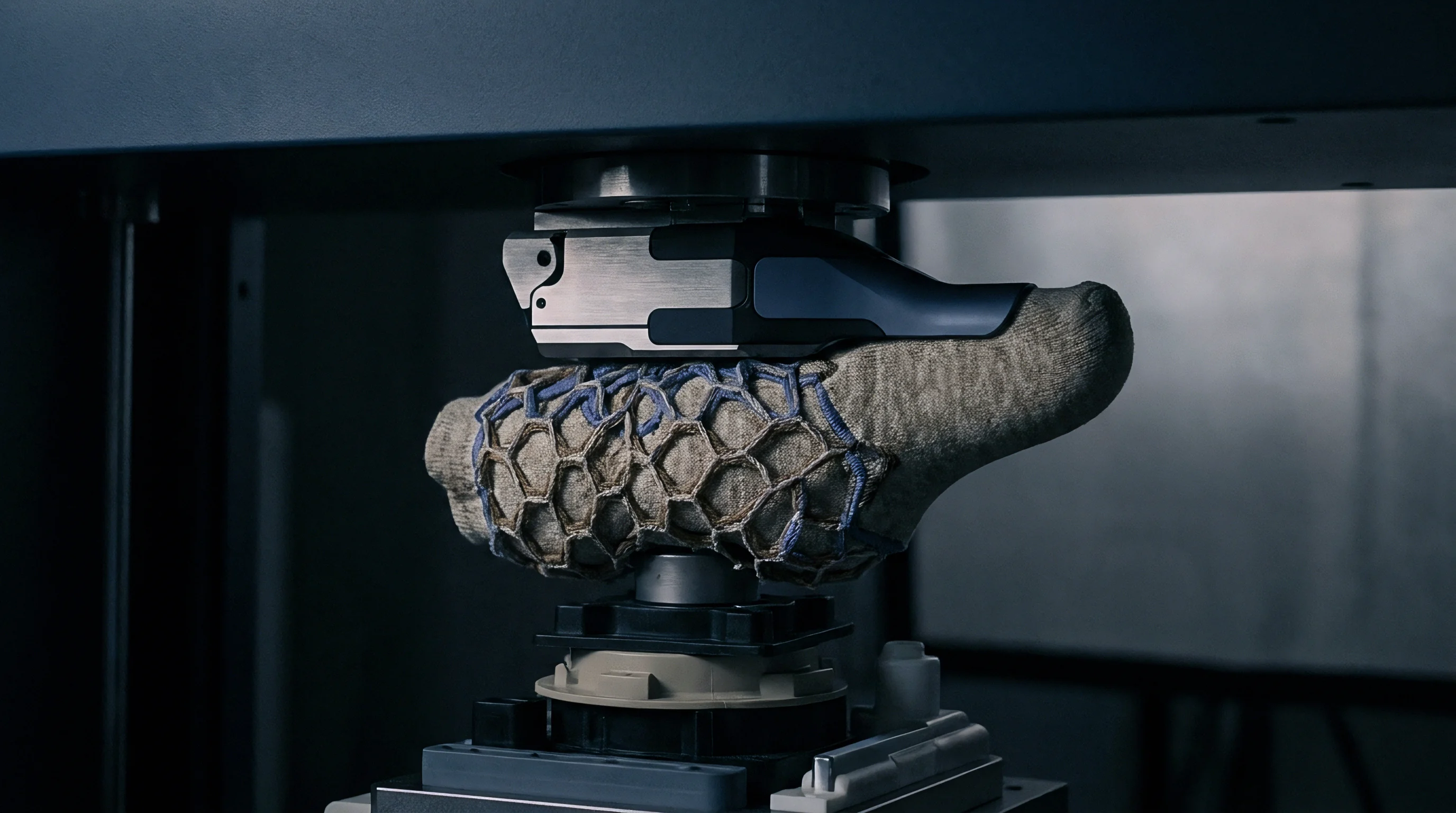
Kinematics

Pneumatic Mass Transport and Fiber Density Disparities
Opening lines transport mixed tuft populations through ductwork via turbulent airflow held between eighteen and twenty-four meters per second. Raw cotton carries a skeletal polymer density of 1.54 grams per cubic centimeter, compared to 1.38 grams per cubic centimeter for polyethylene terephthalate staple. Aerodynamic drag on free-floating tufts scales with projected cross-sectional area and the square of airspeed, modulated by the drag coefficient.
Cotton tufts enter the line as dense, tightly bound clumps with low specific volume, whereas synthetic staple arrives in lofty, crimped masses with high volume per unit mass.
Pneumatic conveying systems force these contrasting material geometries through ninety-degree elbows and distribution chutes, where differences in tuft mass set up distinct momentum profiles across the duct. Denser cotton agglomerates retain linear kinetic energy, riding the outer radius of duct bends, while lighter polyester tufts yield quickly to primary streamlines and pull toward the inner wall. Air velocity gradients inside transport pipes generate local speed differentials up to four meters per second between the centerline and boundary layers.
Because synthetic fibers experience higher boundary-layer acceleration, their transit times shift relative to natural fibers, causing heavy cotton tufts to lag behind and setting off a sequential micro-separation in the pneumatic feed.
This aerodynamic separation intensifies inside condenser cages and reserve hoppers. Perforated drums use differential pressure to pull fiber tufts against wire mesh while venting conveying air. Polyester staple, bearing a mechanical crimp frequency of eleven to fourteen waves per centimeter, forms porous, low-density webs over perforation screens, while cotton tufts pack into high-resistance mats.
Airflow routes through zones of lower resistance, drawing synthetic fibers into high-velocity streams while cotton stays pinned against mechanical surfaces. Micro-fluctuations in hopper fan pressure amplify this mechanical sorting, introducing pulse-driven variance into the downstream blend ratio.
Airspeed exceeding twenty-two meters per second in primary blowroom ducts elevates synthetic fiber advance rates by seven percent relative to cotton tufts, altering feed balance before mechanical opening begins.

Beater Speed Dynamics and Mechanical Impact Stripping
Mechanical opening machinery uses rotating beaters to break tuft mass down from several grams to the milligram scale. Saw-tooth rollers, bladed beaters, and pin cylinders strike fiber clumps fed out from roller pairs. Cotton fibers carry natural spiral convolutions along their axis that lend un-opened tufts high fiber-to-fiber cohesion.
Polyester fibers, by contrast, feature smooth cylindrical cross-sections coated with anti-static spin finishes, resulting in lower boundary friction under impact shear. As a mixed tuft passes through the feed roller nip, beater pins strike at tip speeds exceeding two hundred meters per minute, causing synthetic fibers to slip from the nip prematurely under compressive load.
Fiber length differences govern extraction efficiency at the beater interface. Upland cotton typically shows an upper-half mean length between twenty-eight and thirty-two millimeters, whereas polyester staple for cotton-system processing is cut precisely to thirty-eight or fifty-one millimeters. The longer synthetic fibers span multiple beater teeth at once, flexing elastically under impact without detaching from the tuft body.
Short cotton fibers ~ more brittle and lower in flexural rigidity ~ fracture or break free on initial pin contact. This selective stripping drops natural fibers into trash extraction zones while longer synthetic strands wrap temporarily around beater pins.
Setting beater speed forces a trade-off between thorough tuft opening and fiber damage. Cylinder velocities of nine hundred revolutions per minute generate enough centrifugal force to throw heavy cotton tufts into grid bar clearance spaces, whereas lighter synthetic fibers remain trapped in air vortices around the drum. Grid bars positioned to remove seed coat fragments and motes catch a high proportion of compact cotton tufts while synthetic fibers bypass waste slots entirely.
As a result, waste collected beneath early cleaning positions carries a higher concentration of natural fiber than specified in the input blend declaration.
- Duct Airspeed Calibration reduces transport velocity from twenty-four to nineteen meters per second, narrowing the momentum gap between dense cotton tufts and lofty synthetic bundles inside pneumatic elbows.
- Hopper Static Pressure Balance stabilizes differential pressure across perforated condenser drums to prevent synthetic fibers from forming low-density preferential flow channels during chute feeding.
- Beater Tip Velocity Reduction lowers saw-tooth cylinder speed to seven hundred fifty revolutions per minute, preventing premature slippage of lubricated polyester fibers through feed roller nips.
- Grid Bar Gauge Adjustment closes waste extraction gaps by 0.5 millimeters at early cleaning positions, restricting the drop-out of dense unopened cotton clumps into trash chambers.
Centrifugal forces inside incline cleaners drive heavy components outward against screen grids, causing waste containers under step cleaners to collect high proportions of cotton fragments, dirt, and unopened tufts. Upward air currents inside the cleaner housing sweep lighter polyester fibers directly into main transfer ducts. Consequently, the fiber stream emerging from primary cleaning stages shifts away from original laydown proportions, delivering a matrix enriched in synthetic content to downstream chute feed hoppers.
Whether continuous pneumatic re-injection of cleaner drop-out can stabilize long-term blend ratios without building up short-fiber neps in the feed stream remains an open question.

Wire

Licker-in Action and Waste Extraction Discrepancies
Carding is where fiber tufts resolve into individual fibers. The licker-in roller, wrapped in coarse saw-tooth wire, plucks fibers from the chute-fed lap or mat at surface speeds between twelve and fifteen meters per second. Raw cotton tufts contain seed coat fragments, leaf particles, and short fibers bound by natural waxes, whereas polyester staple presents a uniform length profile free of plant trash but carrying synthetic lubricants.
As saw-tooth points penetrate the feed fringe under high acceleration, wire teeth engage both fiber types differently.
Mote knives and screens beneath the main roller extract heavy impurities through centrifugal force and mechanical stripping. Dense cotton fragments collide with mote knife edges and deflect into the waste chamber beneath the card. Flexible polyester fibers, with higher tensile yield strength and elasticity, bend over knife edges without detaching from the saw-tooth points.
Spatial clearance between licker-in wire points and mote knives, set between 0.20 and 0.30 millimeters, selectively ejects natural fiber waste while retaining synthetic fibers on the metallic clothing.
Licker-in waste analysis highlights clear composition drift between input material and ejected waste. Chemical dissolution testing of waste collected beneath the feed zone shows cotton concentrations exceeding eighty-five percent by weight when processing a nominal fifty-fifty cotton-polyester blend. This preferential removal of cotton shifts the ratio of the fiber web delivered to the main carding cylinder, so that the layer transferring across the licker-in-to-cylinder zone carries a higher synthetic fraction than the blowroom chute supplied.
| Extraction Zone | Extraction Rate (% of Throughput) | Cotton Fraction in Waste (%) | Polyester Fraction in Waste (%) | Dominant Separation Mechanism |
|---|---|---|---|---|
| Licker-in Mote Knives | 1.85 | 88.2 | 11.8 | Centrifugal ejection and kinetic mass differential |
| Revolving Top Flats | 1.20 | 34.5 | 65.5 | Differential staple length pinning and wire loading |
| Under-Cylinder Screens | 0.45 | 76.0 | 24.0 | Short fiber air drop-out and gravity settling |
| Filter Box Fly Waste | 0.80 | 42.0 | 58.0 | Pneumatic suction of unattached boundary fibers |

Cylinder-to-Flat Carding Micro-Mechanisms
The main carding cylinder carries fibers forward at surface speeds up to thirty meters per second, sweeping them against opposing wire teeth on revolving top flats that move at only a fraction of a meter per minute. Wire point density on the cylinder ranges from six hundred to eight hundred points per square inch, whereas top flats carry lower point counts tailored for trash retention. Carding takes place in the clearance gap between cylinder and flat wire, calibrated down to 0.125 millimeters, where high shear forces repeatedly align individual fibers and extract neps.
Staple length differences alter how fibers engage card clothing teeth. Polyester fibers measuring thirty-eight millimeters span multiple wire gaps at once, caught simultaneously by cylinder and flat wire points, which places tension along the synthetic fiber axis. Cotton fibers averaging twenty-eight millimeters nest deeper in cylinder wire grooves, avoiding direct engagement with top flat teeth.
Revolving top flats therefore remove longer polyester fibers preferentially, drawing them into the flat strip waste layer.
Wire tooth geometry and front angle govern fiber transfer between main carding elements. Sharp, forward-leaning saw-tooth profiles hold smooth polyester strands against centrifugal throw, but worn wire points lose their grip on lubricated synthetic polymers, letting polyester fibers roll into spherical entanglements known as mechanical neps. Cotton neps typically wrap short fibers around seed fragments, whereas synthetic neps consist entirely of folded, tangled long staples created by friction and wire slippage.
Contractual delivery specs for carded sliver allow a maximum blend ratio variance of plus or minus one point five percent from nominal laydown targets before commercial penalty clauses trigger.
Flat strip waste composition varies directly with flat speed and clearance settings. Increasing top flat speed from one hundred to two hundred millimeters per minute raises total flat strip extraction mass. Because top flats preferentially capture longer fibers, higher flat speeds draw more polyester staple out of the active carding zone, depressing the synthetic percentage in the emerging web.
Tight cylinder-to-flat settings work cotton fibers harder, breaking brittle natural structures into short fiber waste that under-card suction systems capture.
- Licker-In Mote Knife Over-Extraction occurs when aggressive knife angles strip unopened cotton clumps into drop-off hoppers, leaving excess synthetic fiber on the main cylinder wire.
- Flat Strip Polyester Loading arises when long synthetic staples bridge across top flat wire teeth, dragging high volumes of polyester out of the web into continuous waste rolls.
- Under-Cylinder Air Scour pulls unattached cotton short fibers out of cylinder wire grooves when lower screen clearances exceed 0.70 millimeters during high-speed production runs.
- Doffer Transfer Slippage manifests when smooth, low-friction synthetic fibers fail to transfer from cylinder to doffer wire, creating recirculating fiber layers that form tight synthetic neps.
Doffer wire transfer mechanics control web formation before sliver condensation. The doffer cylinder rotates slower than the main cylinder, establishing a condensing ratio between twenty and thirty to one. Fibers must transfer cleanly across the cylinder-doffer gap to yield a uniform web; synthetic fibers carrying degraded spin finish transfer inconsistently and accumulate on the main cylinder wire to form a recirculating heel.
This layer periodically breaks free, releasing dense synthetic streaks into the card web. Modern high-production card clothing uses specialized wire surface treatments to suppress blend separation, yet plant measurements record steady composition shifts across carding waste outlets anyway.


Tribology

Static Charge Generation and Surface Friction Profiles
Fiber tribology governs interactions between moving fibers and metallic machine surfaces during high-speed processing. Cotton is a hydrophilic cellulose structure with a moisture regain between seven and eight point five percent under standard conditions, whereas polyester is hydrophobic with a natural moisture regain of just 0.4 percent. Because moisture dictates electrical conductivity and charge dissipation, dry synthetic fibers rapidly build up static charge through friction against card clothing, guide plates, and pneumatic ducts.
Triboelectric charge generation follows contact electrification dynamics. When polyester fibers rub against steel card wire or aluminum transport pipes, electron transfer leaves the synthetic polymer strongly negative. Cotton fibers retain structural moisture and dissipate static through conductive ambient paths.
Charged polyester fibers repel neighboring synthetic strands while pulling toward grounded machine frames, detaching from the primary fiber stream to cling to static plates, coiler tops, and chute walls.
Surface friction coefficients differ sharply between natural cellulose and synthetic polyester. Cotton exhibits high static friction owing to surface convolutions, primary wall waxes, and collapsed lumens. Polyester shows low boundary friction when coated with fresh spin finish, but shifts to high friction if mechanical heat degrades surface lubricants.
Friction inside high-speed beaters raises local temperatures beyond sixty degrees Celsius during opening, volatilizing lower-molecular-weight finish components and exposing virgin polymer. This unlubricated synthetic surface clings to metal guides, disrupting uniform fiber flow.

Environmental Control Limits and Spin Finish Mechanics
Relative humidity in opening and carding rooms regulates electro-tribological balance. Operating below fifty percent relative humidity causes rapid static accumulation on synthetic components, causing polyester fibers inside chute feed chambers to balloon outward rather than condense into uniform mats. This low-density, ballooned layer resists mechanical compression by feed rollers, slipping across nip points while cotton feeds normally.
Conversely, relative humidity above sixty-five percent softens natural cotton waxes, increasing fiber-to-metal friction and wrapping cotton webs around card doffer rolls.
Spin finishes applied during extrusion consist of emulsified anti-static agents, lubricants, and emulsifiers. Alkyl phosphate salts provide electrical conductivity, while ethoxylated fatty esters reduce boundary friction against steel wire. Mass-on-fiber application typically ranges between 0.10 and 0.35 percent by weight.
If finish distribution across the fiber lot is uneven, low-finish regions create static hot spots during carding that trap polyester fibers on top flat wire, altering flat strip waste composition within minutes of starting a fresh bale lot.
- Relative Humidity Stabilization locks ambient room conditions to fifty-eight percent relative humidity at twenty-two degrees Celsius, preventing static ballooning of synthetic fibers while maintaining cotton fiber strength.
- Spin Finish Qualification verifies that incoming polyester staple carries a minimum anti-static finish level of 0.18 percent mass-on-fiber with coefficient of friction against steel below 0.22.
- Machine Grounding Inspection tests electrical continuity from carding top flats and cylinder covers to main plant earthing grids, keeping resistance below two ohms to discharge static build-up.
- Chute Wall Surface Treatment applies fluoropolymer anti-static coatings to interior hopper walls, eliminating synthetic fiber adhesion along high-velocity chute transport pathways.

How Does Static Charge Accelerate Polyester Demixing?
Electrostatic field intensity in high-speed carding zones reaches several kilovolts per centimeter in unconditioned environments. Charged polyester fibers align along field lines established between moving machine elements and stationary covers, while neutral cotton fibers ~ discharging via moisture leakage ~ follow airflow. Charged synthetic strands separate from the natural fiber matrix, migrating toward grounded metal surfaces and depositing on carding side plates to form dense fly accumulations that drop back into the web as clustered slubs.
Differential electrostatic behavior creates localized phase separation within the chute feed chamber. Synthetic fibers repel one another, expanding the bulk volume of the polyester phase while cotton tufts stay compacted under gravity. The chute feed sensor measures volume height rather than mass density, misinterpreting the expanded synthetic layer as high fiber mass.
Control systems then slow feed roll speeds, under-feeding natural cotton mass into the carding zone. In practice, keeping relative humidity inside a five-percent control band eliminates static-driven feed sensor errors more effectively than mechanical recalibration.

Drift

Sliver Composition Variance across Production Runs
Blend ratio stability across extended spinning runs depends on consistent material retention through every mechanical stage. A laydown engineered for sixty-five percent polyester and thirty-five percent cotton frequently experiences composition drift between the blowroom and the card sliver coiler. Selective cotton extraction in waste streams, combined with synthetic fiber accumulation inside card clothing, causes continuous shifts in the sliver ratio.
Monitoring composition over seventy-two-hour production cycles reveals cyclical drift patterns tied to waste box filling cycles and card stripping intervals.
Waste accumulation rates differ between natural and synthetic components. Cards collect licker-in waste, flat strips, under-cylinder fly, and filter box waste continuously. Licker-in waste removes mostly natural fibers, pushing the processing stream toward higher synthetic content, whereas revolving top flats remove mostly long synthetic fibers, pulling the stream back toward natural content.
When top flat extraction rates fluctuate from wire loading or mechanical wear, the balance between these opposing mechanisms breaks down, pushing sliver composition past specification limits.
Long-term blend drift degrades downstream yarn properties and dye lot uniformity. Polyester and cotton take drastically different dye chemistries, requiring disperse dyes for the synthetic phase and reactive dyes for the natural cellulose. A two percent drift in sliver ratio alters visual shade depth in finished cloth after piece dyeing, resulting in rejected fabric lots when garment buyers identify side-to-side color variation traced back to unmonitored composition drift at the carding frame.
| Processing Stage | Target Blend Ratio (PET/CO %) | Measured Mean Ratio (PET/CO %) | Cumulative Variance (%) | Financial Claim Exposure ($/1000 kg) |
|---|---|---|---|---|
| Bale Laydown Feed | 65.0 / 35.0 | 65.0 / 35.0 | 0.00 | 0.00 |
| Blowroom Exit (Chute) | 65.0 / 35.0 | 65.8 / 34.2 | +0.80 PET | 120.00 |
| Licker-in Transfer | 65.8 / 34.2 | 67.4 / 32.6 | +2.40 PET | 360.00 |
| Card Doffer Web | 67.4 / 32.6 | 66.1 / 33.9 | +1.10 PET | 165.00 |
| Finished Breaker Sliver | 66.1 / 33.9 | 66.3 / 33.7 | +1.30 PET | 195.00 |
Quantifying Extraction Waste Streams and Mass Balance
Establishing an accurate mass balance across opening and carding requires accounting for raw input against output sliver and all discrete waste fractions. Total waste extraction in high-efficiency carding of blended fibers ranges between three and five percent of throughput mass. Measuring overall waste mass alone provides insufficient control; technicians must determine the specific fiber composition of each waste stream using standardized quantitative chemical separation methods.
Mass balance calculations use differential extraction formulas to reconcile blend shifts. Let total input fiber mass be represented by Min with synthetic mass fraction Xin. Total output sliver mass Msl carries synthetic mass fraction Xsl.
Each waste stream k delivers waste mass Mw,k carrying synthetic mass fraction Xw,k. Conservation of mass mandates that total synthetic mass entering equals total synthetic mass exiting across sliver and waste channels:
Min · Xin = Msl · Xsl + sumk (Mw,k · Xw,k)
Rearranging this relationship shows that whenever the weighted average synthetic concentration across all waste streams exceeds the input blend fraction, the emerging sliver is depleted in synthetic content. Conversely, when waste streams collect predominantly natural fibers, as occurs during aggressive licker-in cleaning, the sliver concentrates synthetic fiber mass.
Unaccounted waste composition shifts exceeding zero point eight percent between bale laydown and card sliver systematically drive finished yarn outside commercial customs clearance tolerances.
Discrepancies between theoretical mass balance models and actual mill laboratory results arise from volatile moisture loss and micro-dust emission. Cotton fibers lose structural moisture during high-speed mechanical opening in dry mill environments, reducing natural fiber weight recorded at output coilers, while polyester retains constant mass regardless of ambient humidity variations. Laboratory technicians frequently misinterpret this moisture-loss weight reduction as physical fiber loss, artificially inflating calculated synthetic retention percentages unless all samples undergo dry-mass conditioning under standard oven-drying protocols prior to chemical separation testing.
Plant operations sustained a forty-thousand-dollar claim on exported yarn when laboratory testing failed to correct for differential moisture regain before issuing blend compliance certificates.
Tolerance

Quantitative Chemical Analysis Protocols and Moisture Regain
Verifying blend compliance requires precise analytical chemistry backed by international testing standards. ISO 1833-11 specifies quantitative chemical analysis of cotton and polyester binary mixtures using seventy-five percent sulfuric acid. The acid reagent selectively dissolves cellulosic cotton at elevated temperature, leaving insoluble polyethylene terephthalate residue intact on sintered glass filter crucibles.
Alternative methods, including ISO 1833-3 using formic acid and zinc chloride, yield equivalent separation provided reagent concentrations and exposure times remain strictly controlled within specified tolerances.
Analytical accuracy hinges on correcting raw dry residue weights for standard moisture regain values defined by trade customs and tariff regulations. Commercial moisture regain allowance for cotton stands at eight point five percent, whereas synthetic polyester carries an allowance of 0.4 percent. When testing a processed sliver sample, raw oven-dry weights derived from chemical separation must be adjusted back to commercial mass using standardized conversion factors:
Mcommercial = Mdry · left(1 + fracR100right)
Failure to apply differential moisture regain corrections introduces a systematic error of approximately two point five percentage points in reported cotton content. A physical mixture measured as fifty percent dry cotton and fifty percent dry polyester translates to fifty-two point percent commercial cotton and forty-seven point nine percent commercial polyester once standard trade regain values apply. Commercial contracts specifying blend ratios without explicitly referencing the moisture correction basis invite immediate legal and financial disputes upon delivery.
- Draw twenty discrete sliver cross-sections totaling fifty grams from random positions across five coiler cans to capture spatial blend variance.
- Condition drawn sliver samples inside a standard atmosphere testing chamber maintained at twenty degrees Celsius and sixty-five percent relative humidity for twenty-four hours.
- Extract non-fibrous spin finishes and natural waxes using petroleum ether solvent inside a Soxhlet extraction apparatus for four hours.
- Dry the extracted specimen to constant mass in a ventilated drying oven at one hundred five degrees Celsius to establish dry initial mass.
- Immerse the dry specimen in seventy-five percent sulfuric acid solution at fifty degrees Celsius for one hour with continuous mechanical agitation to dissolve cellulosic fibers completely.
- Filter the residual polyester suspension through a weighed sintered glass crucible, rinse thoroughly with distilled water and dilute ammonia, then dry to constant mass at one hundred five degrees Celsius.
- Calculate dry polyester mass percentage and apply commercial moisture regain correction factors to determine final reportable commercial blend proportions.
Microscopic examination serves as a secondary verification method alongside chemical dissolution. Longitudinal and cross-sectional optical microscopy identifies structural anomalies, fiber damage, and crimp retention differences between natural and synthetic components. Fiber diameter distribution analysis confirms whether mechanical carding selectively removed finer cotton staples while retaining coarse synthetic fibers.
Advanced automated optical analyzers measure individual cross-sections across thousands of strands per minute, generating statistical distributions that detect subtle micro-segregation patterns invisible to bulk chemical testing.
ISO 1833 chemical separation testing mandates a maximum allowable tolerance of plus or minus one percent between duplicate test specimens before the analytical result must be rejected and re-tested.
Commercial contracts governing raw yarn procurement mandate strict adherence to international blend tolerance limits. Tariff enforcement authorities and customs inspection laboratories enforce zero-tolerance thresholds for blend misdeclaration at cross-border entry points. When incoming sliver tests reveal persistent drift outside specified boundaries, mill managers must adjust opening line chute feed balances or recalibrate card waste extraction settings before spinning proceeds.
Standard purchase agreements incorporate explicit tolerance clauses defining exact penalty structures for non-compliant delivery lots.

Settlement

Customs Classification Mechanics and Tariff Threshold Spikes
Cross-border trade in blended yarns and fabrics relies on the Harmonized Commodity Description and Coding System managed by the World Customs Organization. Harmonized System rules classify textile products based on the fiber component that predominates by weight. A fifty-fifty blend falling on the natural side of the threshold classifies under Chapter 52 as cotton yarn, carrying specific regional import duty rates.
If mechanical opening and carding strip natural fibers, shifting finished product composition to fifty-one percent polyester, classification jumps instantly to Chapter 55 as synthetic staple yarn.
Duty rate differentials between natural and synthetic classification chapters create substantial financial risk for cross-border supply chains. Standard duty rates for carded cotton yarn in major importing jurisdictions frequently sit around four percent, whereas imports of synthetic staple yarn into those same markets often incur tariffs exceeding eleven percent. A minor composition shift within carding waste streams can push a shipment across the fifty percent threshold, triggering an immediate seven-percent duty penalty across the full invoice value of the container lot.
Customs authorities use aggressive sampling protocols at border entry ports to verify declared fiber content. Federal inspection laboratories draw swatches from internal yarn packages, performing quantitative chemical dissolution under strict regulatory test standards. If testing reveals an actual polyester content of fifty-point-six percent on a shipment declared as fifty-fifty cotton-polyester under Chapter 52, customs agents issue formal misdeclaration notices.
Penalties include back-duty assessments, administrative fines, and seizure of non-compliant inventory pending legal financial settlement.
Commercial Dispute Resolution and Financial Risk Mitigation
Commercial yarn contracts incorporate technical dossiers establishing exact blend tolerances, test methods, and financial remedies for non-compliance. Sourcing practices protect client capital by inserting explicit verification clauses into purchase orders, stipulating that certified laboratory test results under ISO 1833 override seller compliance declarations. Contracts set standard blend variance limits at plus or minus one point five percentage points from nominal target ratios, establishing clear boundaries for commercial acceptance.
When sliver ratio drift forces finished yarn outside contracted specifications, financial settlement protocols engage automatically under standard sales terms. Penalty frameworks apply tiered discount scales to non-compliant shipments: deviations within one to two percent of target ratio incur a two-percent invoice price reduction to offset downstream dye formulation adjustments, while deviations exceeding three percent grant the buyer absolute rights to reject the shipment entirely, returning non-compliant packages at the seller’s expense while demanding replacement lots that meet exact specification limits.
Mitigating financial exposure demands continuous technical auditing from bale laydown through card sliver coiling. Sourcing teams implement automated waste stream monitoring, tracking licker-in and top flat waste composition daily. Retaining archived samples from every production lot enables rapid defense against false customs claims and provides clear audit trails when tracing mechanical separation issues back to specific carding frames.
Controlling micro-separation behavior during early mechanical processing preserves both physical product performance and international trade margins.