Differential Aerodynamic Transport and Fiber Segregation during High Speed Pneumatic Conveying
Aerodynamic drag and velocity differentials in pneumatic ducting segregate mixed fiber tufts, causing ratio drift, card sliver variance, and customs reclassification.

Duct
An airflow velocity of 24.5 meters per second inside a 300-millimeter galvanized steel transport line moves twenty kilograms of opened fiber tufts per minute from the blowroom fine opener toward the carding distribution trunk. Air carries mass. When that mass consists of an intimate intimate combination of 1.33 dtex semi-dull polyester staple cut at 38 millimeters alongside 4.2 micronaire Middling Upland cotton with an upper half mean length of 28.5 millimeters, the transport line ceases to behave as a neutral conduit.
The pneumatic stream converts into a continuous fractionation device.
Differential aerodynamic transport begins at the boundary layer where static pressure, fluid shear, and turbulent eddy dissipation act upon raw tufts exhibiting unequal surface-to-mass ratios. Polyester staple possesses a uniform cylindrical cross-section, an initial crimp frequency between 4.5 and 5.5 peaks per centimeter, a specific gravity of 1.38 grams per cubic centimeter, and a moisture regain baseline of 0.4 percent under standard atmosphere (20 degrees Celsius, 65 percent relative humidity). Raw cotton presents a convoluted, collapsed kidney-bean cross-section, a natural spiral structure, an effective skeletal density of 1.52 grams per cubic centimeter, and an operating regain between 6.5 and 8.0 percent.
These physical disparities establish distinct aerodynamic drag coefficients for each constituent.
Under standard atmospheric conditions of 20 degrees Celsius and 65 percent relative humidity, a 1.33 dtex polyester tuft exhibits an aerodynamic drag coefficient thirty-eight percent higher than an equivalent mass cotton tuft.
Drag governs acceleration. In a straight horizontal conveying line, the gas-solid flow operates within a turbulent regime characterized by Reynolds numbers exceeding 450,000. Under this flow structure, the drag force exerted on any suspended tuft depends directly on carrier fluid density, cross-sectional area exposed to the flow vector, relative slip velocity, and the skin-friction coefficient dictated by exterior fiber roughness.
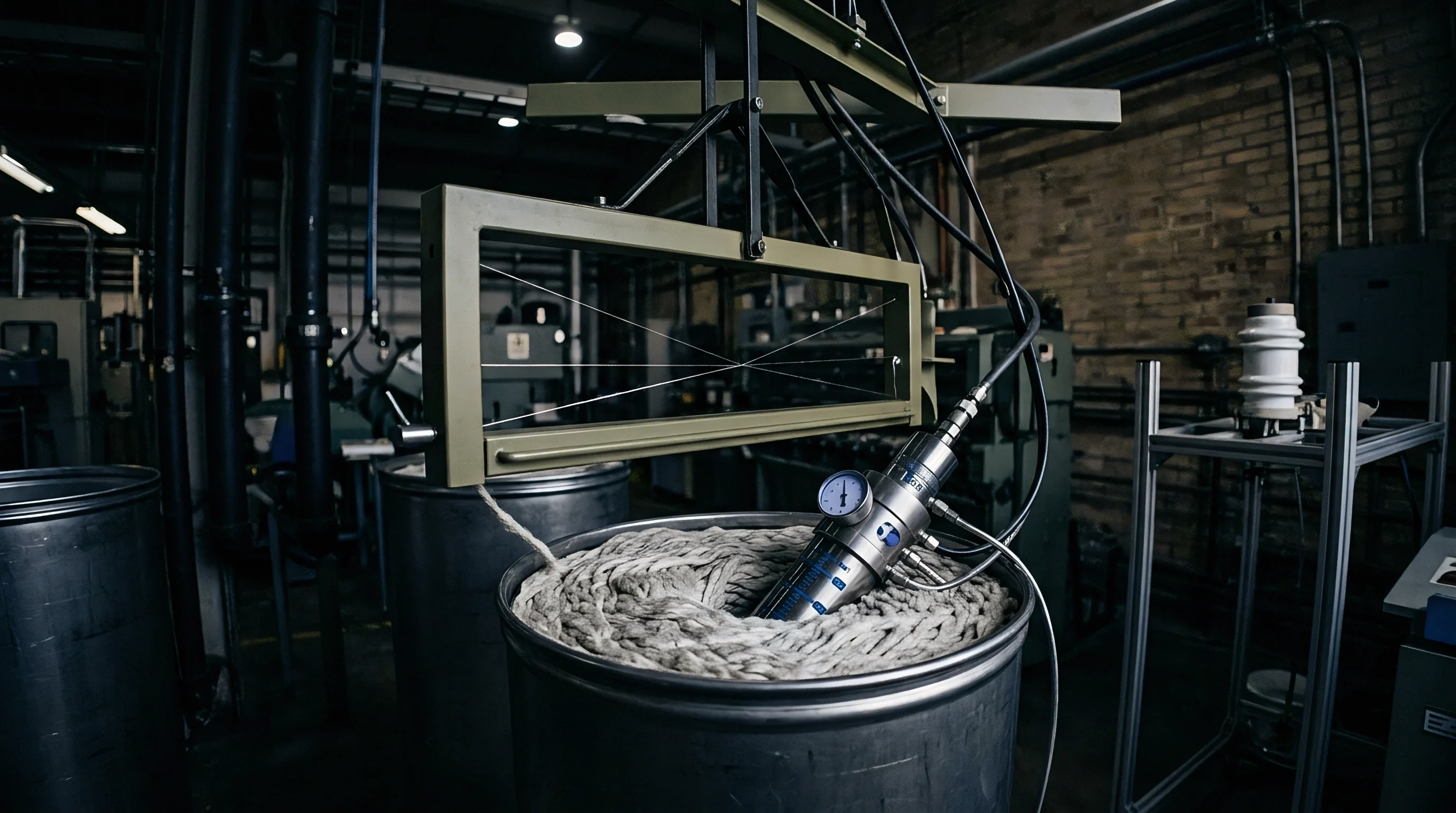
Aerodynamic Drag Disparities across Fiber Species
Staple geometry dictates how moving gas streams impart momentum to individual tufts. Polyester tufts expand radially under turbulent decompression within the duct, presenting high volumetric bulk and lower effective aerodynamic density. Cotton tufts remain comparatively tight, dense, and resistant to radial ballooning due to natural inter-fiber wax cohesion and ribbon reversal interlocking.
The immediate consequence manifests as slip velocity divergence.
Slip velocity defines the arithmetic difference between local carrier air speed and particle linear velocity. The carrier gas travels faster than the entrained solids. Because the bulkier synthetic tuft captures momentum rapidly from the primary airflow core, it achieves a lower slip velocity, accelerating toward carrier speed over a shorter entry transition length.
Cotton tufts accelerate slowly, maintaining a higher slip velocity across the initial eight meters of straight duct. Dense virgin cotton tufts lag behind the gas core, creating instantaneous mass concentration gradients along the pipe centerline.
| Fiber Type And Grade | Linear Density (dtex) | Cut Length (mm) | Specific Gravity (g/cm³) | Aerodynamic Drag Coeff (Cd) | Terminal Velocity (m/s) |
|---|---|---|---|---|---|
| Upland Cotton (Middling 1-1/8) | 1.75 | 28.5 | 1.54 | 0.82 | 3.45 |
| Pima Cotton (Grade 2) | 1.40 | 35.0 | 1.52 | 0.74 | 2.88 |
| Recycled Polyester (100% rPET) | 1.56 | 38.0 | 1.38 | 1.18 | 2.10 |
| Virgin Polyester (Semi-Dull) | 1.33 | 38.0 | 1.38 | 1.24 | 1.92 |
| Bright Viscose (Modal) | 1.44 | 38.0 | 1.51 | 0.96 | 2.62 |

Terminal Settling Velocity and Boundary Layer Slippage
Gravitational drop acts concurrently with horizontal viscous forces during pneumatic transfer. Terminal settling velocity represents the downward speed at which aerodynamic lift balances gravitational pull for an isolated particle in still air. In a conveying duct, this settling velocity determines whether a fiber tuft stays suspended in the high-velocity turbulent core or drops into the low-velocity boundary layer adjacent to the lower duct wall.
Fine polyester tufts exhibit terminal settling velocities between 1.80 and 2.15 meters per second. Cotton tufts of identical mass display settling velocities between 3.20 and 3.85 meters per second. This difference causes a vertical concentration gradient across the pipe cross-section.
Heavier, denser cotton aggregates drift downward, entering the viscous sublayer where air velocity drops toward zero at the conduit boundary. Polyester remains buoyant, carried swiftly within the upper central flow stream. The sliver count drifts.

Tuft Size Variance and Spatial Distribution
Opening cylinders produce a spectrum of agglomeration masses exiting the beater room. Fine wire clothing running on a pinned beater creates individual tuft masses ranging from 0.8 milligrams to 14.5 milligrams. Aerodynamic drag scales with projected surface area, which grows with the two-thirds power of mass for spherical approximations, while gravitational mass scales linearly.
Small tufts experience extreme acceleration; large clumps experience inertial lag.
Substantial mechanical uncoupling occurs across prolonged distribution distances. Conveying systems running past seventy meters from blowroom to card room subject the material to repeated drag sorting cycles. When transport air velocity fluctuates by even ten percent due to filter bag pulsing or fan belt slippage, segregation intensifies exponentially.
The line exhibits recurring process disruptions:
- Streamwise de-synchronization separates high-drag synthetic fibers from low-drag cellulosic fibers over long transit runs, arriving at condenser heads as alternating pulses of unequal composition.
- Boundary deposition traps dense cotton aggregates along duct floors during velocity drops below sixteen meters per second, causing sudden slugging when pressure surges re-entrain settled clumps.
- Frictional static charging targets synthetic fibers disproportionately, driving electrostatic wall adhesion and creating downstream nep clusters when charged skins peel away into the flow.
- Pneumatic micro-shearing strips loose surface fibers from parent tufts, converting longer staple fragments into airborne free fly that concentrates in exhaust air systems rather than entering chute feeds.
- Cross-duct mass skewing shifts the centerline of heavy natural fibers away from conduit centers, feeding card chutes with uneven lateral fiber distributions across their operational widths.
Failure to regulate these aerodynamic differentials delivers raw sliver displaying periodic chemical ratio swings, generating striping across dyed piece goods, uneven moisture pick-up during sizing, and total commercial rejection of the finished cloth lot.

Elbow
Curved conduit sections impose sudden radial accelerations on the two-phase conveying stream. Bends magnify inertia. When the pneumatic vector shifts through a standard ninety-degree elbow with a centerline bend radius equal to 2.5 pipe diameters, suspended solids encounter centrifugal forces ranging from 120 to 350 times standard gravitational acceleration.
Centrifugal acceleration forces separation.
Dense cotton aggregates carry substantial momentum relative to their exposed surface area. These compact natural bundles bypass carrier air streamlines, impacting the outer elbow wall with high kinetic energy. Mass dictates wall contact.
Polyester tufts, possessing lower skeletal density and larger effective surface drag, follow carrier air diversion paths closely, remaining partially entrained within the deflected gas stream.
A tight radius elbow operating at high conveying speed compacts high-density natural fibers against the outer wall while stripping low-density synthetic fibers into the inner flow curve.
Heavy staples migrate outward. The outer wall of the elbow functions as a mechanical compaction zone. Repeated tuft impacts against galvanized steel create a dense, creeping sliding bed of cotton along the extrados of the pipe.
Frictional drag against the conduit wall bleeds kinetic energy from this segregated cellulosic stream, reducing its translational speed to less than forty percent of the carrier gas velocity.
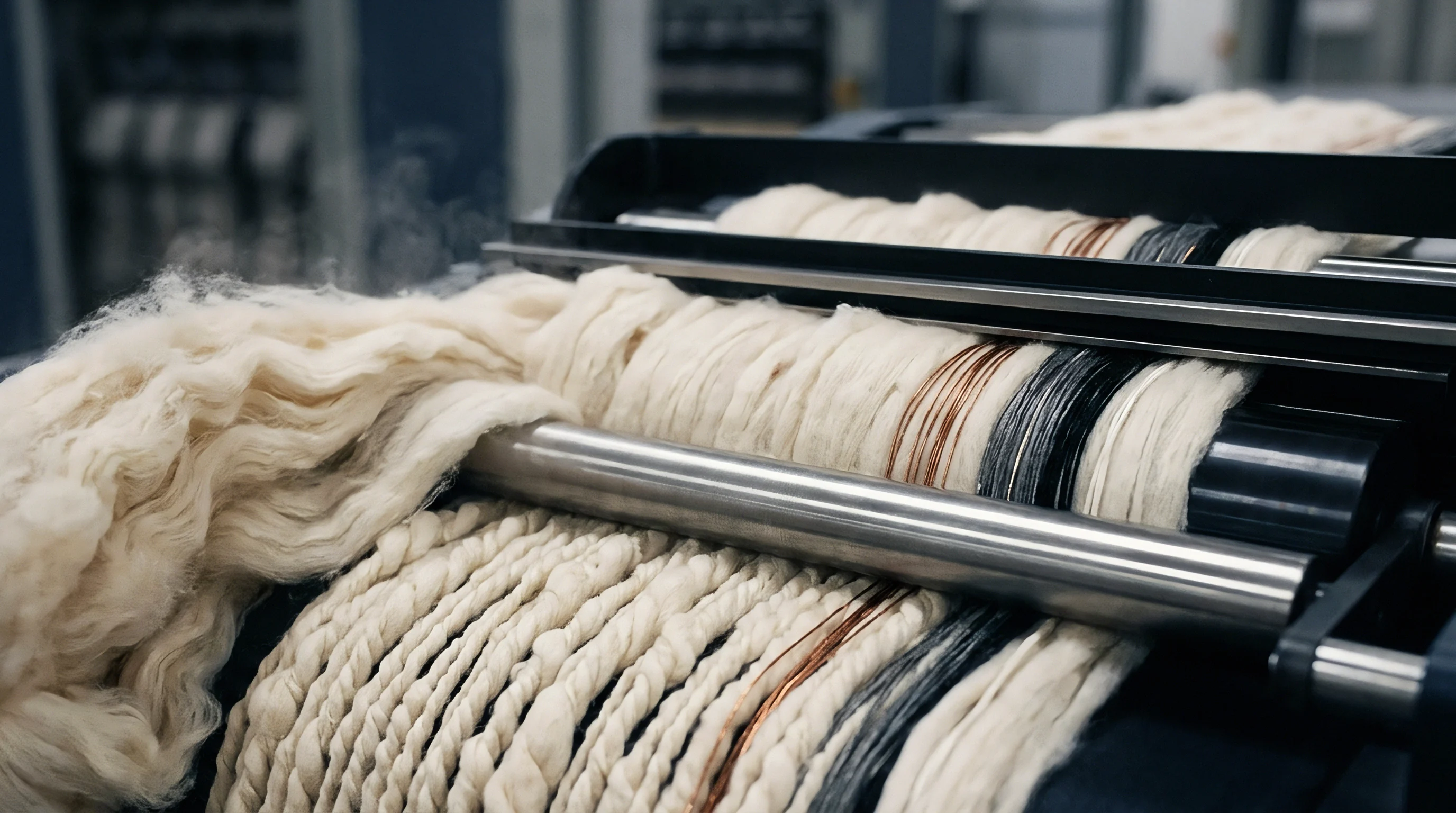
Centrifugal Separation under Radial Acceleration
Inertial forces displace heavier particles outward against the outer wall. A cotton tuft with a mass of 8.0 milligrams moving at 22 meters per second through a 0.75-meter radius bend experiences an instantaneous radial force of 5.16 millinewtons. A buoyant polyester tuft of identical mass, dispersed into a looser volume with twice the aerodynamic drag, experiences the same radial force but encounters vastly higher fluid drag resistance opposing radial displacement.
This dynamic creates complete spatial uncoupling within the bend. The outer quadrant of the pipe cross-section fills with coarse, low-drag, dense cotton. The inner quadrant becomes enriched with fine, high-drag synthetic staple.
In pneumatic pulverized coal conveyance and industrial grain seeding lines, equivalent phase splitting produces uneven fuel combustion and unbalanced furrow seeding densities across branched distributor networks. Inside textile mill ducting, this phase separation directly corrupts intended intimate ratios.
| Conduit Radial Position | Dominant Constituent | Local Air Velocity (m/s) | Solids Velocity (m/s) | Particle Compaction (kg/m³) | Observed Nep Gain (%) |
|---|---|---|---|---|---|
| Outer Wall (Extrados) | Upland Cotton (88%) | 14.2 | 8.6 | 42.5 | +18.4 |
| Centerline Flow Core | Nominal Mix (50/50) | 24.8 | 21.2 | 8.2 | +2.1 |
| Inner Wall (Intrados) | Polyester (79%) | 18.5 | 16.9 | 4.1 | +0.8 |
| Secondary Vortex Zone | Short Cotton Trash (91%) | 11.0 | 5.4 | 19.6 | +24.6 |

Dean Vortices and Wall Compaction Effects
Secondary circulation develops across conduit cross-sections whenever streamline curvature generates transverse pressure gradients. Fluid traveling down the pipe centerline moves faster than boundary layer fluid near the perimeter. In an elbow, this center fluid experiences higher centrifugal force, driving outward toward the pipe extrados and forcing perimeter fluid to return inward along the top and bottom duct walls.
This motion establishes a classical counter-rotating Dean vortex pair.
Dean vortices systematically gather loose, low-mass fiber fragments and short cotton linters from the outer wall, sweeping them inward along conduit surfaces. The twin swirling cells transport short cellulosic fibers toward the inner wall, while the dense sliding bed of mature long-staple cotton continues rolling outward. High-velocity friction against the conduit wall abrades the sliding cotton, snapping fibers, liberating natural waxes, and generating mechanical neps that defy removal at the card licker-in.
Pipelines configured with short-radius elbows continually defeat prior blowroom cleaning stages.
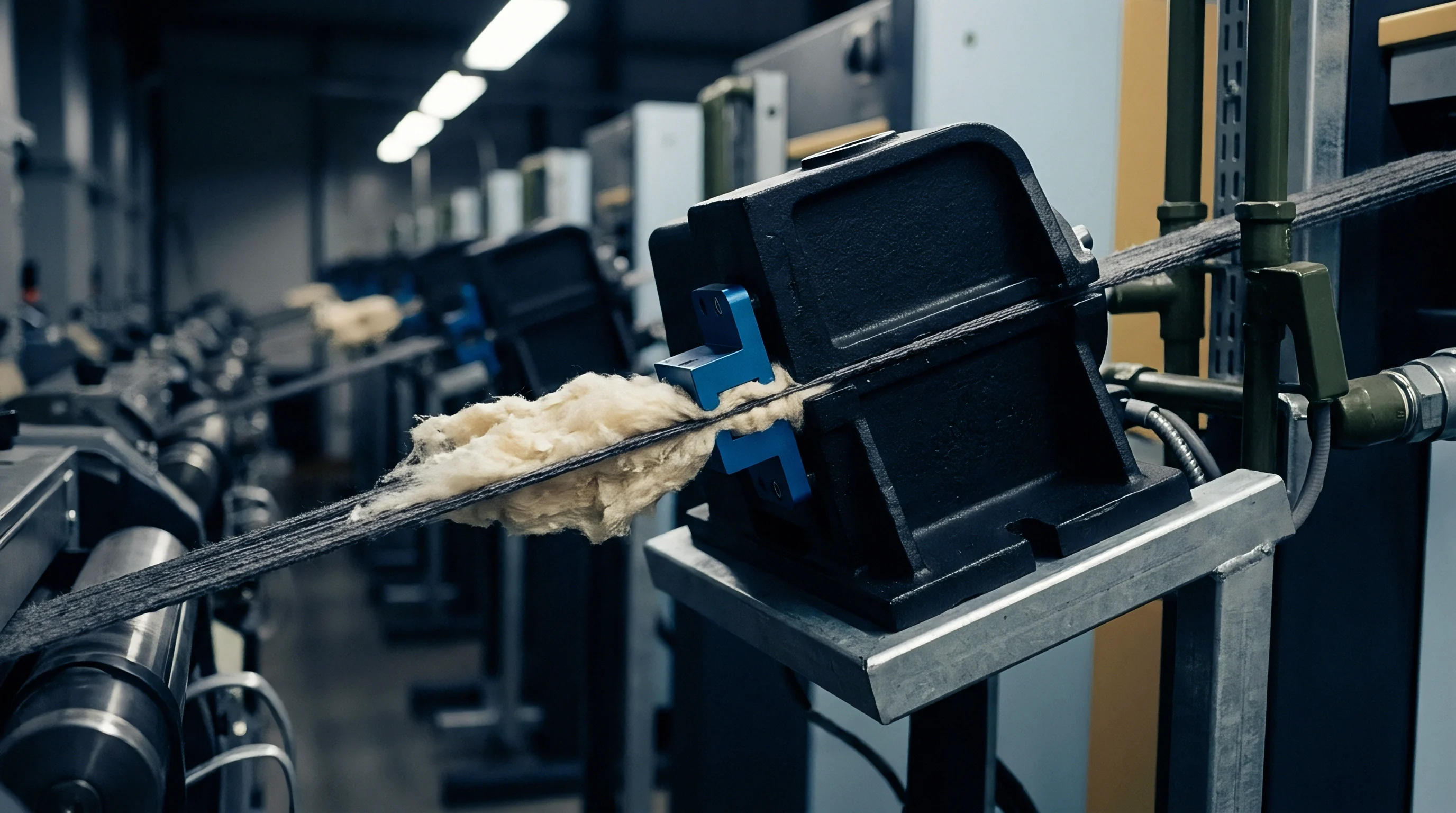

Reception
Card chute feed hoppers collect incoming airborne streams through perforated separation screens. Air velocity drops precipitously. When the pneumatic stream reaches the terminal distributor box above a line of eight or ten high-production cards, static pressure converts into atmospheric exhaust through filter media, and solids drop under gravity into vertical reserve chutes.
Condensers dump air suddenly.
Spatial demixing generated throughout upstream duct runs converts directly into temporal demixing inside the reserve chute. Fast-traveling, buoyant synthetic tufts arrive at condenser screens ahead of the retarded, wall-sliding cotton fractions. As carding machines call for raw stock, reserve feed valves open sequentially.
Chutes positioned closest to duct elbows receive material stripped from the outer pipe radius, while downstream chutes receive the core and inner-wall streams.
Under Section 7.2 of mill purchase contract standard guarantees, chute feed sliver delivery must exhibit an intra-creel linear density variation under 2.5 percent across all working positions.
Chute packing profiles reflect these aerodynamic sorting mechanics. A card chute fed with an aerodynamically fractionated stream develops distinct lateral density bands across its 1000-millimeter working width. Cotton concentrates on the entry side of the condenser box; synthetic staple floats to the bypass side.

Air Disengagement in Reserve Chambers
Pressure drops across condenser screens cause transport air to evacuate while fiber tufts settle downward. The sudden expansion of duct cross-sections from 300 millimeters to feed box dimensions exceeding 1.2 square meters slashes air velocity from twenty meters per second down to less than 1.5 meters per second. This sudden deceleration destroys turbulent suspension capacity.
Particles decouple instantly from fluid motion according to their terminal velocities. The heavier cotton aggregates plunge straight downward toward the reserve box feed rolls. Buoyant polyester staples drift horizontally, carried by exhaust drafts toward the perforated condenser screens, where they form a dense, blinding fiber mat.
When mechanical wipers or pneumatic blowback mechanisms clear these screens, accumulated synthetic sheets fall into the reserve chamber as distinct, concentrated layers. The hopper contents no longer exhibit intimate mechanical distribution.

Hopper Density Gradients and Sliver Irregularity
Mechanical sensors detect mass packing levels across the card feeder width. Compression rolls compress the descending batting into the lower delivery chamber, where a pinned feed roller delivers the web to the card feed plate. Segregated fibers respond differently to mechanical compression.
- Mechanical spring-back testing reveals that polyester-enriched zones within the chute batting possess three times the elastic recovery force of adjacent cotton-heavy zones, distorting feed roller nip pressures across the machine profile.
- Licker-in tooth loading spikes sharply when dense cotton slugs enter the licker-in zone, causing fiber breakage, seed coat fragmentation, and rapid clothing dulling.
- Card cylinder transfer efficiency fluctuates systematically because synthetic fibers transfer to the doffer at significantly higher rates than un-carded, waxy cotton staples under identical wire settings.
- Card sliver draw-off rolls consolidate these uneven web fractions into a continuous sliver displaying cyclic, long-wave mass and constituent variations that carry untouched through first-passage drawframes.
Downstream autolevellers compensate for total cross-sectional sliver mass by adjusting draft ratios on the drawframe, yet they remain blind to constituent ratios. An autoleveller detects a heavy spot and thins the sliver mechanically; it cannot detect that the heavy spot consists of seventy percent cotton while the adjacent thin spot contains sixty-five percent polyester.
Tariff
Customs authorities classify imported spun yarns and textiles strictly by predominant raw constituent weight under Chapter 52 and Chapter 55. Importers bear full liability. When an invoice declares a single-yarn shipment as 52 percent combed cotton and 48 percent polyester staple by weight under Harmonized System heading 5205, duty assessments hinge upon laboratory verification of that thin two percent margin.
Tariff lines penalize errors.
Aerodynamic segregation during blowroom pneumatic conveyance represents the unrecognized mechanical driver behind sudden customs border reclassifications. A mill sets its automated weigh-pan laydown to deliver an exact 50/50 or 52/48 master recipe. Over three hundred meters of distribution piping, high-velocity transport fractions the components.
The outer chutes feed card sliver testing at 56 percent cotton; the end-of-line chutes feed card sliver testing at 44 percent cotton. Sliver drawn from these unbalanced cards enters yarn spinning untouched. Customs inspectors retest sliver.
A measured two percent shift in synthetic fiber mass fraction moves a combed yarn from Chapter 52 into Chapter 55, triggering an immediate six percent base duty increase under European Union customs schedules.
Tolerances vanish at customs. When customs laboratory technicians test landed yarn or finished piece goods using quantitative chemical dissolution under ISO 1833 or ASTM D629, they do not average the mill laydown logs. They test the specific physical cones pulled from the shipping container.
If solvent extraction reveals polyester content exceeding 50.0 percent on a lot declared as predominantly cotton, the shipment fails classification under Chapter 52.

Commercial Fiber Ratio Drift from Bale to Sliver
Chemical testing of intake stock rarely matches the quantitative composition of carded intermediate product. Intake bale laydown relies on load-cell weigh pans with an accuracy rating of plus or minus 0.5 percent per drop. Yet testing card sliver across eight active cards reveals profound divergence from initial recipe settings due entirely to pneumatic transport sorting and filtration losses.
Quantitative analysis demonstrates that fine dust collection systems and condenser exhaust filters selectively strip high-drag fibers and loose cellulosic linters from the flow. A system transporting a nominal 60 percent Upland cotton and 40 percent 1.33 dtex polyester mix routinely exhausts between 1.2 and 1.8 percent of raw cotton linter mass through roof filters, while synthetic staple loss remains below 0.15 percent. This selective filtration moves the delivered mass balance toward the synthetic constituent before the carding cylinder ever touches the stock.
| Declared Ratio (Bale Laydown) | Actual Delivered Ratio (Spun Yarn) | Declared Tariff Classification | Enforced Tariff Classification | Base Duty Differential (%) | Landed Cost Exposure (per 20-ton Lot) |
|---|---|---|---|---|---|
| Cotton 52% / Polyester 48% | Cotton 48.5% / Polyester 51.5% | HS 5205.12 (4.0% Duty) | HS 5509.53 (8.0% Duty) | +4.0% | $3,680.00 |
| Viscose 55% / Cotton 45% | Viscose 49.2% / Cotton 50.8% | HS 5510.11 (4.0% Duty) | HS 5205.11 (8.0% Duty) | +4.0% | $3,520.00 |
| Merino Wool 52% / Recycled Poly 48% | Merino Wool 47.8% / Recycled Poly 52.2% | HS 5106.10 (3.8% Duty) | HS 5509.52 (8.0% Duty) | +4.2% | $8,820.00 |
| Cotton 85% / Recycled Cotton 15% | Cotton 92.0% / Recycled Cotton 8.0% | Circular Label Guarantee | Greenwashing Penalty | Civil Penalty | $15,000.00 |

Chief Weight Demarcation under Harmonized System Rules
Border enforcement agencies determine taxation schedules based on dry mass content verified through ISO 1833 solvent extraction. Under the General Rules for the Interpretation of the Harmonized System, specifically GRI 3(b) and Note 2 to Section XI, goods composed of two or more textile materials classify according to that constituent which predominates by weight over any other single material. When constituent masses match closely, minute operational errors create massive financial penalties.
Consider a typical commercial contract involving a twenty-metric-ton shipment of Ne 30/1 ring-spun knitting yarn. The contract specifies 52 percent cotton and 48 percent polyester to secure preferential entry under bilateral trade concessions. Take a forty-ton yarn order valued at four dollars per kilogram CIF destination port.
Assume pneumatic sorting shifts the mean delivered polyester fraction to 50.8 percent across forty percent of the production lot. The customs laboratory pulls ten test cones, applies boiling 75 percent sulfuric acid to dissolve the cellulosic fraction per ISO 1833-11, weighs the dried polyester residue, applies standard moisture regain allowances, and determines chief weight belongs to polyester.
Customs authorities immediately reclassify the container from HS 5205.12 to HS 5509.53. In addition to demanding the base tariff rate difference, customs officials routinely initiate formal fraud investigations, hold the cargo in bonded storage at compounding demurrage rates of $220 per container per day, and mandate complete testing of subsequent shipments. The financial damage rapidly exceeds total commercial margin for the buyer.
Purchasing specifications must defend the contract against pneumatic sorting defaults. Purchase orders must contain exact compliance covenants:
- Individual cone composition bounds dictate that no single yarn package drawn from a container may deviate by more than plus or minus 1.5 percentage points from the declared master ratio, superseding general lot-average allowances.
- Chemical separation verification specifies ISO 1833-11 testing for cotton-polyester or ISO 1833-7 for polyamide mixtures, requiring accredited third-party test reports cut directly from finished spinning packages prior to port dispatch.
- Moisture regain correction criteria mandate strict application of commercial moisture allowances (cotton at 8.5 percent, polyester at 0.4 percent, viscose at 13.0 percent per ISO 6741) to resolve raw dry weight versus commercial weight disputes.
- Indemnity allocation provisions assign all reclassification duties, customs penalties, inspection laboratory bills, and shipping demurrage expenses directly to the spinning mill upon documented proof of ratio deviation.
Suppliers routinely dismiss downstream ratio drift as standard laboratory margin of error, claiming the opening room weigh scales prove absolute compliance with the purchase contract.

Remedy
Engineering adjustments to conveying pipelines suppress differential drag segregation before material deposits into card chutes. Pipeline geometry governs mixing. Mill engineers can eliminate constituent uncoupling by redesigning conduit geometry, capping transport speeds, and installing mechanical recombining units ahead of card feeding lines.
Speed degrades component uniformity.
Air velocity must operate within a tightly controlled operational window. Conveying velocities exceeding 22 meters per second guarantee severe aerodynamic drag separation, wall compaction, and nep generation. Velocities dropping below 12 meters per second invite catastrophic pipe blockage, boundary layer settling, and unstable line surging.
Balancing transport systems precisely between 14.0 and 15.5 meters per second minimizes slip velocity disparities between natural and synthetic staples while maintaining total suspension capacity across prolonged horizontal lines.

Velocity Modulation and Line Balancing
Operating transport fan speeds between 12 and 15 meters per second prevents extreme momentum splitting between disparate staples. Modern variable-frequency drives controlled by static pressure sensors throughout the conduit run dynamically regulate blower output to sustain constant velocity regardless of filter bag resistance or card chute demand cycles.
Duct diameters must scale progressively along distribution lines. When an airflow of 10,000 cubic meters per hour branches to feed consecutive card chutes, the main trunk diameter must decrease proportionally after each takeoff point to maintain a flat velocity profile. Systems utilizing uniform-diameter distribution trunks suffer rapid velocity decay toward dead-ends, dropping heavy cotton out of suspension and over-supplying synthetic fibers to terminal cards.

Geometric Redesign and Aerodynamic Decouplers
Long-radius bends featuring centerline radius-to-diameter ratios above three reduce wall strike pressures. Replacing standard 90-degree elbows with smooth, sweeping bends or twin 45-degree offsets separated by four pipe diameters of straight pipe allows centrifugal forces to dissipate without driving material into compact sliding beds.
Installing multi-chamber blending units immediately ahead of card chute distributors provides the ultimate defense against pneumatic fractionation. Machines utilizing six or eight vertical gravity blending chambers accept the pneumatic stream, drop the stock downward under atmospheric deceleration, and cross-slice the vertical columns using horizontal pinned lattice aprons. This mechanical cross-cut re-integrates any phase separation generated during duct transit, presenting the card chutes with an entirely homogeneous, intimate fibrous structure.
Quality control begins at the card sliver coiler rather than the opening room bale laydown sheet. Implementing routine chemical extraction testing on every card position once per shift catches localized aerodynamic segregation before thousands of kilograms of out-of-spec intermediate sliver pass to ring frames or rotor spinning positions. The resulting yarn runs uniform, bills clear customs without administrative seizure, and landed costs match commercial pro-forma projections precisely.