Liquid Junction Potential Drift in High Temperature Differential Potentiometric Sensors during Continuous Mercerization Monitoring
Liquid junction drift in hot caustic mercerizing sensors is controlled by using pressurized flowing junctions verified against manual shift titrations.


Drift
Continuous mercerization relies on maintaining sodium hydroxide concentrations between 200 and 300 grams per liter at temperatures frequently exceeding 60 degrees Celsius. When wet-on-wet impregnation runs continuously across four-shift operational rotations, bath liquor entrains hemicellulose fragments, cotton waxes, and polyanionic wetting agents. Online differential potentiometric systems attempt to track this caustic charge by measuring the potential difference between two ion-selective or reference half-cells placed across an extraction loop or a controlled dilution junction.
Liquid junction potential instability at the interface between the high-concentration caustic analyte and the reference electrolyte generates baseline tracking errors that disrupt automated replenishment feeds.
The potential across the junction arises from unequal ionic mobilities. In strong caustic baths, the limiting equivalent ionic conductance of the hydroxide anion reaches 198 square centimeters per ohm equivalent at 25 degrees Celsius, while the sodium cation displays a conductance of 50.1 square centimeters per ohm equivalent. Elevating bath temperature to 65 degrees Celsius raises mobility values across all species, widening the velocity gap across the diaphragm.
Hydroxide ions diffuse into the porous reference structure significantly faster than sodium ions, creating a separation of charge across the phase boundary. The resulting boundary potential directly offsets the target millivolt signal.
Mercerizing saturator baths rarely remain binary mixtures of sodium hydroxide and water. Industrial scouring and mercerizing lines accumulate dissolved sizing agents, degraded cellulose short chains, and sulfonated surfactants. These macromolecular species alter the physical boundary at ceramic or Teflon junctions by adsorbing onto the pore walls.
As pores constrict, the transport numbers of the diffusing electrolytes shift from bulk values to surface-governed values, causing a continuous translation of the baseline potential.
A five-millivolt junction shift at sixty-five degrees Celsius forces an automated dosing controller to miscalculate caustic concentration by up to twelve grams per liter.
When an automated titrator or direct potentiometric loop experiences this offset, process controllers interpret the voltage shift as an alteration in bath strength. The control valve delivers excess concentrated caustic or process water, driving the effective impregnation concentration away from the target specification. Fabric passing through the stenter under incorrect caustic saturation exhibits uneven crystalline transformation, incomplete conversion from cellulose I to cellulose II, and unlevel dye pick-up during downstream dyeing operations.

Junction
Porous ceramic diaphragms, ground-glass sleeves, and laser-drilled polymer apertures define the physical boundary between reference half-cells and the process stream. Standard saturated potassium chloride reference electrolytes yield a relatively matched diffusion profile under neutral conditions, given the similar ionic mobilities of potassium and chloride ions. Exposing this junction to a bath containing 260 grams per liter of sodium hydroxide creates a steep chemical activity gradient across a spatial dimension often narrower than one millimeter.
Thermodynamic modeling of this boundary relies on the Henderson equation to approximate the liquid junction potential based on ion concentrations, charges, and mobilities across the transition zone. Real mercerization saturators depart from ideal Henderson assumptions. The boundary is not an unconstrained, continuous diffusion plane; it is a restricted porous geometry experiencing thermal gradients, turbulent cross-flow, and chemical precipitation.
Viscosity within the junction rises sharply when caustic analyte contacts potassium-based electrolytes, promoting local salt crystallization.

Transport Alteration across Porous Substrates
Convective forces within recirculating mercerizer loops superimpose hydraulic pressure differentials onto the ionic diffusion process. If process line pressure surpasses the internal head of a gel-filled reference electrode, caustic process liquor penetrates the diaphragm interior. This reverse flow alters the internal electrolyte chemistry, neutralizes acidic buffer components, and precipitates insoluble hydroxides inside the ceramic matrix.
Forward electrolyte flow prevents process liquor ingress, yet it depletes electrolyte reservoirs rapidly under elevated operating temperatures.
Solid-state and polymer reference junctions eliminate free liquid leakage by suspending salts within cross-linked matrices. These polymer systems face structural plasticization and saponification when subjected to prolonged hot alkali baths. Hydrolysis of polymer backbones opens macro-voids, destabilizing the diffusion profile and inducing random low-frequency potential noise that filtering algorithms fail to eliminate.
| Ionic Species | Conductance at 25 C (S cm2 mol-1) | Conductance at 65 C (S cm2 mol-1) | Transport Number in 5M NaOH | Diffusion Coefficient (10-5 cm2 s-1) |
|---|---|---|---|---|
| Hydroxide (OH-) | 198.3 | 342.0 | 0.78 | 5.27 |
| Sodium (Na+) | 50.1 | 108.5 | 0.22 | 1.33 |
| Potassium (K+) | 73.5 | 145.2 | 0.50 | 1.96 |
| Chloride (Cl-) | 76.3 | 148.8 | 0.50 | 2.03 |
Differences between the mobility of the hydroxide ion and the counter-ions remain the primary generator of junction bias. In systems where ceramic frits develop particulate fouling from cotton lint and sizing gums, effective pore diameters shrink below ten nanometers. Electrical double layers on the pore surfaces begin to overlap, excluding anions and favoring cation transport.
This selective transport regime invalidates standard Henderson calculations, generating junction potentials exceeding thirty millivolts.
A supplier often states that differential sensor pairs cancel out junction potentials by design. That claim assumes both junctions encounter identical interface conditions, identical flow velocities, and identical foulant deposition rates. Industrial mill operations disrupt this symmetry within hours of line startup.

Clog
Cotton greige goods entering continuous preparation lines carry natural impurities alongside applied processing chemistries. Pectins, proteins, natural waxes, and inorganic salts release directly into the caustic liquor during hot impregnation. Desizing efficiencies vary across weaving lots, meaning residual native starches, modified starches, polyacrylates, and polyvinyl alcohol enter the mercerization bath continuously.
Thermal degradation breaks these polymers into fragments that alter fluid rheology at the sensor interface.
Alkaline extraction conditions dissolve low molecular weight cellulose fractions and hemicelluloses, which re-precipitate when local thermal or chemical equilibria shift. The junction perimeter creates a localized zone of reduced temperature and altered ionic strength. Dissolved cellulosic material precipitates precisely at this boundary, forming an amorphous gel layer over the diaphragm pores.
This surface coating restricts ionic migration and establishes asymmetric Donnan potentials.

Interference Profiles of Process Auxiliaries
Commercial mercerization recipes require specialized wetting agents capable of functioning in bath strengths exceeding 28 Bé. These formulations contain sulfated aliphatic alcohols, alkyl phosphate esters, or branched non-ionic surfactants. Surfactant molecules adsorb aggressively onto the high-energy ceramic and glass surfaces of potentiometric assemblies.
The hydrophobic tails orient outward, creating an admicellar barrier that impedes the free diffusion of ions into and out of the reference junction.
- Anionic wetting auxiliaries complex with reference metal cations escaping the diaphragm, depositing insoluble salts inside the micro-channels.
- Solubilized starch fragments retrogradate at stagnant reference interfaces, forming dense polysaccharide plugs resistant to chemical cleaning flushes.
- Silicate stabilization residues carried over from upstream bleaching steps precipitate as hydrated amorphous silica under shifting local pH conditions.
- Suspended fiber lint binds physically to rough ceramic frits, creating a stagnant boundary layer that isolates the sensor from the bulk fluid dynamics.
Fouling rates correlate with process line speed and bath turnover volume. Slower lines with high liquor retention times accumulate dense organic loads that coat electrodes rapidly. High-speed continuous ranges sweep bulk solids past the sensor face, yet boundary-layer physics preserves a slow-moving fluid envelope right against the diaphragm, allowing foulant deposition to continue uninterrupted.
A mill floor technician clears these coatings using hot acidic wash cycles during weekly maintenance stops. Acid flushing dissolves carbonate scales and extracts precipitated metal complexes. Acid contact strips the hydration layer from specialized alkaline-resistant glass membranes and risks precipitation of organic surfactants that remain soluble only in alkaline environments.
Maintenance protocols that ignore auxiliary solubility chemistry accelerate irreversible junction damage.


Flux
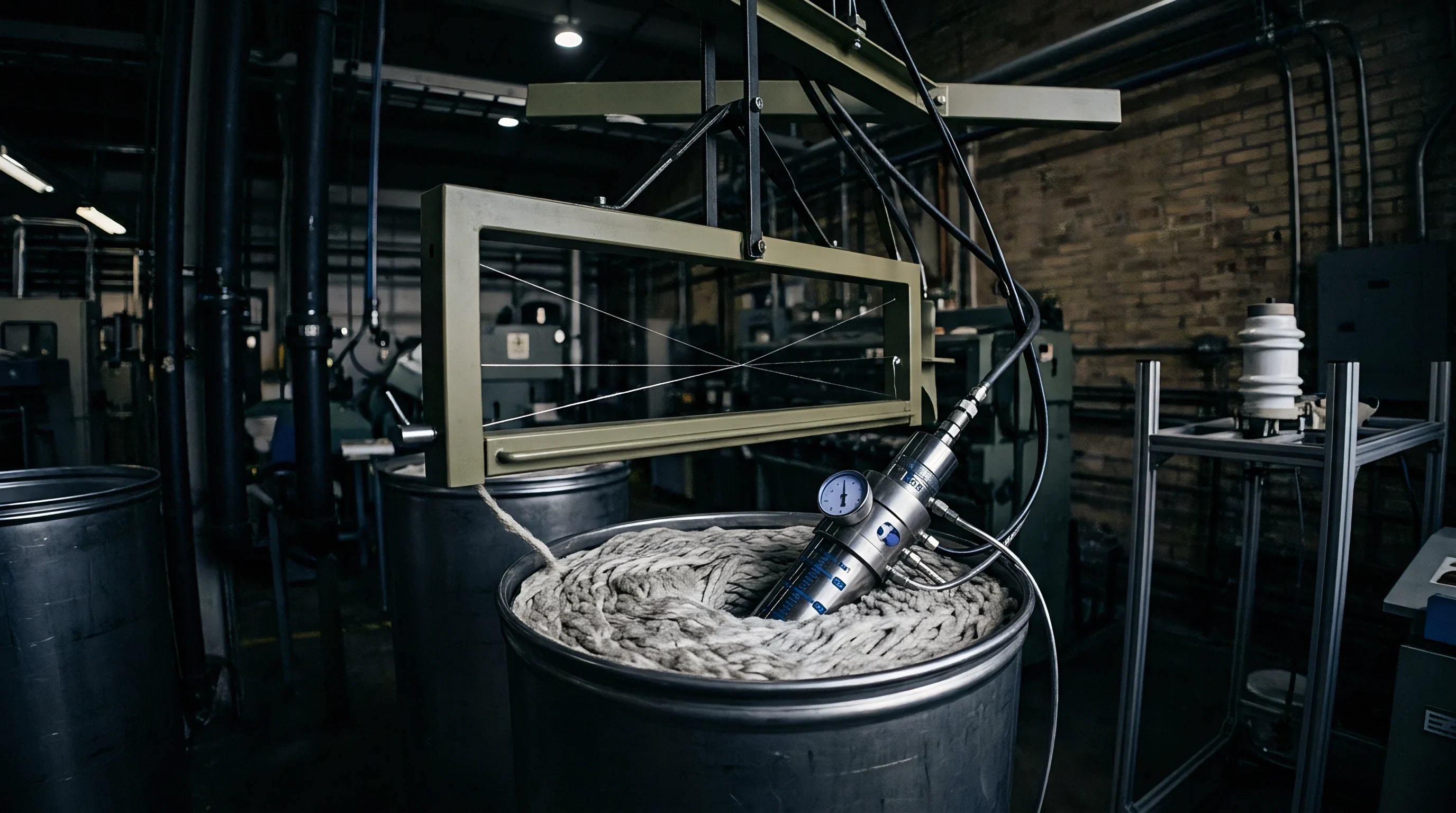
Managing liquid junction potential drift requires regulating the physical transport of electrolyte across the phase boundary. Flowing junction designs counter outward diffusion and inward fouling by maintaining a continuous, positive mass displacement of reference solution into the process stream. Pressurized electrolyte chambers, driven by external air blankets or mechanical spring-loaded pistons, force fresh potassium chloride or alternative saline mixtures through the diaphragm at fixed volumetric rates.
Positive pressure offsets the process line hydraulic head, preventing caustic penetration into the reference chamber. This constant flushing preserves reference electrode stability by keeping internal chloride activities constant. Physical delivery of electrolyte dilutes the immediate process boundary layer, introducing a localized concentration gradient that requires compensation algorithms to account for micro-volume dilution at the sensing tip.

Can Pressurization Eliminate Boundary Potential Variation?
Imposing an external overpressure stabilizes the physical position of the diffusion zone, anchoring it at the exterior face of the diaphragm. Fluid consumption accelerates under high pressure, demanding frequent electrolyte replenishment that operators often neglect during extended production campaigns. When reservoir pressure drops below line pressure during process surges, the direction of flux reverses instantly, drawing concentrated alkali into the porous core and destroying calibration integrity.
Restricting reference electrolyte seepage below three microliters per hour exposes the junction to rapid ionic back-diffusion and fouling.
Equitransferent bridge electrolytes attempt to minimize the magnitude of the potential by selecting salt mixtures whose cations and anions move at identical velocities. Concentrated potassium chloride performs adequately in neutral media, yet falls short against the high mobility of concentrated hydroxide. Formulations utilizing concentrated lithium acetate, ammonium nitrate, or specialized potassium nitrate matrices alter the mobility distribution across the junction.
High-temperature caustic baths limit the effectiveness of standard bridge mixtures because chemical stability breaks down and ion pairing changes unexpectedly above 60 degrees Celsius.
| Delivery System | Electrolyte Type | Mean Junction Drift (mV per 24h) | Maintenance Cycle (Days) | Consumption Rate (mL per day) |
|---|---|---|---|---|
| Free Diffusion Fritted Ceramic | 3M KCl Liquid | 14.2 | 3 | 0.2 |
| Overpressurized Capillary (1.5 bar) | 3M KCl Liquid | 2.1 | 14 | 18.5 |
| Polymer Gel with Open Aperture | Polymerized Salt Matrix | 8.6 | 7 | 0.0 |
| Double Junction Sleeve (0.5 bar) | 1M KNO3 Outer / 3M KCl Inner | 4.3 | 10 | 6.2 |
Ground-glass sleeves provide an adjustable, renewable liquid interface superior to fixed-pore ceramics in fouling service. Loosening or tightening the ground-glass collar alters the electrolyte outflow rate, allowing the verifier to match the purge velocity to the particulate load of the bath. The mechanical nature of the sleeve requires continuous alignment and cleaning.
If workers overtighten the collar during routine inspection, electrolyte flow halts, and junction drift returns to levels typical of unpressurized assemblies within twelve hours.
A rigorous verification regime requires logging reservoir pressures alongside potentiometric readings. Sensor assemblies that operate without dynamic flow monitoring conceal junction deterioration behind electrical damping circuits, blinding the automated dosing panel to the true rate of caustic consumption.


Shift
Converting a differential potentiometric voltage into a reliable concentration value requires compensating for the temperature dependence of ionic activity and junction potential. The Nernst factor scales linearly with thermodynamic temperature, multiplying any potential error generated by the liquid boundary. Continuous mercerizing lines experience temperature swings during fresh water make-up cycles, stenter speed changes, and shift-change ramp-ups.
When bath temperature changes from 20 degrees Celsius during line start-up to 65 degrees Celsius during steady operation, the junction potential shifts non-linearly.
Differential potentiometric setups deploy two distinct sensing electrodes to isolate the concentration signal: a caustic-sensitive half-cell, often an antimony, bismuth, or specialized alkali glass electrode, and a reference half-cell. Alternatively, the system uses two identical sodium-responsive electrodes immersed in separated streams of known and unknown concentrations connected through an internal salt bridge. This differential configuration aims to cancel symmetric temperature shifts.
Non-symmetric thermal gradients between the sensor bodies break this balance, generating false voltage readings.

Empirical Matrix Correction Formulation
Online transmitters apply automated algorithms to convert raw sensor voltages into concentration equivalents. Standard Nernstian slope correction compensates for standard electrode response but fails to correct for the non-linear, multi-component junction shift. Process engineers construct multi-variable empirical models mapping potential deviations across temperature and concentration matrices.
- Raw sensor acquisition captures the uncompensated potential difference and the internal resistance across the electrode network.
- High-speed resistance measurement evaluates high-frequency alternating-current impedance to calculate true solution conductivity and detect junction clogging.
- Temperature normalization applies a third-order polynomial correction to account for non-linear ionic mobility shifts in hydroxide solutions between 40 and 80 degrees Celsius.
- Hydroxide activity translation processes the corrected potential through activity-coefficient tables to resolve target concentration in grams per liter.
Process controllers rely on these mathematical corrections to maintain stability. If fouling alters the physical transport properties of the junction, the empirical polynomial coefficients fail, and mathematical compensation exacerbates measurement errors instead of correcting them.
Operating procedures that lack weekly calibration checks against standardized wet chemical titrations produce automated control loops that compound chemical waste.
Take an operational run processing medium-weight woven poplin through an eight-box continuous open-width range. The target concentration sits at 240 grams per liter of sodium hydroxide at 60 degrees Celsius. Over forty-eight hours of steady production, organic foulants settle into the reference diaphragm, generating a continuous junction potential drift of negative seven millivolts.
The differential amplifier registers this drift as an artificial reduction in bath alkalinity.
Responding to this artificial signal, the automated dosing valve opens, feeding 50 percent concentrated commercial caustic soda into the dilution tank. Actual bath strength climbs to 258 grams per liter before operators notice the error. The stenter running behind the mercerizer applies tension to fabric containing excess swelling agent, causing uneven warp-wise shrinkage and structural stiffening.
The lot fails tear-strength and dimensional stability testing under ISO 13934-1, forcing the converter to reclassify thousands of meters of first-quality goods into secondary utility grades.


Audit
Downstream certification frameworks enforce tight boundaries around process chemistry, residual chemical limits, and fabric physical performance. The OEKO-TEX STANDARD 100 Annex 4 establishes clear limits for fabric surface pH, specifying an acceptable band between 4.0 and 7.5 for Class I baby articles and 4.0 to 8.5 for Class II articles contacting skin. When continuous mercerization monitors drift, washing and acid neutralization boxes downstream receive inaccurate feed commands, causing residual caustic to remain in the textile core.
Unneutralized fabric delivered to garment confection facilities produces finished goods that fail import compliance audits. REACH Regulation Annex XVII restricted-substance testing targets trace heavy metal impurities like antimony, arsenic, and lead often present as impurities in low-grade commercial caustic soda supplies. When uncontrolled junction drift drives continuous over-dosing of technical-grade caustic, heavy metal accumulation in the finished textile substrate rises proportionally, threatening compliance with strict consumer safety standards.

Contractual Liability and Retest Realities
Commercial contracts between textile mills, converters, and brand buyers establish strict quality liability clauses. An unverified sensor loop produces off-spec tensile strengths, variable dye affinities, and irregular shrinkage rates that lead directly to container detentions or batch rejections at destination ports. Brand compliance inspectors reject delivery lots when core extraction pH tests deviate from specified purchase order limits.
Resolving an extraction pH failure demands accredited laboratory testing under standard ISO 3071 methods. Retesting stalled shipping lots generates significant warehouse storage fees, freight demurrage, and administrative costs. If laboratory reports confirm an out-of-spec alkaline condition, the mill faces the expense of unpacking, unrolling, scouring, re-neutralizing, and drying the entire production run.
Such corrective processing destroys operating margins and damages long-term commercial relationships.
| Standard / Regulation | Applicable Class | Parameter Limit | Test Method | Non-Compliance Commercial Impact |
|---|---|---|---|---|
| OEKO-TEX STANDARD 100 | Class I (Infants) | pH 4.0 to 7.5 | ISO 3071 (Aqueous Extract) | Certificate suspension, lot recall |
| OEKO-TEX STANDARD 100 | Class II (Skin Contact) | pH 4.0 to 8.5 | ISO 3071 (Aqueous Extract) | Batch rejection at importer audit |
| REACH Annex XVII | Direct Skin Contact | Trace Metals ( | EN 16711-2 (Extractable) | Border detention, market withdrawal |
| Brand Quality Manual | Woven Apparel | Tensile Loss | ISO 13934-1 (Strip Method) | Financial penalty, chargebacks |
A mill floor verifier confirms bath parameters directly rather than trusting online control displays. Verifiers pull liquor samples directly from the saturator box at defined sampling points, cooling them to ambient temperature in sealed vessels to prevent atmospheric carbonation, and executing manual potentiometric or acid-base titrations against certified standard hydrochloric acid solutions. The transaction certificate and the batch inspection file must reflect these offline manual confirmations alongside the continuous digital trends.
Standard quality agreements mandate that all continuous online analytical sensors undergo physical cross-checks against calibrated secondary standards at least once per twelve-hour operational shift, and the failure to execute these manual verification steps shifts the financial liability for off-spec yardage entirely onto the processing facility.