Standard Laboratory Methods for Quantitative Fibre Blend Analysis
Quantitative fibre blend analysis uses selective chemical dissolution, gravimetric desiccation, and microscopic counting to verify trade declarations.


Specimen
Quantitative analysis of intimate fibre mixtures begins with the physical mass balance of the drawn sample. Standard test procedures ISO 1833 and AATCC 20A cover binary and ternary mixtures by measuring the oven-dry mass of an intact specimen, selectively dissolving or mechanically extracting one component, and re-weighing the dry insoluble residue. A single percentage point deviation on a customs declaration can swing tariff headings between natural fibres and man-made filaments, exposing sourcing operations to duty penalties and misdeclaration liability whenever spinning lots drift outside designated chemical tolerances.
Proper sampling controls test validity across bulk textile shipments. Pulling a single laboratory swatch from the edge of a finished roll introduces skew from sizing agents, topical softeners, and local tension variations. Standard ISO 5089 mandates drawing multiple samples across the lot, stripping selvages, and conditioning cut specimens to a standard textile atmosphere at twenty degrees Celsius and sixty-five percent relative humidity.
Any non-fibrous matter that could distort the initial weight requires complete extraction before chemical digestion.
Standard ISO 1833 Part 1 prescribes petroleum ether Soxhlet extraction followed by warm water washing to clear non-fibrous lubricants before gravimetric testing.
Pre-treatment solvents target process oils, yarn waxes, knitting lubricants, and residual starch sizes without attacking the underlying polymer backbone. Soxhlet extraction using petroleum ether runs for at least four hours at no fewer than six cycles per hour. Water-soluble sizes wash out through continuous agitation in distilled water held at fifty degrees Celsius for thirty minutes.
Skipping this preliminary clean leaves three to five percent non-fibrous mass in the calculation, artificially inflating the main fibre percentage.
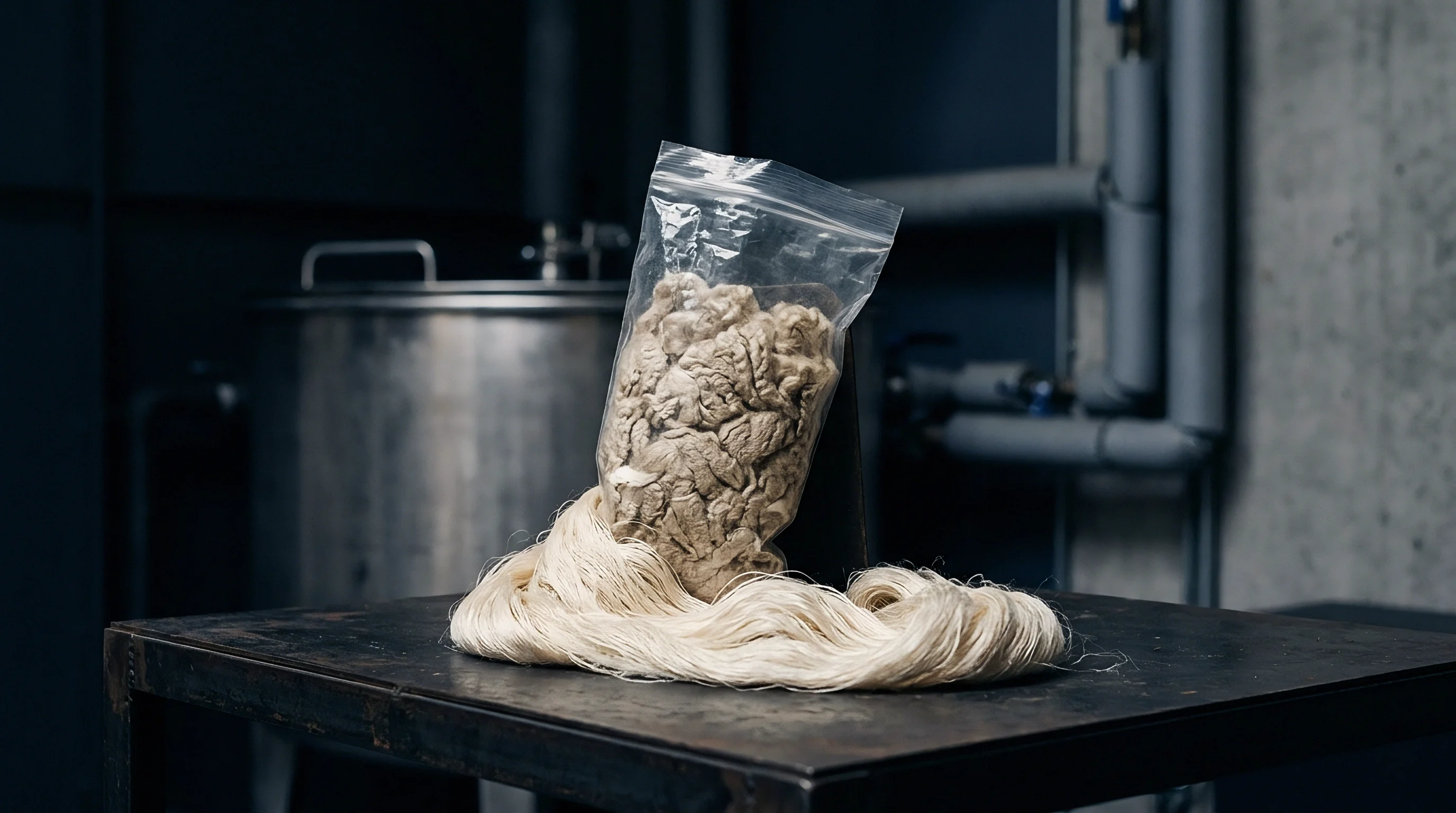
Gravimetric Desiccation and Standard Moisture Allowance
Oven-dry weighing takes place in ventilated drying chambers held at one hundred and five degrees Celsius, plus or minus two degrees. The technician dries the clean specimen to constant mass, confirmed when successive weighings at fifteen-minute intervals vary by less than 0.05 percent mass. Direct laboratory values represent clean dry percentages, but commercial trade declarations require applying agreed commercial moisture regains specified in regulatory schedules.
| Fibre Classification | Polymer Composition | Standard Commercial Regain Percentage | Solvent Sensitivity Class |
|---|---|---|---|
| Combed Cotton | Natural Cellulosic Polymer | 8.50 | Resistant to cold acetone and seventy-five percent sulphuric acid |
| Wool and Fine Animal Hair | Natural Keratin Protein | 17.00 | Soluble in cold alkaline sodium hypochlorite |
| Viscose Rayon | Regenerated Cellulose | 11.00 | Soluble in zincate solution and cold sixty percent sulphuric acid |
| Polyester | Polyethylene Terephthalate | 1.50 | Resistant to strong mineral acids and seventy-five percent sulphuric acid |
| Polyamide 6,6 | Polyhexamethylene Adipamide | 6.25 | Soluble in cold eighty percent formic acid |
| Acrylic | Polyacrylonitrile Copolymer | 2.00 | Soluble in warm dimethylformamide |
Converting clean oven-dry mass ratios to commercial trade compositions requires careful math. The technician multiplies each constituent oven-dry mass by one plus its official moisture regain percentage divided by one hundred. Commercial mass calculations govern landed invoices at customs borders; omitting the moisture adjustment shifts a 60/40 cotton-polyester ratio to an apparent 58/42 dry ratio, which can trigger customs audits under preferential trade agreements.
Purchase contracts stipulate the specific standard version and agreed commercial regain schedule governing final lot settlement.


Reagent
Chemical dissolution separates fibre phases through selective polymer cleavage, exploiting differing solubilities between organic and synthetic polymers. ISO 1833 breaks these analytical paths into twenty-four distinct parts, each specifying a solvent, contact time, liquor ratio, bath temperature, and residue correction factor. Technicians handle aggressive acids and harsh organic solvents to strip away the soluble fraction while preserving the insoluble residue.
Recovering the residue requires sintered glass crucible filtration under vacuum. Grade 2 porosity crucibles trap the insoluble fibre structure without clogging. The retained residue is washed in neutralising baths, then rinsed thoroughly with demineralised water until litmus tests confirm full chemical neutralisation.
Incomplete washing leaves reagent salts trapped in the fibre matrix, producing false mass gains during final desiccator weighing.
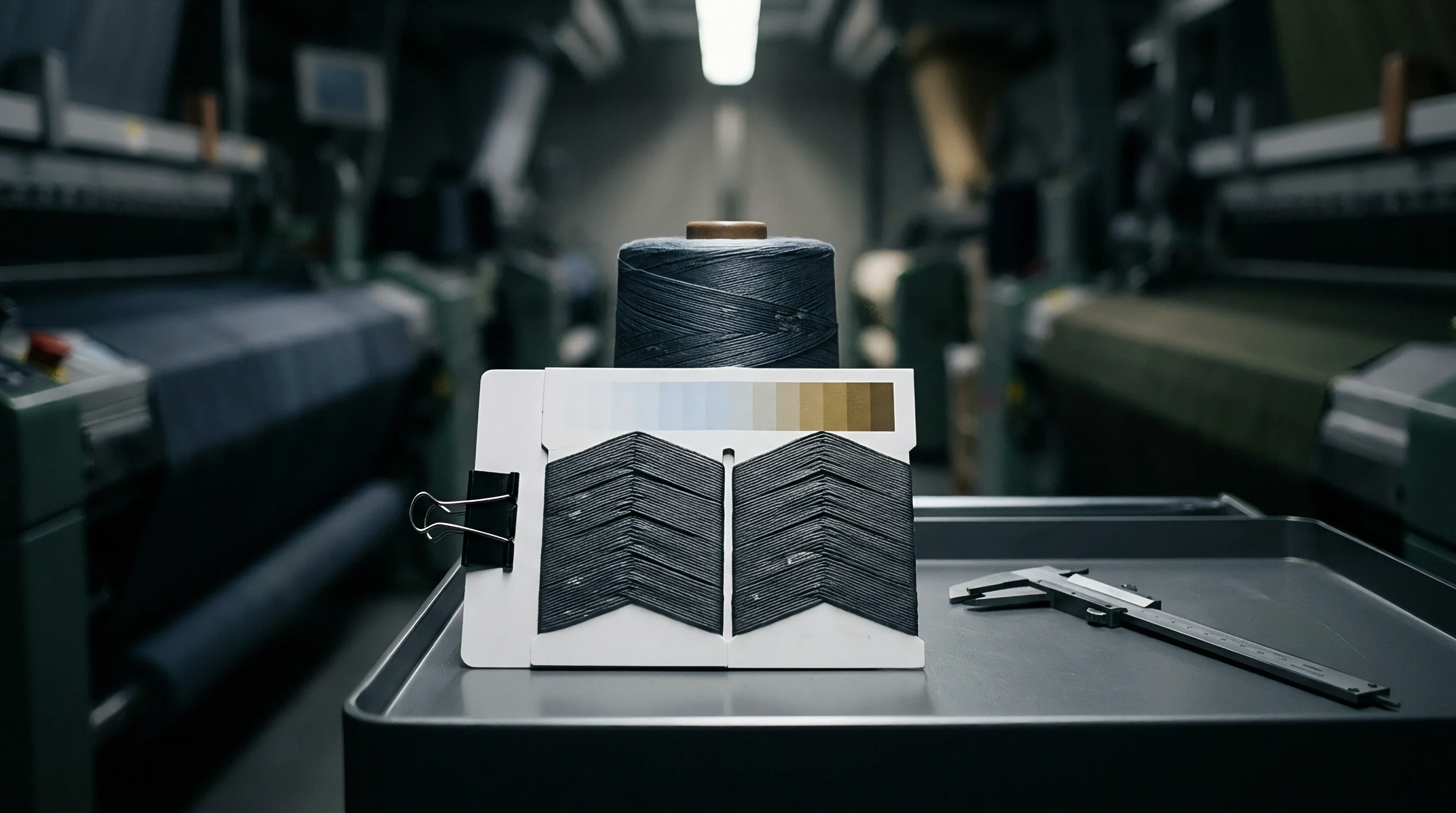
Selective Dissolution Pathways for Binary Mixes
Targeted chemical separation relies on precise liquid reagents acting at strictly controlled temperatures. Choosing the dissolution bath depends on which fibres are present in the yarn structure.
- Formic Acid Eighty Percent dissolves polyamide 6 and polyamide 6,6 at room temperature within fifteen minutes without attacking polyester or cellulosic cores.
- Sulphuric Acid Seventy-Five Percent hydrolyses cotton, viscose, and modal polymers at fifty degrees Celsius while leaving polyester filament intact.
- Sodium Hypochlorite Alkaline Solution digests wool, cashmere, and silk protein chains at twenty degrees Celsius without degrading acrylic or cellulosic fibres.
- Dimethylformamide Solvent strips acrylic and modacrylic polymers at ninety degrees Celsius while maintaining the gravimetric integrity of polyolefin and wool substrates.
Correction factor d accounts for minor mass loss in the insoluble residue during chemical exposure. Seventy-five percent sulphuric acid dissolves cellulose completely, but polyester residues still lose about one percent mass, establishing a standard d-factor of 1.01. Formic acid leaves cotton with a d-factor of 1.00, whereas untreated wool residues in hypochlorite digestion require recalibration based on prior scouring.
A laboratory report quoting sulphuric acid separation on cotton-polyester yarn applies a 1.01 d-factor correction to the recovered synthetic mass.
Temperature control dictates chemical selectivity. Cold seventy-five percent sulphuric acid selectively dissolves regenerated cellulose while sparing combed cotton if contact time is kept tight. If the temperature drifts above twenty-five degrees Celsius, the cotton crystalline core begins to hydrolyse.
The technician monitors bath temperatures using calibrated immersion probes.
Minor chemical over-etching can explain why declared wool percentages drop upon laboratory testing.


Microscopy
Physical counting replaces chemical dissolution when polymers share identical chemical compositions. Mechanical blends of wool with cashmere, fine mohair, or camel hair resist solvent separation because of their shared keratin proteins. Microscopic projection under ISO 137 and image analysis scanning under AATCC 20 quantify animal hair mixtures by measuring longitudinal cuticular scales, scale frequencies, cross-sectional geometry, and diameter distributions.
Specimen preparation requires microtome sectioning of parallel fibre tufts. Ten-micrometre cross-sectional slices sit inside immersion oils with calibrated refractive indices. The microscopist measures at least one thousand individual fibre diameters across designated grid coordinates to establish a sound distribution.
Modern scanning electron microscopy also helps identify scale height: cashmere displays scale thickness below 0.55 micrometres, whereas sheep wool margins exceed 0.65 micrometres.

How Optical Retardation Distinguishes Synthetic Cross Sections?
Polarised light microscopy identifies synthetic polymers by assessing birefringence patterns and refractive index differences. Birefringence measures the gap between parallel and perpendicular refractive indices in drawn filaments. Melt-spun polyester displays high positive birefringence under cross-polars, whereas acetate fibres show low retardance.
Transverse microtome slices allow technicians to identify trilobal, round, hollow, and micro-denier profiles.
| Fibre Variety | Longitudinal Structure | Cross-Sectional Morphology | Cuticular Scale Frequency per 100 Micrometres |
|---|---|---|---|
| Cashmere Goat Hair | Uniform cylindrical, faint scales | Circular to elliptical, no medulla | 6.0 to 7.0 |
| Fine Merino Wool | Prominent jagged cuticular scales | Circular to slightly oval | 9.5 to 11.0 |
| Mulberry Cultivated Silk | Smooth, structureless filament | Triangular with rounded corners | 0.0 (Smooth Protein Surface) |
| Tussah Wild Silk | Coarse striations across length | Flattened wedge shape | 0.0 (Striated Protein Surface) |
| Lyocell Solvent-Spun Rayon | Smooth cylindrical without striations | Uniform circular | 0.0 (Smooth Cellulosic Core) |
| Modal High-Wet-Modulus | Fine longitudinal surface lines | Kidney-bean to rounded profile | 0.0 (Striated Cellulosic Skin) |
Visual counting yields fibre count ratios rather than weight ratios. The analyst converts counted fibre frequencies into mass percentages using mean fibre diameter, diameter variance, and official volumetric density in grams per cubic centimetre. Mass calculations multiply total cross-sectional area by polymer density, converting visual tallies into mass declarations.
Irregular fibre diameters in poorly sorted wool clips increase variance, requiring larger sample sizes to suppress standard error.
Chemical processing and heavy enzymatic washing frequently strip cuticular scales from animal fibres, making it difficult for optical microscopy to reliably separate de-scaled sheep wool from genuine cashmere in heavily finished knitwear.
Variance
Test tolerances reconcile laboratory variation with commercial trade limits. Production runs show inherent composition drift between the blowroom blend stage, spinning ring frames, and final woven rolls. Standard international trade regulations, including European Union Regulation 1007/2011 and United States FTC Textile Rules, allow a manufacturing tolerance of three percentage points between the declared composition on the label and the quantitative laboratory result.
Tolerance bands are not a license to under-blend raw materials. A declared 60/40 cotton-polyester yarn testing at 57/43 sits within legal limits. A declared 100 percent pure extra-fine merino wool allows zero tolerance for intentional substitution, permitting only up to two percent extraneous fibrous impurities from inadvertent spinning floor carryover.
Sourcing contracts specify whether tolerance calculations apply before or after moisture regain adjustments.
Worked Gravimetric Quantification for a Dual-Polymer Mix
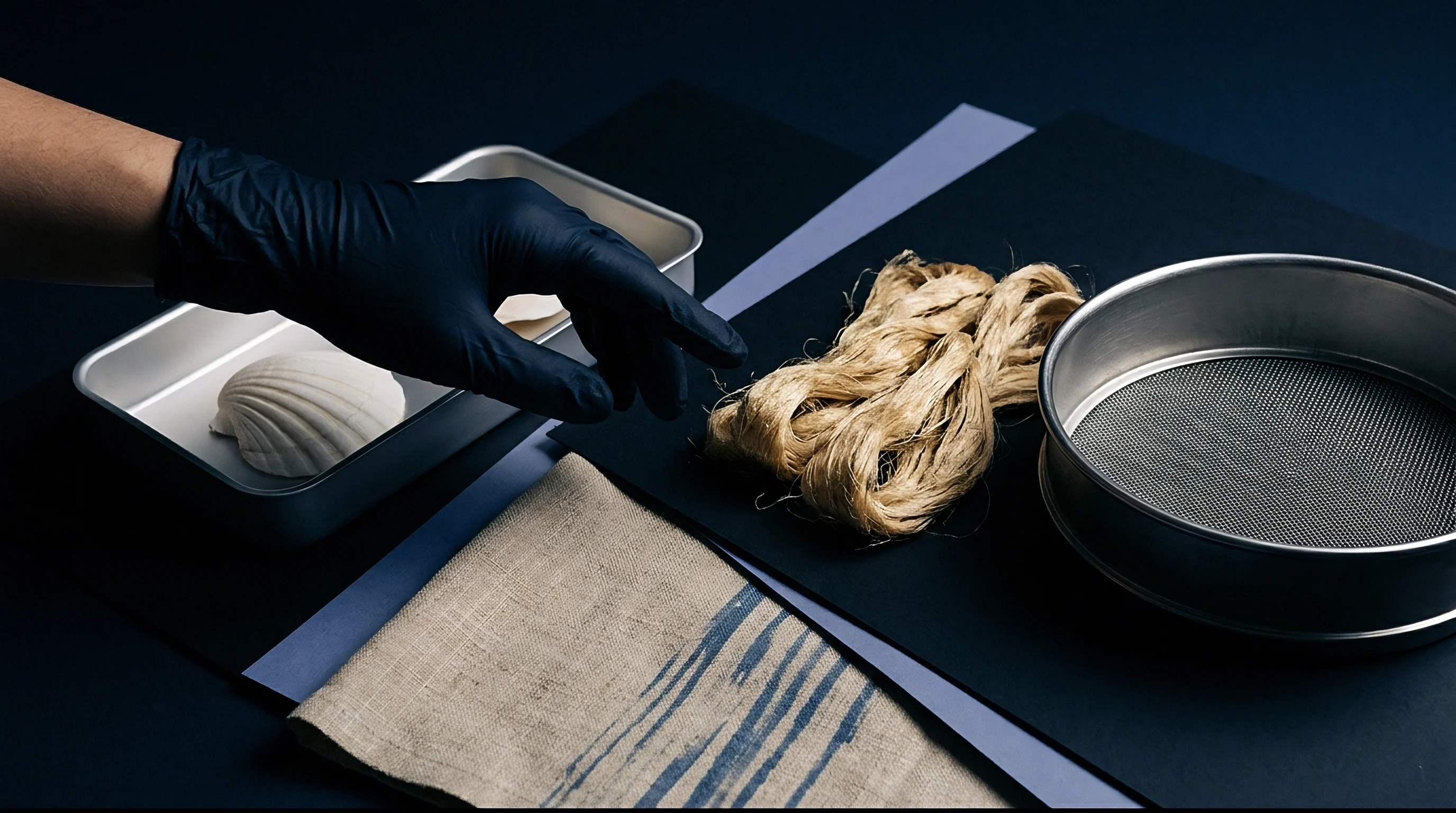
A standard laboratory calculation shows how raw gravimetric readings translate into certified commercial percentages. Consider an intact specimen drawn from un-dyed knit cloth combining combed cotton and polyethylene terephthalate polyester.
- Initial clean oven-dry specimen mass after complete Soxhlet scouring: 2.5000 grams.
- Specimen undergoes seventy-five percent sulphuric acid digestion under ISO 1833 Part 11 at fifty degrees Celsius, dissolving the entire cellulosic cotton fraction.
- Insoluble polyester residue collected in sintered crucible, neutralised, washed, and dried to constant mass: 1.0420 grams.
- Application of polyester residue correction factor d equal to 1.01 adjusts dry residue mass to 1.0524 grams.
- Cellulosic cotton dry mass determined by subtraction: 2.5000 minus 1.0524 equals 1.4476 grams.
- Clean dry percentage results: 57.90 percent cotton and 42.10 percent polyester.
- Commercial moisture regain adjustment applied: 8.50 percent for cotton, 1.50 percent for polyester.
- Commercial cotton mass: 1.4476 multiplied by 1.085 equals 1.5706 grams.
- Commercial polyester mass: 1.0524 multiplied by 1.015 equals 1.0682 grams.
- Total commercial mass: 1.5706 plus 1.0682 equals 2.6388 grams.
- Final commercial composition: 59.52 percent cotton and 40.48 percent polyester.
Oven-dry mass ratios shift by nearly two percentage points once legal commercial moisture regains enter the final mass balance.
Disputes between independent testing houses usually stem from minor calibration offsets. Differences in sieve porosity, desiccation vacuum levels, and reagent concentrations create inter-laboratory discrepancies. Sourcing departments resolve border rejections by running triplicate cross-tests across accredited neutral facilities.
Bulk production lots drifting outside the technical tolerance window require immediate label revisions before shipping cartons leave the factory floor.

Classification
Customs tariffs turn strictly on quantitative weight ratios. Under the international Harmonized System Nomenclature, textile products containing mixtures of two or more materials classify according to whichever single material predominates by weight over every other individual material. A woven fabric composed of 51 percent combed cotton and 49 percent textured polyester filament classifies under Chapter 52 as a cotton textile.
The same cloth containing 49 percent cotton and 51 percent polyester shifts into Chapter 54 as synthetic woven fabric.
Tariff shifts alter landed costs instantly. Natural cotton piece goods entering major Western markets frequently face duties around seven to eight percent, whereas synthetic woven fabrics carry duties exceeding twelve to fourteen percent. Border agencies pull random swatches for laboratory analysis.
If a separation reveals a cotton-polyester ratio of 49.5/50.5 on a lot declared as 52/48 cotton-rich, authorities reclassify the entry under Chapter 54, recover back taxes, and initiate misdeclaration inquiries.
Commercial Verification Workflow for High-Risk Sourcing
Importers manage customs exposure through systematic batch qualification before dispatching shipping containers.
- Yarn Stage Testing verifies component ratios directly from ring-spinning bobbins before warping and weaving commence.
- Greige Cloth Separation provides baseline gravimetric readings to detect sizing agent contamination before wet finishing.
- Pre-Shipment Swatch Audits draw finished cut swatches from rolls at the center of production lots under ISO 5089 protocols.
- Accredited Dual Certificates require the mill to present testing reports from ISO 17025 accredited laboratories matching destination country customs methods.
Cost calculations extend beyond raw yarn pricing. A two percent shift in synthetic composition alters spinning efficiency, dye recipes, and fabric finishing. Sourcing teams evaluate fabric cost per linear metre alongside landed duty exposure.
When mills substitute raw polyester for natural fibres to trim yarn prices, the resulting tariff reclassification often wipes out the operating margin on the finished garment program.
Failing to verify composition percentages against authoritative laboratory standards leads to seized containers, retroactive tariff adjustments, and substantial customs fines at the port of entry.