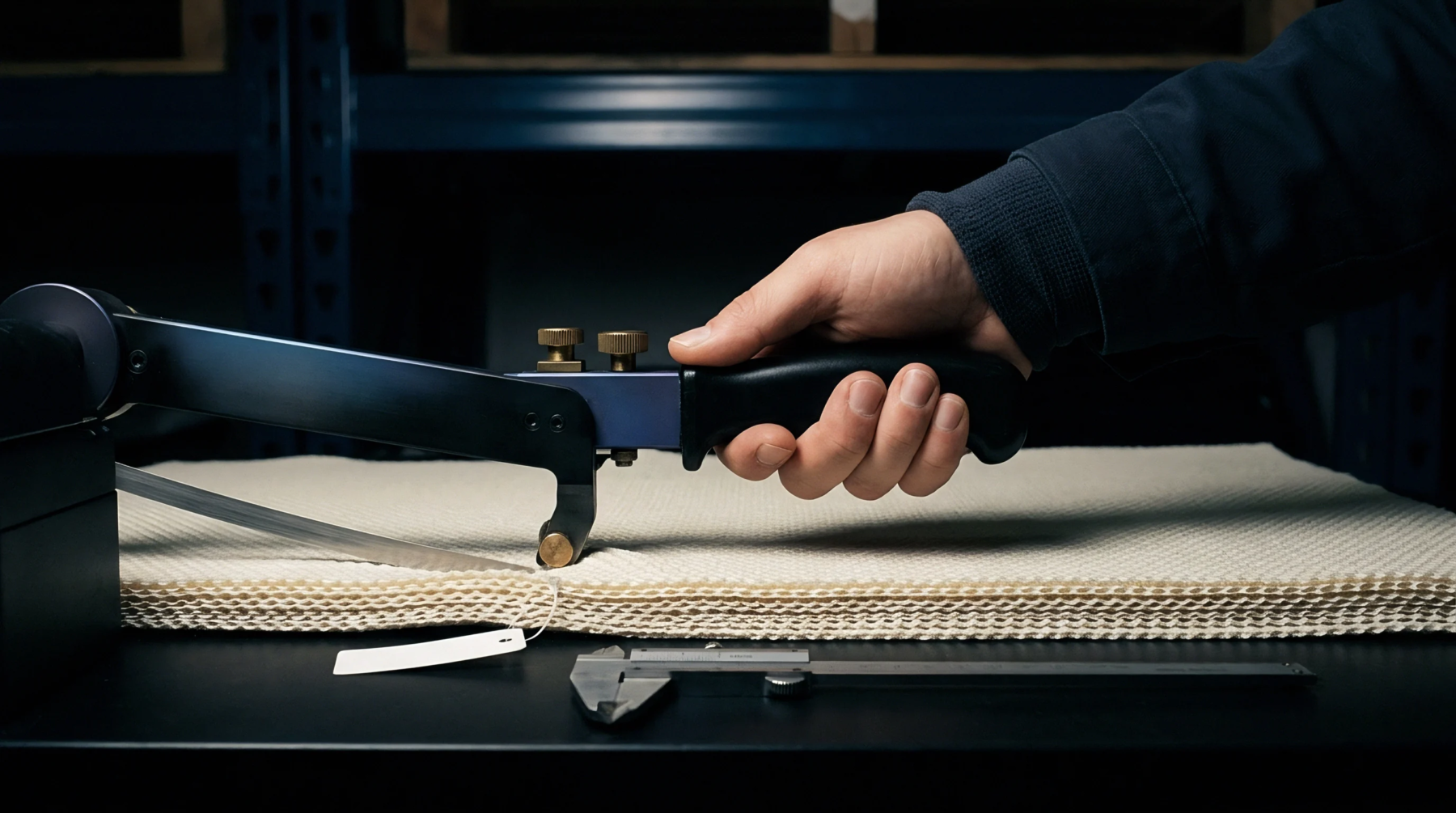
Swatch Sampling Position Deciding Whether a Batch Passes
Physical swatch position across fabric width and length determines chemical compliance, requiring three-point cross-web sampling to validate batch pass status.
Thermal energy balance compared against the set temperature across the width of a drying oven defines the heat distribution found within a stenter frame. In fabric finishing, stenter frame heat distribution refers to the consistency of the temperature at every point where the fabric is held by the pins or clips as it travels through the machine. This uniformity is necessary for ensuring that dyes are fixed evenly and that chemical finishes are cured properly across the entire textile web.
If the temperature on one side of the oven is higher than the other, the fabric will show variations in color, hand feel and shrinkage. The boundary of this condition is defined by the thermal tolerance of the specific fiber and chemical finish being processed.
Mechanical adjustment of the nozzles and fans within the stenter chambers is the primary method for maintaining an even temperature profile. Stenter frame heat distribution is influenced by the velocity and direction of the hot air as it is blown onto the fabric surface from the top and bottom. The mechanism of heat transfer relies on the balanced flow of air to ensure that every square centimeter of the fabric receives the same amount of energy.
If the nozzles are clogged or the fans are not running at the correct speed, the air will not be distributed evenly, leading to cold spots or overheating. Operators must regularly check the airflow balance and clean the filters to prevent these issues. Modern machines use automated sensors to monitor the temperature in real-time and adjust the burners and fans to compensate for any deviations.
Fixation of resins and water-repellent chemicals depends on a precise and uniform heat history as the fabric moves through the drying zones. Inconsistent stenter frame heat distribution can lead to under-curing in some areas and over-curing in others, which compromises the durability of the finish. For example, a flame-retardant treatment may not provide the required level of protection if the fabric did not reach the activation temperature across its entire width.
This variation also affects the dimensional stability of the fabric, as the heat triggers the relaxation of the fibers and the setting of the yarn structure. If the heat is not uniform, the fabric may develop waves or distortions that make it difficult to cut and sew accurately. Laboratories test samples from different parts of the web to verify that the finish is stable and that the physical properties are consistent.
Tension and drying rates are closely linked to the thermal environment within the machine and affect the final width of the processed fabric. Even stenter frame heat distribution allows the operator to maintain a consistent width from the beginning to the end of the production run. If the temperature varies, the fabric will shrink at different rates, which causes the edges to pull in or push out unevenly.
This variation is a major cause of fabric bowing and skewing, where the warp and weft yarns are no longer perpendicular to each other. Maintaining a flat and uniform temperature profile ensures that the fabric meets the customer’s width specification and is free from structural defects. Regular calibration of the temperature sensors and the use of thermal profiling tools are necessary for any mill that produces high-quality finished goods.
Physical swatch position across fabric width and length determines chemical compliance, requiring three-point cross-web sampling to validate batch pass status.
Expertise is a utility, not a secret. sentiention™ publishes its working knowledge as open reference: intelligence layer covering the materials it sources, the markets it enters, and the reference that serves both.