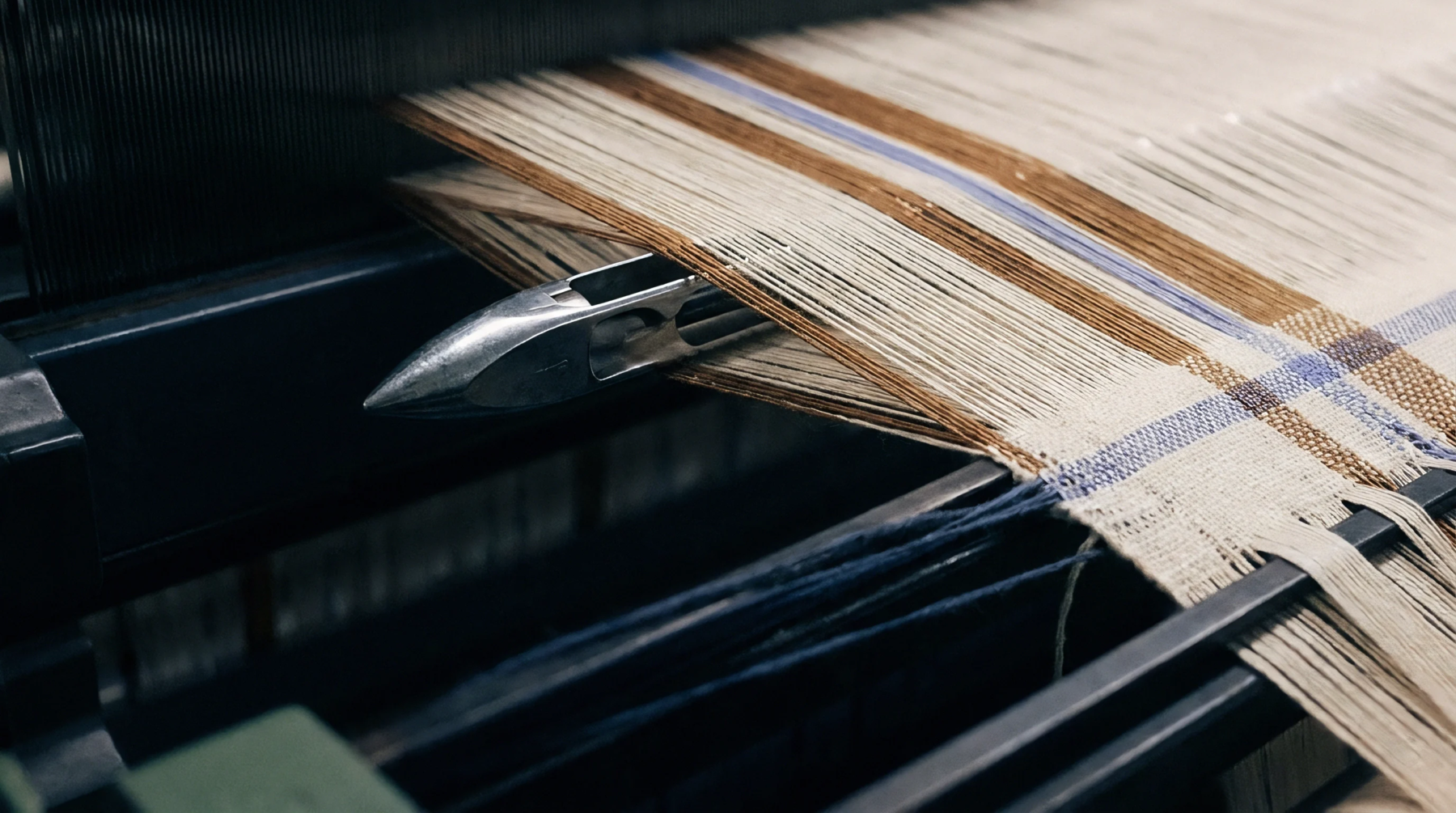
Basic Minimum Warp Set Calculation Principles for Greige Weaving
Greige warp set calculations must integrate reed width contraction, warp crimp, sizing stretch, and setup waste to establish accurate yarn purchase masses.
Fiber geometry defines the deviation from a straight line within a synthetic filament bundle, a property quantified through yarn crimp contraction to evaluate how much length a strand loses after the removal of tension. This calculation represents the difference between the fully extended state and the relaxed state of the fiber when subject to standardized atmospheric conditioning. Factories verify this value to ensure consistent processing behavior during downstream knitting or weaving, as a deviation in the internal geometry alters the hand feel and drape of a finished garment.
Quality departments perform these assessments upon receiving raw materials to predict how much slack a yarn bundle will introduce into a production machine under normal operating force.
Technicians determine the final value by applying a specific weight to a loop of fiber until it reaches a straightened state, recording the initial length before removing the load. The sample undergoes a period of rest under standardized humidity to allow the internal forces of the material to return to their equilibrium, at which point the technician measures the new length. Calculations rely on the ratio of the difference between these two measurements relative to the fully extended length, expressed as a fraction or a whole number representing the percentage of length loss.
Variations occur based on the modulus of the polymer and the cooling rate applied during the initial spinning process. Machines calibrated for low tension allow for accurate capture of this recovery, while higher forces artificially stretch the fiber and skew the result toward a false lower contraction. A sample that fails to relax fully within the designated time frame indicates incomplete heat setting, a condition that disrupts uniformity across a fabric surface.
Uniformity in yarn crimp contraction dictates the level of tension control required during high speed warping or circular knitting. A low contraction value suggests a rigid fiber that may snap or produce uneven tension peaks, whereas a high value warns of excessive slack that leads to loops or structural defects in the final textile. Dyeing houses observe these metrics because the density of the fiber structure influences how the dye molecules penetrate the core, with higher levels of internal deformation resulting in darker shades.
Each batch receives a unique reference number tied to these physical properties to prevent mixing disparate reels that would create visual streaks in a finished piece of apparel. Consistent control over this physical property prevents the puckering of seams during garment assembly.
Textile laboratories maintain testing cabinets that replicate global standards to ensure that raw fiber performance matches the specifications provided by the manufacturer. Disagreements arise when different laboratories utilize varying amounts of pre-tension weight, as even minor changes in the applied mass alter the baseline extension. Regulators require clear documentation of the test method alongside the reported value to maintain transparency between the supplier and the buyer.
Fabric integrity depends on the strict adherence to these reported limits.
Greige warp set calculations must integrate reed width contraction, warp crimp, sizing stretch, and setup waste to establish accurate yarn purchase masses.
Expertise is a utility, not a secret. sentiention™ publishes its working knowledge as open reference: intelligence layer covering the materials it sources, the markets it enters, and the reference that serves both.