Cotton Polyester Blended Yarn Mechanics in High Density Workwear Weaving
65/35 poly-cotton workwear performance relies on ring twist multipliers near 4.4 and early shed timing to maximize warp cover factor without pilling failure.
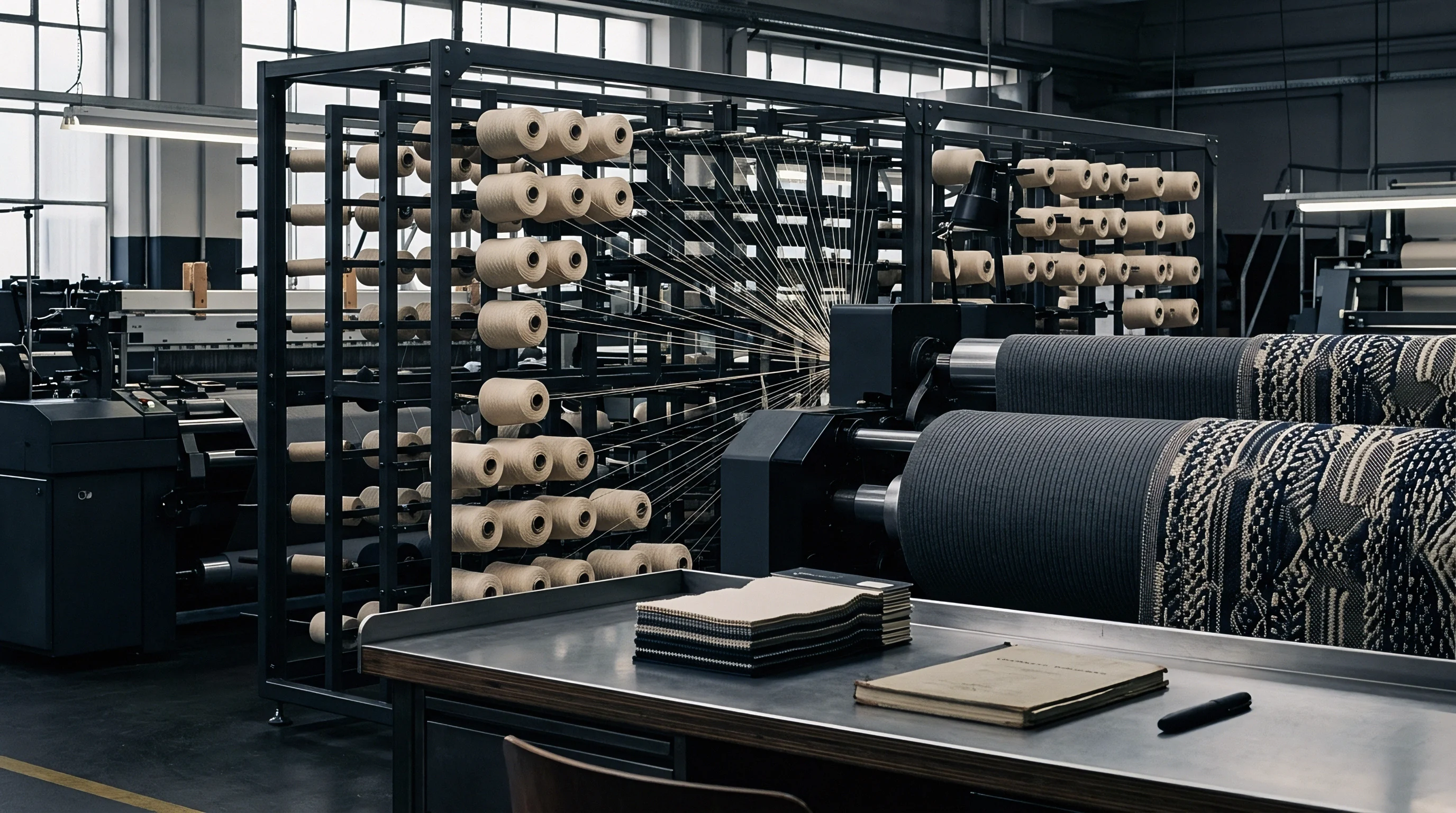

Draft
Cotton staple length directly governs radial pressure distribution inside intimate blended yarns. Mixing carded short-staple cotton with high-tenacity polyester filament or cut staple causes the two fibers to respond to mechanical attenuation with distinctly different frictional behaviors. Polyester staple, typically supplied at 38 millimeters with a linear density of 1.3 to 1.5 dtex, features a uniform cross-section and high crimp memory.
Combed upland cotton shows natural convolutions, with fiber lengths spanning 28 to 32 millimeters and Micronaire values between 3.8 and 4.2. In ring spinning frames, the roller drafting system pulls both fibers at once. Because polyester has a higher surface friction coefficient against steel draft aprons than un-lubricated cotton, the synthetics pull toward the core of the yarn bundle while the cotton fibers migrate to the outside.
This migration establishes a distinct mechanical gradient across the yarn cross-section. The internal polyester core carries tensile load and modulus under strain, whereas the outer cotton sheath supplies moisture absorption and thermal resistance. In high-density workwear fabrics, where warp cover factors frequently exceed 22 under Peirce calculations, this fiber arrangement dictates yarn behavior under heavy beat-up forces on the loom.
If drafting settings fail to control migration rates, cotton fibers slide over the polyester core during shed opening, producing end breaks and surface fuzz that hurt weaving efficiency.
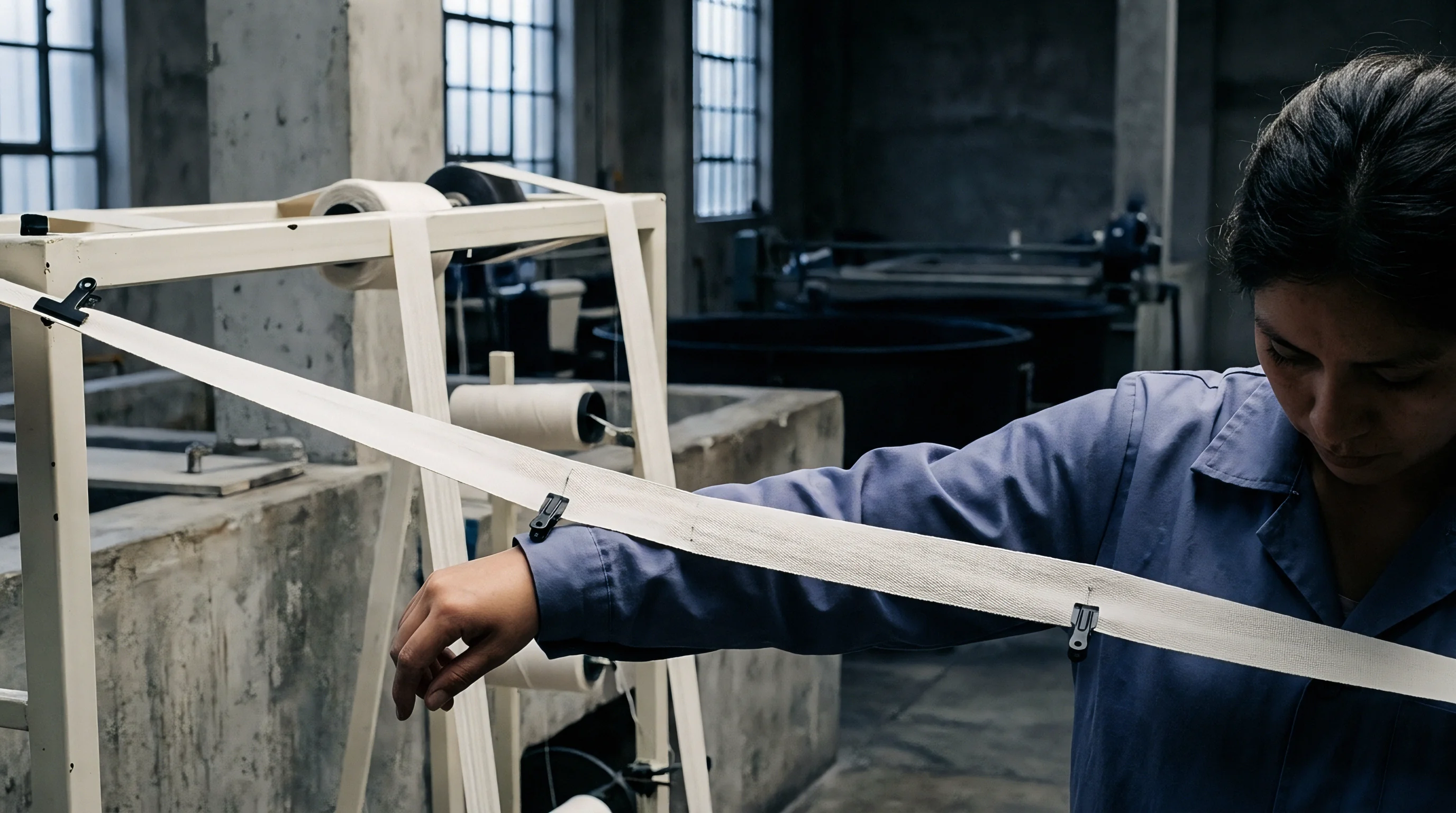
Staple Separation Kinetics and Migration Mechanics
Fiber placement within an intimate blend depends on drafting speed, nip pressure, and break draft ratios. The speed ratio between the back and middle draft rollers changes inter-fiber friction. Setting the break draft too high causes short cotton fibers to slip prematurely before reaching the main drafting zone, generating periodic mass variations called drafting waves.
These variations show up as thin and thick places in the spun yarn, directly lowering tenacity when tested under ISO 2062 conditions.
Changing the spinning technology shifts this core-sheath distribution entirely. Open-end rotor spinning yields a cross-sectional structure completely different from ring spinning. Rotor spinning wraps surface fibers around a central core, trapping short cotton fragments on the perimeter while longer polyester fibers align along the axis.
The resulting rotor yarn has lower tensile strength than ring-spun yarn of the same count, but resists surface abrasion far better during high-density beat-up because the wrapper fibers keep the yarn from flattening under lateral pressure.
Combed 30s Ne yarn spun with a 65 percent polyester ratio retains 92 percent of its initial dry tenacity after twenty consecutive industrial laundry cycles under ISO 6330 Procedure 7A.
Workwear requiring flame retardancy or high abrasion resistance depends heavily on precise blend ratios. A 65/35 polyester-cotton blend is the standard industrial baseline for heavy-duty twills. Pushing polyester content beyond 65 percent increases overall yarn tenacity, but degrades thermal stability if the fabric encounters molten metal splash or open flame.
Dropping polyester below 50 percent lowers tear strength under ISO 13937-2 testing, leading to premature fabric failure at stress points like pocket joins and knee panels.
Air-jet spinning ~ specifically vortex technology ~ changes staple arrangement by using high-pressure air streams to wrap surface fibers around a parallel fiber core. Vortex-spun 65/35 polyester-cotton yarns have an exceptionally tight surface structure with minimal hairiness. That clean surface keeps lint from building up in the loom reed, letting weavers maintain high beat-up densities without warp ends clinging together in the harness frame.
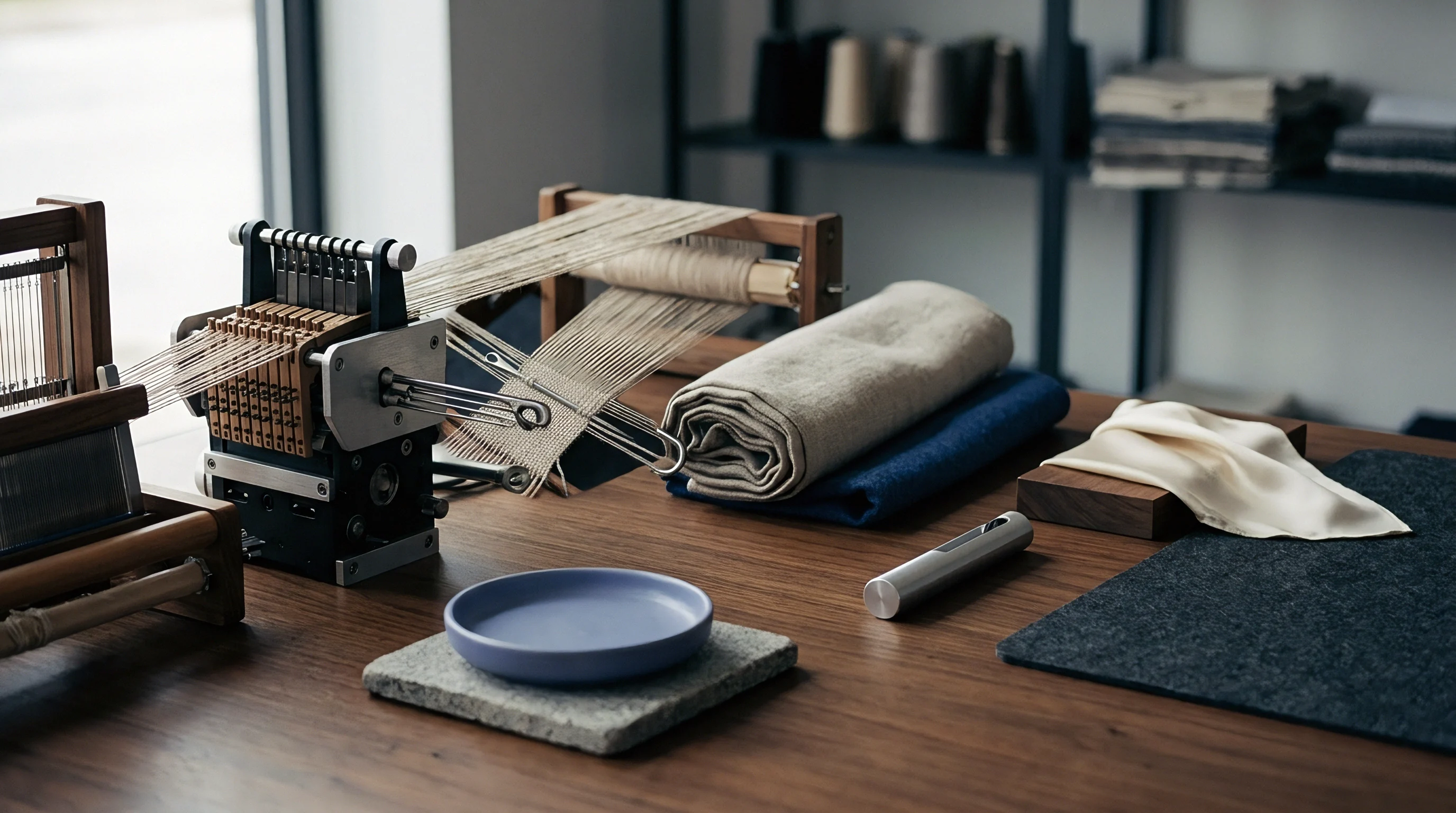
Yarn Count Uniformity and Structural Cross-Sections
Weaving high-density workwear requires tight control over yarn count variation. Mass irregularity, measured as Uster CV percentage, must stay below 11.5 percent for warp yarns destined for air-jet looms running over 700 picks per minute. Thin places in these warp yarns concentrate stress during shedding, where peak warp tension reaches up to 1.2 grams per denier.
| Spinning System | Core Fiber Concentration | Surface Hairiness (S3 Value) | Tenacity (cN/tex) | Elongation at Break (%) |
|---|---|---|---|---|
| Ring Spun (Combed) | High Polyester Density | 180 – 240 | 32.5 ± 1.2 | 11.8 ± 0.4 |
| Rotor Spun (Open End) | Random Fiber Distribution | 80 – 120 | 24.2 ± 1.5 | 9.5 ± 0.6 |
| Vortex Spun (Air-Jet) | Parallel Core / Wrapped Shell | 35 – 60 | 28.4 ± 1.0 | 10.2 ± 0.5 |
| Siro Spun (Twin Strand) | Interlocked Dual Core | 110 – 150 | 35.1 ± 1.1 | 12.4 ± 0.4 |
Mass distribution analysis centers on tracking thin places (-50%), thick places (+50%), and Neps (+200%) per 1000 meters of yarn. In high-density constructions, high Nep counts cause reed marks and lock adjacent warp threads together. When two yarns carrying heavy Neps pass through the same reed dent, friction spikes during beat-up, shifting the cloth fell and creating uneven pick spacing.
Optical microscopy and image analysis confirm yarn cross-sectional packing factors in ring-spun 65/35 blended yarns at 0.68 ~ meaning 68 percent of the yarn boundary volume is solid fiber mass and 32 percent is inter-fiber air void. This high packing density stops the yarn from flattening excessively during weaving, preserving a crisp, sharp twill line in finished 3/1 workwear fabrics.
Blend Homogeneity across the Production Stream
Consistent dye behavior in polyester-cotton blends depends on strict blend homogeneity. If cotton and polyester segregate during blowroom processing or carding, localized fiber ratio shifts follow. A change of just 3 percent in polyester content across a warp beam causes visible streakiness ~ warp reedy bands ~ after thermosol dyeing.
Blowroom intimate blending combines multi-bale plucking with weigh-hopper feeders to hold component weight ratios within ±0.5 percent. Draw-frame blending takes another approach, passing pure cotton slivers and pure polyester slivers through a single drafting head. While draw-frame blending ensures accurate overall ratios, it lacks the micro-blending intimacy of blowroom processing, making fiber clustering in the final yarn more likely.
Fiber bundle orientation during drawing directly influences how the yarn responds under axial load. A double-passage draw frame aligns fibers parallel to the sliver axis, cutting crimp variations and improving load transfer between synthetic and natural fibers. When an axial load reaches the cotton’s yield point, the higher-elongation polyester fibers carry the remaining stress until final tensile breakdown.
High packing density increases yarn-to-metal friction during warping. Beaming tension must stay within ±2 grams of target levels to prevent permanently stretching the polyester component. Elastic recovery differs sharply between the fibers: polyester snaps back quickly from high strain, while cotton exhibits delayed elastic deformation.
Tension fluctuations during warping create uneven beam density, causing localized slack ends during weaving.
Cotton fiber length distribution dictates drafting efficiency. Short fibers under 12 millimeters act as floating elements, clustering together and triggering sudden drafting surges. Combing clears these short fibers out, dropping the short-fiber index below 8 percent and maintaining a smooth, predictable draft zone.
Yarns made from combed cotton display higher tenacity, lower hairiness, and better durability under mechanical abrasion.
Twist distribution along the yarn responds directly to mass variations. Twist concentrates in thin places, leaving thicker areas with fewer turns per inch. When dense fabric experiences mechanical shearing during weaving, these low-twist thick places act as point failures where fibers pull free from the yarn matrix, creating surface fuzz that eventually rolls into pills.
Spinning tension shifts the radial pressure inside the yarn core. Heavier ring travelers raise spinning tension, pulling surface fibers deeper into the core to build a tight, rigid structure. But excessive tension reduces elongation at break, leaving the yarn brittle and vulnerable to impact spikes when the loom reed drives against the cloth fell.
Synthetic fiber crimp plays two distinct roles during drafting. Mechanical crimp supplies the inter-fiber cohesion needed for sliver integrity through carding and drawing. Too much crimp, however, prevents smooth fiber sliding during final ring drafting, generating slubs and structural flaws.
Synthetic producers apply targeted spin finishes to stabilize crimp behavior and suppress static build-up during high-speed processing.
Static charge buildup is a constant issue in polyester-cotton processing. Polyester rapidly builds negative electrostatic charges at low relative humidity, causing fiber repulsion and wild loops during drafting. Spinning rooms maintain relative humidity between 55 percent and 65 percent so static charges dissipate through the moisture film on the cotton fibers.
Rotor speed directly affects yarn bulk and torque. Running rotors above 100,000 revolutions per minute increases yarn liveliness, causing it to snarl whenever tension drops during unwinding. Snarling in the loom creel causes machine stops and cuts weave room efficiency.
Steaming yarn packages under vacuum relaxes these internal stresses, neutralizing torque before warping.
Coarser synthetic deniers increase the flexural rigidity of blended yarns. Substituting 2.0 dtex polyester for 1.3 dtex fiber stiffens the yarn significantly. High flexural rigidity resists the sharp bending required around adjacent threads in tight weave structures, increasing fabric thickness and yielding a stiff hand that demands chemical softeners during finishing.
Sliver uniformity monitoring relies on capacitive sensor arrays at the draw-frame delivery point. These systems track mass variations across short, medium, and long wavelengths, auto-leveling the draft ratio to correct thickness errors before the sliver reaches the roving frame. Keeping sliver mass consistent prevents long-term count swings across warp beams and ensures uniform fabric weight.
High drafting speeds require carefully chosen roller coatings. Rubber aprons and top roller cots need specific Shore hardness ratings to grip fibers without pinching or damaging them. Synthetics demand harder cots ~ around 75 to 80 Shore A ~ to handle high nip pressures without grooving, while soft cots around 65 Shore A work better for delicate natural fibers.
Combining synthetic filaments with staple fibers through core-spinning yields high-strength yarns with natural surface feel. Elastomeric or high-tenacity polyester filament cores fed through the front drafting roller are wrapped by the drafted staple matrix. Proper alignment keeps the filament centered; core exposure ~ known as grin-through ~ causes severe shade streaking during piece dyeing.
Yarn torque stability directly dictates twill line sharpness. Left-hand Z-twist yarns suit right-hand twill weaves by accentuating the diagonal weave lines. Mismatching twist and weave directions flattens the twill line, muting surface texture and altering fabric hand.
Fiber crimp recovery governs yarn bulk after thermal finishing. Exposed to hot water or dry heat, polyester fibers shrink and crimp, pulling the outer cotton wrapping inward. This thermal compaction increases bulk density, boosting fabric cover factor and wind resistance without adding weight.
Fiber friction coefficients change with sliding speed. At low drafting speeds, static friction dominates, requiring high initial force to start fiber movement. Once sliding begins, kinetic friction takes over, demanding steady draft speed control to prevent drafting waves and keep yarn cross-sections uniform.
Using recycled polyester staple introduces distinct drafting problems. Recycled fibers show wider variation in staple length, dtex uniformity, and crimp consistency than virgin synthetics. These fluctuations raise mass irregularity and hairiness, forcing lower spinning speeds and adjusted roller gauge settings to maintain acceptable yarn quality.
Moisture content in raw cotton bales controls fiber strength and flexibility. Cotton below 6 percent moisture becomes brittle, breaking during cleaning and drafting to create short fiber lint. Bringing cotton moisture back up to 8.5 percent before spinning restores flexibility, improving draftability and lowering yarn hairiness.
Fiber alignment inside the sliver governs drafting efficiency. Carding aligns fibers in the machine direction, but hook-shaped ends remain widespread. A second drawing passage removes rear hooks, while roving eliminates front hooks, maximizing the number of effective load-bearing fibers along the yarn axis.
Higher polyester fiber strength allows spinning finer counts without sacrificing weaveability. Fine yarns let mills construct ultra-dense fabrics with ends per inch exceeding 150. These dense weaves block wind and resist physical penetration while keeping fabric weight within practical limits for heavy workwear.
Drafting force variations tie directly to fiber surface topography. Smooth synthetic fibers require tailored spin-finish lubricants to build sufficient inter-fiber cohesion without causing stick-slip motion. Stick-slip behavior produces sudden mass surges along the yarn, degrading quality and causing visible repeats in dense woven fabrics.
Coarser cotton fibers reduce the total fiber count in the yarn cross-section. A 30s Ne yarn needs at least 75 fibers in its cross-section to maintain spinning stability. Falling below this threshold increases count variation and end break rates across both spinning and high-speed weaving.
Dynamic inter-fiber friction during drafting generates heat, which can soften synthetic coatings if draft speeds get too high. Monitoring cot temperatures prevents thermal breakdown of spin finishes, maintaining consistent friction coefficients across long production runs.
Modern yarn quality control relies on multi-vector optical sensors to measure roundness and shape factor alongside standard mass. Non-circular cross-sections cause irregular warp packing on the loom, changing the open area between threads and throwing off air permeability values in protective workwear.
Optimized drafting settings ensure a smooth fiber transition from the break draft to the main drafting zone. Setting roller gauges based on mean fiber length prevents fiber breakage and spikes in tension, producing a uniform, durable blended yarn built for demanding industrial weaving.
Strong fiber cohesion keeps outer wrapping fibers locked against the core under friction. As a rule of thumb, when fiber length uniformity exceeds 85 percent, draft aprons can be set one millimeter closer without raising mass variation or inducing drafting waves.

Twist
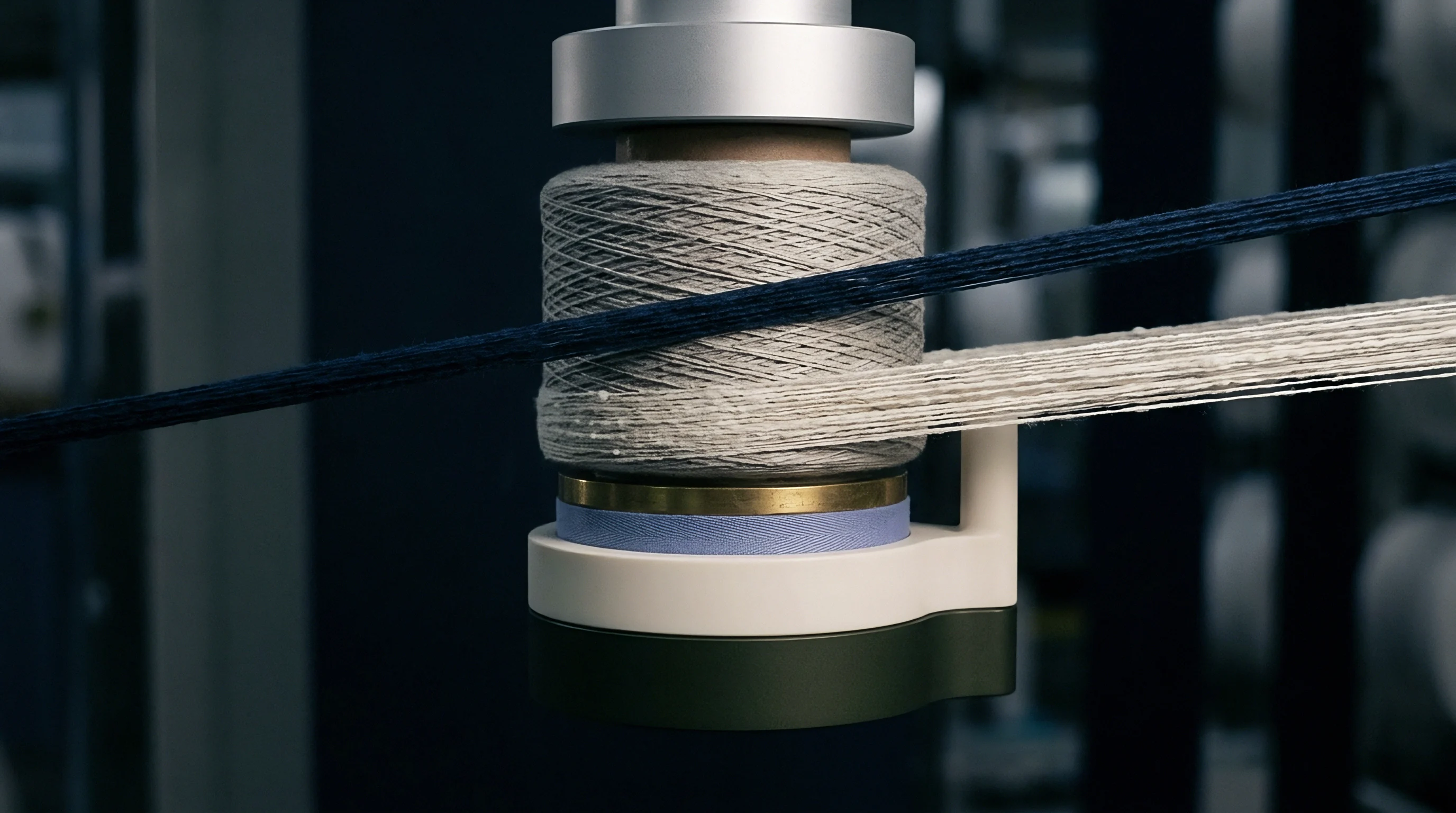
Axial rotation applied during ring spinning locks synthetic filament or staple clusters into tight helical paths. The twist multiplier, designated as alpha in metric or English systems, sets the helix angle of outer fibers relative to the central axis. For standard cotton-polyester workwear yarns, English twist multipliers run from 3.8 to 4.5.
Raising the twist multiplier increases internal radial pressure, boosting inter-fiber friction and overall yarn tenacity up to a critical threshold.
Past this critical threshold, additional twist introduces severe torsional shear stresses into individual fibers. These shear forces lower axial fiber strength, causing total yarn tenacity to drop. In high-density workwear weaving, warp yarns need higher twist multipliers than weft yarns to handle cyclic flexural fatigue and continuous rubbing against drop wires, heddles, and the reciprocating reed.
Tensile Stress Mechanics under Angular Twist
Because fibers lie at an angle within a twisted yarn, individual fiber strength cannot be fully realized along the yarn axis. The force vector parallel to the axis equals individual fiber tensile strength multiplied by the cosine of the helix angle. As twist increases, this helix angle widens, lowering the axial contribution of each fiber while increasing the frictional binding forces that stop inter-fiber slippage.
In intimate 65/35 poly-cotton blends, differing fiber elongations complicate stress distribution under load. Cotton breaks at low elongation ~ typically 6 to 8 percent ~ whereas polyester staple stretches 15 to 30 percent before failure. At low twist, cotton carries nearly the entire initial load under tension; when the cotton breaks, stress shifts abruptly to the polyester.
Higher twist multipliers increase radial compaction, forcing polyester fibers to share the load earlier in the strain cycle and producing a single, smooth stress-strain curve with high overall energy-to-break.
Controlling hairiness comes down to containing protruding fiber ends during twist insertion. High hairiness ~ measured as the total length of fibers per meter exceeding 3 millimeters (the S3 value) ~ causes warp ends to entangle in the shed. These clinging ends refuse to separate cleanly, causing the insertion element to strike warp threads and create flat picks, short picks, or loom stops.
Compact spinning alters twist insertion by adding a pneumatic condensing zone at the delivery of the drafting frame. Air suction draws edge fibers into the main bundle before twist is inserted, virtually eliminating the spinning triangle. Compact blended yarns show up to 80 percent lower S3 hairiness than standard ring-spun yarns of the same count and twist.
This clean surface allows weaving mills to run dense constructions without heavy warp sizing.
Yarn Tenacity and Abrasion Resistance Metrics
Single-strand tensile testing under ISO 2062 evaluates yarn strength, recording maximum force in centinewtons and tenacity in cN/tex. Workwear warp yarns must maintain at least 28 cN/tex to survive dynamic tension spikes during beat-up. Elongation at break should stay between 10 and 12 percent: lower elongation causes brittle end breaks, while higher elongation leads to warp stretch and reed marks.
| Twist Multiplier (Ne) | Helix Angle (Degrees) | Tenacity (cN/tex) | Martindale Abrasion Cycles to Rupture (Yarn) | Snarl Count (per Meter) |
|---|---|---|---|---|
| 3.6 | 18.2 | 26.1 | 1,200 ± 80 | 0 |
| 4.0 | 21.5 | 31.8 | 2,450 ± 120 | 2 |
| 4.4 | 24.8 | 33.2 | 3,800 ± 150 | 7 |
| 4.8 | 27.9 | 29.5 | 4,100 ± 180 | 14 |
Yarn abrasion resistance dictates weaving performance in dense workwear fabrics. Constant friction against metal loom parts strips surface fibers and thins the yarn cross-section. Martindale abrasion testing on single yarns under standard pre-tension shows that compact yarns with a 4.4 twist multiplier withstand over three times the friction cycles of conventional yarns before breaking, thanks to their tightly bound outer fibers.
Excessive twist generates lively torque that causes yarn to loop and snarl whenever tension drops. On shuttleless looms, lively weft kinks as it enters the shed, causing permanent looped picks in the fabric. Conditioning yarn packages with saturated steam at 80 degrees Celsius under partial vacuum relaxes these internal stresses, setting the twist and stabilizing torque without sacrificing tensile strength.
Dynamic Load Sharing and Friction Interfaces
Tension spikes during weaving demand effective load sharing between fibers in the yarn core. When the reed strikes the cloth fell in a high-density weave, warp yarns undergo rapid cyclic stretching lasting milliseconds. High inter-fiber friction from twist compaction spreads these peak loads across thousands of fiber contact points, preventing local stress build-up and end breaks.
Yarn-to-yarn friction climbs steeply as warp density increases. When warp ends exceed 110 ends per inch in a 2/1 twill, adjacent yarns rub constantly during shedding. Low-twist yarns shed short fibers under this friction, generating fly waste that gathers on drop wires and optical sensors to cause false stops.
Plied yarns, made by twisting two singles together, provide outstanding strength and surface smoothness for heavy workwear. Folding two S-twisted 30s Ne singles into a 2/30s Ne plied yarn with a Z-twist balances torsional forces to produce a torque-neutral yarn. Plied yarns have a rounder cross-section and lower hairiness than equivalent singles, allowing higher warp density with less shed friction.
The twist direction of single yarns relative to the weave direction alters surface characteristics. Right-hand twills woven with Z-twist warp yarns give a softer hand because shedding slightly untwists the outer fiber helices. Using S-twist warp yarns in a right-hand twill does the opposite, tightening the structure during shedding to yield a firm, compact fabric with high water resistance.
Crimp interchange during twist insertion shifts yarn diameter dynamics. Higher twist pulls outer fibers toward the center, reducing overall yarn diameter by up to 12 percent compared to a low-twist state. This slimmer diameter allows higher reed density without crowding dent gaps, keeping shed openings clean for smooth weft insertion.
Thermal stability during finishing reflects twist history. Highly twisted synthetic fibers trap mechanical stresses locked in during spinning. Exposure to temperatures above 180 degrees Celsius during heat-setting releases these stresses, causing the yarn to shrink.
If twist varies across warp packages, uneven shrinkage causes fabric rippling ~ baggy warp defects ~ that cannot be fixed.
Friction between yarn and machine guides changes with speed and contact angle. Ceramic guides with a surface roughness around Ra 0.4 micrometers keep friction minimal during warping and winding. Worn or grooved guides strip surface cotton off blended yarns, exposing the polyester core and leaving bright streaks in piece-dyed fabric.
Twist distribution in rotor yarns differs fundamentally from ring-spun yarns. Rotor yarns have a core with little true twist wrapped by highly twisted surface fibers. Under tension, the core fibers slip slightly until the wrapper fibers lock them down ~ giving lower tensile strength but excellent resistance to surface scraping and beat-up abrasion.
Flexural rigidity rises non-linearly with the twist multiplier. Stiff yarns resist bending over tight radii, raising tension as warp threads interlace with the weft. This stiffness increases motor power draw and accelerates heddle eye wear, making titanium nitride-coated heddles necessary for long production runs.
Uneven twist insertion leaves periodic soft spots in single yarns. With lower fiber density, these soft spots act as weak points under high shedding tension. Modern ring frames use individual electronic spindle monitoring to spot twist drops from slipping tapes immediately, stopping affected spindles before low-twist yarn winds onto the package.
Siro-spinning combines drafting and twisting by feeding two parallel rovings into the front roller nip together. The twin strands merge at the twist point, wrapping around each other like a plied yarn. Siro-spun 65/35 poly-cotton yarns show low hairiness, high abrasion resistance, and strong tensile properties without needing a separate plying operation for workwear warp yarns.
Friction heat can degrade spin finishes during high-twist spinning. Friction between traveler and ring at high speeds generates local temperatures above 120 degrees Celsius. Heat breaks down soft finishes into sticky residues that ruin yarn tension profiles during high-speed unwinding.
Fiber orientation across the yarn cross-section determines shear strength. Outer fibers aligned at steep angles carry the load during surface scraping, protecting the core fibers from direct wear. This protective structure makes twisted staple yarns far superior to untextured continuous filaments in heavy-duty workwear.
Variations in traveler tension across a ring frame introduce twist differences within a single production lot. Heavier travelers raise yarn tension, inserting tighter twist and yielding smaller diameters, whereas light travelers give larger diameters with lower twist. Mixing these packages on a warp beam creates subtle banding across the fabric width after piece dyeing.
Warp sizing lays down surface fibers temporarily, but size films break under severe beat-up friction, allowing unbound surface fibers to ball up behind the reed and forcing frequent manual stops.
Reed
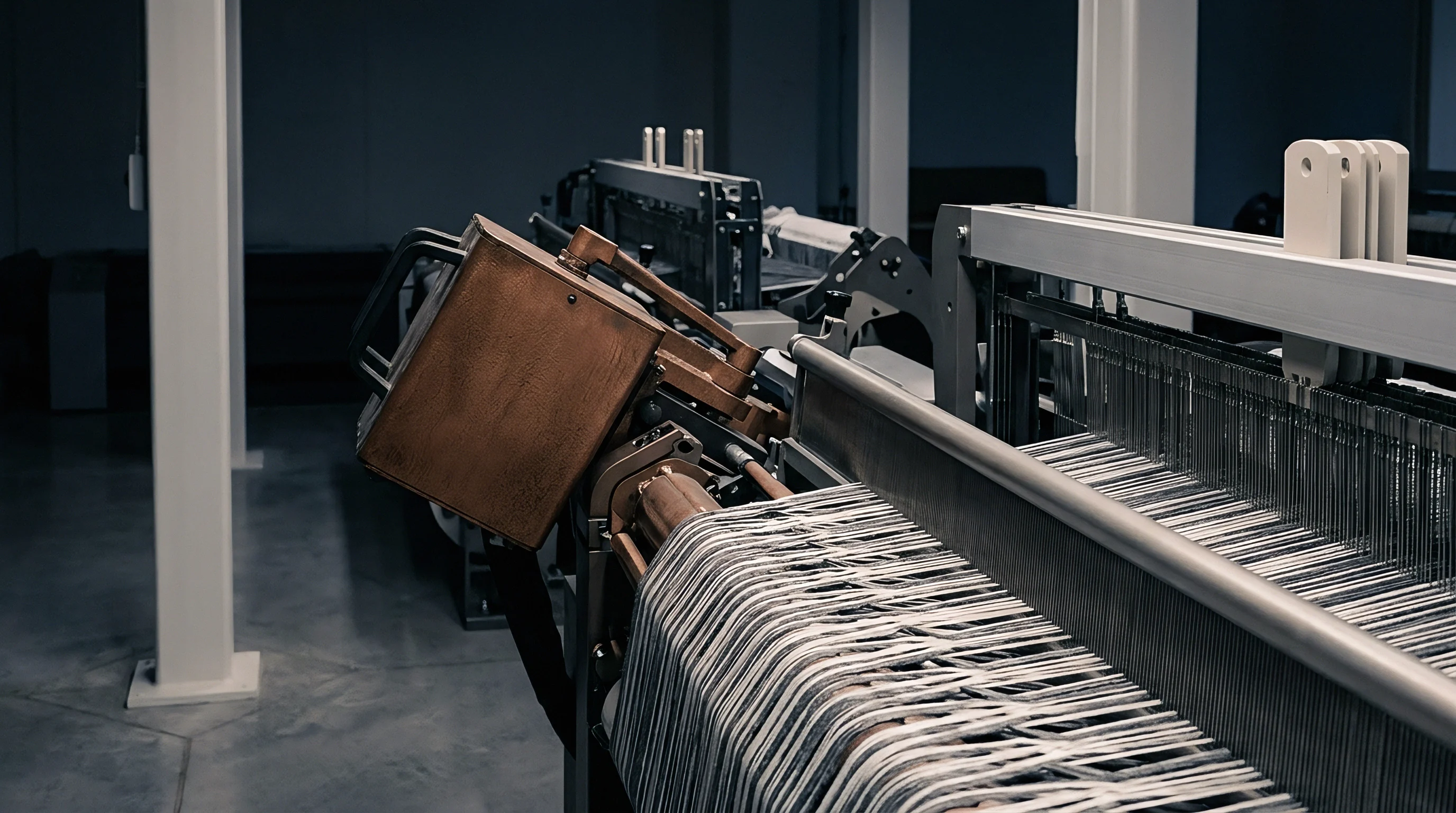
High end counts force the sley assembly to hit the cloth fell with substantial force. In dense workwear fabrics like 3/1 twills running 120 ends per inch and 60 picks per inch, the loom reed serves two roles: guiding weft insertion and driving structural compaction. Reed selection sets dent density and wire thickness.
A 10-dent per centimeter reed carrying four ends per dent lets warp threads move through with enough clearance to avoid excessive shedding friction.
Warp cover factor directly governs beat-up resistance. Under Peirce’s classic formula, warp cover factor is ends per inch divided by the square root of the cotton yarn count. When warp cover factor passes 20 and weft cover factor passes 12, overall fabric cover approaches theoretical density limits.
At these levels, inserting each pick takes considerable energy to displace existing warp threads and form the required weave crimp.
Beat-Up Force Dynamics and Crimp Interchange
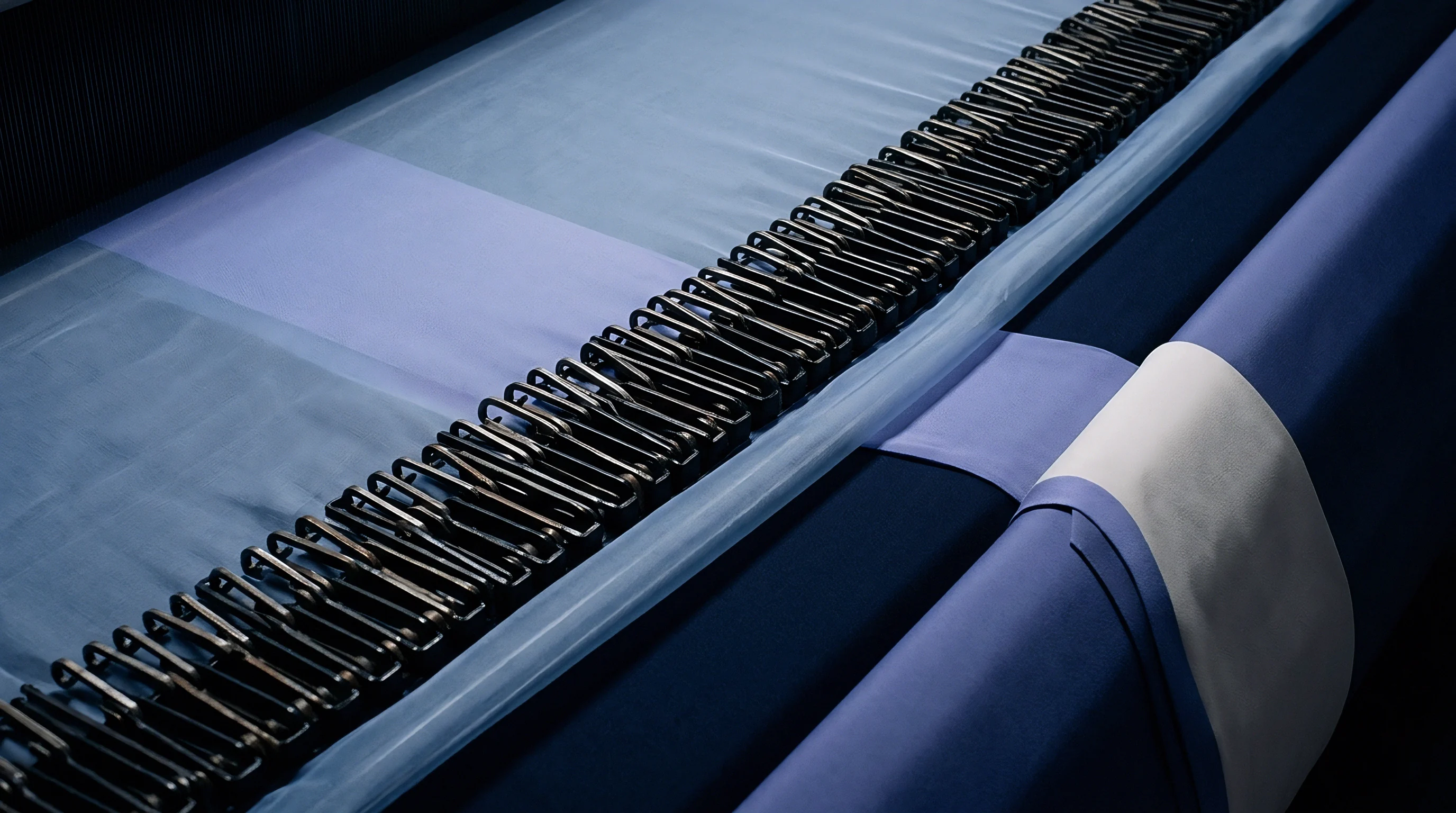
Beat-up force spikes sharply during the sley’s final forward stroke. As the reed drives the new pick into the cloth fell, warp threads see sudden tension peaks. High-speed load cells on warp stop motions show beat-up tension reaching up to 2.5 times static warp line tension.
Blended 65/35 poly-cotton yarns absorb these spikes through the elastic stretch of the polyester, preventing brittle warp breaks.
Crimp interchange handles structural adjustments during beat-up. Before the reed strikes, warp threads travel a flat path through the open shed while the weft pick lies straight. When the reed hits, warp threads bend sharply around the weft pick, converting linear length into crimp amplitude while pulling crimp into the weft pick.
In dense workwear twills, warp crimp typically settles between 8 and 12 percent, with weft crimp running lower at 3 to 5 percent.
Shed timing changes beat-up effectiveness and fabric appearance. Standard timing crosses the harness right at front center. Early shed timing closes the harness 10 to 25 degrees before front center, locking warp threads over the new pick while the reed is still moving forward.
This early crossover traps the pick firmly at the fell, preventing bounce-back and allowing higher pick densities in heavy workwear.
Too much beat-up resistance causes fell movement, where the cloth fell shifts back and forth rhythmically with the sley. This movement leads to uneven pick spacing, showing up as thick and thin horizontal bars known as reed marks or pick bars. Eliminating fell movement requires aligning backrest height, whip roll spring tension, and take-up synchronization.
Loom Tensions and Machine Gauge Controls
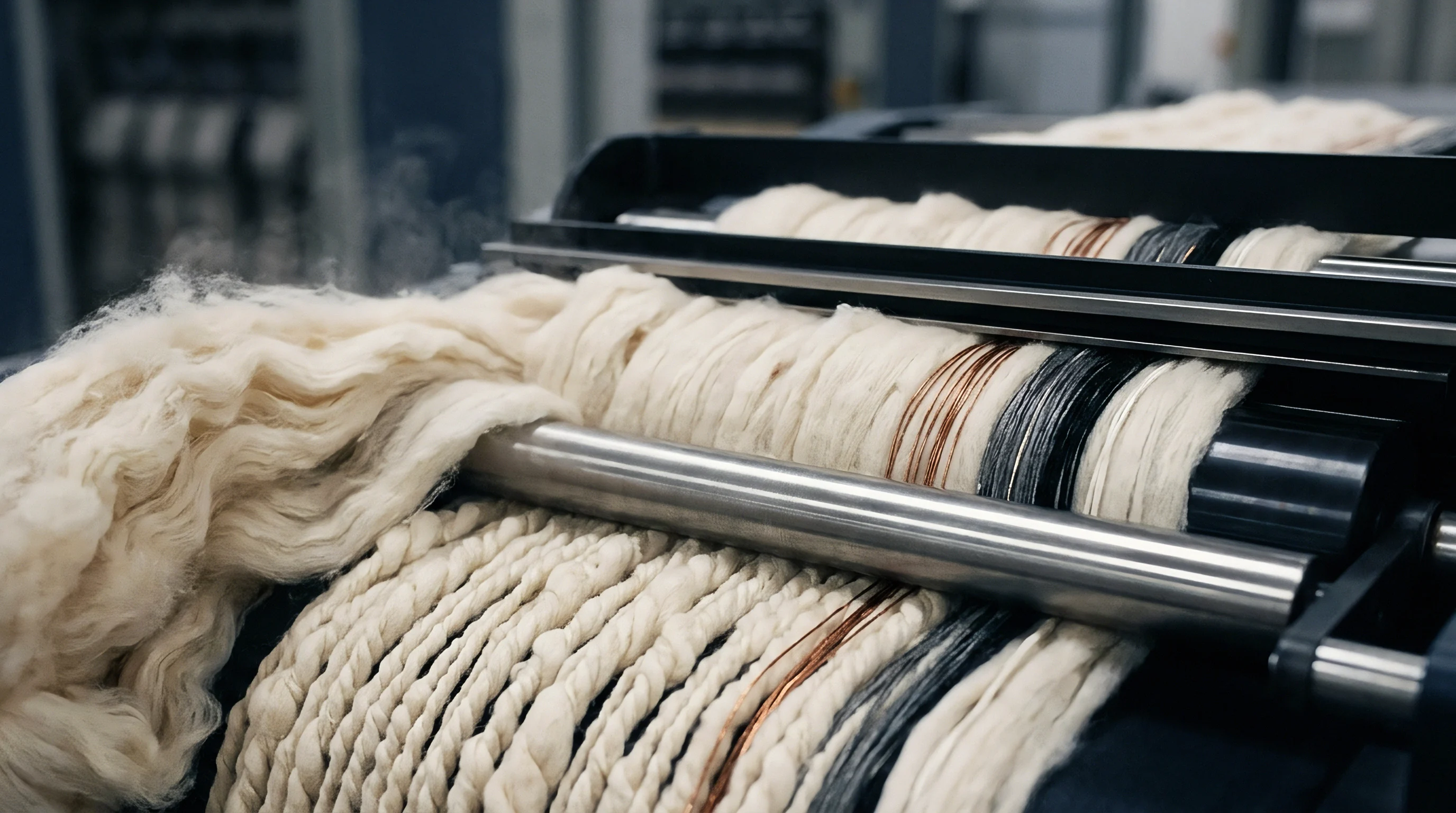
Warp tension controls must keep line tension steady from full beam to empty core. Electronic let-off systems monitor beam rotation speed and load cell feedback, adjusting motor speed to keep tension within ±3 percent. Tension drops allow warp threads to sag during shedding, causing rapiers or nozzles to pierce warp ends and trip loom stops.
| Parameter | Air-Jet Weaving | Rapier Weaving | Tolerance Limit |
|---|---|---|---|
| Warp Line Static Tension | 1.1 grams/denier | 0.95 grams/denier | ±0.05 g/denier |
| Beat-Up Peak Tension | 2.4 grams/denier | 2.1 grams/denier | ±0.15 g/denier |
| Shed Timing (Harness Crossing) | 340° (Early) | 355° (Standard) | ±2° Crank Angle |
| Backrest Height Position | +15 mm Above Center | +5 mm Above Center | ±2 mm |
| Reed Dent Pass-Through Rate | 4 Ends/Dent | 3 Ends/Dent | Fixed Design |
Backrest roller position adjusts shed geometry and changes tension between upper and lower shed sheets. Raising the backrest above center line increases tension on the bottom sheet while slackening the top sheet during asymmetric opening. This tension difference lets warp ends spread evenly, preventing adjacent threads from twisting around each other and improving fabric smoothness and cover.
Air-jet weaving relies on auxiliary main and relay nozzles positioned along the reed length to carry weft yarns across wide looms. Profile reeds with molded air channels focus the air stream around the yarn. When weaving heavy blended workwear, insertion air pressure must be raised to 0.5 ~ 0.6 MPa to push thick, dense weft yarns cleanly through tight sheds without stalling.
Does High Reed Density Alter Warp End Breakage Mechanics?
Increasing reed density concentrates abrasion onto less wire surface area. As warp ends move during shedding, surface cotton fibers rub against the polished reed wires. If the warp size lacks adequate binder strength or lubrication, the size film cracks and exposes raw fibers.
Abraded fibers then collect behind reed dents as lint balls, catching nearby warp ends and causing cat-head breaks during beat-up.
Sizing formulations containing polyacrylic acid or polyvinyl alcohol protect blended yarns against high-density reed wear. Sizing coats protruding surface fibers and penetrates the yarn core, boosting bundle strength by 15 to 25 percent while lowering friction. Size pickup must be kept between 10 and 12 percent by dry weight: lower pickup gives insufficient protection, while higher pickup leaves yarns stiff, brittle, and prone to flexing breaks.
Rapier looms use mechanical grippers to carry weft yarns across the shed, avoiding dependence on air currents. Rapiers require larger shed openings than air jets, increasing warp thread lift and raising peak strain. This cyclic dynamic stress requires higher sizing film elasticity to prevent micro-cracking during insertion.
Reed wire thickness balances open dent space against wire stiffness. Standard reed wires run 0.5 to 0.8 millimeters thick. Thinner wires increase open area within each dent, reducing lateral yarn pinching during shedding.
However, thin wires can flex under heavy beat-up forces, causing pitch variations that leave permanent vertical streaks in dense fabrics.
Temples mounted near the fell prevent fabric contraction driven by crimp interchange. Dense twill weaves pull edge warp threads inward out of alignment with reed dents. Ring temples with spiked rubber or brass rings grip selvedges to match cloth width to reed width.
Worn temple rings let selvedges slip inward, causing severe reed wire abrasion on outer warp ends and leading to edge breaks.
High-density weaves demand higher motor torque during beat-up. Modern looms rely on heavy flywheels and high-torque direct-drive motors to hold constant crank speed through front center. Any drop in motor speed at beat-up reduces impact energy delivered to the fell, causing variable pick density along the fabric roll.
Warp leasing behind drop wires separates ends into distinct sheets to stop tangling. Dual lease rods maintain alternating paths so warp ends enter harness eyes without crossing. In ultra-dense setups, triple lease arrangements separate ends across three distinct planes, cutting friction behind the stop motion assembly.
Drop wire weights must be matched to yarn count and warp tension. Heavy drop wires on fine blended yarns cause localized tension spikes and premature fatigue failure. Conversely, light wires on heavy yarns float during shedding, triggering false stop signals.
Dropper weights between 3.5 and 5.5 grams work best for dense 30s Ne workwear warps.
Heddle eye shape influences surface abrasion during shedding. Polished steel heddle eyes with oval or teardrop shapes avoid point-contact stress on the yarn. Nickel-plated or ceramic-coated heddles reduce frictional heat, preventing static charge buildup and fiber melting during long production runs.
Weft accumulators pull yarn off supply packages continuously, rewinding it onto internal drums to deliver steady, low tension during insertion. Uniform insertion tension prevents pick variation across wide looms. When running coarse 20s Ne 65/35 blended weft, accumulator brake rings must maintain constant drag to prevent loops forming inside the shed.
Shed angle adjustments balance insertion clearance against warp fatigue. Wider shed angles give clean clearance for rapiers or air jets, but increase vertical warp lift and peak tension. Weaving dense workwear requires keeping the shed angle as small as possible while ensuring clean insertion, protecting yarn fatigue life.
Frictional heat from high-speed reeds can soften synthetic fibers in blended yarns. Profile reeds running on air-jet looms at 800 picks per minute build up heat along the channel. Air-cooling channels or low-friction ceramic coatings dissipate this heat, protecting polyester fibers from softening and structural damage.
Preventing loom stop marks requires automated motor positioning and fell offset control. When a loom stops for a weft break, warp ends under constant tension relax slightly while idle. Starting without compensation causes the first beat-up to land off-target, leaving a thick or thin mark.
Automatic kickback controls shift the cloth fell backward fractionally before restart to match the original crimp geometry.
Selvedge construction must match body weave density to prevent uneven shrinkage during wet processing. Tucked or leno selvedges woven with strong plied polyester hold edge picks securely against beat-up impacts. Uneven selvedge tension distorts beam winding, causing edge sag during warping and sizing.
Heavier sley profiles deliver greater impact energy at beat-up. Dense industrial twills require reinforced carbon fiber or solid steel sley beams that resist flexing across 340-centimeter loom widths. Deflection at the center of the sley reduces pick compaction in the middle of the fabric compared to the edges.
Continuous drive lubrication prevents micro-vibrations that destabilize beat-up accuracy. Precision gears and oil-bath main bearings damp harmonic vibration, ensuring the reed hits the fell with positional accuracy down to hundredths of a millimeter shift after shift.
Standard quality specifications require high-density workwear to meet overall fabric cover within ±1.5 percent of target, measured under ISO 3801 mass per unit area testing and optical end-and-pick counts. Failure to comply results in immediate lot rejection at incoming inspection.
Shed
Heat during stenter drying converts residual fiber mobility into a permanent crystalline structure. Off the loom, high-density 65/35 poly-cotton grey goods go through wet processing and thermal finishing to set dimensions, clear surface hairiness, and meet physical performance specifications. Singeing is the first critical step: passing grey fabric over direct gas flames at 100 to 140 meters per minute singes off protruding cotton fibers and loose synthetic filaments without scorching the base fabric.
Inadequate singeing leaves fiber tails that quickly form pills during wear. Flame intensity, burner distance, and web speed must be synchronized to raise surface temperatures above cotton’s ignition point while keeping internal fabric temperatures below polyester’s 250 degrees Celsius melting point. If surface polyester melts without burning, it forms hard microscopic beads.
These synthetic beads then anchor loose cotton fibers during laundering, accelerating pilling under ISO 12945-2 testing.
Thermal Fixation and Microstructural Stabilization
Heat setting relaxes internal stresses built up during spinning, warping, and weaving. Running the stenter frame at 190 to 205 degrees Celsius for 30 to 45 seconds melts small, imperfect crystals in the polyester structure, allowing polymer chains to realign into stable configurations. This reorganization locks in dimensional stability, keeping fabric shrinkage under 2.0 percent after repeated industrial laundering under ISO 5077 testing.
Stenter overfeed controls fabric weight, width, and warp crimp relief. Feeding grey goods into the pin chains with an overfeed of +3 to +8 percent relieves warp tension, letting warp yarns crimp fully to achieve the target weight per unit area. Under-feeding stretches warp yarns, producing light finished weight and causing severe warp shrinkage when laundered in hot water and tumble dried.
Single-strand yarn tenacity measurements must be conducted after 24 hours of standard conditioning at 20 degrees Celsius and 65 percent relative humidity to achieve reproducible force-displacement curves.
Mercerization treats the cotton component under tension with sodium hydroxide solutions at 28 to 30 degrees Baumé. The swelling cotton fibers change from kidney-shaped cross-sections into round cylinders, collapsing lumens and converting Cellulose I structures into Cellulose II. Mercerizing increases cotton dye affinity, tensile strength, and luster.
In dense workwear blends, mercerizing under strict width tension prevents shrinkage and locks high warp density into a smooth, stable state.
Chemical softeners applied during stenter finishing change inter-yarn shear friction. Macro-emulsion silicone softeners coat yarn surfaces, lowering friction to give a soft hand. But reduced friction lets yarns slide easily under stress, lowering seam slippage resistance under ISO 13936-2 and accelerating pilling as fibers pull out of yarn cores.
Micro-emulsion silicones penetrate into the yarn bundle instead, providing internal flexibility while maintaining surface friction to hold fibers in place.

Pilling Kinetics and Industrial Laundry Abrasion Life
Surface abrasion failure in high-density workwear follows three steps: fiber entanglement, pill growth, and pill detachment. Martindale testing under ISO 12945-2 rubs fabric samples against wool abradant under 415-gram loads. Initial cycles pull loose fiber ends out of yarn bundles as surface fuzz.
Continued rotation rolls this fuzz into tight pills containing both cotton fragments and long polyester strands.
Pill retention depends on fiber anchor strength. Strong polyester fibers act as resilient legs, holding pills to the surface long after weaker cotton fibers break off. Thorough singeing, antipilling resin finishes, or low-pilling polyesters engineered with lower molecular weight decrease this anchor strength, letting pills snap off under light friction to keep the fabric surface clean.
| Finishing Setup | Martindale Pilling Grade (5000 Cycles) | ISO 12947 Abrasion Life (Rubs to Break) | Warp Tear Strength ISO 13937-2 (N) | Dimensional Change ISO 5077 Warp (%) |
|---|---|---|---|---|
| Unsinged / Standard Heat-Set | 2 – 3 (Severe Pilling) | 45,000 ± 2,500 | 38.5 ± 1.5 | -3.2 ± 0.3 |
| Singed Both Sides / Heat-Set 195°C | 4 (Slight Surface Fuzzing) | 55,000 ± 3,000 | 36.2 ± 1.2 | -1.2 ± 0.2 |
| Singed / Mercerized / Resin Finish | 4 – 5 (Virtually Unchanged) | 50,000 ± 2,800 | 31.0 ± 1.0 | -0.8 ± 0.1 |
| Singed / High Silicone Softener | 3 (Moderate Pilling) | 38,000 ± 2,000 | 42.0 ± 1.8 | -2.1 ± 0.3 |
Abrasion testing under ISO 12947-2 subjects workwear fabrics to friction using standard worsted abradant loaded at 12 kilopascals. Dense workwear fabrics withstand over 50,000 rubs before thread breakage. Tight warp packing distributes friction over a larger surface area, lowering load per fiber.
As surface cotton wears away, the high-modulus polyester core continues to carry the load, delaying fabric breakdown.
Industrial laundering degrades fabrics through high alkalinity, heavy agitation, wash temperatures up to 85 degrees Celsius, and high-heat tunnel drying. Sodium hydroxide and peracetic acid bleach in wash formulas oxidize unprotected cotton, breaking down cellulose chains. Repeated washing degrades the cotton, steadily reducing tear strength over 50 wash cycles until the durable polyester matrix bears the entire load.
Dye selection dictates color fastness during industrial laundering. Disperse dyes color polyester via high-temperature pressure dyeing or thermosol fixation at 210 degrees Celsius, while reactive dyes form covalent bonds with cotton cellulose. Poorly fixed disperse dye can sublime out of polyester during hot tunnel drying, staining adjacent high-visibility panels on safety garments.
Resin crosslinking treatments like dimethyloldihydroxyethyleneurea (DMDHEU) impart durable press and wrinkle recovery to blended workwear. DMDHEU reacts with cotton cellulose chains, forming crosslinks that block molecular sliding when bent. However, crosslinking embrittles cotton, lowering tear and tensile strength by up to 25 percent and requiring higher polyester ratios to make up for lost mechanical strength.
Water-repellent fluorocarbon or fluorine-free finishes alter surface energy without blocking air permeability pores. Pad application coats individual fibers with low-surface-energy structures, causing water droplets to bead with contact angles above 130 degrees. Dense weave structures support this repellent effect, as close thread spacing stops droplets from forcing through under rain impact.
Air permeability, measured under ISO 9237 at a 100 Pascal differential, drops non-linearly as warp density rises. High-density workwear typically shows air permeability values between 15 and 40 millimeters per second. Thermal shrinkage during stenter finishing closes air gaps further, so mills must balance thermal compaction against breathability requirements for hot work environments.
Calendering applies heavy pressure and heat using heated steel and cotton rolls. High-pressure calendering flattens yarn crowns, boosting smoothness, lowering air permeability, and sharpening twill lines. Too much calendering flattens yarns permanently, impairing flexural recovery and leaving the fabric prone to hard creases during laundry extraction.
Severe mechanical shearing during wet processing frequently strips the cotton wrap off core-spun blended yarns. When shear forces in jet dyeing machines exceed fiber cohesion, the cotton shell rolls back along the yarn axis and exposes the polyester filament core. This damage creates light-reflecting streaks that permanently ruin piece-dyed goods.
Fluid flow inside jet dyeing machines affects surface pilling rates. High rope speeds (over 300 meters per minute) driven by hydraulic nozzles subject fabric surfaces to continuous hydrodynamic drag and wall friction. If liquor ratios run too low, rope-to-rope friction increases, abrading fibers and causing pre-pilling before the fabric ever reaches the stenter frame.
Desizing strips out the starch, polyvinyl alcohol, and acrylic size applied during warp prep. Complete size removal before dyeing is mandatory: residual size blocks dye penetration, producing blotchy shades and uneven fastness. Enzyme desizing uses alpha-amylase to break down starch into water-soluble dextrins without damaging synthetic or natural fibers.
Scouring removes natural cotton waxes, pectins, and spinning lubricants. Continuous pad-steam lines treat fabric with hot sodium hydroxide, wetting agents, and chelators. Removing these hydrophobic waxes restores absorbency, ensuring rapid wet-out during dyeing and uniform pickup during chemical finishing.
Bleaching with hydrogen peroxide under alkaline conditions at 95 degrees Celsius removes natural cotton pigments, providing a white base for light or fluorescent shades. Stabilizers control peroxide breakdown rates, preventing rapid free-radical generation that causes localized cellulose damage and pin-hole defects.
Thermosol dyeing applies disperse dyes to polyester in a continuous dry-heat process. Padded fabric passes through an infrared pre-dryer into the thermosol zone at 210 degrees Celsius for 45 seconds. Heat expands the polyester structure, allowing disperse dye particles to sublime, dissolve directly into the synthetic polymer, and lock in as the fiber cools.
Reactive dyeing of the cotton component follows thermosol processing on continuous pad-steam lines. Reactive dyes applied via cold pad-batch or pad-steam methods form stable ether or ester bonds with cellulose under alkaline conditions. Continuous washing ranges remove unfixed surface dye to prevent color bleeding in washing.
Controlled compressive shrinkage on sanforizing machines stabilizes warp dimensions mechanically. Fabric passes around a thick rubber blanket pressed against a heated steam cylinder. As the compressed rubber relaxes, it forces warp yarns to buckle inward, compressing the fabric structure linearly.
Sanforizing keeps wash shrinkage below 1.0 percent, ensuring garments maintain fit over long service lives.
Antistatic finishes apply conductive hydrophilic polymers to fabric surfaces, dissipating static charges from polyester in dry environments. Dissipating static prevents sparks in chemical or explosive environments, ensuring compliance with EN 1149-5 safety standards for protective clothing.
Fluorocarbon stain-release finishes alter oil repellency mechanics. Oleophobic layers stop oil-based soils from penetrating deep between fibers. During laundering, hydrophilic segments in the finish polymer swell, lifting trapped oil spots off fibers so they wash away cleanly in standard detergent baths.
Odor-control and antimicrobial finishes use bound silver ions or quaternary ammonium salts to stop bacterial growth in moist cotton fibers. Preventing bacterial growth protects natural fibers and stops odor buildup in workwear worn over multi-shift rotations.
Friction melt marks occur when heavy poly-cotton garments rub against hot metal dryer drums during high-speed laundering. Friction heat at garment seams melts surface polyester, forming hard, shiny patches that ruin appearance and lower tear strength at critical seams.
Shearing machines use rotating spiral knife cylinders to shave off uneven surface fibers after singeing and dyeing. Shearing produces a uniform surface, clearing residual fuzz and raising Martindale pilling resistance from Grade 3 up to Grade 4-5 on heavy 3/1 twill fabrics.
Batch color matching requires spectrophotometric measurement under multiple illuminants, including D65 daylight, TL84 store lighting, and A tungsten. High metamerism indices mean the polyester disperse dye and cotton reactive dye react differently under different light sources, causing shade mismatches between panels cut from different rolls.
Back-coating with polyurethane or acrylic polymers provides hydrostatic resistance while anchoring yarn structures. While back-coating prevents thread slippage in looser weaves, it stiffens drape. In high-density workwear, light microporous coatings deliver high hydrostatic head resistance without sacrificing fabric hand or comfort.
Quality audit dossier reviews must continuously verify that finished roll mass matches greige engineering specifications within ±2.5 percent, ensuring finished goods maintain the density required for heavy industrial performance.
A remaining debate in mill practice is whether high-temperature heat-setting should occur before or after continuous piece dyeing to minimize metamerism while maximizing pill resistance in recycled poly-cotton blends.