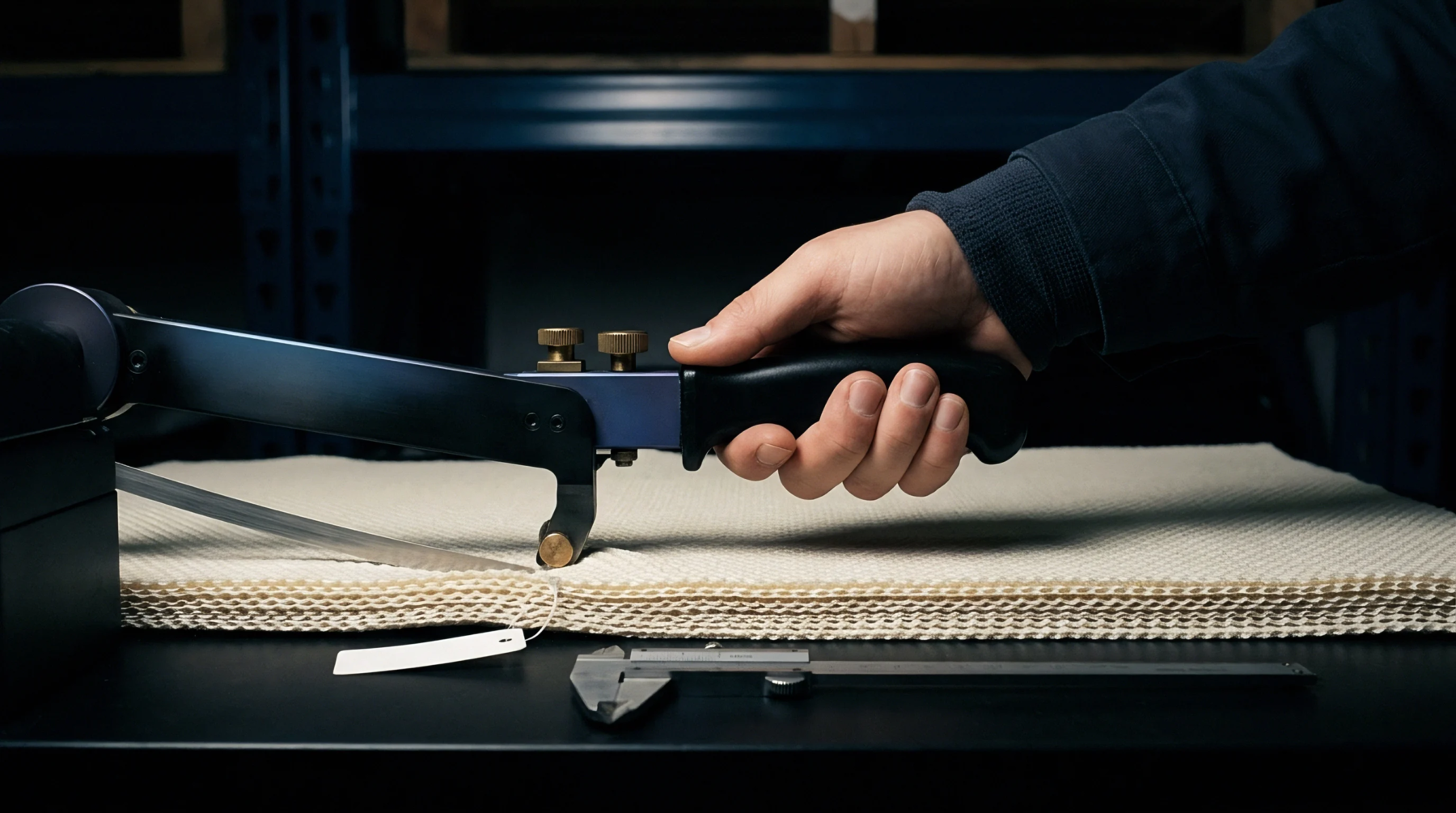
Force Application
Calibrated tensile force uncurls woven or knitted thread samples without inducing elastic extension during physical testing. Specifying correct yarn extraction tension ensures reliable measurement of un-crimped length during fabric structural analysis. Test standards prescribe specific mass loads per unit yarn linear density to straighten wave geometry completely.
Force application ceases to yield accurate structural data if the load induces permanent filament drawing.
Measurement Standard
Standard test methods designate pre-tension weights based on tex or decitex values of the yarn under test. Insufficient force leaves residual wave curvature, yielding artificially low un-crimped length values. Excessive force stretches the yarn elastomeric core, inflating measured length beyond true structural dimensions.
Applying standardized yarn extraction tension eliminates operator subjective error during manual crimp determination. Laboratory equipment utilizes precision deadweights or spring balances to maintain uniform force application.
Laboratory Execution
Technicians extract individual yarn strands from conditioned fabric swatches using mounted clamps and guide pins. Securing one yarn end to a fixed clamp, the operator attaches specified tensioning weights to the free end before reading length on a graduated scale. Automated test instruments record load-elongation curves to isolate the exact point where crimp removal ends and thread stretching begins.
Maintaining correct yarn extraction tension prevents miscalculation of yarn count and weave contraction factors during fabric decomposition analysis. Quality control managers review test tension records to audit laboratory compliance with international standard methods.
Analytical Impact
Incorrect tension values lead to inaccurate raw material cost calculations and flawed fabric reproduction plans. Precise force control ensures reproducible laboratory results across different testing facilities.