Solvent Extraction Residual Analysis for Recycled Cotton Synthetic Ternary Mixes
Accurate solvent extraction of recycled cotton ternary mixes demands resin stripping, precise filter porosity, and adjusted d-factors to prevent tariff misclassification.


Reagent
Gravimetric isolation of recycled cotton within ternary mixtures containing polyethylene terephthalate and secondary polymers demands rigid solvent selectivity. Post-consumer cotton differs from virgin staple through shortened cellulosic chains, fractured fibrillar morphology, and residual crosslinking resins. Standard dissolution regimes under ISO 1833-2 depend upon predictable mass depletion rates that shift when mechanically shredded cellulose encounters aggressive acids.
When a ternary yarn combines recycled cotton, polyester, and polyamide 6 or elastane, the analyst executes sequential separations where the secondary synthetic and cellulosic fractions dissolve while leaving the target polyester substrate undamaged. Reagent purity fixes dissolution boundaries.
Selective chemical cleavage begins with the complete removal of non-fibrous matter through petroleum ether Soxhlet extraction, followed by a secondary water rinse at 50 degrees Celsius. In a ternary union containing 50 percent recycled cotton, 40 percent polyester, and 10 percent polyamide 6, the initial attack targets the amide linkages. Formic acid prepared at 80 percent mass fraction dissolves polyamide 6 and nylon 6,6 within twenty minutes at 20 degrees Celsius.
Glacial acetic acid cannot substitute here, because it fails to cleave aliphatic polyamide bonds within practical analytical windows. Cellulosic hydroxyl networks remain largely stable under this organic acid concentration, provided liquor ratios do not exceed 100 millilitres per gram of specimen and agitation stays moderate.
A twenty-minute exposure to eighty percent formic acid at twenty degrees Celsius removes aliphatic polyamides while preserving ninety-nine percent of intact cellulosic mass.
Dissolution of the cellulosic component represents the second procedural phase. Concentrated sulfuric acid at 75 percent mass fraction dissolves recycled cotton at 50 degrees Celsius over a thirty-minute immersion. Recycled cellulose exhibits an average degree of polymerization ranging between 600 and 1100, contrasted with virgin cotton values between 1800 and 2500.
This molecular fragmentation accelerates hydrolytic degradation. Cellulose degrades under hot acid. If the reagent temperature rises past 52 degrees Celsius, polyester surface etching commences, causing mass loss in the insoluble synthetic residue.
- Specimen scouring strips spinning lubricants, residual knitting oils, and loose surface finishes through eighty extraction cycles in a Soxhlet apparatus containing light petroleum boiling between 40 and 60 degrees Celsius.
- Polyamide solvation clears the amide fraction into an 80 percent formic acid bath agitated gently at 20 degrees Celsius for twenty continuous minutes.
- Acid neutralization halts esterification through immediate vacuum filtration over sintered glass, rinsing the retained cake with dilute ammonium hydroxide followed by boiling distilled water until litmus neutrality confirms chemical removal.
- Cellulose digestion dissolves degraded cotton fibrils in 75 percent sulfuric acid held at 50 degrees Celsius for thirty minutes under continuous magnetic stir-bar rotation.
- Final gravimetric desiccation isolates the insoluble polyester skeleton inside a tared weighing container dried at 105 degrees Celsius until consecutive weighings vary by less than 0.0005 grams.
Solvent selectivity governs gravimetric accuracy. Elastomeric ternary mixtures substitute dimethylformamide or dimethylacetamide for the formic acid stage. Dimethylformamide at 90 degrees Celsius dissolves polyurethane segments within forty-five minutes without cleaving ester bonds within polyester staple.
Acrylic components require 70 percent zinc chloride aqueous solution or warm dimethylformamide at 80 degrees Celsius. The wash temperature remains critical. Residual chemical carryover into subsequent stages distorts mass calculations by precipitating degraded polymers directly onto the filter substrate.
| Mix Combination | Solvation Stage | Active Reagent | Temperature and Time | Dissolved Phase | Retained Phase |
|---|---|---|---|---|---|
| Cotton / PET / Nylon 6 | Primary | 80% Formic Acid | 20 °C, 20 min | Polyamide | Cotton and PET |
| Cotton / PET / Nylon 6 | Secondary | 75% Sulfuric Acid | 50 °C, 30 min | Recycled Cotton | Polyester |
| Cotton / PET / Elastane | Primary | Dimethylformamide | 90 °C, 45 min | Polyurethane | Cotton and PET |
| Cotton / PET / Elastane | Secondary | 75% Sulfuric Acid | 50 °C, 30 min | Recycled Cotton | Polyester |
| Cotton / PET / Acrylic | Primary | Dimethylformamide | 80 °C, 40 min | Polyacrylonitrile | Cotton and PET |
| Cotton / PET / Acrylic | Secondary | 75% Sulfuric Acid | 50 °C, 30 min | Recycled Cotton | Polyester |
Spinning mills blending open-end post-consumer cotton routinely claim that aggressive chemical extraction strips functional spinning finishes and natural waxes, arguing that mass deficits reflect external chemical aggression rather than deficient base fibre proportions.


Filter
Gravimetric residue recovery hinges upon mechanical retention at the porous interface. Mechanically pulled recycled cotton sheds micro-fibrils during yarn opening and carding, generating microscopic lint with diameters below fifteen micrometres and lengths under two hundred micrometres. Standard ISO 1833 crucibles equipped with sintered glass discs of porosity grade 1, featuring pore diameters between 100 and 160 micrometres, allow these fragmented cellulose fines to escape into the vacuum flask during initial solvent rinses.
Coarse discs lose critical fractions. Using porosity grade 2 or 3, where pore openings span 40 to 90 micrometres, prevents fine loss but introduces severe cake compaction during viscose or degraded cotton dissolution.
Does Mechanical Shredding Alter Dissolution Kinetics?
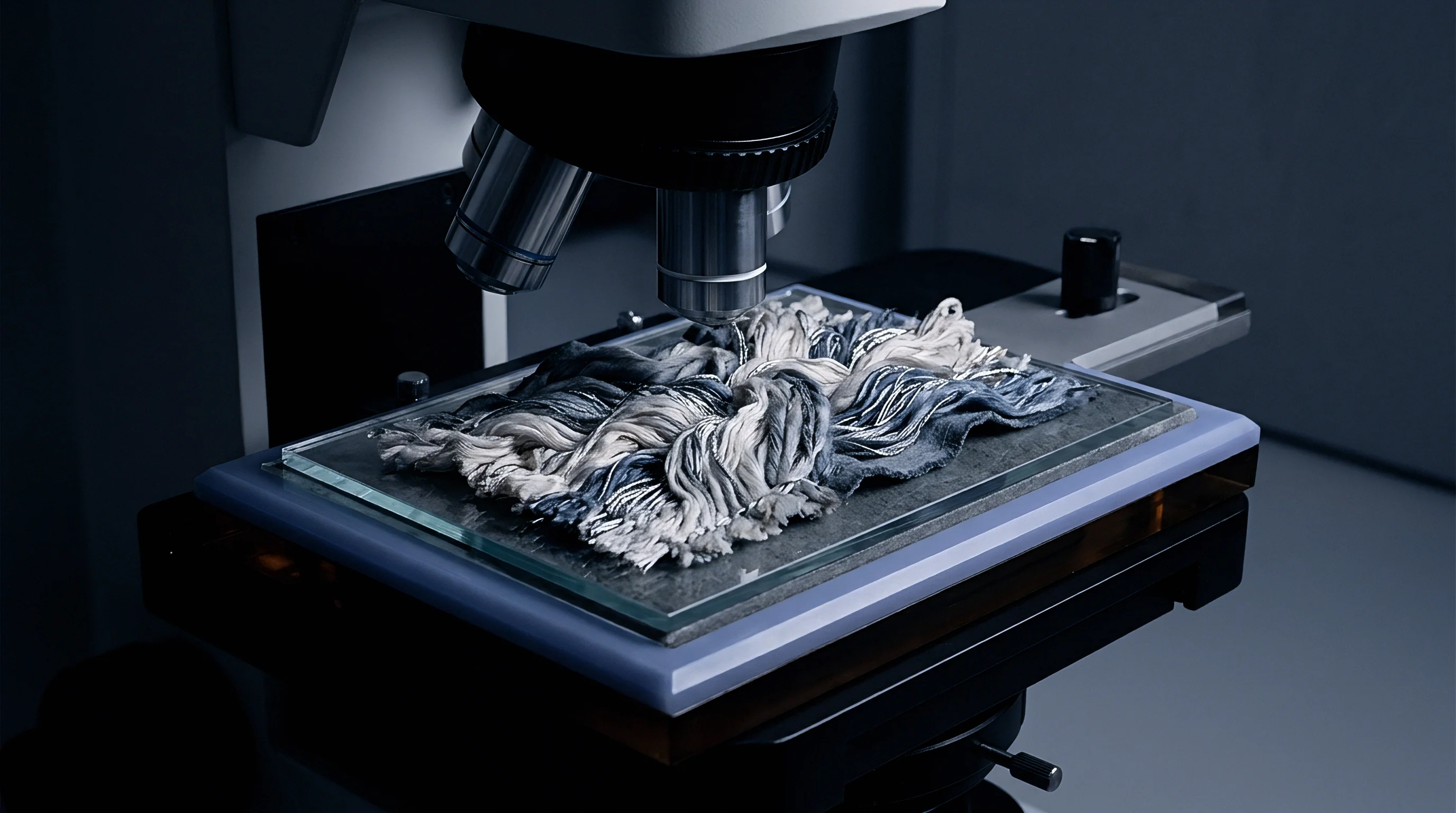
Shedding patterns observed in post-consumer denim tearing operations demonstrate severe structural fragmentation along the cotton secondary wall. The torn fibres exhibit ruptured spiral fibrils and exposed lumen cavities. When exposed to 75 percent sulfuric acid, these split ends disintegrate into colloidal suspensions within three minutes, whereas virgin cotton filaments swell into a gel state before dissolving uniformly across twenty minutes.
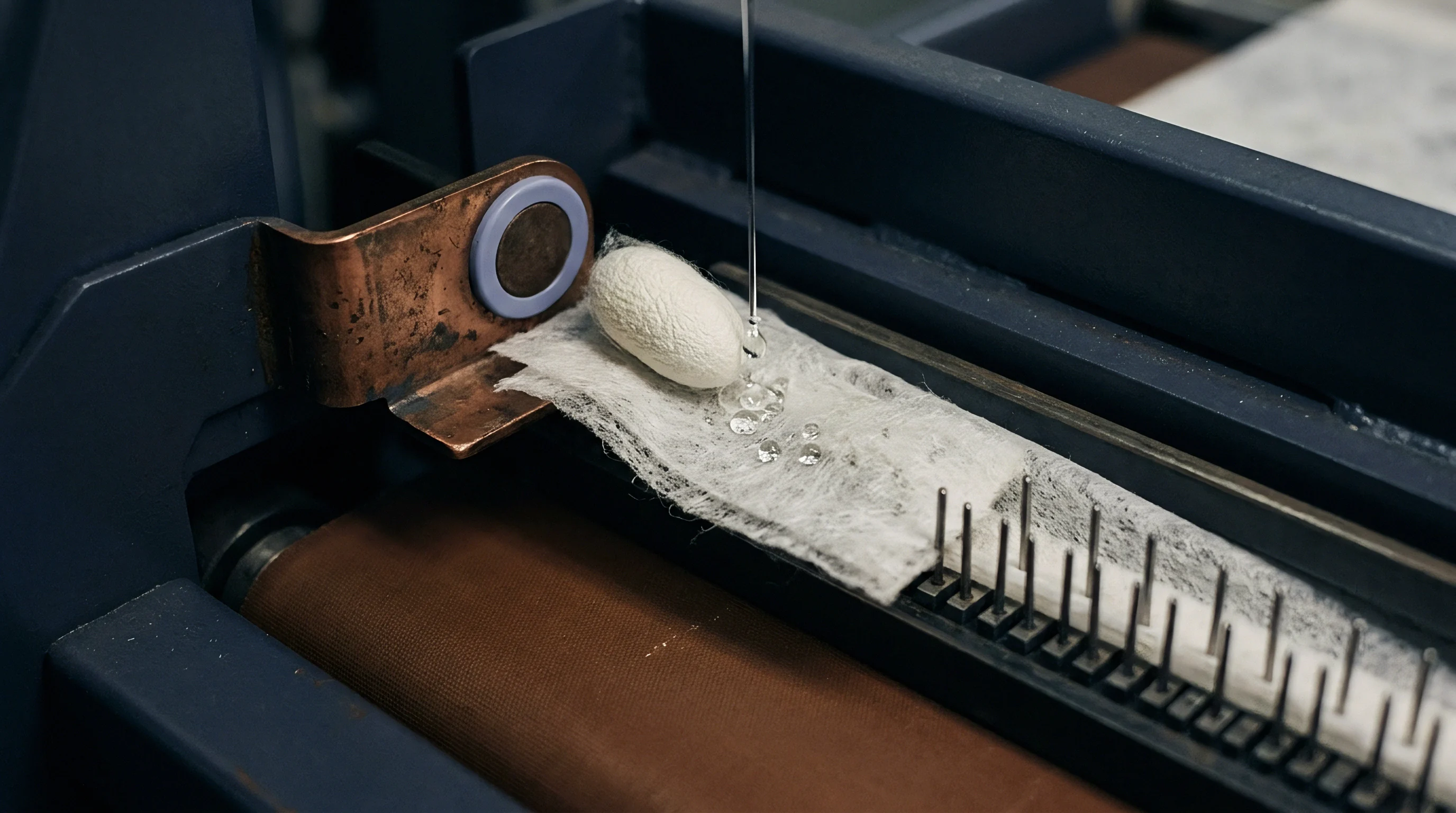
The rapid formation of viscous cellulose paste blinds crucible pores. Incomplete draining traps dissolved sugars within the retained polyester web, yielding false positive masses for the synthetic residue.
- Crucible blinding occurs when dissolved cellulose syrups fail to clear the sintered glass disc before the vacuum pulls gelled fibrils into the porous pathways.
- Fibril washthrough releases microscopic cotton fragments through coarse filter apertures during the neutralising rinse cycles. Short fibrils escape coarse discs.
- Oligomer precipitation deposits low-molecular-weight polyester cyclic trimers onto the filter surface when hot dimethylformamide or concentrated solvents cool too quickly during transfer.
- Resin agglomeration leaves insoluble crosslinked polyacrylate or polyurethane printing binders resting on the filtration medium as spurious synthetic mass.
Crucible porosity alters the filtrate. A technician filtering shredded post-consumer material must balance draining velocity against fibril capture. Applying a glass microfibre pre-filter disc inside the crucible captures sub-sieve particles.
This approach adds tare mass complexity, requiring baseline moisture desiccation for both crucible and quartz filter papers before touching the solvent bath. Rapid solvent cooling during vacuum filtration also precipitates polyester oligomers. Cyclic trimers migrate to fibre surfaces during heat setting and spinning, dissolving into hot solvent phases and crystallising as crystalline needles when the liquor temperature drops across the crucible wall.
Coarse filtration discs lose up to two percent of fragmented recycled cotton directly into the extraction filtrate.
Rinsing procedures govern analytical repeat accuracy. After draining the primary dissolving liquor, three washes of fifty millilitres of distilled water clear residual reagents. A five percent sodium bicarbonate rinse neutralises remaining sulfuric acid droplets trapped inside dense yarn fragments.
Failure to neutralise residual acid leads to cellulose charring during the subsequent 105-degree oven desiccation cycle. Charred organic matter adheres tenaciously to sintered discs, permanently shifting crucible tare masses for subsequent determinations. Clean filters maintain analytical integrity.
Factor
Quantitative analysis of ternary combinations relies on applying empirical correction factors, designated as d-factors, to adjust for the slight solubility of insoluble fibres in specific reagents. Standard standards specify fixed d-factors established on virgin, undamaged fibres. ISO 1833 assigns a d-factor of 1.00 to polyester exposed to 75 percent sulfuric acid, indicating zero mass loss.
Recycled cotton receives an assigned d-factor of 1.03 under formic acid systems to balance minor extraction of natural pectin, waxes, and low-molecular-weight hemicellulose. These baseline values lose validity when applied to post-consumer feedstock subjected to multiple industrial dyeings, mechanical shredding, and chemical finishing treatments.

Do Insoluble Finishes Distort Gravimetric Results?
Post-consumer cotton textiles frequently carry durable-press finishes based on dimethyloldihydroxyethyleneurea or modified melamine resins. Resin crosslinks arrest chemical attack. These chemical bridges tie cellulose polymer chains together through ether linkages, resisting acid hydrolysis in 75 percent sulfuric acid.
The untreated portions of the fibre dissolve, leaving an insoluble crosslinked shell that remains in the crucible alongside the polyester staple. The analyst measures this undissolved residue as synthetic content, which artificially lowers the calculated recycled cotton percentage on the test certificate. Solvent pre-treatments with 1 percent boiling hydrochloric acid strip resin crosslinks, but simultaneous cellulose chain scission risks solubilizing significant cellulosic mass.
Commercial contracts fail when laboratory reports overlook processing-induced correction factor shifts across mechanically shredded inputs.
The calculation sequence for a ternary mixture containing recycled cotton, polyester, and polyamide 6 follows mass conservation laws adjusted by individual solubility factors:
P1 = ((m0 – m1) / m0) 100
P2 = ((m1 – (m2 / d2)) / m0) 100
P3 = 100 – P1 – P2
Here, m0 represents clean dry starting mass. The mass m1 denotes dry residue after formic acid extraction of polyamide. The value m2 represents dry residue following sulfuric acid dissolution of recycled cotton.
The parameter d2 represents the correction factor for polyester mass survival under 75 percent sulfuric acid. If mechanically degraded polyester surface chains suffer 1.5 percent mass loss during acid exposure, d2 drops to 0.985. Applying the standard default factor of 1.00 transfers that missing 1.5 percent directly into the calculated cotton fraction.
| Fibre Substrate | Reagent Chemistry | Standard d-Factor | Observed Degraded d-Factor | Mechanical Influence |
|---|---|---|---|---|
| Virgin Polyester | 75% Sulfuric Acid | 1.00 | 0.998 | Negligible surface erosion |
| Recycled PET (Bottle Flake) | 75% Sulfuric Acid | 1.00 | 0.982 | Oligomer dissolution and etch loss |
| Virgin Mako Cotton | 80% Formic Acid | 1.02 | 1.015 | Pectin and surface wax clearing |
| Mechanically Torn Cotton | 80% Formic Acid | 1.03 | 1.055 | Fragmented fibril washthrough |
| Post-Consumer Dyed Cotton | Dimethylformamide | 1.01 | 1.042 | Azo dye and finish leaching |
| Values represent dry-mass retention ratios verified across five analytical runs per substrate at 105 degrees Celsius drying plateaus. | ||||
Dry mass determines baseline content. Disperse dyes enter solvent phases. Dark reactive dyes applied to cotton can account for 2 to 6 percent of dry fiber weight.
When sulfuric acid hydrolyzes the cellulose backbone, water-insoluble dye pigments and hydrolyzed dye molecules precipitate or remain caught within the filter mesh. These colored residues coat the polyester filaments, artificially elevating the final gravimetric reading. Determining whether an observed mass variance arises from crosslinked finishes or altered dissolution kinetics remains an open question across commercial dispute testing.
Exposure
Cross-border apparel trade relies on exact fibre composition percentages to establish legal customs classifications, determine preferential duty eligibility, and comply with textile labeling regulations. Under the international Harmonized System tariff schedule, tariff shifts turn on which fiber constitutes chief weight. In a ternary mix containing recycled cotton, polyester, and elastane, small chemical measurement errors cause significant commercial disruption.
A fabric declared as 52 percent cotton, 45 percent polyester, and 3 percent elastane falls under Chapter 52 as a cotton textile. If incomplete cellulosic dissolution in sulfuric acid leaves two percent undissolved resin mass in the crucible, the laboratory returns 50 percent cotton, 47 percent polyester, and 3 percent elastane. The classification flips to Chapter 55 as a man-made synthetic piece good.
Tariff lines pivot on weight. Under United States International Trade Commission schedules, Chapter 52 cotton woven fabrics carry average Most Favoured Nation ad valorem duties between 7 and 12 percent. Polyester-dominated wovens under Chapter 55 face duty rates ranging from 14 to 27 percent.
A three percent shift in calculated synthetic content triggers an automatic tariff classification change, imposing a 15 percent duty differential across an entire ocean container. Customs authorities audit entries retrospectively, demanding back-duties, commercial interest, and administrative penalties when import testing contradicts invoice documentation.
A two percent calculation variance in cellulosic content can shift tariff classification from cotton to man-made goods, doubling customs liability.
Moisture regain alters dry calculations. Laboratory reports provide bone-dry masses, yet trade declarations demand commercial mass adjusted by official moisture regains. ISO 6741-2 fixes standard commercial allowances at 8.5 percent for virgin cotton, 1.5 percent for polyester, and 12.0 percent for polyamide 6.
Mechanically shredded recycled cotton exhibits altered moisture sorption isotherm plateaus due to loss of amorphous cellulose regions and resin occlusion. Standard tables do not distinguish post-consumer cotton from virgin staple. Calculating commercial masses using virgin coefficients distorts final invoice compositions by up to 1.8 percent, undermining conformity against European Union Textile Regulation 1007/2011.
- Tolerance buffer review validates whether the declared yarn ratio absorbs the standard plus-or-minus three percent regulatory allowance without breaching the threshold separating natural from synthetic tariff chapters.
- Commercial regain alignment applies precise regional moisture regain percentages to bone-dry laboratory outputs before transcribing values onto formal customs declarations.
- Extraction verification protocol tracks whether laboratory technicians scoured non-fibrous sizing agents prior to executing selective chemical dissolutions. Lab reports carry real liability.
- Duplicate crucible cross-check requires running parallel gravimetric determinations to isolate anomalies caused by filter disc blinding or incomplete rinsing.
A customs dispute stops freight. Importers facing reclassification actions bear bonded warehouse storage fees, shipment demurrage, and clearance delays while retests run. Independent accredited testing houses frequently return differing ternary compositions on identical fabric rolls when one laboratory applies standard ISO virgin correction factors while another attempts finish stripping.
Importers who misdeclare fiber percentages risk goods forfeiture, mandatory container re-exportation, and commercial penalties based on full shipment valuation.

Ledger
Commercial settlements in yarn and piece-goods contracts depend directly upon precise mass verification. Mill contracts state prices per kilogram based on specified component fractions. Post-consumer recycled cotton sliver trades at commercial discounts compared to long-staple virgin combed cotton, yet processing costs escalate during spinning due to higher short-fiber content and nep generation.
In intimate ternary spinning combining mechanically shredded denim waste, recycled polyester, and nylon, yarn spinners face tight operational margins. A discrepancy of two percent in synthetic content shifts production economics across multi-tonne spinning lots.
Consider a sourcing contract for 40,000 kilograms of ternary knitted jersey fabric specified at 60 percent recycled cotton, 35 percent recycled polyester, and 5 percent elastane. Raw material assumptions reflect base commodity prices: recycled cotton open-end sliver at 1.45 US dollars per kilogram, recycled polyester staple at 1.15 US dollars per kilogram, and elastane filaments at 6.80 US dollars per kilogram. Blended material raw cost stands at 1.61 US dollars per kilogram.
Finished fabric sells at 4.20 US dollars per kilogram delivered duty unpaid. Total invoice value reaches 168,000 US dollars.
Destination customs testing extracts the fabric using warm dimethylformamide followed by 75 percent sulfuric acid. Insoluble durable press resins present in the post-consumer feedstock resist the acid bath, leaving 2.2 percent undissolved resin mass credited to the synthetic residue. The laboratory issues a test report certifying 57.8 percent recycled cotton, 37.2 percent polyester, and 5.0 percent elastane.
Under local labelling laws, the shipment fails to match the invoiced composition. The customs authority suspends preferential clearance and issues a redetermination order.
| Cost Component | Declared Specification (60/35/5) | Laboratory Redetermination (58/37/5) | Net Financial Variance |
|---|---|---|---|
| Base Duty Rate | 8.4% (Cotton-rich, Ch. 52) | 14.9% (Synthetic-rich, Ch. 55) | +6.5% ad valorem |
| Customs Duty Charge | $14,112.00 | $25,032.00 | +$10,920.00 |
| Port Demurrage (14 days) | $0.00 | $4,200.00 | +$4,200.00 |
| Re-testing and Lab Fees | $0.00 | $1,850.00 | +$1,850.00 |
| Client Chargeback Penalty | $0.00 | $8,400.00 | +$8,400.00 |
| Total Landed Cost Impact | $14,112.00 | $39,482.00 | +$25,370.00 |
The resulting 25,370 US dollar cost escalation erodes operational profitability across the order. The buyer passes these costs backward to the fabric mill through commercial chargebacks. Dispute resolution procedures require clear contractual mechanisms to arbitrate conflicting laboratory reports.
Standard purchase agreements must define exact testing workflows to eliminate exposure to variable gravimetric methods.
Commercial purchase contracts establish binding settlement terms by inserting ISO 1833-2 reference requirements that mandate non-fibrous extraction, five-point duplicate sampling across whole production rolls, and predetermined empirical correction factors for post-consumer feedstocks before either party signs an invoice.