Calibrating Yarn Pretension Weights for Linear Density Testing
Calibrating yarn pretension weights at 0.5 cN per tex removes crimp without permanent elongation, securing precise linear density figures across laboratory tests.


Load
Calculating linear density requires pulling out yarn crimp and mechanical slack as test skeins are wound. If a skein goes onto the reel without enough tension, the waviness from spinning or package winding stays in place. That slack shortens the actual loop path of each wrap, reading as a false high mass per unit length on the balance.
Overloading does the reverse: it pulls the yarn past its yield point, permanently stretching the filaments and recording an artificially fine count.
In testing standards, pretension is the force placed on a single strand between the supply package and the reel drum. Methods like ISO 2060 and ASTM D1907 fix target tension windows based on fibre composition and nominal count. Spun staple yarns take a nominal 0.5 centinewtons per tex, with an allowance of 0.1 centinewtons per tex.
Continuous synthetic filaments need less ~ typically 0.25 centinewtons per tex ~ to keep from pulling out the heat-set crimp built into textured polyester and polyamide.
Standardized Tension Thresholds by Structural Fibre Class
Proper pretension depends on how the yarn deforms under load. High-modulus cellulosics resist dimensional change across fairly high static loads, while low-modulus synthetics yield under relatively light pull. The table below outlines standard pretension ranges across yarn classes and test specifications.
| Fibre Classification | Yarn Structure | Nominal Range | Specified Tension (cN/tex) | Mass Equivalent (g/tex) |
|---|---|---|---|---|
| Carded or Combed Cotton | Single Staple Spun | 10 to 100 tex | 0.50 ± 0.10 | 0.51 ± 0.10 |
| Wool and Wool Blends | Worsted or Woollen Spun | 15 to 200 tex | 0.50 ± 0.10 | 0.51 ± 0.10 |
| Continuous Filament Polyester | Flat Fully Drawn (FDY) | 30 to 300 dtex | 0.25 ± 0.05 | 0.25 ± 0.05 |
| Textured Synthetic Filament | Draw Textured (DTY) | 50 to 167 dtex | 0.10 ± 0.02 | 0.10 ± 0.02 |
| Elastomeric Core Spun | Covered Spandex Blend | 15 to 80 tex | 0.75 ± 0.15 | 0.76 ± 0.15 |
In many testing rooms, operators simply leave the same deadweight on the guide for every sample that comes through. This introduces systematic bias into commercial test records. Running a 100-tex cotton and a 15-tex worsted through identical static tension puts more than three times the recommended load onto the finer strand.
That permanent draft shifts the count, throwing off fabric yield calculations downstream on knitting or weaving frames.
ISO 2060 mandates a pretension force of 0.5 cN per tex for spun yarns to fully extend structural crimp without exceeding the yield point of the constituent fibres.
Skipping tension checks against the yarn’s nominal weight creates lot-to-lot count discrepancies. For a mill, relying on unverified pretension weights can mean accepting yarn that misses target cover factors, producing light fabric and rejected garment shipments at the finishing stage.

Reel
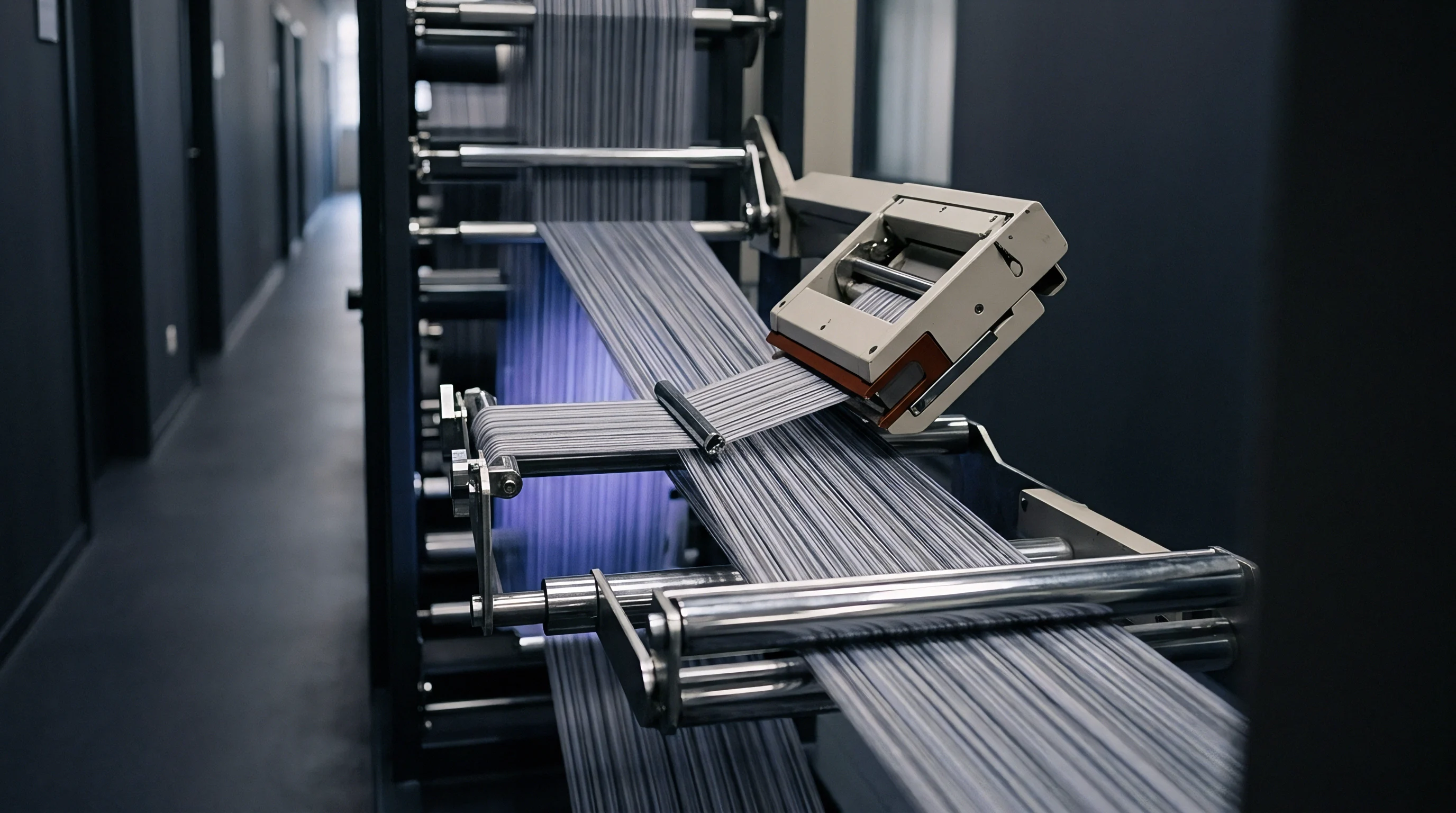
Preparing test skeins demands uniform winding speed and steady strand tension. A standard wrap reel uses a skeletal drum ~ typically one metre or one yard around ~ driven by a motor configured with smooth acceleration ramps. The yarn unwinds from the package through guides, deadweight discs, and a traversing eyelet that spaces wraps across the drum bars without bunching.
Mechanical Assemblies and Perimeter Accuracy
Length accuracy hinges largely on the contact between the strand and the tensioning assembly. Most reels apply tension through friction discs, spring-loaded plates, or weighted drop bars. Over time, running yarn cuts grooves into disc faces, changing the friction profile even when the mass on top is correct.
Polished ceramic and hard chrome contact faces prevent that drift and hold a steady coefficient of friction over long runs.
Several mechanical points require ongoing inspection to keep skein prep within tolerance:
- Grooved ceramic guides alter yarn wrap angles and raise running tension well past the deadweight rating.
- Accumulated lint deposits jam spring-loaded tension discs and cause erratic force spikes.
- Eccentric drum rotation produces cyclical tension surges that draw out fragile synthetic strands during the run.
- Oxidized deadweight masses shift calibrated gravitational loads, creating slow tension drift over time.
Drum perimeter dimensions warrant the same scrutiny. Skeletal frames subjected to knocks or temperature swings rarely hold a true one-metre circle. ISO 139 defines standard testing atmosphere as 20 degrees Celsius and 65 percent relative humidity; temperature drift in an unconditioned lab expands aluminum reel arms enough to shift a one-metre perimeter by as much as 0.8 millimetres, directly skewing the length calculation.
Under ISO 2060 Clause 6.2, reel circumferences must be checked with a 20 centinewtons measuring load strung across the drum bars, and recalibrated if dimensions drift more than 0.2 percent from nominal.
Hysteresis
Textile yarns are viscoelastic, displaying time-dependent strain under load rather than pure elastic behavior. Wool, textured filaments, and synthetic polymers all combine immediate elastic stretch with delayed deformation and varying degrees of permanent set. Accounting for these mechanics prevents testing errors caused by strand recovery after winding.

Does Textured Yarn Deformation Shift Mass per Unit Length Results?
Draw-textured yarns carry three-dimensional crimp set by false-twist heating. Applying standard spun-yarn tension to a draw-textured polyester collapses that crimp completely and begins pulling on the filament structure itself. On a load-elongation curve, an initial decrimping slope transitions into a steeper region where the filaments take the load.
Measuring textured yarns demands tension high enough to remove bulk crimp without stretching the underlying polymer.
The force-elongation curve shows two distinct transitions. The first marks where structural crimp straightens out fully, establishing true nominal length. The second marks the material yield point of the fibre.
Ideal pretension sits squarely on the plateau between the two: lighter weights leave residual crimp in the skein, while heavier weights cause permanent filament draft.
Skein preparation for continuous filament nylon requires a steady sequence to preserve dimensional stability:
- Mount the supply package on the creel for overhead takeoff without edge drag.
- Thread the strand through the primary ceramic eyelet and clean tension disc faces.
- Pick a calibrated deadweight equivalent to 0.25 centinewtons per tex for the nominal count.
- Seat the deadweight gently into the guide column to avoid shock loading.
- Secure the strand in the reel clamp and turn the drum twice by hand to check alignment.
- Start the drive motor, reaching standard running speed within three seconds.
- Stop at exactly 100 revolutions and tie off or clamp the ends immediately to hold tension.
- Collapse the reel arm, lift the skein clear, and transfer it straight to the balance.
Excessive pretension weight elongates elastomeric core yarns beyond their elastic recovery threshold, understating the true linear density on the conditioned skein.
Recovery dynamics become critical when evaluating high-stretch or elastomeric-core yarns. An over-tensioned skein snaps back immediately upon release from the drum, but stress relaxation continues for hours. Weighing the skein right away captures a mass tied to that extended length.
Conditioning the skein loose in the testing room permits partial recovery, though any plastic deformation incurred on the reel permanently alters the final count.
Winding speed also affects measured linear density on textured nylon. At 300 revolutions per minute, a reel applies brief, dynamic pulses, whereas slower winding exposes the running yarn to sustained creep under the same deadweight mass. That difference in dwell time generates noticeable count discrepancies between labs running reels at different rotational speeds.
Assigning pretension weights purely by fibre category rather than empirical decrimping curves remains an operational compromise. High-throughput testing facilities balance exact viscoelastic response against sample turnaround, accepting small systematic margins to keep routine queues moving.


Arithmetic
Converting skein weight into linear density relies on formulas linking sample length, conditioned mass, and moisture content. Direct systems express count as mass per unit length (tex, denier), whereas indirect systems report length per unit mass (English cotton count, metric count). Accurate pretensioning ensures that the length term in these equations reflects the actual yarn delivered to the drum.
Count System Conversions and Moisture Adjustment Equations
Tex is calculated by dividing mass in grams by length in metres and multiplying by 1,000; denier follows the same ratio scaled by 9,000. For indirect counts like English cotton count, the calculation divides the count of 840-yard hanks by the conditioned mass in pounds. An error in pretension corrupts the length denominator or numerator, biasing the resulting yarn count directly.
The practical effect shows up clearly when testing a nominal 150-denier (16.67 tex) draw-textured polyester at three different pretension settings. Using a 100-metre skein on a one-metre reel, the table below tracks the resulting skein lengths, unconditioned masses, and calculated denier values across each run.
| Test Case | Pretension Setting | Actual Skein Length (m) | Unconditioned Mass (g) | Calculated Denier | Percentage Error (%) |
|---|---|---|---|---|---|
| Case A: Under-Tensioned | 0.05 cN/tex | 98.2 | 1.671 | 153.1 | +2.07 |
| Case B: Correct Tension | 0.10 cN/tex | 100.0 | 1.667 | 150.0 | 0.00 |
| Case C: Over-Tensioned | 0.50 cN/tex | 103.4 | 1.667 | 145.1 | -3.27 |
The results demonstrate how tension errors skew results unevenly. In Case A, insufficient tension leaves micro-crimp along the strand, so 100 drum revolutions capture only 98.2 metres of true yarn, reading as a denier more than two percent too heavy. In Case C, excessive load stretches the yarn by 3.4 percent, spreading the mass over extra length and depressing denier by over three percent.
Commercially, a shipment of nominal 150-denier yarn tested under Case C conditions would be invoiced around 145-denier, losing value across production lots.
Balance weights must be adjusted using standard commercial moisture regain allowances. ISO 2060 fixes these allowances by fibre ~ 8.5 percent for cotton and 11.0 percent for viscose staple, for instance. Commercial linear density is calculated by multiplying the oven-dry mass by one plus the commercial regain factor, then dividing by the sample length.
Deadweight verification requires systematic checking on a certified balance:
- Degrease the deadweight mass with isopropyl alcohol to clear oils and debris.
- Tare a calibrated Class F balance readable to 0.1 milligrams.
- Center the deadweight on the pan using non-magnetic tweezers.
- Record the mass in grams under standard lab conditions.
- Convert mass to centinewtons using local gravitational acceleration.
- Check the resulting force against nominal ISO 2060 tolerances.
- Color-code verified weights to indicate calibrated force rating.
A deviation of 0.05 cN per tex in pretension force alters measured linear density by 1.2 percent on 150 denier textured polyester.
While suppliers often trace count variation back to raw fibre lots or spinning room humidity, laboratory audits regularly show uncalibrated wrap reel tensioners to be the actual source of these commercial disputes.

Variance
Aligning count results between vendor and customer laboratories requires eliminating systematic tension errors. Gauge repeatability and reproducibility studies consistently identify tension control as the primary driver of inter-lab variance in linear density testing. ISO 17025 audits enforce strict calibration on analytical balances, yet reel pretensioners often run for years without inspection, accumulating spring fatigue and surface grooving.

Laboratory Bench Tolerances and Calibration Mass Drift
Deadweight discs degrade through drop impacts, abrasive handling, and surface oxidation. A brass disc worn down by friction under-tensions the strand, leaving crimp in the wraps and artificially inflating mass per unit length. Conversely, oil and lint on the guide posts add drag, pulling the yarn under excessive tension.
Recalibrating deadweight discs against certified standards twice a year keeps measurements traceable.
Modern wrap reels increasingly substitute closed-loop electronic tensioning for passive deadweights. Optical sensors and electromagnetic brakes adjust drag continuously to compensate for creel friction and package unwinding dynamics. These systems hold target tension within 0.01 centinewtons, bypassing the handling errors and miscalculations common with manual disc selection.
Deadweight pretension masses require recalibration against certified laboratory standards whenever surface oxidation or mechanical abrasion alters their physical mass.
Commercial disputes over yarn count usually point back to differences in tension hardware between labs. Whether passive deadweights or active electronic controllers should serve as the definitive reference method remains an ongoing debate within international standards bodies.