Primary Void Geometry Dictating Chemical Flow in Dense Wovens
Primary void geometry sets the hydraulic entry threshold for dense wovens, requiring high-differential pressure equipment to prevent surface ring dyeing defects.

Throat
Microscopic cross-sections of greige poplin cut along the warp reveal distinct geometric passages between adjacent yarns. Under twenty magnifications on a calibrated optical micrometer, the inter-yarn spacing measures twelve micrometres at the narrowest pinch between orthogonal yarn crowns. Intra-yarn gaps between individual continuous filaments within the same bundle compress down to 1.8 micrometres.
These dimensional boundaries govern liquor entry. High-density looms beat warp ends and weft picks together until structural jamming occurs. The interstitial opening contracts into a constricted nozzle that fluid must traverse under external force.
Loom state metrics establish the initial hydraulic aperture. When warp cover factor reaches 18.5 and weft cover factor hits 16.0 under the Peirce formula, interstitial space drops below eight percent of total surface area. Greige constructions specified at 130 ends per inch and 70 picks per inch in 40s combed cotton yarn present severe hydraulic resistance to unpressurized aqueous baths.
The fluid mechanics within these micro-channels follow modified Hagen-Poiseuille relations. The effective hydraulic diameter of the passage scales inversely with yarn diameter and packing fraction. Surface tension of the sizing starch further closes the entry.
A four-micrometre reduction in effective pore radius elevates the displacement pressure threshold by sixty-five kilopascals during continuous padding at twenty-five metres per minute.
Filament bundles deform under lateral beat-up pressure inside the reed. Circular yarn cross-sections transition into lenticular geometries. The flattened profile elongates the entry path while compressing the vertical throat dimension down to minimal clearances.
Capillary pressure across this profile rises inversely with the menor radius of curvature. A liquid droplet resting on this greige surface maintains a contact angle exceeding 110 degrees when polyvinyl alcohol sizing coats the outer perimeter. Penetration stalls without continuous mechanical displacement.

Aperture Metrics in High Sett Goods
Thread counts measured according to ISO 7211-2 verify that loom tensions set the physical boundary conditions for all subsequent wet processing. High pick densities clamp warp filaments into tight crimp amplitudes. This mechanical locking eliminates channel deflection when liquor hits the cloth plane.
| Construction Type | Yarn Count (Warp x Weft) | Sett (Ends x Picks Per Inch) | Cover Factor (Peirce Total) | Mean Pore Throat Radius (μm) | Primary Void Porosity (%) |
|---|---|---|---|---|---|
| Downproof Cambric | 60s Ne x 60s Ne Combed Ring | 140 x 110 | 32.2 | 3.8 | 6.2 |
| High-Density Poplin | 40s Ne x 40s Ne Combed Compact | 136 x 72 | 31.4 | 5.4 | 8.5 |
| Filament Micro-Twill | 50D/72F x 50D/72F Polyester | 160 x 120 | 33.8 | 2.1 | 4.1 |
| Tactical Oxford | 500D x 500D Polyamide 6.6 | 54 x 48 | 28.6 | 9.2 | 12.8 |
Void ratios determine volumetric liquor uptake during rapid transit through the chemical trough. When primary void porosity drops below seven percent, hydrodynamic displacement overrides spontaneous capillary wetting. Liquid cannot enter through natural suction.
Mechanical force must overcome the capillary entry pressure defined by the Young-Laplace equation. The pore throat radius dictates the precise pressure required to displace air from the interior voids.
Porosity evaluations conducted under ASTM D737 air permeability standards show direct correlation with hydrodynamic resistance. A high-density poplin registering four cubic feet per minute at 125 pascals contains primary apertures that block spontaneous immersion. Desizing enzymes suspended in aqueous liquor bypass these miniature openings entirely when nip pressures remain set for standard loose sheetings.
Unpenetrated yarn bundles exit the mangle dry inside.
- Inter-yarn macro-pores define continuous fluid channels bounded by orthogonal yarn crowns where convective flow dominates during high-speed mechanical padding.
- Intra-yarn micro-pores represent sub-micron capillary voids between individual staple fibres or synthetic filaments where molecular diffusion controls mass transfer.
- Boundary constriction zones develop at yarn crossover nips where mechanical beat-up forces compress yarns into solid polymer barriers that stop transverse liquor flow.
- Perimetric size skins form when sizing formulations dry over yarn exteriors, converting accessible open apertures into impermeable glassy planes prior to desizing.
Pore distributions within dense textiles exhibit severe spatial heterogeneity. Yarn twist inserts another physical barrier. High twist multipliers draw outer filaments into tight outer helices that shield the yarn axis from liquid penetration.
Ring-spun yarns with twist factors above 4.2 create an external shell that restricts transverse liquid movement. Compact spinning further eliminates surface hairiness, removing the microscopic wetting wicks that accelerate initial fluid draw.
Loom settings directly define the volume of chemical solids that can penetrate the greige cloth. Scouring baths fail to emulsify spinning oils when flow remains restricted to macro-channels. Processors adjust chemical concentrations without altering yarn packing.
The initial mechanical geometry continues to dictate chemical distribution throughout the entire processing line.
Drag
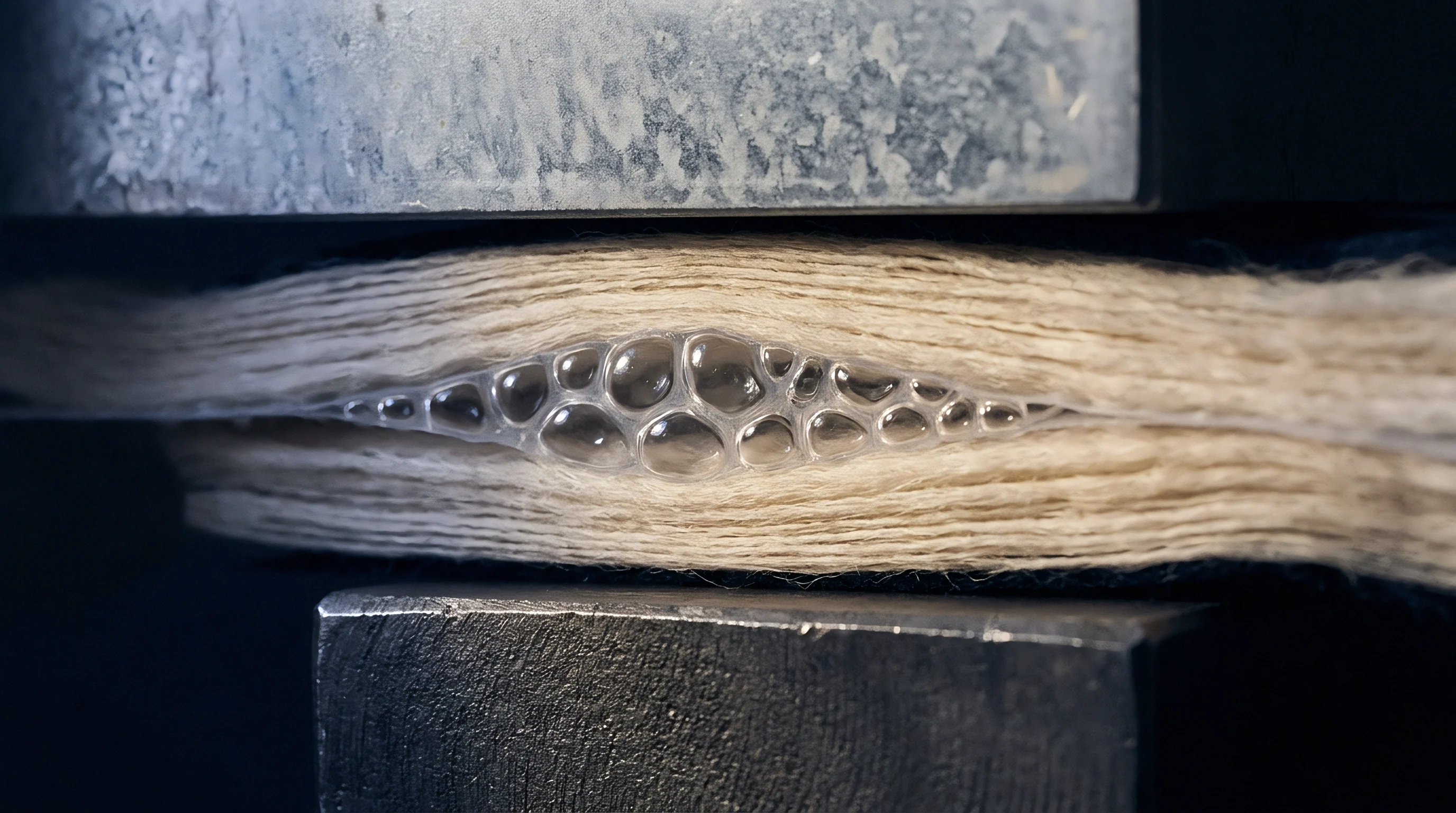
Viscous forces dominate aqueous flow through microscopic interstitial passages. Fluid passing through an aperture measuring four micrometres encounters extreme wall shear against outer yarn surfaces. The Reynolds number inside these micro-channels remains far below 0.1 during continuous open-width processing.
Viscous drag dampens transverse liquor momentum, forcing chemistry to channel around yarn bundles rather than penetrating into bundle cores. This hydrodynamic resistance stalls liquor exchange across the fabric thickness.
Capillary pressure calculations derived from the Lucas-Washburn relation assume constant pore radii and laminar flow. Real textiles present tortuous conduits characterized by alternating expansions and severe contractions. When advancing liquid fronts reach a sudden divergence past the pore throat, capillary draw drops abruptly.
The advancing meniscus pins at the sharp boundary of the yarn crown. The wetting front halts until external hydrostatic pressure overcomes the pinning barrier.
A continuous open-width line operating above forty metres per minute leaves intra-yarn voids dry whenever mechanical immersion dwell falls below 1.2 seconds.
Air displacement constitutes a physical barrier to uniform chemical delivery. Air trapped inside intra-yarn micro-pores forms pressurized bubbles as external liquor seals the outer pore throats. The Young-Laplace pressure of these entrapped bubbles resists further chemical entry.
High bath temperatures exacerbate this condition by expanding the trapped air volume. Unless wetting agents lower interfacial tension below thirty millinewtons per metre, the air pockets remain locked inside the yarn core throughout the dipping cycle.
Does Yarn Flattening Alter the Pore Throat?
Mechanical tension on the warp during continuous transport compresses the interlacing yarns against the roll face. The cross-sectional aspect ratio shifts from circular to elliptical under twenty decanewtons of web tension. This deformation cuts the vertical hydraulic opening by forty percent.
Shear rates generated within the pore throat reach ten thousand reciprocal seconds during rapid nip passage. Non-Newtonian finishing formulations, including modified starches and cross-linking DMDHEU resins, exhibit shear-thinning or dilatant rheology under these extreme conditions. Dilatant formulations increase in apparent viscosity precisely at the entrance to the pore throat, blocking entry.
Newtonian dye liquors maintain viscosity but generate boundary layers that limit mass transport at the yarn surface.
Diffusion boundary layers form immediately adjacent to stationary yarn surfaces. While liquor moves through macro-pores via bulk convection, liquid within intra-yarn spaces remains stagnant. Chemical transport shifts entirely from convective flow to passive diffusion.
The Peclet number inside the yarn bundle drops below unity. Solute molecules must traverse the stagnant boundary layer through concentration gradients alone, which requires extensive contact time rarely permitted on continuous finishing ranges.
Padder nip mechanics determine whether viscous drag is overcome. When the pneumatic pressure applied across the roll face fails to generate sufficient hydraulic head in the entry wedge, the liquor takes the path of lowest mechanical resistance. The fluid skirts along the exterior face of the goods.
A mill technician will claim that poor wetting reflects bad batch chemistry rather than inadequate nip pressure across dense yarn geometry.
Gradient
Unequal liquor penetration across yarn cross-sections creates severe chemical non-uniformity. When reactive dye baths encounter high-density poplins, dye molecules exhaust rapidly onto exterior filaments. The core filaments receive zero dye mass.
Microtome cross-sections analyzed under reflective spectrophotometry show intense coloration on the outer twenty percent of the yarn radius, while the inner eighty percent remains uncoloured greige. This ring dyeing defect compromises both shade consistency and long-term fastness.
Alkaline scouring suffers from identical geometric constraints. Sodium hydroxide solutions applied via pad-steam lines must saponify natural cotton waxes nestled deep within intra-yarn voids. Constricted pore throats restrict caustic migration into the interior of the bundle.
Outer waxes dissolve while interior waxes remain intact. Subsequent dyeing cycles reveal pale streaks and resist spots wherever residual waxes repel water-soluble dyes.
Uneven cross-sectional chemical distribution guarantees that abrasive wear will expose undyed white filament cores within fifty domestic laundry cycles.
Cross-linking resin finishes for non-iron performance demonstrate catastrophic failure modes when controlled by pore geometry. Dimethylolethyleneurea resins deposited predominantly on yarn crowns cause localized hyper-crosslinking of outer cellulose chains. Outer filaments become brittle and lose sixty percent of their tensile strength.
Core filaments remain completely un-crosslinked, offering no recovery from wrinkling. The finished cloth exhibits low tear strength paired with unacceptable crease recovery angles.
- Ring-scoured yarn profiles occur when caustic liquor fails to penetrate dense yarn cores, leaving residual pectins and waxes that reject dye molecules in subsequent stages.
- Differential mercerization bands develop across warp faces due to uneven sodium hydroxide access, creating visible variations in optical reflectance and shade depth.
- Brittle shell yarn degradation results from excessive resin catalyst concentration on exposed yarn perimeters, cutting Martindale abrasion resistance below ten thousand cycles.
- Hydrophobic core retention happens when desizing amylase enzymes bypass tightly wound filament bundles, preserving starch size that later triggers blotchy dye pickup.
- Two-sided flame retardant failure emerges when heavy organophosphate finishes deposit on one face of high-sett twills, failing vertical flammability tests after five washes.
Optical anomalies amplify the commercial consequence of these gradients. When dense textiles undergo wet processing with incomplete core penetration, surface abrasion during garment laundering shears off outer dyed filaments. The undyed or under-mercerized yarn core becomes exposed to the viewer.
Garments fail visual inspection after three domestic washes because microscopic abrasion creates a frosty, faded appearance known across the trade as wash wear-out.
Dyehouse managers encounter recurring shade reproducibility failures on dense constructions. Colorimetric values measured under illuminant D65 may match an approved standard initially on the surface. Spectrophotometers measuring under illuminant A or F02 reveal significant metameric shifts driven by light scattering from undyed internal filament facets.
Non-penetrated textiles generate unpredictable shade shifts across varying retail light sources. Skimping on penetration mechanics creates an uncorrectable fastness failure that scrap auditors reject upon port delivery.

Kier
Overcoming hydraulic bottlenecks in dense constructions requires specialized processing equipment. Standard atmospheric winch becks and continuous low-pressure wash boxes fail completely on dense wovens. Machine designs must impose controlled pressure differentials across the web to force liquor through constricted pore throats.
Without forced transverse convection, processing times escalate to economically unviable levels.
Beam dyeing vessels provide an effective route for dense high-count filament textiles. The cloth is wound around a perforated central cylinder under controlled, uniform tension. High-volume centrifugal pumps drive dye liquor radially through the compressed layers of cloth.
Flow direction reverses cyclically from inside-out to outside-in. Differential pressure transmitters monitor the pressure drop across the entire fabric package, maintaining values between 1.5 and 2.8 bar. This pressure drop forces liquor through the sub-micron pore throats, eliminating air pockets and ensuring complete core saturation.
| Machine Configuration | Differential Pressure Across Web (kPa) | Liquor Exchange Rate (Cycles/Min) | Core Saturation Depth (%) | Electrical Energy Draw (kWh/100m) |
|---|---|---|---|---|
| Standard Horizontal Padder | 12 – 18 | 1.0 | 38 | 4.2 |
| High-Pressure Vacuum Slot | 45 – 75 | 8.5 | 96 | 14.8 |
| Automated High-Tension Jig | 5 – 8 | 0.2 | 52 | 6.5 |
| Perforated Beam Dye Vessel | 150 – 280 | 12.0 | 100 | 28.4 |
Open-width continuous lines rely on specialized vacuum extractors positioned immediately following chemical application troughs. Standard nip rollers generate only compressive forces that flatten pores without purging air. High-capacity vacuum slots pull a dry web over an adjustable orifice operating at negative pressures between forty and seventy kilopascals.
This pressure drop strips boundary-layer moisture and extracts entrapped micro-bubbles from intra-yarn voids. As the vacuum collapses the air pockets, incoming chemistry rushes into the evacuated pore throat.
Why Do Boundary Layers Retard Wetting?
Fluid friction against dense yarn surfaces establishes a zero-velocity zone that blocks chemical exchange. This stagnant film insulates the yarn interior from bulk bath chemicals. The boundary layer thickness decreases only when relative fluid velocity increases significantly.
Submerged spray manifolds disrupt this stagnant boundary film through direct kinetic impact. High-velocity water needles operating at four bar strike the open-width cloth face perpendicularly. The kinetic energy of the water jet shatters the hydrodynamic boundary layer and forces liquor through the primary void geometry.
Ultrasonic transducers integrated into open-width wash boxes achieve similar results through acoustic cavitation. Microscopic cavitation bubbles collapse against the yarn crowns, driving high-speed micro-jets into the intra-yarn voids.
- Mechanical desizing impregnation drives formulated enzyme liquors through outer pore throats via dual-deflection nip rolls loaded to sixty kilonewtons per linear metre.
- High-differential vacuum extraction strips air pockets from internal filament channels at fifty kilopascals of negative pressure to permit instantaneous bath collapse.
- Atmospheric steam dwelling expands the chemical solution inside yarn cavities across ninety seconds of saturated steam exposure at one hundred degrees Celsius.
- Kinetic spray washing injects high-pressure wash liquor perpendicularly through the open matrix to displace hydrolysed starch before size retrogradation occurs.
Open-width washing ranges designed for dense goods split the processing line into multiple counter-current wash compartments. Each compartment incorporates vertical squeeze rolls and submerged high-velocity flow chambers. Counter-current flow maintains the maximum chemical concentration gradient between the cloth and the wash liquor at every stage.
Rapid liquor turnover prevents re-deposition of suspended impurities back into the pore throats. Tightly woven structures demand that physical pressure differentials replace passive dwell time on every wet finishing line.

Outlay
Selecting a high-density construction directly determines the manufacturing route and its capital requirements. When product specifications dictate a downproof cambric or an ultra-dense poplin, standard dyeing and finishing mills cannot execute the order. The buyer must route production through specialized wet-processing facilities equipped with vacuum extractors, high-pressure beam vessels, or heavy-duty jiggers.
These specialized machines carry higher hourly operational costs and operate at lower throughput speeds.
A standard 40s poplin processed through an atmospheric open-width range achieves continuous line speeds of eighty metres per minute. Processing a dense 140×110 cambric requires slowing the line to twenty-five metres per minute to ensure adequate chemical penetration during desizing and scouring. The lower throughput triples machine run time per thousand metres.
Dyehouses incorporate this capacity penalty directly into their finishing quotes, adding significant surcharges to the greige conversion price.
Commercial contracts referencing ISO 105-C06 wash fastness must specify cross-sectional penetration ratings alongside standard grey-scale surface change values.
Chemical costs escalate when dealing with high hydraulic drag. Dyehouse chemists must increase surfactant concentrations fourfold to depress liquor surface tension below twenty-eight millinewtons per metre. High-performance non-ionic wetting agents designed to withstand hot alkaline baths command prices exceeding four dollars per kilogram.
Enzyme formulations for high-density goods demand specialized low-viscosity carriers to facilitate entry through microscopic apertures. Chemical outlays increase by fifteen to twenty-five cents per finished metre simply to overcome greige void resistance.
| Cost Component | Standard Open-Width Line ($/m) | Vacuum-Assisted Line ($/m) | Beam Dyeing Route ($/m) |
|---|---|---|---|
| Base Energy (Steam & Power) | 0.14 | 0.22 | 0.41 |
| Specialized Wetting Chemistry | 0.06 | 0.18 | 0.12 |
| Direct Machine Line Time | 0.22 | 0.48 | 0.74 |
| Scrap and Off-Shade Allowance | 0.18 | 0.04 | 0.03 |
| Total Wet Processing Cost | 0.60 | 0.92 | 1.30 |
| Cost model assumes 2024 industrial utility baselines and standard reactive dye formulations. | |||
Rework arithmetic destroys commercial margins when penetration fails. If bulk goods exhibit ring dyeing, stripping and re-dyeing the lot requires aggressive chemical boiling off. This process damages cotton fibre maturity, reducing final tear strength below performance thresholds.
The lot becomes unsaleable scrap. The buyer absorbs air freight penalties, missed delivery windows, and mill claims that run into tens of thousands of dollars per dye lot.
Minimum order quantities expand because machine setup for high-pressure beam or specialized vacuum lines involves extensive downtime. Beam winding requires strict tension calibration to prevent package channeling. Mills refuse orders below five thousand metres per colourway for beam dyeing routes, compared to fifteen hundred metres on continuous jet equipment.
Sourcing managers must plan inventory commitments around these equipment constraints.
Inspection criteria must capture cross-sectional penetration before cutting begins. Standard four-point visual checks catch surface colour variances but fail to detect core starvation. Technical dossiers must require microscopic cross-sectional evaluations under twenty-times magnification alongside standard ISO 105 colour fastness tests.
Purchase orders that fail to specify minimum core penetration percentages leave the buyer legally exposed when abrasive field wear reveals undyed fibres after delivery.