Air Jet Spinning Waste Generation across Polyester Cotton Blend Ratios
Vortex spinning waste falls from eight percent in combed cotton to one percent in polyester as synthetic staple tenacity resists nozzle air drag.
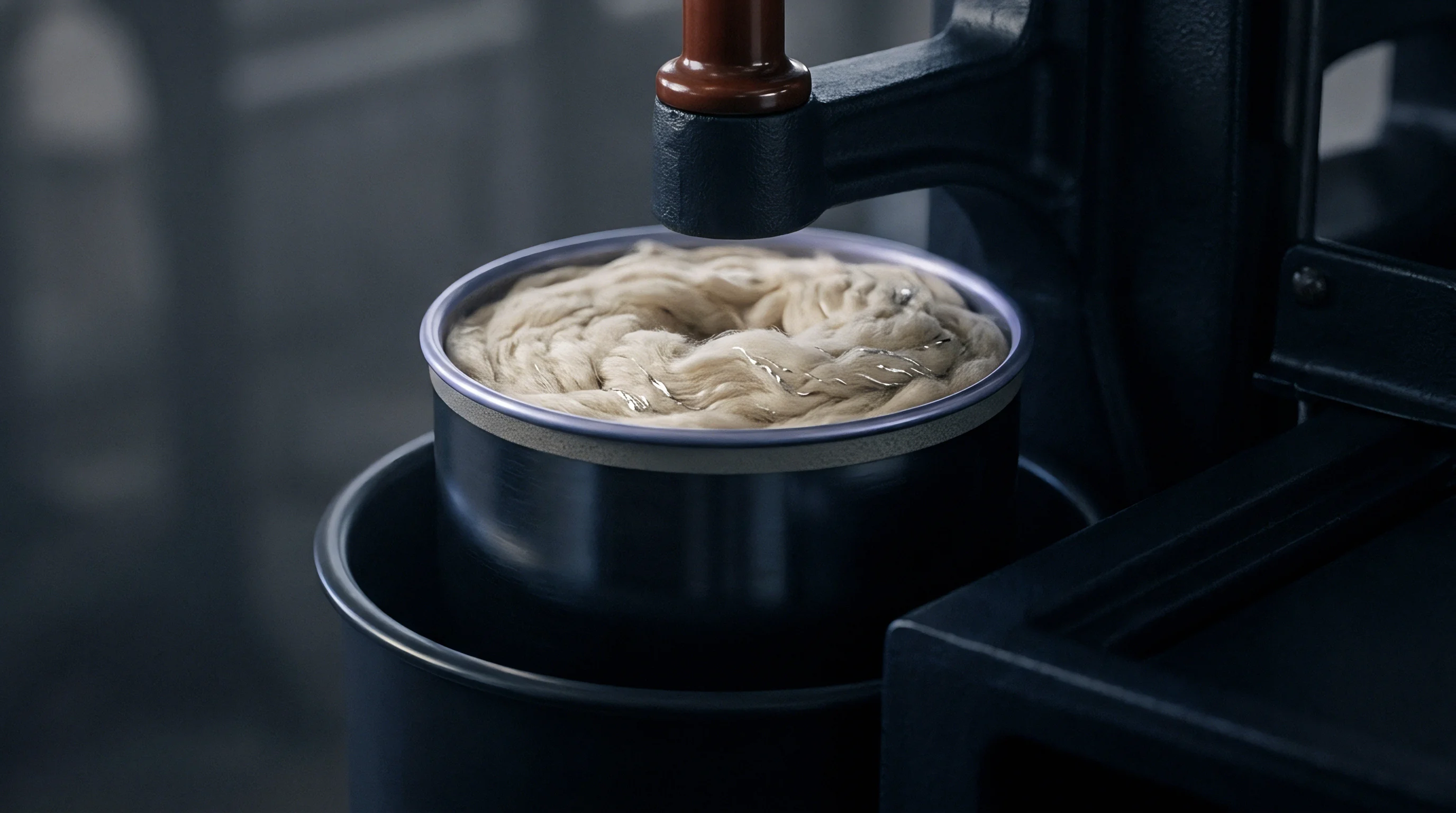

Chamber
Compressed air enters the swirling zone through tangential injector ports at velocities exceeding four hundred metres per second. High-speed fluid rotation creates a depression behind the hollow spindle tip, pulling drafted sliver directly from the front delivery rollers into the central channel. While continuous core strands proceed along the axial line, peripheral hair ends spread across the spindle exterior under centrifugal acceleration.
The resulting differential velocity between the rotating air vortex and the forward-moving core turns these loose ends into helical wrapping loops. Open air evacuation ports capture stray filaments that fail to anchor into the advancing yarn structure.
Drafting breaks weak fibres. Cotton staples exhibit natural length distributions with non-uniform maturity, presenting high quantities of short elements below twelve millimetres. Synthetic polyester filaments, produced via melt extrusion and precision chop cutting, maintain absolute length regularity with zero short-fibre content.
When a mixed sliver enters the swirling zone, pneumatic drag forces exert identical shear upon mismatched mechanical properties.
Under nozzle pressures of zero point five megapascals, uncombed cotton loses eight point four percent mass to the evacuation exhaust while semi-dull polyester cut to thirty-eight millimetres loses zero point seven percent.
Polymer content reduces total fly. Tensile resistance enables synthetic staples to bridge the open expanse between the drafting apron nip point and the spindle intake aperture. Cotton staples shorter than fourteen millimetres lack sufficient surface contact within the advancing strand to withstand circumferential aerodynamic drag.
Centrifugal velocity strips unbonded fibres away from the central axis. Ejected material travels into the negative pressure collector line rather than incorporating into the yarn body.
- Aerodynamic stripping force shears loose exterior staples from the central strand whenever rotational drag overcomes inter-fibre friction.
- Boundary layer detachment occurs along the conical spindle face, preventing short cotton hairs from bridging onto the core filament path.
- Collector exhaust velocity sweeps unanchored material through radial vacuum channels to isolate trash and airborne debris.
- Nip distance instability leaves unprotected fibre ends vulnerable to turbulence before mechanical twist stabilizes the bundle.
The sliver enters the nozzle. Air currents rotate faster than mechanical spindles, reaching equivalent rotational speeds above three hundred thousand revolutions per minute. Because synthetic polyester carries higher flexural rigidity, polyester ends flex across the spindle edge and wrap tightly around the axial bundle.
Cotton hairs possess lower bending stiffness when dry, yielding irregular loops or detaching completely. Centrifugal ejection strips these detached elements instantaneously. Unstable pneumatic settings create chronic hair shedding, high yarn irregularity, elevated commercial yield penalties, and costly spinning downtime throughout knitting operations.

Partition
Differential material extraction alters the chemical proportions between the supplied sliver and the wound package. Carded cotton stock carries short fibre fractions ranging from nine to sixteen percent by weight. Combed cotton stock reduces this short-staple volume below seven percent.
Industrial staple polyester contains no short fractions prior to mechanical draft. During nozzle passage, pneumatically driven fractionation ejects short cotton staples at ten times the frequency of synthetic staple loss.
The air vortex strips them. As the ratio of synthetic staple increases, gross waste collection volume drops in direct mathematical correlation to the diminishing cotton mass fraction. A pure cotton sliver yields substantial waste collectors loading, whereas heavy polyester proportions preserve raw stock volume.
| Nominal Sliver Proportion | Combed Cotton Waste Fraction | Carded Cotton Waste Fraction | Collector Polyester Content | Delivered Package Polyester Content |
|---|---|---|---|---|
| 100% Cotton | 7.2% | 10.8% | 0.0% | 0.0% |
| 20% Polyester / 80% Cotton | 5.8% | 8.6% | 3.1% | 21.1% |
| 40% Polyester / 60% Cotton | 4.4% | 6.7% | 5.4% | 42.3% |
| 50% Polyester / 50% Cotton | 3.6% | 5.3% | 7.2% | 51.9% |
| 65% Polyester / 35% Cotton | 2.4% | 3.8% | 9.8% | 67.2% |
| 100% Polyester | 0.9% | 1.1% | 100.0% | 100.0% |
Cotton generates higher nozzle debris. Microscopic examination of filter box waste confirms that sixty-five to eighty percent of extracted lint measures under twelve point seven millimetres. Seed coat fragments and residual leaf motes accompany these ejected short staples.
Polyester fragments present in the collector consist predominantly of peripheral filaments caught during apron drafting. Polyester resists pneumatic shearing forces.
Synthetic staple content above sixty percent drops total pneumatically collected lint below three percent of processed sliver mass.
Carding removes heavy motes. When carded slivers run through air-jet machinery without preliminary combing passes, total debris generation spikes sharply. Trash particles choke the swirl.
Carded cotton stock introduces micro-dust that coats the internal geometry of the swirling cavity. Friction rises inside the tip zone, causing tension spikes and strand rupture. Spinners processing high cotton percentages run dedicated combing sequences to suppress nozzle waste, adding processing cost to preserve spinning stability.
Spinning supervisors justify elevated collector levels by stating that the aggressive vortex purge purifies the core structure, ejecting low-grade trash and weak fragments to guarantee a clean, pill-resistant outer surface.

Migration
Radial distribution patterns within the spinning zone explain the selective loss of cellulosic material. During drafting, differences in fibre elongation and surface friction govern which component assumes the interior axial position and which stays on the exterior perimeter. Polyester fibres possess a smooth circular cross-section, uniform diameter, and high tensile elongation.
Cotton fibres possess a convoluted ribbon structure with high natural friction and low extension.
Fibre migration alters surface wrapping. As the drafted strand accelerates through the front nip, low-friction synthetic staples slip easily toward the core where tension stays highest. Higher-friction cotton fibres push radially outward toward the periphery.
This structural sorting places cotton hairs directly in the trajectory of the swirling air currents. Stated simply, cotton concentrates precisely where aerodynamic stripping reaches maximum intensity.
Nozzle suction collects unattached tails. Quantitative chemical dissolution demonstrates the magnitude of this extraction discrepancy. To verify actual component shifts between incoming sliver and completed yarn packages, technical teams execute analytical extractions using standardized chemical solvent procedures.
- Specimen conditioning stabilizes draw-frame slivers and wound cones in standard atmosphere at twenty degrees Celsius and sixty-five percent relative humidity for twenty-four hours.
- Mass determination records clean dry test portions before solvent immersion to establish baseline weight values within zero point one milligram precision.
- Selective dissolution immerses sample aliquots into seventy-five percent sulphuric acid per ISO 1833 part eleven to dissolve cellulosic cotton while preserving polyester solids.
- Residue collection isolates undissolved synthetic filaments on sintered glass filter crucibles using continuous vacuum filtration.
- Gravimetric quantification measures oven-dry synthetic residue weights after extensive neutral washing and thermal curing at one hundred and five degrees Celsius.
Staple length controls fiber loss. Long synthetic staples remain pinned beneath the wrapper coils while unanchored cotton fragments exit through collector conduits. Incoming sliver formulated precisely at fifty percent polyester and fifty percent combed cotton yields delivered yarn containing fifty-one point nine percent polyester.
The difference leaves the machine inside vacuum waste bins. Contractual purchase orders containing strict compliance clauses under ISO 1833 tolerance bands penalize suppliers whenever delivered yarn cross-fibre shares exceed commercial target allowances by more than one point five percent.

Orifice
Injector diameter, entry angle, and air supply pressure control the mechanical violence inside the vortex housing. Standard injector nozzles feature four to six radial air bores positioned tangentially at angles between sixty and seventy degrees relative to the spindle axis. Air pressure dictates lint ejection.
Increasing manifold pressure from zero point four to zero point six megapascals expands the air swirl velocity from three hundred and fifty to five hundred and twenty metres per second. Elevated pressure improves wrapper tightness and boosts yarn tenacity. Simultaneously, increased kinetic energy strips a wider envelope of peripheral fibres into the waste suction system.
| Mixture Ratio | Injector Orifice Diameter | Manifold Pressure | Delivery Velocity | Collected Waste Rate |
|---|---|---|---|---|
| 100% Cotton | 1.0 mm | 0.45 MPa | 380 m/min | 6.8% |
| 100% Cotton | 1.2 mm | 0.55 MPa | 420 m/min | 8.9% |
| 50% Poly / 50% Cotton | 1.0 mm | 0.50 MPa | 430 m/min | 3.4% |
| 50% Poly / 50% Cotton | 1.2 mm | 0.60 MPa | 460 m/min | 4.8% |
| 65% Poly / 35% Cotton | 1.0 mm | 0.50 MPa | 450 m/min | 2.1% |
| 100% Polyester | 1.0 mm | 0.55 MPa | 480 m/min | 0.9% |
Short fibres fly into exhaust. The distance separating the front drafting delivery nip from the hollow spindle aperture sets the unguided transit length. Setting this gap to twenty-one millimetres preserves processing stability when running thirty-eight millimetre polyester staples.
Processing cotton through this wide setting increases uncontrolled hair detachment. Slower delivery increases spinning tension.
Machine operators balance delivery speed against air pressure to minimize nozzle fallout while maintaining core yarn cohesion.
Spinning finishes applied during synthetic extrusion change surface friction characteristics. Liquid lubricant coatings protect polyester filaments from thermal melting during high-friction draft sequences. Cotton natural waxes behave inconsistently across fluctuating room temperatures.
Maintaining dry bulb temperature at twenty-six degrees Celsius with relative humidity at fifty-two percent prevents static build-up on synthetic stock while preserving natural cotton suppleness. Cohesive staple friction anchors peripheral hairs against aerodynamic extraction.
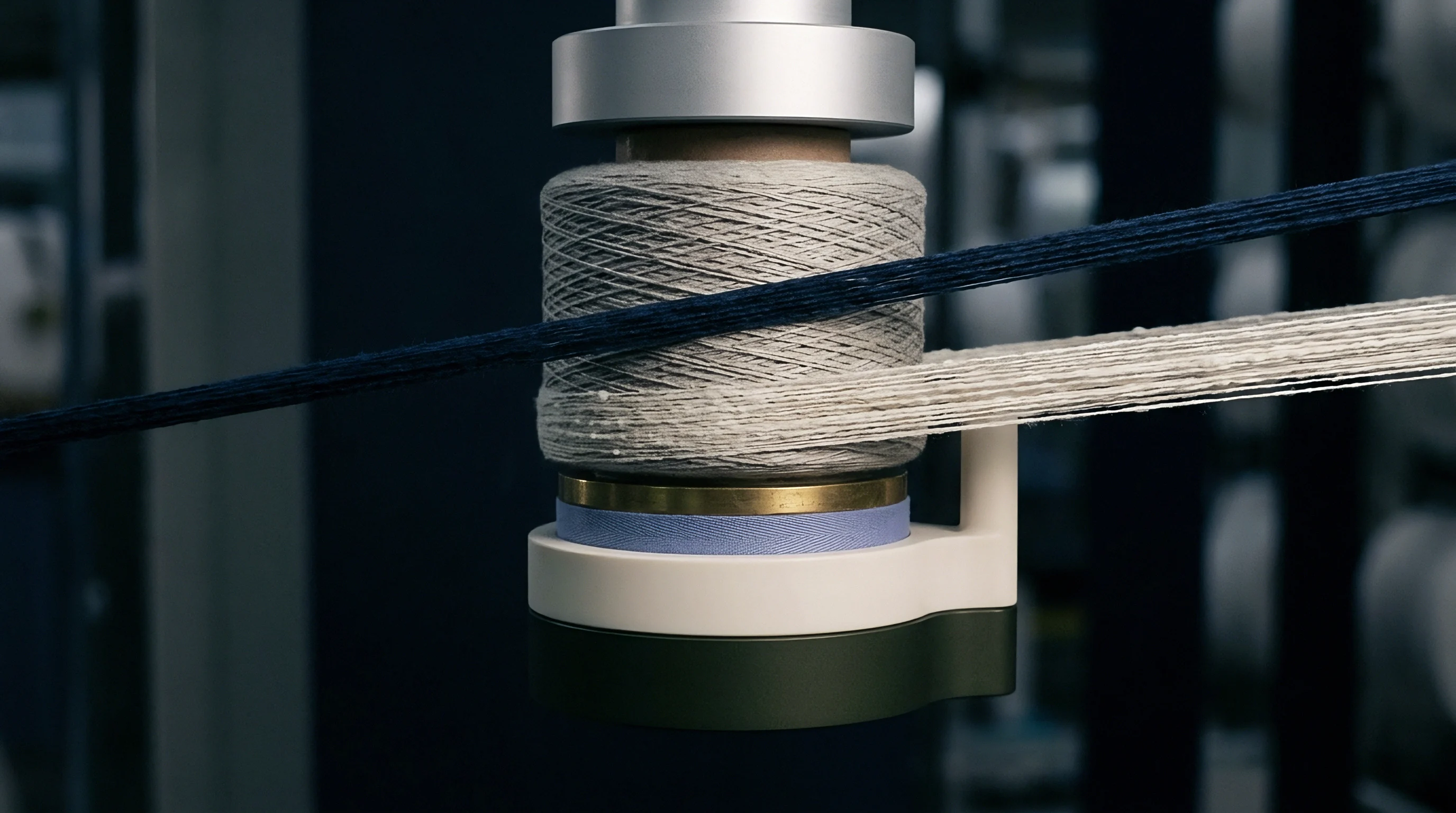
Balance
Financial ledger calculations reflect mass losses directly into unit manufacturing costs. Sourcing fifty thousand kilograms of intimate mixture sliver produces divergent delivered yarn yields depending strictly upon component selection. Virgin polyester staple prices trade near one dollar and twenty-five cents per kilogram, whereas high-grade combed cotton trades near two dollars and forty cents per kilogram.
Material exiting the spinning unit as collector waste commands secondary market salvage values under fifty-five cents per kilogram.
Combing reduces cotton short fiber. Processing pure combed cotton through air-jet frames generates seventy-two kilograms of low-value waste per metric ton. Running an intimate mixture of sixty-five percent polyester and thirty-five percent cotton drops total collector waste to twenty-four kilograms per metric ton.
The resulting raw material yield savings compounds across high-capacity industrial production schedules.
| Component Proportion | Gross Sliver Input | Collected Waste Mass | Finished Yarn Mass | Net Material Cost Per Kilogram |
|---|---|---|---|---|
| 100% Combed Cotton | 10,775 kg | 775 kg | 10,000 kg | $2.53 |
| 20% Poly / 80% Cotton | 10,615 kg | 615 kg | 10,000 kg | $2.28 |
| 50% Poly / 50% Cotton | 10,373 kg | 373 kg | 10,000 kg | $1.88 |
| 65% Poly / 35% Cotton | 10,245 kg | 245 kg | 10,000 kg | $1.67 |
| 100% Polyester | 10,090 kg | 90 kg | 10,000 kg | $1.26 |
| Calculations assume combed cotton at $2.40/kg, semi-dull polyester staple at $1.25/kg, and recovered spinning waste credited at $0.50/kg. | ||||
Waste generation shifts international trade classifications. Global customs schedules differentiate yarn lines based on chief weight rules. Under Harmonized Tariff Schedule Chapter 52, cotton-predominant yarns attract distinct duties, quota rules, and trade preference origins compared to synthetic staple yarns classified under Chapter 55.
A spinning mill formulating sliver at exactly fifty percent cotton and fifty percent polyester creates finished yarn containing fifty-one point nine percent synthetic staple. Preferential loss of cotton short hairs in the air vortex crosses the tariff boundary cleanly into Chapter 55. This unintended transition changes customs duty liabilities at the importing border terminal.
Procurement teams protect margins by auditing incoming sliver formulations against spun cone chemical analysis. When mill partners fail to account for selective cellulosic ejection, customs entries require costly retro-declarations and re-testing procedures. Floor managers check collector filters every shift to measure physical waste mass against calculated yield models.
Accurate mass accounting tracks every single kilogram between blowroom intake, draft zones, nozzle collection boxes, and packing floor scales.