Controlling Padding Liquor Absorption Rates across High Density Cotton Twills
Controlling twill padding liquor absorption requires matching rapid-decay wetting chemistry with deflection-compensated squeeze rolls to displace core yarn air.
Nip
Padding liquor pickup across dense 3/1 and 2/1 cotton twills is governed by mechanical displacement rather than passive capillary wetting. When loom-state fabric approaches weights exceeding 240 g/m² with thread counts surpassing 110 ends per inch in the warp and 60 picks per inch in the weft, yarn packing density creates internal hydrodynamic resistance that repels chemical baths during high-speed continuous application. Standard continuous ranges running at 45 to 80 meters per minute expose the moving web to chemical contact in the trough for less than 1.8 seconds.
Impregnation under these velocity limits fails to displace core air pockets trapped inside combed ring-spun yarns without high mechanical nip pressures and chemical penetration assistants operating at matched surface tension thresholds.
Uniform chemical expression across the fabric width requires deflection-compensated squeeze rolls. A standard cylindrical steel or ebonite roller bends under hydraulic loading applied at its journals, reducing physical pressure at the roller midpoint relative to the driven edges. This crown deflection produces a wet pickup profile that runs dry on the selvedges and excessively wet through the center, generating severe center-to-edge shade variation, side-to-center delta E values exceeding 1.8 under D65 illumination, and uneven resin deposition across the stenter frame.
Controlled-crown rolls, such as swimming rolls with internal hydraulic pressure chambers or counter-deflection rubber covers ground with a calculated parabolic camber, maintain flat line pressure across the full working width.
Dynamic nip pressure deviations exceeding five percent across the roller width yield detectable center-to-edge shade divergence on heavy twill structures.
Shore hardness of the elastomeric roller covering defines the physical nip width and the resulting dwell time under pressure. Squeeze rollers covered in carboxylated nitrile butadiene rubber with a hardness of 70 Shore A create a wider contact footprint than 85 Shore A rolls under identical linear force, providing extended contact time for liquor expression while lowering peak compression pressure. For high-density combed twills intended for uniform vat pigmentation or water-repellent fluorocarbon application, a dual-dip, dual-nip configuration optimizes liquor turnover.
Submerging the dry fabric, expressing sixty percent of the liquor at 22 kilonewtons per linear meter, submerging the wet substrate a second time, and completing a final expression at 32 kilonewtons per linear meter forces liquor through the tightly nested twill floats without causing structural flattening or surface glaze.
Tension control between the unwinding j-box, entry guide rollers, and the first immersion roll establishes warp yarn presentation at the nip line. High warp tension stretches longitudinal yarns, flattening the cross-over geometry of the 3/1 twill floats and compressing interlacing voids before fluid entry. This tension-induced flattening physically blocks the liquor from accessing the weft core.
Operating entry tension at the lowest threshold that prevents web drift preserves the three-dimensional crimp voids, permitting chemistry to seat within the interior bundle before consolidation at the pressure line.

Wicking
Fluid migration into tightly compacted cellulose bundles depends on displacing hydrophobic impurities during preparatory wet processing. High-density cotton twills woven on air-jet looms carry polyvinyl alcohol, modified starches, and tallow lubricants that saturate yarn inter-fiber channels. Incomplete desizing leaves residual size films that reject aqueous baths during padding.
When residual size content measured via starch-iodine colorimetry or gravimetric extraction exceeds 0.2 percent by fabric weight, liquor penetration stalls at the yarn perimeter, creating a ring-dyeing effect that exhibits poor crock fastness and patchy appearance after domestic laundering.

Preparatory Substrate Absorbency Metrics
Pretreatment validation for high-density twills targets rapid immersion wetting rather than superficial drop absorption. Testing absorbency through standard drop methods often measures water droplet dissipation on raised warp floats rather than liquor movement through compacted weft intersections. Capillary rise testing along the warp and weft directions provides direct confirmation of core openness across dense woven constructions.
| Evaluation Method | Standard Designation | Acceptable Production Range | Operational Risk Level |
|---|---|---|---|
| Water Drop Absorbency | AATCC TM79 | Less than 1.5 seconds | High if surface lubricants mask core resist |
| Wicking Height (Warp, 5 min) | DIN 53924 | 35 to 48 millimeters | Medium if weft counts diverge from warp sett |
| Wicking Height (Weft, 5 min) | DIN 53924 | 28 to 38 millimeters | High if heavy air-jet filling insertion compacts yarns |
| Residual Size Content | AATCC TM103 | 0.05 to 0.15 percent | Severe if starch retrogradation coats inner fiber walls |
| Residual Pectin Residuals | Ruthenium Red Stain | Uniform light pink (Grade 1) | Critical if wax complexes survive bleaching |
Alkaline scouring efficiency determines the removal of natural cotton waxes, which melt at 68 degrees Celsius and migrate inward during uncontrolled drying. Saponifying these wax esters using continuous pad-steam scouring units with 40 grams per liter sodium hydroxide and low-foaming ethoxylated alcohol surfactants clears inter-crystalline channels within individual fibers. Mercerization under high tension swells the cotton lumen from a flattened kidney bean shape into a round cross-section, increasing hydroxyl group availability and chemical accessibility.
Mercerized twills exhibit liquor absorption rates up to 35 percent faster than unmercerized twills of identical yarn sett, reducing the mechanical pressure required at the padder to achieve thorough wet pick-up.
Inconsistent moisture content in fabric arriving at the continuous range introduces run-to-run pickup drift. Fabric coming off open-air staging pallets exhibits dry edges and higher humidity in the center roll wraps. When this unevenly conditioned substrate enters the pad trough, sections containing six percent moisture absorb liquor at different rates than outer sections holding ten percent moisture.
Running an inline infrared pre-conditioning scanner linked to stenter cylinder pre-dryers homogenizes incoming regain to a uniform four percent across all warp yarns prior to liquor entry.
Suppliers routinely claim that modern scouring ranges strip all surface lipids regardless of greige yarn sizing formulations.

Surfactant
Dynamic surface tension governs wetting dynamics on running textile machinery where dwell times are measured in milliseconds. Standard wetting agents that perform reliably in static laboratory beakers often fail on continuous ranges running dense 280 g/m² twills at industrial production speeds. When fabric passes through a trough in under two seconds, surfactant molecules must migrate to the newly created water-air interface instantly.
Classical high-molecular-weight nonionic ethoxylates diffuse too slowly through aqueous solution, leaving surface tension at the dynamic interface near the 72 millinewtons per meter level of pure water rather than dropping it to the target wetting threshold.
Dynamic Interfacial Surface Tension Decay
Rapid bubble tensiometry measures the ability of wetting chemistry to reduce surface tension under millisecond surface ages. Conventional nonylphenol ethoxylate replacements stabilize surface tension only after 1000 milliseconds of interface existence. High-speed padding requires formulations based on branched sulfosuccinates, alkoxylated short-chain alcohols, or acetylenic diol surfactants that suppress dynamic surface tension down to 26 to 32 millinewtons per meter within a surface age of 20 to 50 milliseconds.
| Chemistry Class | Dynamic Surface Tension (at 40 ms) | Foam Volume (Ross-Miles, 0 min) | Thermal Stability Threshold |
|---|---|---|---|
| Sodium Dioctyl Sulfosuccinate | 27.2 mN/m | 185 mm | Breaks down above 55 degrees Celsius |
| Branched Alcohol Ethoxylate (C8-C10) | 31.5 mN/m | 45 mm | Cloud point shifts above 60 degrees Celsius |
| Ethoxylated Acetylenic Diol | 29.0 mN/m | 5 mm (Defoaming) | Stable across 20 to 80 degrees Celsius |
| Linear Fatty Alcohol Phosphate Ester | 36.8 mN/m | 80 mm | Stable in high alkaline mercerizing baths |
Foam stabilization presents an immediate operating hazard when running high-shear squeeze nips. Sulfosuccinates generate substantial mechanical foam when driven through tight roller gaps at high velocity, pulling micro-bubbles into the nip line. These air bubbles become pressed into the twill intersections, forming round, pale resist spots known as pinhole voids.
Formulating padding baths with acetylenic diols delivers both dynamic wetting and self-defoaming performance, breaking foam mechanically at the roller junction without the use of oil-based silicone defoamers that precipitate under high squeeze pressures.
Bath replenishment dynamics dictate chemical concentration stability inside low-volume troughs. High-density fabrics displace liquor rapidly while stripping surfactant from solution through preferential fiber adsorption, a phenomenon known as tailing or baths depletion. When the rate of chemical exhaustion onto the cotton cellulose exceeds the rate of water consumption, the active wetting agent concentration inside the trough drops continuously throughout a 5000-meter run.
Continuous metering units governed by conductivity probes or optical refractive index detectors inject concentrated surfactant stock directly into the replenishment line, stabilizing interfacial tension across the entire dye lot.
A laboratory dip approved on bone-dry cloth without verifying wet-on-wet pickup equilibrium guarantees shade variation on bulk continuous runs.
Concentration drifting transforms initial bulk yards into off-shade scrap before laboratory personnel verify the run on an inspection table. Wet processing technicians stabilize this interface by keeping trough volume minimal, using displaced displacement wedges that limit bath capacities to twenty or thirty liters. Minimal volume accelerates liquor turnover, cycling the entire reservoir every two to four minutes and denying surfactants the dwell time necessary to undergo thermal or alkaline decomposition.

Trough
Fluid dynamics within the immersion tank define the boundary layer shearing that permits bath penetration. A heavy cotton twill entering a liquor reservoir carries an adhering air layer that moves along the fabric surface at machine velocity. This air boundary layer acts as a mechanical shield, preventing aqueous chemistry from touching dry fibers.
Submerged expander rolls, grooved guide rolls, and angled squeeze-under-liquor bars strip this boundary layer by forcing fluid cavitation and physical displacement against the face of the running twill.
Trough design geometry directly impacts turnover efficiency and fluid mechanics. Deep vertical tanks hold substantial liquor volume, which resists temperature homogenization and promotes the thermal degradation of finishing auxiliaries over extended shifts. Shallow horizontal troughs with bottom-mounted displacement wedges reduce total volume while increasing liquor velocity counter-current to the path of the fabric web.
Running liquor counter-current strips the surface air envelope faster than co-current flow systems, doubling wetting efficiency without requiring higher concentrations of chemical auxiliaries.
A mill that routes heavy twill through a single vertical dip tank without submerged under-liquor squeegees leaves up to forty percent of internal yarn voids un-wetted.
Bath temperature control dictates liquor viscosity and cellulose swelling behavior during continuous immersion. Operating liquor baths at ambient temperatures between 20 and 25 degrees Celsius maintains higher aqueous viscosity, which inhibits penetration through dense warp ribs. Elevating trough temperature to 45 to 55 degrees Celsius cuts water viscosity from 1.002 millipascal-seconds down to 0.547 millipascal-seconds.
This viscosity reduction doubles the Reynolds number of the flow within the interstitial spaces of the twill, enabling chemistry to pass through the compact weave interface before hitting the extraction squeeze rolls.
Exceeding 60 degrees Celsius in padding baths containing reactive dyes triggers premature hydrolysis of chlorotriazine or vinyl sulfone reactive groups before fixation, rendering the dyestuff inert and unable to form covalent bonds with the cellulose polymer chains. When running resin finishes or fluorocarbon water repellents, excessive bath temperatures initiate pre-polymerization within the trough, coating rollers with insoluble gummy residues that leave permanent impressions across finished fabric yards. Constant indirect heating via double-walled trough jackets managed by proportional-integral-derivative controllers keeps the bath inside a strict plus or minus one degree Celsius operating band.

Extraction
Wet pickup calibration establishes the boundary between thorough core impregnation and chemical migration during subsequent thermal drying. In high-density cotton twills, moisture retention splits into three distinct physical states: capillary water held within the macroscopic inter-yarn voids, capillary water trapped inside microscopic intra-yarn channels between individual fibers, and structural water swollen directly within the cellulose lumen and amorphous cell walls. Squeeze roll expression easily evacuates the macroscopic inter-yarn volume.
The primary engineering challenge centers on stripping excess intra-yarn liquor while maintaining complete saturation of the fiber interior.

Target Wet Pickup across Dense Cotton Twill Classifications
Achieving low wet pickup targets on heavy twills eliminates surface flooding and migration defects during hot-air drying. When expression rolls are set too loose, capillary moisture pools on the surface of the raised warp twill lines. During entry into the stenter or hotflue dryer, radiant heat causes rapid surface evaporation, drawing dissolved dyes, flame retardants, or easy-care crosslinking resins from the core of the yarn out to the surface, an effect that destroys finished crocking and tear performance.
| Finished Weave Structure | Finished Sett (Ends x Picks / Inch) | Areal Weight (ISO 3801) | Target Wet Pickup Range | Calculated Nip Pressure |
|---|---|---|---|---|
| 2/1 Chino Twill | 108 x 56 | 215 g/m² ± 3% | 62 to 66 percent | 24 kN/m |
| 3/1 Heavy Workwear Twill | 128 x 60 | 275 g/m² ± 3% | 58 to 62 percent | 30 kN/m |
| 3/1 Combat Uniform Twill | 140 x 64 | 320 g/m² ± 3% | 52 to 56 percent | 36 kN/m |
| 2/2 Technical Cavalry Twill | 136 x 72 | 340 g/m² ± 3% | 50 to 54 percent | 40 kN/m |
High-extraction systems that replace standard squeeze mangles lower wet pickup below the fifty percent threshold on dense cotton substrates. Vacuum slot extractors mounted directly after the padding nip pull continuous streams of dry air through the wet cloth using liquid ring vacuum pumps operating between 20 and 40 kilopascals of negative pressure. This pressure differential evacuates water from the inter-fiber voids without compressing the fabric profile, retaining the dimensional loft and soft hand of the twill while driving moisture levels down to 45 percent prior to dryer entry.
Porosity limits restrict the operational envelope of vacuum extraction systems. When fabric areal density surpasses 330 g/m² and air permeability drops below 40 liters per square meter per second at a 100-pascal pressure drop under ISO 9237, the vacuum slot pulls unevenly across the width. Edge leakage occurs where air escapes past the unsealed selvedge borders, reducing the effective extraction force applied at the central twill field.
Operators resolve this width differential by installing automatic mechanical deckle plates that slide over the vacuum opening, matching slot dimensions to the precise untrimmed width of the incoming textile web.
Skipping routine pneumatic calibration of the left-right pressure cylinders results in long rolls with lopsided residual moisture that split garment color lots at the cutting room table.
Migration
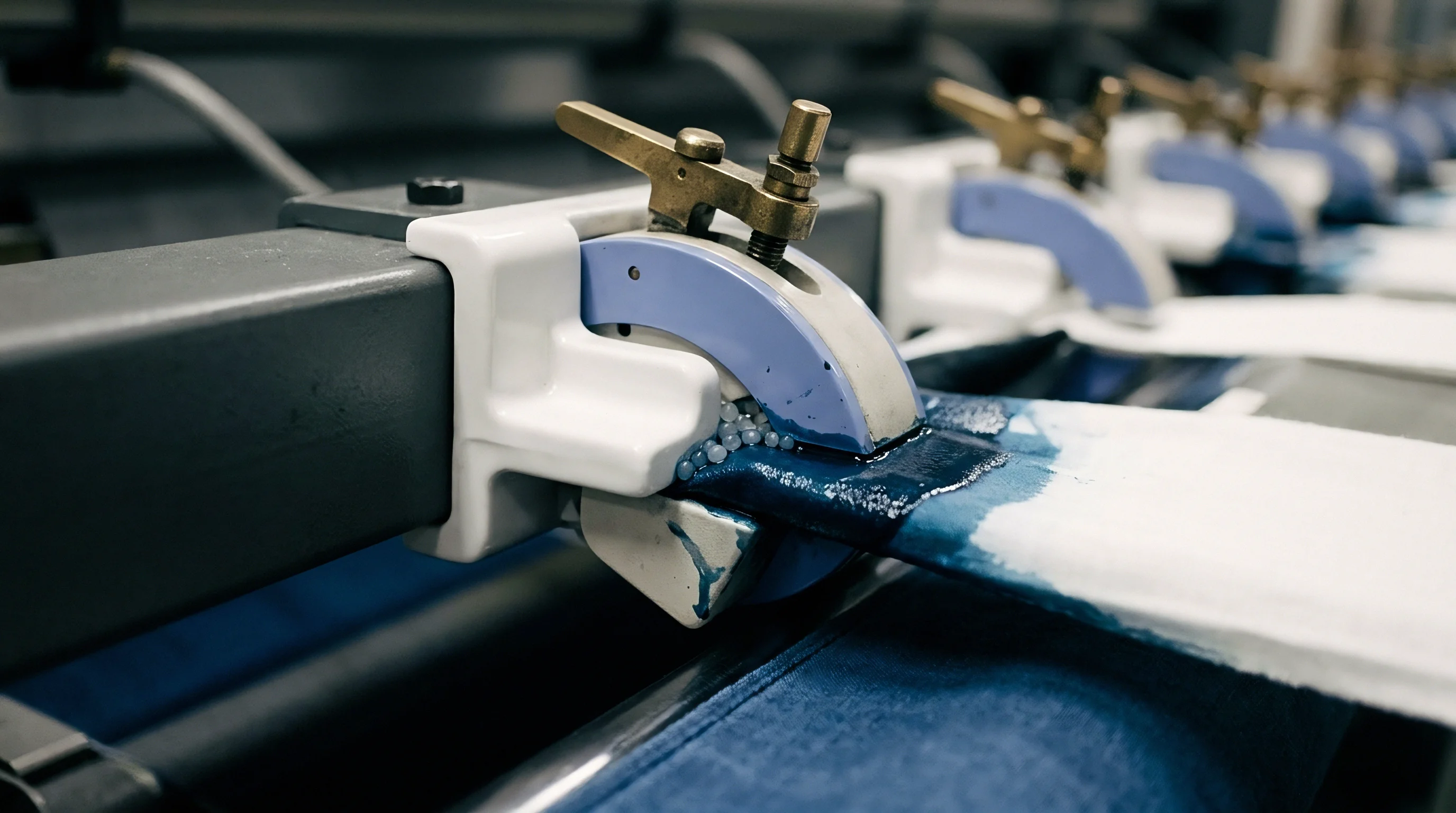
Capillary transport during the initial drying phase determines the ultimate distribution of non-substantive chemistry throughout the fabric thickness. In high-density twills, the large volume of fluid trapped inside fiber bundles vaporizes under infrared or convection drying. If drying energy applies too aggressively to one side of the running web, liquid water containing dissolved chemicals travels along thermal gradients toward the heat source.
This thermal migration strips chemistry from the back of the twill and deposits it exclusively upon the face floats, causing two-sided shade variation, differential soil release properties, and erratic abrasion performance across the warp yarn crowns.
Drying Profile Mechanics
Intermediate drying requires controlled energy transfer that immobilizes dissolved solutes before moisture leaves the fiber structure. Continuous pad lines achieve this stabilization through sequential heating zones that balance radiant energy with low-velocity convection air.
- Infrared predrying applies radiation at medium wavelengths between 1.5 and 2.5 microns, heating moisture inside internal yarn bundles without creating aggressive convective air currents that move dissolved dyes to the yarn face.
- Hotflue intermediate drying supports the tensionless transport of the running web through alternating heated duct chambers, drying the fabric gradually to a residual moisture level of twenty-five to thirty percent.
- Air-jet velocity modulation maintains nozzle air speed below fifteen meters per second across initial dryer chambers to prevent fluid displacement along twill ridges before the gel point of applied chemistry.
- Symmetrical two-sided heating balances gas-fired heat exposure equally across the fabric face and technical back, stopping directional solute migration toward one side of the weave structure.
Chemical antimigrant auxiliaries mitigate transport by altering bath rheology during moisture evaporation. Formulating pad liquors with sodium alginates, polyacrylates, or modified etherified locust bean gums introduces thermal gelling behavior. As the wet fabric warms within the predryer to temperatures above 60 degrees Celsius, the antimigrant increases bath viscosity exponentially, locking dissolved dye particles or finishing chemicals into an immobilized gel matrix within the fiber matrix before evaporation can move them outward.
Polyacrylate antimigrants destabilize in the presence of multi-valent electrolytes or high-ionic-strength fixatives. Adding magnesium chloride catalysts or high-concentration Glauber salts screens the electrostatic repulsion of the polyacrylate chains, causing the polymer to collapse and drop out of solution as stringy precipitates that choke padding supply pipes. Verifying ionic compatibility through laboratory bench stability tests across a 24-hour settling period confirms formulation integrity prior to chemical delivery on the production floor.
Standard commercial supply contracts assign absolute financial liability for shade divergence and side-to-side listing to the wet processing mill whenever finished goods fail the agreed delta E tolerance bands established under ISO 105-J03.
Balance
Controlling pickup across high-density cotton twills involves balancing structural greige yarn geometry with mechanical expression limits and finishing chemistry kinetics. A mill cannot resolve structural loom-shed density errors by merely adjusting padder pressure at the finishing range. When warp cover factors exceed 22 according to the Peirce calculation system, the packing of longitudinal yarns creates physical boundaries that defy even 40-kilonewton roller loadings.
Finishing high-density twills demands an integrated production protocol that controls grease, size, tension, temperature, and chemistry across every operational unit.
Can Altering Loom Crimp Distribution Improve Wet Pickup Uniformity?
Adjusting the relative crimp balance between warp and weft yarns alters the internal void architecture of the twill, directly shifting liquor penetration performance. Elevating weft yarn tension during weaving flattens the filling yarn profile, forcing the warp ends to take on higher out-of-plane curvature over the 3/1 float bridges. This elevated warp crimp opens small micro-valves between adjacent warp yarns, allowing chemical liquor under nip pressure to access the central cavity of the twill structure rather than deflecting across a flat, impermeable textile surface.
- Verify greige fabric desize efficiency by conducting five random starch-iodine spot extractions across incoming rolls, rejecting raw lots that present residual size values exceeding 0.15 percent by weight.
- Audit continuous scouring ranges to ensure residual cotton wax content measures under 0.3 percent via Soxhlet petroleum ether extraction, confirming unblocked fiber channel access.
- Calibrate Shore A hardness and dynamic crown profiles of padder squeeze rolls using nip impression paper loaded under running production pressure, checking for line-width variance within plus or minus 0.5 millimeters across the full working face.
- Measure pad bath dynamic surface tension via bubble pressure tensiometry at a 40-millisecond surface age, confirming that rapid-wetting chemistry maintains values below 30 millinewtons per meter.
- Set intermediate drying stages to low-velocity infrared preheating, bringing residual moisture levels smoothly down to 25 percent before subjecting the dense twill to high-velocity convective airflow in the main stenter frame.
Production calculations show the economic stakes behind running controlled pickup setups. Take a continuous run of 50,000 meters of 300 g/m² military twill operating at 60 meters per minute. Running with uncontrolled wet pickup at 75 percent instead of an optimized 55 percent forces the drying range to evaporate 3,000 kilograms of unnecessary water every operational hour.
At industrial steam costs of 35 USD per metric ton, the excess thermal load generates thousands of dollars in unnecessary fuel expenditures per run, while forcing line speed reductions of 22 percent that consume available mill capacity.
Beyond thermal costs, uncontrolled wet pickup causes the deposition of excess chemical solids on the outermost fiber faces. When crosslinking resin finishes such as dimethyloldihydroxyethyleneurea accumulate on the fabric surface rather than diffusing evenly through the fiber wall, cellulose crosslinking concentrates in the exposed float crowns. This imbalance degrades tear strength by 45 percent and cuts Martindale abrasion resistance under ISO 12947-2 from an acceptable 40,000 cycles down to 18,000 cycles, generating scrap inventory that fails buyer physical performance specifications.