Analytical Extraction Protocols and Regulatory Thresholds for Unfinished Textile Matrices
Unfinished textile extraction demands matrix-matched calibration and solid-phase cleanup to prevent spin-finish lipids from distorting regulatory compliance limits.

Grease
Loom-state yarns and unwashed knitted fabrics arrive at the analytical laboratory carrying heavy loads of non-target chemical processing aids. Raw cotton fibers contain native waxes, fatty acids, and sterols reaching up to two percent of total dry mass. Synthetic filament yarns carry polyorganosiloxane antistatic agents, fatty acid esters, and ethoxylated mineral oils applied during high-speed spinning to prevent filament friction.
Knitted grey goods retain emulsified paraffin oils and emulsifiers introduced during circular needle lubrication. Matrix interference skews lab results.
Analytical extraction of unfinished substrates forces organic solvents through these dense hydrophobic coatings before reaching target restricted compounds. When testing raw goods for restricted aromatic amines, alkylphenol ethoxylates, or phthalate plasticizers, non-target surface compounds dissolve alongside target analytes. High concentrations of paraffin waxes and polyacrylic sizing agents pass into the raw liquid extract, creating severe physical and chemical barriers during subsequent chromatographic separation.
Greige yarns retain heavy lipids.
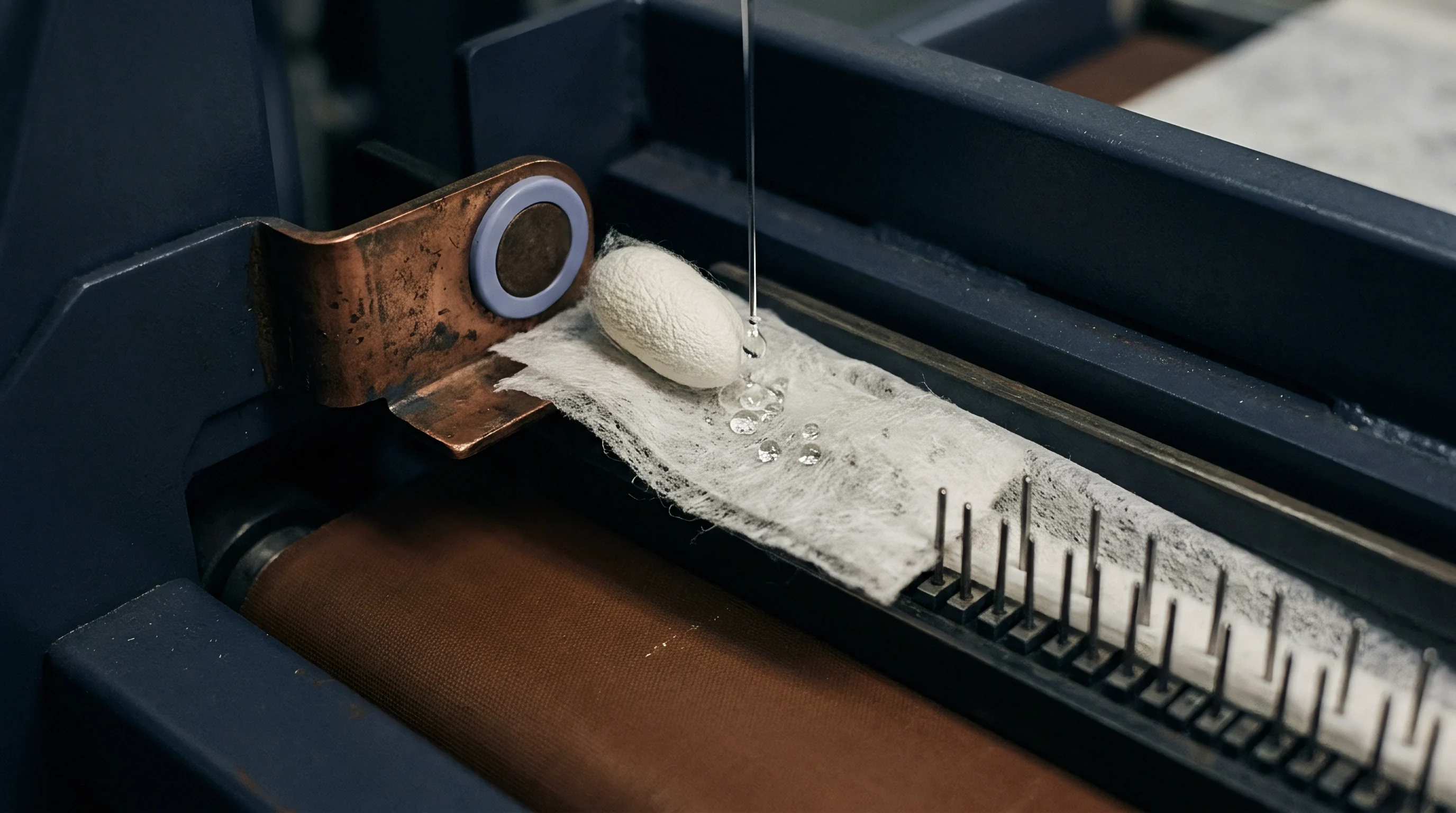
Composition of Non-Target Substrate Compounds
Native plant lipids on raw cotton form a protective hydrophobic layer consisting of long-chain aliphatic alcohols, saturated wax esters, and free fatty acids spanning carbon numbers C20 to C34. Bast fibers such as flax and hemp introduce complex pectic substances, insoluble hemicelluloses, and residual lignin fragments into solvent mixtures. Raw wool presents an even higher non-target loading, where unrefined lanolin comprises up to fifteen percent of raw fleece mass, consisting of sterol esters, lanolin hydroxy acids, and residual sheep dip treatments.
Cotton waxes trap volatile residues.
Synthetic sizes applied to warp yarns prior to weaving add another layer of complexity. Polyvinyl alcohol formulations, carboxymethyl cellulose, and modified potato starches form tough, film-like envelopes around individual yarn bundles. These polymeric barriers resist mild cold-solvent soaking, preventing target dye residues or residual pesticides from leaching into extracting media unless aggressive thermal energy or matrix-swelling solvents are applied.
- Polyacrylic sizing residues coat fiber surfaces, preventing solvent penetration to internal dye layers during ultrasonic extractions.
- Paraffin wax components co-elute during gas chromatography, causing severe baseline drift and signal masking for organotin compounds.
- Ester-based spin finishes decompose under thermal pressure, generating false positive signals during mass spectrometry scanning.
- Residual wool waxes emulsify aqueous extraction phases, blocking phase separation during liquid-liquid preparation steps.

Physical Interferences in Untreated Yarn Layers
Surface lubricants alter the thermodynamic solubility kinetics between target molecules and extraction media. Highly non-polar solvent systems such as hexane or petroleum ether dissolve target organotins or halogenated flame retardants, but they also pull gram-level quantities of paraffinic spin finish into the extraction flask. When the laboratory concentrates this crude extract under nitrogen flow, the resulting residue forms a viscous, opaque sludge that clogs syringe filters and destroys solid-phase extraction columns.
Conversely, polar solvent systems like methanol or acetonitrile penetrate hydrophilic starch sizes but fail to dissolve hydrophobic target analytes trapped beneath paraffin coatings. The analyst balancing these competing chemical physical realities selects solvent mixtures capable of swelling the fiber lattice without fully dissolving the interfering polymer skin. Phase separation requires exact polar balance.
Spinning mills frequently claim that residual oils on unfinished yarns represent benign mechanical aids that disappear entirely during commercial scouring and require no chemical screening prior to fabric conversion.


Solvent
Selecting appropriate liquid media for extracting target analytes from raw textiles demands careful matching of dielectric constants, boiling points, and polymer swelling capabilities. Methanol, dichloromethane, tetrahydrofuran, hexane, and acetonitrile serve as the primary liquid carriers in textile compliance testing. Pressurized Liquid Extraction, also termed Accelerated Solvent Extraction, uses elevated temperatures between eighty and one hundred fifty degrees Celsius under pressures of one hundred bar.
This mechanical force drives liquid media deep into crystalline fiber structures, completing target isolation within fifteen minutes.
Soxhlet extraction maintains continuous refluxing of hot solvent over solid substrates for four to sixteen hours, offering complete recovery for non-volatile organic compounds at the cost of high solvent volume consumption. Ultrasonic bath extraction operates at ambient or mildly elevated temperatures, relying on acoustic cavitation bubbles to disrupt surface films on greige fibers. Ultrasonic methods yield rapid screening results but show reduced efficiency when target molecules reside deep inside dense synthetic filament lattices.
Solvent selection dictates extraction yield.

Thermodynamic and Mass Transfer Kinetics
Solvation energy must overcome the binding forces holding target contaminants to active sites on raw fibers. In natural cotton, residual organochlorine pesticides bind tightly to interior lumen walls, requiring polar solvent mixtures like acetone-hexane to break hydrogen bonds. For synthetic polyester or polyamide yarns, restricted phthalate plasticizers or brominated flame retardants diffuse into the amorphous regions of the synthetic polymer during extrusion.
Extracting these embedded compounds requires a swelling liquid such as dichloromethane or tetrahydrofuran. Swelling opens the polymer chains, increasing the diffusion coefficient of target molecules by several orders of magnitude. Target analytes degrade under extreme heat.
| Target Analyte Class | Primary Extracting Medium | System Temperature (°C) | Pressure (bar) | Extraction Duration (min) |
|---|---|---|---|---|
| Azo Aromatic Amines (EN 14362-1) | Citrate Buffer (pH 6.0) / Diethyl Ether | 70 | 1.0 | 60 |
| AP / APEOs (EN ISO 18218-1) | Methanol | 60 | 1.0 | 30 |
| Phthalates (EN ISO 14389) | Dichloromethane | 100 | 100.0 | 15 |
| PFAS (C9-C14 PFCAs) | Methanol / Acetonitrile | 60 | 1.0 | 45 |
| Chlorinated Phenols | Potassium Carbonate / Hexane | 80 | 1.0 | 40 |
Accelerated solvent extraction using dichloromethane at 100 degrees Celsius under 100 bar pressure achieves 98 percent recovery of target phthalates from greige polyester within 15 minutes.

Thermal Pressure and Analyte Stability
High temperatures accelerate extraction kinetics but risk thermal degradation of heat-sensitive analytes. Certain organophosphorus flame retardants and specific azo dyes undergo thermal cleavage when subjected to pressurized solvent extraction above one hundred twenty degrees Celsius, producing false positive readings for restricted aromatic amines. Laboratory blanking exposes baseline solvent noise.
Maintaining system pressure keeps volatile liquids liquid well above their atmospheric boiling points. Dichloromethane boils at thirty-nine degrees Celsius under standard atmospheric conditions; pressurized liquid extraction systems maintain dichloromethane as a dense liquid phase at one hundred degrees Celsius under one hundred bar pressure. This high-density liquid state dissolves embedded plasticizers while preserving molecular structural integrity.
Select extraction media that swell the polymer backbone without dissolving co-extracted sizing compounds into the liquid phase.

Cleanup
Crude extracts derived from raw greige substrates contain high masses of non-target lipids, fatty acid esters, and polymeric sizing agents that severely degrade analytical instrumentation. Injecting unpurified textile extracts directly into gas chromatography mass spectrometry systems causes rapid contamination of injection port liners, irreversible degradation of capillary column stationary phases, and severe ion source fouling. Solid Phase Extraction cartridges provide essential sample purification by selectively retaining interfering matrix compounds while allowing target analytes to elute freely.
Gel Permeation Chromatography, also known as size-exclusion chromatography, separates high-molecular-weight spin finishes and waxes from low-molecular-weight target analytes based on hydrodynamic volume. Extract evaporation steps require precise automated nitrogen blowdown systems to prevent volatile analyte loss during solvent exchange operations. Column clogging stops automated liquid handling.

Is Matrix Matching Mandatory for Alkylphenol Ethoxylate Assays?
Testing unwashed greige yarns for nonylphenol ethoxylates presents severe matrix-induced ion suppression during liquid chromatography tandem mass spectrometry. Fatty acid methyl esters and ethoxylated needle lubricants co-elute at identical retention times with target alkylphenols, competing for charge in the electrospray ionization source. Laboratory analysts construct matrix-matched calibration curves using blank greige yarn extract free from target analytes to compensate for ion suppression losses.
Without matrix matching or isotopic internal standards, reported alkylphenol ethoxylate concentrations routinely underestimate true batch contamination levels by forty to sixty percent. Interference masks critical chromatographic peaks.

Solid Phase Extraction Cartridge Selection
Selecting sorbent chemistry depends on the chemical properties of target contaminants versus background matrix oils. Silica-based reversed-phase C18 cartridges retain hydrophobic paraffin waxes while polar target compounds elute in methanol-water wash phases. Aminopropyl-functionalized cartridges retain acidic sizing compounds through ion exchange interactions while releasing neutral phthalate plasticizers into non-polar solvents.
Sorbent selection dictates clean extract purity.
- Reversely bonded silica cartridges retain non-polar waxes while allowing polar aromatic amine target molecules to pass cleanly into the eluate.
- Aminopropyl functionalized sorbents trap acidic sizing contaminants, releasing neutral target phthalate esters during hexane wash steps.
- Florisil magnesium silicate columns absorb heavy synthetic lubricants while transmitting fluorinated alkyl substances without fluorosurfactant retention loss.
- Polymeric styrene-divinylbenzene sorbents concentrate trace alkylphenols from aqueous extracts, rejecting high molecular weight starches entirely.
Excessive extract evaporation temperatures cause volatilization losses of low-molecular-weight aromatic amines before chromatographic injection occurs.
Solid phase cleanup steps demand precise calibration of elution volumes to prevent target analyte breakthrough. Passing ten milliliters of dichloromethane through a two-gram silica cartridge purifies phthalate extracts from raw polyester; increasing elution volume to fifteen milliliters washes retained paraffinic spin finishes off the sorbent bed into the final analytical vial.
Analytical chemistry has yet to establish whether automated inline solid phase extraction can completely eliminate ion suppression effects in mass spectrometry for heavily sized greige elastane blends.


Threshold
Global regulatory frameworks establish strict concentration limits for hazardous substances in textile products, enforcing these limits regardless of whether the substrate is raw grey fabric or a finished retail garment. Regulation EC 1907/2006 REACH Annex XVII Entry 43 restricts twenty-two carcinogenic aromatic amines derived from azo colorants to a maximum of thirty milligrams per kilogram per individual amine. REACH Annex XVII Entry 46a limits nonylphenol ethoxylates to one hundred milligrams per kilogram in washable textile products.
The European Persistent Organic Pollutants Regulation sets actionable thresholds for perfluorooctanoic acid at twenty-five parts per billion and total perfluoroalkyl carboxylic acids at two hundred sixty parts per billion.
The United States Consumer Product Safety Improvement Act mandates a total lead limit of one hundred milligrams per kilogram and restricts specific phthalates to a maximum of one thousand milligrams per kilogram in accessible textile components. California Proposition 65 enforces clear and reasonable warning requirements based on daily exposure thresholds, driving brand compliance desks to set default action limits at analytical limits of quantification. Customs officers enforce raw substrate limits.

Regulatory Limit Specifications across Substrate States
Importers often mistakenly assume that unfinished greige yarn carrying temporary processing aids qualifies for relaxed chemical limits. Customs authorities and market surveillance bodies apply standard regulatory threshold limits to imported goods in their state of entry. A container of raw woven cotton fabric containing two hundred milligrams per kilogram of nonylphenol ethoxylate spin finish violates REACH Annex XVII Entry 46a upon arrival at European ports, leading to immediate customs detention.
Limits of Quantification define the lowest concentration of an analyte that a laboratory can quantitatively report with acceptable precision and accuracy. Limits of Detection mark the lowest signal distinguishable from baseline instrument noise. Compliance dossiers demand explicit reporting of LOQ values alongside measured analyte figures.
| Restricted Substance | Regulatory Base | Maximum Permissible Limit | Standard Test Method | Reporting Limit (LOQ) |
|---|---|---|---|---|
| Azo Dyes (22 Amines) | REACH Annex XVII Entry 43 | 30 mg/kg per amine | EN ISO 14362-1 / -3 | 5.0 mg/kg |
| Alkylphenol Ethoxylates (APEO) | REACH Annex XVII Entry 46a | 100 mg/kg sum | EN ISO 18218-1 (LC-MS) | 10.0 mg/kg |
| Perfluorooctanoic Acid (PFOA) | EU POPs Regulation (EU) 2019/1021 | 0.025 mg/kg (25 ppb) | CEN/TS 15968 / EN ISO 23702 | 0.010 mg/kg |
| Total Lead Content | US CPSIA 16 CFR 1303 / REACH Entry 63 | 100 mg/kg total Pb | CPSC-CH-E1002-08.3 | 10.0 mg/kg |
| Di(2-ethylhexyl) phthalate (DEHP) | REACH Annex XVII Entry 51 / CPSIA | 1000 mg/kg sum | EN ISO 14389 / CPSC-CH-C1001-09.4 | 50.0 mg/kg |
REACH Annex XVII Entry 46a restricts nonylphenol ethoxylates to 100 milligrams per kilogram in washable textile articles, stranding unfinished fabric lots that exceed this limit prior to wet processing.

Commercial Certification Standard Classifications
Private assurance systems establish tiered product classifications reflecting end-user exposure risks. The OEKO-TEX Standard 100 defines four distinct product classes: Class I covers items for babies and toddlers up to three years; Class II covers items with direct skin contact; Class III covers items without direct skin contact; Class IV covers decoration materials. Class I imposes the strictest chemical thresholds, enforcing a limit of twenty milligrams per kilogram for total APEOs and banning formaldehyde above detection limits.
The Global Organic Textile Standard version 7.0 enforces strict inputs control, prohibiting synthetic processing oils, heavy metal sizing agents, and fluorinated soil repellents across all processing stages. Obtaining GOTS certification for greige yarn requires transaction certificates tracing chemical inputs back to certified organic spinning facilities. Uncertified yarn risks total lot rejection.
Section 4 of the OEKO-TEX Standard 100 testing guidelines dictates that unfinished fabrics must meet finished-product chemical limit values despite the presence of temporary processing aids, forcing converters to account for incoming yarn contamination before dyeing.


Recovery
Spike recovery experiments quantify the percentage of target analyte successfully extracted and measured from a complex sample matrix. The analyst fortifies a known mass of blank greige fabric with a precise quantity of certified reference material, subjects the spiked matrix to the complete extraction and cleanup protocol, and compares the recovered concentration against the theoretical added concentration. Spike recoveries prove analytical method validity.
Calculating analytical recovery percentage relies on the standard mathematical formula where recovery equals the difference between the measured concentration of the spiked sample and the unspiked sample, divided by the known concentration of the added spike, multiplied by one hundred. Target analyte recoveries between eighty and one hundred twenty percent validate the analytical run, while recoveries below seventy percent indicate severe matrix entrapment or chemical degradation.

Matrix Spike Methodologies and Calculation Protocols
Consider a practical spike recovery evaluation conducted on a ten-gram sample of raw unwashed cotton yarn containing three and a half percent native wax content. The target analyte selected is 4-aminobiphenyl, a restricted aromatic amine covered under REACH Annex XVII Entry 43. The laboratory spikes five micrograms of 4-aminobiphenyl into ten grams of raw yarn, establishing a theoretical added concentration of 0.50 milligrams per kilogram.
After undergoing pressurized liquid extraction with methanol at sixty degrees Celsius and subsequent solid-phase cleanup over an aminopropyl column, chromatographic analysis yields a total measured concentration of 0.41 milligrams per kilogram in the spiked sample. The unspiked control sample shows no detectable native amine residue. Applying the calculation formula yields an analytical recovery factor of exactly eighty-two percent, demonstrating acceptable method performance for raw fiber matrices.
Calibration curves demand matrix-matched reference standards. When target recoveries drop to forty-five percent due to excessive spin-finish interference, the laboratory applies a matrix correction factor to final raw batch sample results. If a raw greige cotton sample yields a raw instrument reading of twenty milligrams per kilogram of nonylphenol ethoxylate under a forty-five percent recovery regime, the true matrix-corrected concentration equals forty-four point four milligrams per kilogram.
This corrected concentration exceeds internal brand compliance action limits, triggering lot rejection despite the uncorrected raw reading appearing compliant.
Internal Standard Corrections in Mass Spectrometry
Isotopically labeled internal standards, such as deuterated phthalates or carbon-13 labeled perfluorinated acids, correct for volume losses, evaporation errors, and mass spectrometry ion suppression effects simultaneously. The laboratory adds a fixed quantity of internal standard to every sample vial prior to solvent extraction. Because the isotopically labeled compound possesses chemical properties identical to the target analyte, any physical loss or ionization suppression affects both molecules equally.
Mass spectrometers measure the peak area ratio between target analyte and internal standard, automatically compensating for matrix-induced recovery drops.
- Weigh four identical 5.0-gram subsamples from the center of the greige fabric roll using an analytical balance calibrated to 0.1 milligram accuracy.
- Fortify two subsamples with target analytes at exactly 50 percent of the target regulatory limit using certified reference materials.
- Subject all four subsamples to identical pressurized solvent extraction parameters alongside a blank control container.
- Quantify target analyte concentration using matrix-matched calibration standards and calculate the mean analytical yield.
Misinterpreting matrix recovery suppressions as actual chemical compliance leads to border seizures, mandatory shipment destruction, and total forfeiture of import landed value.


Clearance
Customs authorities conducting market surveillance audits examine physical goods at the container terminal, selecting swatches for targeted laboratory testing. Importers presenting scope certificates or transaction certificates for grey yarn must verify that testing methods match the exact article construction and fiber blend contained in the shipment invoice. A scope certificate issued for one hundred percent cotton yarn provides zero regulatory coverage for a cotton-elastane core-spun yarn carrying polyorganosiloxane spinning lubricants.
Traceability files must link every batch lot number on the bill of lading directly to specific laboratory test reports dated within the annual renewal window.
Purchase orders executed between converters and spinning mills require clear compliance clauses governing pre-finishing chemical parameters. Standard contracts assign total financial liability for downstream batch failures to the yarn spinner when greige yarn testing reveals restricted substance levels exceeding final garment standards. Retest provisions mandate that split-sample re-analysis occur at ISO 17025 accredited laboratories using identical solvent extraction and cleanup parameters.

Customs Audit Mechanics and Scope Reconciliation
When border authorities hold a shipment for chemical testing, the importer receives a formal notice of detention specifying the target substance and applicable regulatory clause. Customs laboratories cut sample swatches from internal roll positions to avoid surface contamination introduced during transit. The testing facility extracts the sample using standard European or US regulatory methods, issuing a formal test report that determines whether the container clears customs entry or faces export redelivery mandates.
Reconciling certificate scope discrepancies requires mapping invoice item descriptions against laboratory test report article declarations line by line. If a test report lists woven fabric but the imported commodity code declares knitted grey fleece, customs officers reject the compliance dossier, holding the container until a matching test report is submitted.
| Compliance Risk Point | Untested Exposure | Verification Instrument | Liability Transfer Mechanism |
|---|---|---|---|
| Spin Finish Contamination | Excessive APEO lubricants on yarn | ISO 17025 Test Report (EN ISO 18218-1) | Yarn Specification APEO Cap Clause |
| Sizing Agent Heavy Metals | Lead/Cadmium in starch sizing agents | ICP-MS Total Heavy Metal Assay | Supplier Batch Conformity Guarantee |
| Loom Oil Phthalate Transfer | Recycled needle oil carrying DEHP | GC-MS Phthalate Screen (EN ISO 14389) | Weaving Subcontractor Indemnity Agreement |
| Raw Wool Solvent Residues | Organochlorine dip residues in fleece | Gas Chromatography Pesticide Screen | Fleece Origin Transaction Certificate |
Transaction certificates issued for grey yarn fail to protect importers if customs authorities extract finished fabric under modified polar solvent parameters.
Contractual Allocation of Pre-Finishing Chemical Risk
Managing supply chain risk demands writing precise analytical protocols directly into commercial purchase agreements. Global brand compliance specs require suppliers to submit lot-specific analytical certificates before dispatching raw yarn or loom-state cloth to wet processing dyehouses. Contracting parties establish explicit protocols defining who covers sample freight costs, retest fees, and vessel demurrage charges incurred during laboratory disputes.
Alignment between purchase specification tolerances, lab analytical capability, and importer record-keeping establishes the defense against regulatory non-compliance enforcement at the port of entry.