Bayesian Gaussian Process Depth Profiling for Polymeric Plasticizer Diffusivity
Bayesian Gaussian Process depth profiling accurately maps polymeric plasticizer concentration gradients and quantifies diffusivity uncertainty in coated fabrics.
Strata
Coated technical textiles rely on liquid additives to impart flexibility, impact resistance, and elongation to rigid polymer backbones. Flexible polyvinyl chloride and coated polyurethane structures incorporate up to forty percent plasticizer by weight. Monomeric phthalate species migrate rapidly toward material interfaces due to weak steric binding within the host matrix.
Regulatory limits under REACH Annex XVII and OEKO-TEX Standard 100 Class I enforce a maximum concentration threshold of 0.1 percent by weight for low-molecular-weight phthalates. Converting operations have replaced monomeric phthalates with high-molecular-weight polymeric plasticizers, such as polyadipates, polysebacates, and polyester condensation products possessing number-average molecular weights between 1,000 and 8,000 grams per mole.
Diffusivity drives batch migration kinetics. Polymeric additives display hydrodynamic radii four to ten times larger than monomeric species. Their convoluted chain architectures slow spatial translation through polymer free volume.
Temperature spikes, solvent exposure, and sustained mechanical compression force additive molecules outward. Exudation occurs when spatial concentration gradients develop between core yarn coatings and ambient boundary layers. Evaluating migration dynamics requires tracking spatial concentration profiles as a function of depth and thermal exposure time.
Coating thickness varies across lots.

Plasticizer Exudation and Polymer Matrix Dynamics
Phase separation initiates when additive compatibility limits are exceeded during batch compounding. Molecular weight polydispersity in polymeric adipates creates differential migration rates. Low-molecular-weight oligomeric fractions migrate faster than higher-molecular-weight chains within the same batch formulation.
Diffusivity is not constant through the layer thickness; local plasticizer concentration alters polymer free volume, creating a concentration-dependent diffusion coefficient. Monomeric plasticizers leach out rapidly. Polymeric variants retard exudation rates.
Physical defects emerge when additives accumulate at material surfaces or cross multi-layer lamination boundaries. Surfacing additives reduce surface energy, disrupting topcoat adhesion and printability in coated industrial fabrics. In multi-layer Polyurethane-Polyvinyl Chloride composites, plasticizers migrate across interfacial boundary zones, softening adjacent polyurethane skin layers and inducing structural delamination.
Quantifying depth profiles reveals whether phase separation is driven by compounding errors, incomplete gelation during oven curing, or post-manufacture thermal history.
- Interfacial Delamination Failure Plasticizer accumulation at the adhesive interface lowers critical peel strength below contract specifications, causing skin separation under mechanical load.
- Topcoat Surface Blooming Low-molecular-weight oligomeric fractions exude through protective acrylic or fluoropolymer lacquers, forming sticky surface residues that collect airborne particulates.
- Core Matrix Embrittlement Excessive additive loss from internal coating layers increases the glass transition temperature of the resin, leading to cold-flex cracking during transport.
- Subcontracted Laminate Softening Plasticizers migrating into contiguous polyurethane membranes reduce tensile modulus, altering mechanical stretch performance beyond target tolerances.
Polymeric Adipates and Monomeric Phthalate Displacement
Linear polyester plasticizers synthesized from adipic acid and glycol monomers resist solvent extraction and volatilization far better than monomeric diisononyl phthalate. Their spatial distribution across a thirty-micrometer coating slice remains non-uniform after thermal conditioning. Measuring concentration gradient slopes determines whether plasticizers remain bound within matrix free-volume sites or drift toward surface boundaries.
Diffusivity coefficients for polymeric adipates range between 10-11 cm2/s and 10-15 cm2/s at room temperature, compared to 10-8 cm2/s for monomeric phthalates. Accurately determining these low diffusivities requires analytical resolution below one micrometer along the spatial depth axis. Standard solvent extraction methods fail to differentiate surface concentration spikes from interior matrix levels.
Depth-resolved spatial profiling isolates concentration values along defined distance increments from the top surface.
Mills frequently assert that high-molecular-weight polyesters cannot exude into adjacent polyurethane layers during storage.

Spectra
Analytical depth profiling isolates elemental and molecular signatures through sequential material slices. Attenuated total reflectance Fourier-transform infrared spectroscopy, confocal Raman microscopy, and time-of-flight secondary ion mass spectrometry measure additive concentration gradients. Spectroscopic techniques avoid chemical extraction steps that destroy spatial localization.
Selecting the optical probing method fixes spatial depth resolution, analytical detection limits, and specimen preparation demands.
Variable-angle attenuated total reflectance Fourier-transform infrared profiling alters radiation incidence angles to vary evanescent wave penetration depth. Refractive index variations between crystal elements and polymer matrices control maximum sampling depths. Confocal Raman spectroscopy focuses monochromatic laser source radiation to sub-micrometer focal volumes, measuring ester carbonyl band intensity relative to polymer backbone reference peaks.
Microtomy physical slicing removes ten-micrometer cross-sectional wafers for subsequent gas chromatography mass spectrometry analysis, sacrificing sub-micron spatial accuracy for quantitative mass determination.

Analytical Instrumentation for Depth Measurement
ATR crystals demand precise alignment. Silicon, germanium, and zinc selenide internal reflection elements generate distinct optical path lengths inside flexible coatings. Germanium crystals, possessing a high refractive index of 4.0, restrict evanescent wave depth penetration between 0.2 and 0.8 micrometers in polyvinyl chloride formulations.
Diamond and zinc selenide crystals probe deeper, reaching two to five micrometers into the matrix bulk, but suffer from lower spatial depth resolution. Confocal optics isolate submicron depths.
| Technique | Spatial Resolution | Maximum Penetration Depth | Signal to Noise Ratio | Sample Preparation Impact |
|---|---|---|---|---|
| Variable Angle ATR-FTIR | 0.1 to 0.5 micrometers | 3.0 micrometers | 45:1 to 80:1 | Non-destructive, crystal pressure contact required |
| Confocal Raman Microscopy | 0.5 to 1.2 micrometers | 100.0 micrometers | 20:1 to 60:1 | Non-destructive, vulnerable to fluorescence interference |
| Time-of-Flight SIMS | 0.005 to 0.02 micrometers | 2.0 micrometers | 100:1 to 300:1 | Destructive, high vacuum exposure redistributes volatiles |
| Cryo-Microtomy GC-MS Extraction | 5.0 to 10.0 micrometers | Unlimited | 200:1 to 500:1 | Destructive, sectioning introduces edge compression artifacts |
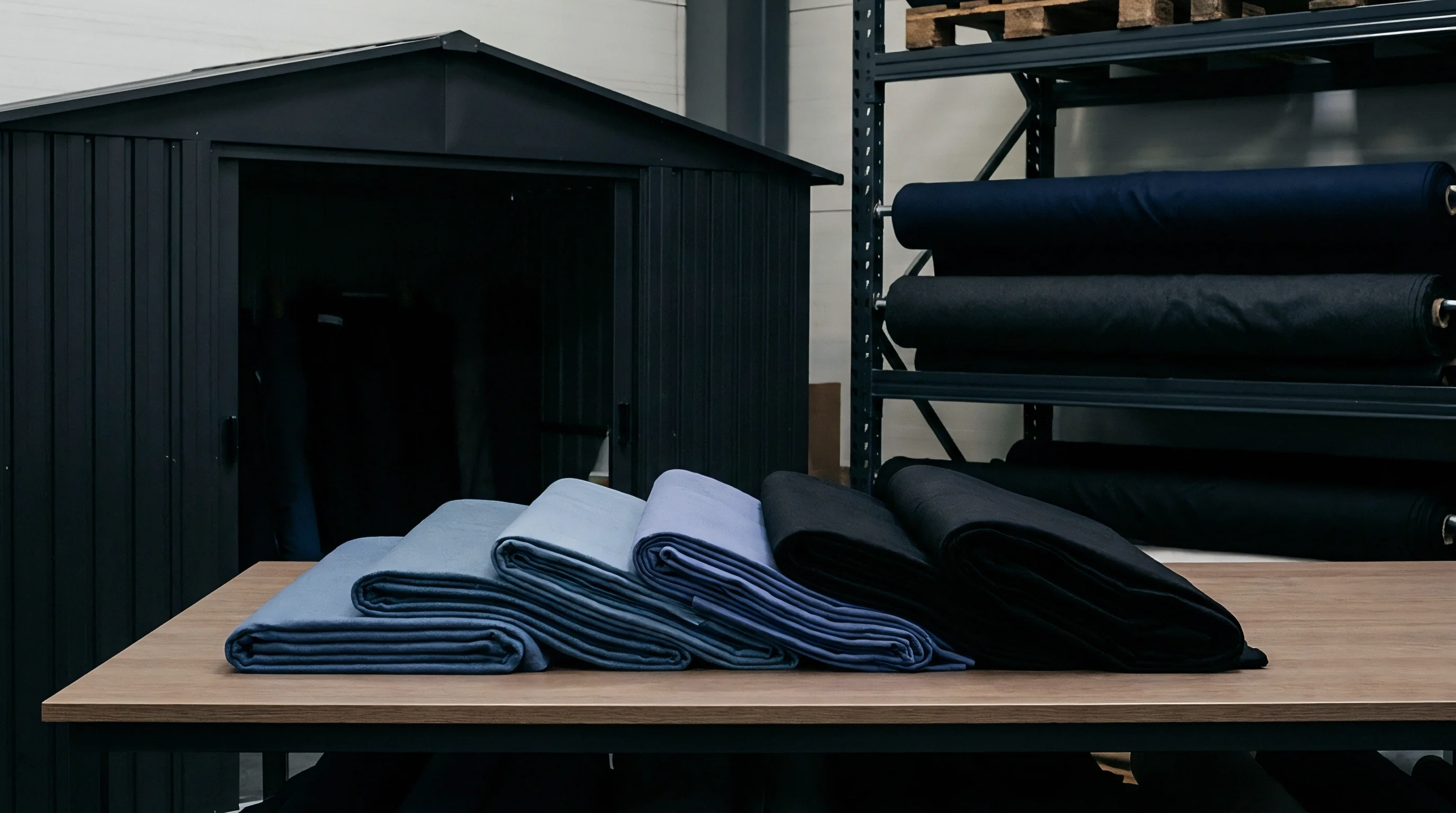
Depth Slicing and Optical Sampling Workflow
Ill-posed inversions corrupt depth curves. Extracting concentration profiles from variable-angle infrared absorbance spectra requires solving a Laplace-type integral transformation. Instrument noise, slight sample tilt, and non-uniform crystal optical contact amplify mathematical instability during numerical inversion.
Analytical laboratories must execute structured preparation procedures to ensure spectral measurements accurately mirror physical concentration gradients.
Attenuated total reflectance spectra recorded above critical incidence angles isolate surface boundary conditions without damaging core yarn matrices.
- Cryogenically freeze the coated textile sample at minus forty degrees Celsius using liquid nitrogen vapor to lock plasticizer molecular positions within the matrix.
- Section the sample edge cleanly with a diamond-blade microtome to establish an optically flat reference face normal to the coated surface plane.
- Mount the sectioned swatch in a rigid sample holder, recording ambient temperature and relative humidity within the testing enclosure.
- Collect baseline reference spectra against a clean germanium crystal at incidence angles from thirty-five to sixty degrees in two-degree increments.
- Normalize peak absorbance ratios between the ester carbonyl vibration band at 1725 inverse centimeters and the polymer backbone vinyl chlor-stretching mode at 615 inverse centimeters across all recorded angles.
Deeper probing depths always require higher refractive index crystal elements to prevent total internal reflection breakdown at polymer interfaces.

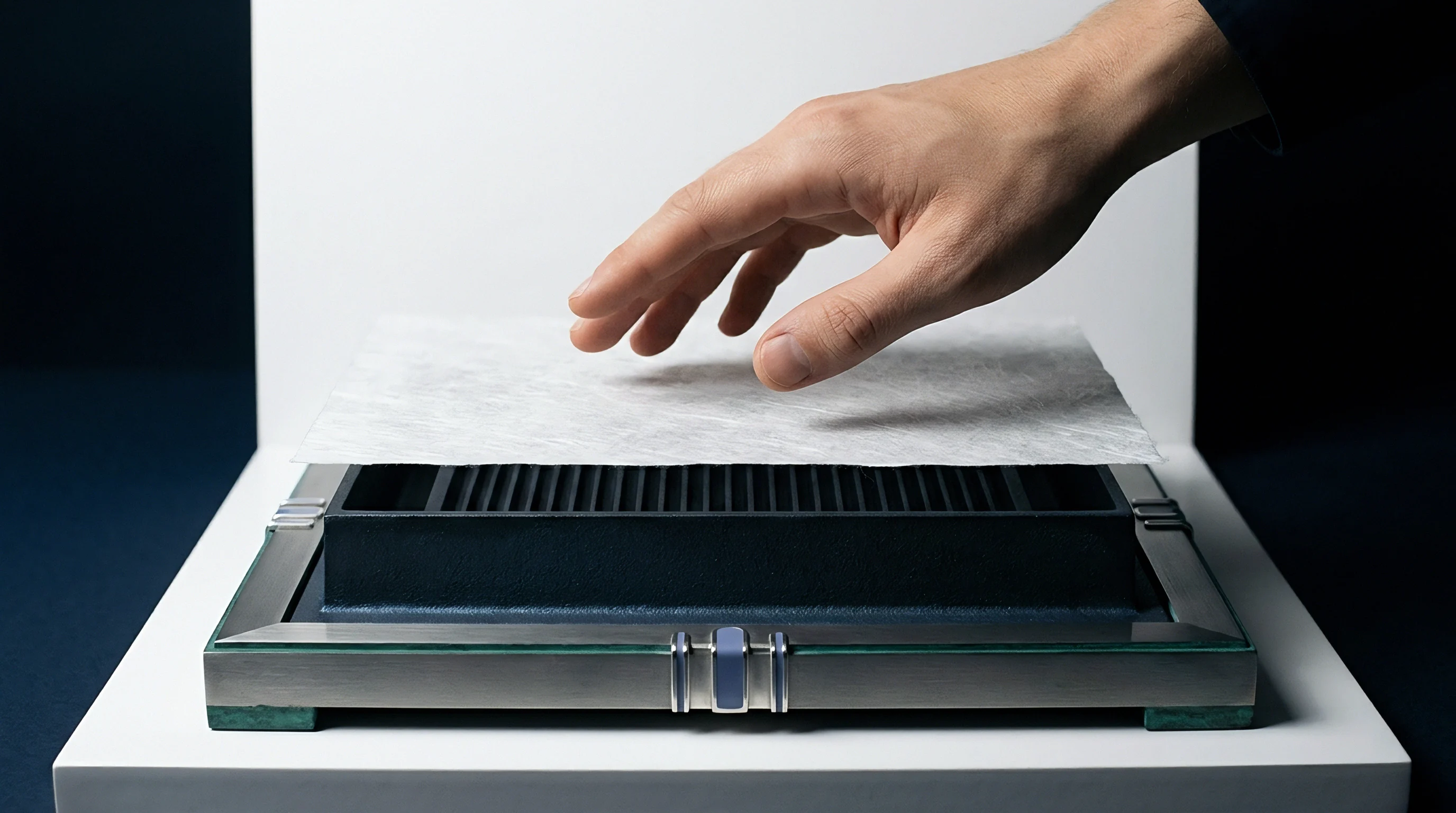
Kernel
Non-parametric probabilistic modeling converts discrete spectroscopic depth signals into continuous plasticizer concentration profiles. Bayesian Gaussian Process regression models spatial depth concentration functions without imposing rigid analytical shapes. The continuous concentration distribution over spatial depth is assigned a Gaussian process prior, defined entirely by a mean function and a spatial covariance kernel.
Experimental absorbance measurement errors enter the framework through a flexible likelihood distribution model.
Physics-informed covariance kernels incorporate governing boundary conditions derived from diffusion equations. Standard squared-exponential kernels model smooth concentration transitions, but fail near sharp material interfaces or coated surfaces where exudation causes steep spatial gradient changes. Incorporating Matérn covariance functions with intermediate smoothness parameters allows realistic profile modeling near boundary layers.
Integrating Fickian transport kinetics directly into kernel structure constrains spatial profile slope within physically allowable parameter domains.

How Does Gaussian Process Depth Profiling Quantify Plasticizer Migration?
Absorbance spectra gathered across angles or focus planes serve as noisy observational data inputs. Spatial covariance functions establish correlation strength between plasticizer concentration values at adjacent depth locations, where points closer together exhibit stronger statistical dependency. Prior covariance constrains spatial gradient slope.
Posterior variance flags sparse measurements. The Bayesian framework calculates posterior distributions over the spatial concentration function by conditioning the kernel prior on observed spectroscopic data.
Inferring diffusion coefficients requires sampling from posterior parameter probability spaces using Markov Chain Monte Carlo or Variational Inference methods. Temperature shifts alter diffusion pathways. Bayesian Gaussian Process depth profiling outputs point estimate concentration values alongside point-by-point posterior uncertainty variance bounds.
Spatial depth locations containing sparse analytical measurement points or high spectral noise display wider posterior variance bands, preventing false confidence in calculated diffusion coefficients.
Prior variance parameters set above 0.25 fractional concentration broaden posterior confidence intervals beyond action limit threshold boundaries at 60 degrees Celsius.
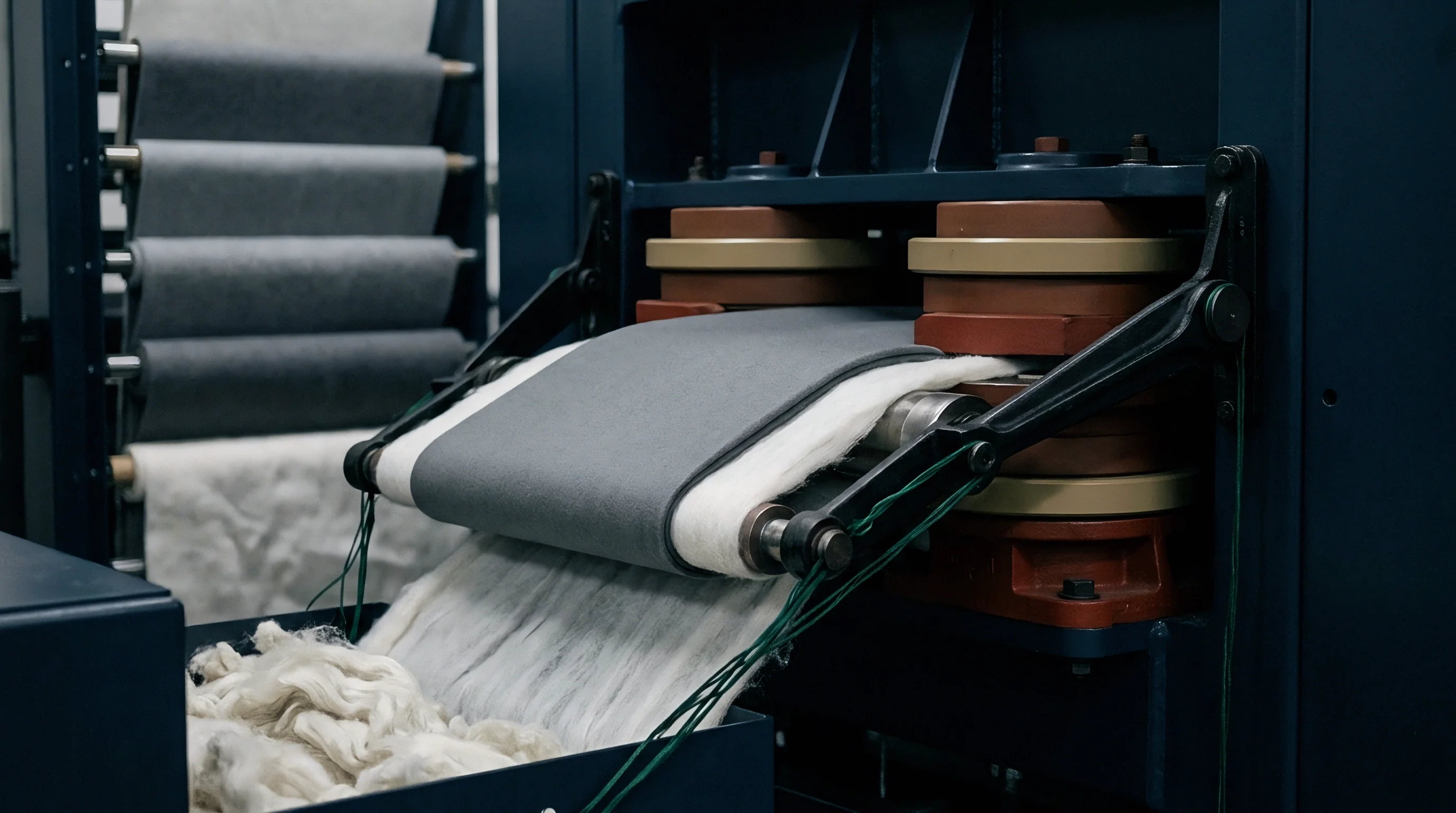
Physics Informed Covariance and Prior Distributions
Fickian transport models express mass conservation through spatial and temporal derivatives of concentration. Enforcing the partial differential operator inside the Gaussian Process prior ensures that generated concentration curves obey fundamental mass balance equations. The diffusivity parameter enters the covariance function as a hyperparameter to be inferred simultaneously with spatial noise variance and kernel length scale parameters.
Hyperparameter optimization relies on maximizing marginal likelihood functions using empirical analytical data. Prior distributions for diffusivity are centered on published historical polymer additive reference ranges, specified with broad variance scales to avoid biasing final predictions. When spectroscopic noise is elevated, physics-informed priors restrict inferred depth profiles to physically viable solutions, preventing mathematical inversion algorithms from outputting negative concentration values or infinitely steep spatial gradients.
Whether non-linear plasticizer concentration dependencies in multi-layer PU-PVC composites can be fully decoupled from thermal history remains an active analytical dispute.

Margin
Quantifying plasticizer diffusivity differences between monomeric and polymeric formulations requires validating analytical inferences across thermal aging periods. A comparative trial evaluated flexible polyvinyl chloride coated industrial fabrics conditioned at seventy degrees Celsius over twenty-eight days. Sample A incorporated diisononyl phthalate at thirty-five parts per hundred resin, while Sample B utilized a polymeric polyadipate with a number-average molecular weight of 4,000 grams per mole at the same loading level.
Variable-angle ATR-FTIR spectra were captured at seven-day intervals, processed via standard non-linear least squares Fickian fitting alongside Bayesian Gaussian Process depth profiling.
Standard non-linear least squares routines forced smooth theoretical curves over noisy experimental spectra, underestimating surface plasticizer depletion levels by twenty-eight percent after twenty-eight days. The Bayesian Gaussian Process depth profiling method revealed a distinct non-Fickian surface depletion zone in Sample A, capturing local phase separation kinetics near the coating boundary. Diffusivity inference for Sample B remained stable across all time points, proving that high molecular weight polyesters retain uniform structural distribution within the polymer matrix.

Comparative Diffusivity Inferences and Uncertainty Bounds
Uncertainty bounds protect compliance claims. Test results demonstrate that monomeric diisononyl phthalate exhibits rapid early-stage diffusion, causing sharp surface concentration spikes that decay as core matrix depletion progresses. Polymeric adipate formulations maintain lower diffusion magnitudes, with posterior uncertainty bands narrowing as conditioning time increases due to sustained spatial uniformity.
| Plasticizer Chemistry | Aging Duration (Days at 70°C) | Least Squares Fitted Diffusivity | Bayesian GP Mean Diffusivity | Bayesian 95% Posterior Interval |
|---|---|---|---|---|
| Diisononyl Phthalate (DINP) | 7 | 4.2 × 10⁻⁹ | 5.8 × 10⁻⁹ | |
| Diisononyl Phthalate (DINP) | 28 | 1.1 × 10⁻⁹ | 2.4 × 10⁻⁹ | |
| Polymeric Polyadipate (Mw 4000) | 7 | 3.1 × 10⁻¹³ | 3.4 × 10⁻¹³ | |
| Polymeric Polyadipate (Mw 4000) | 28 | 2.8 × 10⁻¹³ | 3.0 × 10⁻¹³ |

Audit Criteria for Diffusivity Test Dossiers
Uncertainty interval evaluation prevents inaccurate qualification of candidate textile materials. Third-party testing laboratories frequently report single-point diffusivity values derived from simplified mass-loss calculations, concealing local concentration spikes that breach surface compliance limits. Buyers auditing chemical compliance dossiers must demand full probabilistic depth profiles to verify additive stability under field temperatures.
Test protocols omitting temperature history data render ISO 177 migration reports invalid during REACH Annex XVII compliance audits.
- Verification of Prior Kernel Assumptions Ensure the testing facility selected a Matérn or physics-informed covariance kernel rather than an unconstrained smooth Gaussian function.
- Boundary Condition Explicit Inclusion Check that the mathematical model accounts for open surface evaporation or adjacent matrix partitioning rather than assuming zero surface flux.
- Posterior Variance Threshold Inspection Confirm that 95 percent confidence interval limits remain strictly below maximum allowable chemical regulatory thresholds across all depth points.
- Temperature Sensitivity Calibration Data Validate that diffusion coefficients were measured across at least three distinct temperature steps to derive realistic Arrhenius activation energies.
Selecting an inappropriate kernel length-scale underestimates plasticizer migration rates by two orders of magnitude, exposing importers to product recall penalties under European market surveillance.


Sanction
Border detentions halt whole shipments. Regulatory authorities enforce chemical safety through strict batch-level testing of imported consumer articles. REACH Annex XVII entries 51 and 52 restrict DEHP, DBP, BBP, DIBP, DINP, DIDP, and DNOP to aggregate concentrations below 0.1 percent by weight in plasticized materials.
Discovering restricted monomeric plasticizers above statutory limits leads to immediate customs seizure, mandatory destruction orders, and public recall notifications under the European Safety Gate system.
Importers carry legal responsibility for non-compliant articles crossing territorial borders. Relying solely on raw material supplier material safety data sheets provides zero legal protection during enforcement proceedings. Converting processes can contaminate polymeric plasticizers with residual monomeric reagents or unreacted ester intermediates if chemical synthesis conditions are poorly controlled.
Scope limits bind legal obligations.

Regulatory Enforcement and Reach Annex XVII Limits
Market surveillance authorities utilize destructive gas chromatography mass spectrometry extraction alongside non-destructive screening methods to intercept non-compliant shipments at port entry terminals. When test reports reveal total phthalate levels exceeding 1,000 parts per million, customs authorities impound the container, pending full analytical verification at accredited laboratories. Storage fees, re-testing expenses, and administrative fines accrue rapidly while containers sit in bonded holding zones.
Plasticizer exudation ruins bond strength. Chemical migration from internal coated layers to packaging surfaces can cause non-regulated packaging materials to fail chemical compliance screening upon arrival. Importers must demonstrate that chemical batch testing occurred on the specific production lot inside the container, supported by traceable sampling documentation and accredited analytical test method references.
Laboratory certificates covering pure plasticizer resins offer zero protection against customs detention when finished coated fabrics exude regulated monomeric fragments.

Contractual Allocation of Migration Liabilities
Purchase orders must transfer technical and financial liabilities associated with plasticizer exudation directly to converting mills. Standard warranty clauses guaranteeing general compliance with environmental regulations fail to protect buyers against post-border detention costs. Legal teams write explicit technical acceptance criteria based on validated depth-profiling parameters directly into mill manufacturing contracts.
Defining clear testing procedures, temperature aging protocols, and maximum allowable diffusivity coefficients within purchase specifications establishes enforceable grounds for lot rejection prior to export dispatch. Contracts should stipulate that any lot exhibiting plasticizer diffusion coefficients greater than 10-12 cm2/s at fifty degrees Celsius will be rejected at the converter’s expense, backed by independent Bayesian depth-profiling verification analysis.
Inserting a specific clause requiring lot-level Bayesian diffusivity validation for all coated deliveries transfers post-border detention liabilities directly back to the converting mill.