Electrochemical Probe Calibration in Mercerizing Caustic Baths
Inline calibration of mercerizing probes requires dual-endpoint lab titration cross-checks to compensate for carbonation and non-linear thermal shifts.


Electrolyte
Industrial cotton mercerization runs at sodium hydroxide concentrations between 220 and 300 grams of solute per liter of liquor, corresponding to 20 to 28 degrees Baumé or roughly 5.5 to 8.0 molar. At this concentration, depressed water activity and saturated hydroxide levels distort standard electrochemical response curves. High ionic strength shifts activity coefficients enough that direct conversion from activity to concentration becomes non-linear across production temperature ranges.
Cellulose swelling depends entirely on hydroxyl ions penetrating the crystalline matrix. Converting Cellulose I to Cellulose II requires holding the bath within 24 to 26 Baumé, with liquor temperatures at 15°C to 20°C for cold mercerization or 50°C to 60°C for warm runs. Dropping below 20 Baumé leaves the cotton partially unreacted, yielding dull luster, patchy dye uptake, and erratic tensile strength.
Above 30 Baumé, rising bath viscosity impedes liquor penetration into dense yarns and wastes caustic without improving fiber properties.
| Caustic Density (Baumé) | NaOH Mass Fraction (wt%) | Conductivity at 20°C (mS/cm) | Cellulose Swelling Factor | Process Risk Index |
|---|---|---|---|---|
| 18.0 | 13.5 | 310 | 1.25 | Under-mercerization, patchy dye affinity |
| 22.0 | 17.2 | 385 | 1.85 | Threshold for structural conversion |
| 25.0 | 20.6 | 420 | 2.40 | Optimal luster and fiber strength zone |
| 28.0 | 24.2 | 395 | 2.35 | High liquor drag-out, excessive viscosity |
| 32.0 | 28.8 | 340 | 2.10 | Liquor penetration failure on heavy fabric |
Direct electrochemical measurement in concentrated caustic runs into severe practical limits. Conventional glass pH electrodes break down quickly: multi-molar sodium ions migrate into the membrane’s hydrated gel layer, generating an alkaline error where the probe responds to sodium rather than hydrogen and under-reports alkalinity by several pH units. The caustic also attacks the silicate network of standard glass bulbs directly, leading to permanent zero drift and structural failure within days.
At 25 degrees Baumé and 20°C, sodium hydroxide conductivity peaks near 420 milliSiemens per centimeter before dropping as concentration increases further.
The main analytical problem is conductivity curve inversion. While conductivity scales predictably with ion concentration in dilute solutions, mercerizing baths experience ion pairing and high viscosity that restrict ion mobility. Conductivity peaks and then falls as caustic density continues to rise.
Any inline instrument must therefore determine whether a falling conductivity signal indicates chemical depletion or an over-concentrated bath.
Temperature shifts complicate these readings further. Concentrated caustic solutions exhibit non-linear conductivity temperature coefficients exceeding two percent per degree Celsius. Exothermic fiber wetting and neutralization reactions create rapid bath temperature swings, making continuous thermal compensation essential.
Without it, automated dosing systems misread conductivity shifts, over-dosing alkali during high-speed runs and creating downstream washing bottlenecks along with chemical waste.
Sensor
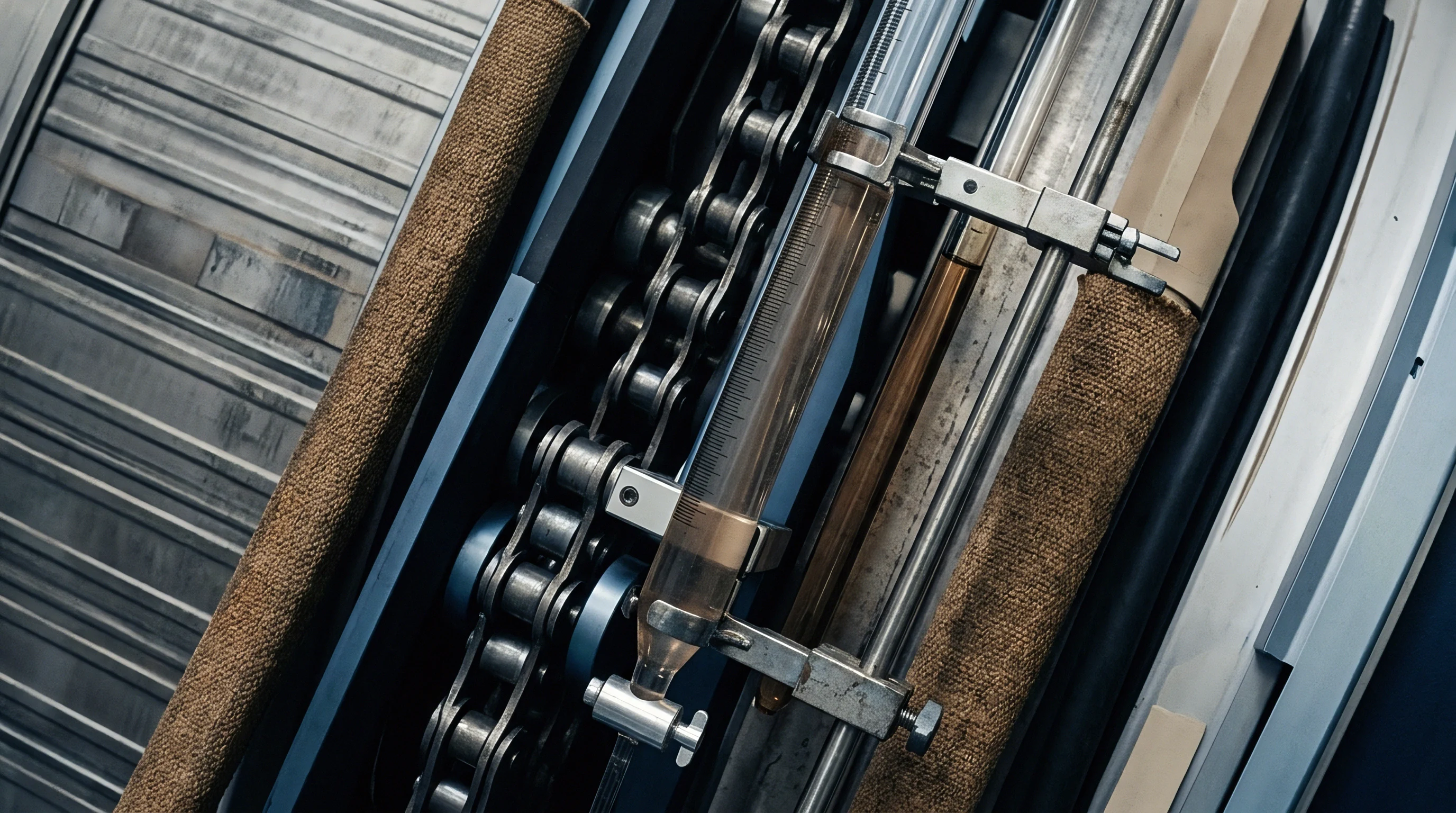
Inline caustic measurement requires sensors that can survive aggressive chemical attack. Traditional glass electrodes with liquid reference junctions fail as sodium hydroxide clogs ceramic or porous PTFE junctions with insoluble precipitates, cutting off ion exchange. Mercerizing lines turn instead to electrodeless toroidal inductive sensors or flat glass probes made with lithium silicate membranes.
Toroidal inductive sensors measure conductivity without wetted metal electrodes. An alternating current through a primary coil creates a magnetic field within the probe housing, inducing a voltage in the caustic liquor passing through the center bore. The resulting ionic flow creates a secondary magnetic field in a pickup coil, yielding an output signal proportional to bulk bath conductivity.
- Toroidal core fouling occurs as lint, cotton waxes, pectins, and sizing agents coat the center bore, constricting flow geometry and dampening the induced signal.
- Thermal lag errors develop when thick polyetheretherketone or fluoropolymer sensor bodies slow heat transfer to internal RTDs, distorting conductivity compensation during rapid temperature shifts.
- Gas pocket entrapment happens when air bubbles entrained by fast-moving fabric lodge against the bore wall, displacing liquor and triggering sharp, false concentration drops.
- Structural coating cracking stems from thermal cycling, which allows caustic liquor to penetrate into the copper windings and short out the sensor.
Lithium-glass electrodes offer an alternative for direct potential measurement. Substituting lithium oxide for sodium oxide in the glass matrix curbs alkaline error, measuring potential across a thick glass bulb against a sealed double-junction polymer gel reference. Mechanical wear remains an issue: high liquor velocities carrying abrasive grey-cloth lint erode the glass surface over time.
Failing to isolate inline toroidal sensors from ground loop currents in stainless steel mercerizing vats voids sensor calibration data within hours of continuous run time.
Sensor placement directly affects signal stability and service life. High-turbulence zones introduce microbubble interference, while stagnant areas delay measurement response. Installing probes in a recirculating bypass loop running at 15 to 20 liters per minute avoids both extremes.
Isolation valves allow technicians to pull the probe for maintenance without draining the main impregnation box or halting production.
Automated wash systems help maintain sensor calibration through extended runs. High-pressure water or periodic dilute acid rinses clear away organic foulants and carbonate scale. Without regular washing, waxes and biopolymers stripped from raw cotton form a hydrophobic film over the probe face, stretching response times from seconds into tens of minutes.
Regime
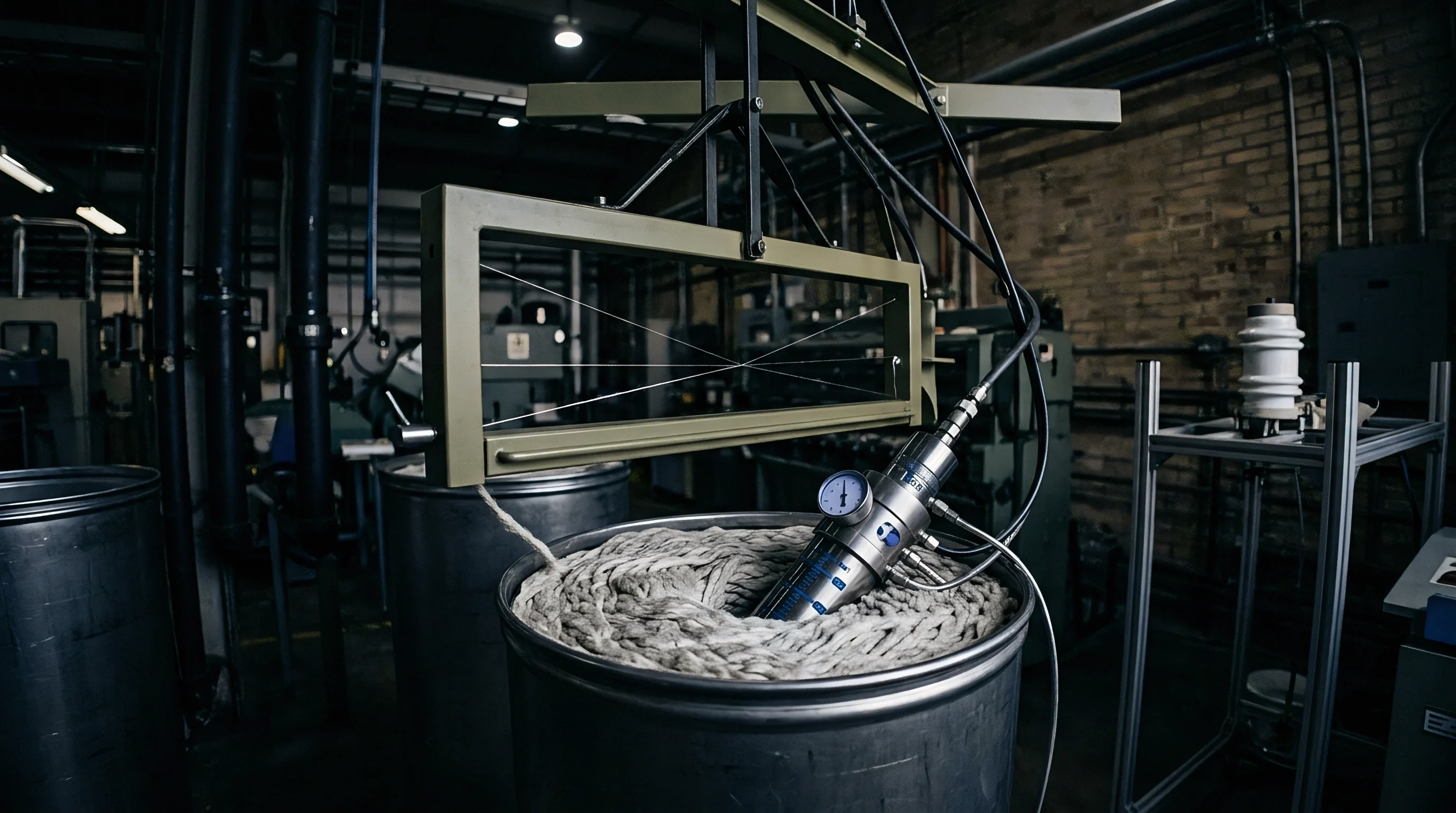
Calibrating high-concentration caustic sensors requires validation against analytical standards rather than conventional buffers. Off-the-shelf pH 4, 7, and 10 solutions lack the ionic strength needed for mercerizing baths. Calibration relies instead on wet acid-base titrations of process grab samples alongside certified high-salinity conductivity standards.
Setting a baseline requires drawing liquor directly at the sensor during steady-state operation. The technician takes a 50-milliliter sample, seals and cools it immediately to 20°C to prevent evaporation, and titrates against standardized 1.0 Normal hydrochloric acid with phenolphthalein and methyl orange. This dual-endpoint titration separates active sodium hydroxide from built-up sodium carbonate, providing the mass values needed to calibrate the transmitter span.
- Isolate the bypass loop and drain residual caustic into a secondary recovery tank.
- Flush the measurement chamber with deionized water until effluent conductivity drops below ten microSiemens per centimeter.
- Inspect the probe face for mechanical wear, wax films, or carbonate scale.
- Fill the chamber with a certified conductivity standard matching the 400 milliSiemens per centimeter nominal target at 20°C.
- Allow fifteen minutes for the reference fluid and internal temperature sensor to reach thermal equilibrium before logging span adjustments.
- Key the titrated sodium hydroxide mass fraction into the transmitter to match calculated density to laboratory figures.
- Reopen bypass valves slowly and confirm that inline readings match laboratory titration within zero point five Baumé.
Temperature compensation calibration follows. Instruments normalize conductivity to a baseline, typically 20°C or 25°C, but the slope varies non-linearly with concentration. Using a fixed two percent per degree Celsius correction introduces major errors whenever bath temperatures drift between 50°C warm mercerization and cooler rinse stages.
| Concentration (% NaOH) | Base Temp (°C) | Slope at 20°C (%/°C) | Slope at 40°C (%/°C) | Slope at 60°C (%/°C) |
|---|---|---|---|---|
| 15.0 | 20.0 | 1.82 | 1.71 | 1.58 |
| 20.0 | 20.0 | 1.98 | 1.85 | 1.70 |
| 25.0 | 20.0 | 2.15 | 2.01 | 1.82 |
| 30.0 | 20.0 | 2.42 | 2.20 | 1.96 |
A multi-slope slope polynomial program must handle thermal adjustments whenever process temperatures deviate by more than five degrees Celsius from reference targets.
Calibration frequency tracks line throughput and fabric weight. A zero check with fresh water runs daily, while full span calibrations occur weekly or after unscheduled line stops. Logging sensor slope over time flags degradation; a drop below eighty-five percent of original factory sensitivity points to membrane failure or internal damage, requiring replacement.


Interference
Atmospheric carbonation creates substantial error in inline caustic monitoring. Exposed sodium hydroxide baths absorb carbon dioxide readily, generating soluble sodium carbonate. The reaction consumes active hydroxyl ions and adds carbonate ions, shifting solution conductivity and ionic strength without lowering total sodium mass density.
Because conductivity tracks total ion mobility, converting hydroxide to carbonate alters the signal. Carbonate-paired sodium ions exhibit lower equivalent conductance than those paired with hydroxyl ions. A toroidal sensor calibrated strictly for pure sodium hydroxide registers this drop as a loss of concentration.
Automated systems respond by dosing fresh caustic, driving actual bath alkalinity beyond target limits and running up chemical costs.

How Does Sodium Carbonate Accumulation Shift Conductivity Readings?
On a mercerizing range running at 25 degrees Baumé (roughly 20.6 percent sodium hydroxide by weight), seventy-two hours of air exposure and fabric agitation can convert five percent of the active caustic to sodium carbonate. Total alkalinity titration still shows a 20.6 percent sodium equivalent, but active sodium hydroxide has fallen to 18.6 percent while sodium carbonate has climbed to 2.6 percent.
Solution conductivity drops accordingly, moving from 420 milliSiemens per centimeter down to 392 milliSiemens per centimeter at 20°C. An uncompensated controller treats this 28 milliSiemens drop as a dilution to 22.8 Baumé and calls for 36 Baumé feed liquor until conductivity returns to 420 milliSiemens per centimeter. At that point, real bath concentration has risen to 27.2 Baumé, well above the target swelling range.
The resulting finish defects appear quickly: stiff handle, irregular residual shrinkage, and dyeing streaks. Added to this is the cost of excess caustic and the extra acid needed to neutralize goods during washing.
Organic load accumulation from un-scoured cotton increases bath viscosity, shifting the relationship between caustic density and electrochemical signal output.
Separating active caustic concentration from carbonate interference requires dual sensing. Pairing toroidal conductivity with inline refractometry or ultrasonic density measurement isolates the carbonate fraction. Refractive index tracks total dissolved solids ~ both sodium hydroxide and sodium carbonate ~ whereas conductivity responds primarily to hydroxyl mobility.
Correlating both signals allows control software to calculate true caustic strength and carbonate accumulation together.
- Verify carbonation levels by running dual-endpoint titrations every twelve hours of continuous operation.
- Dump contaminated bath liquor once sodium carbonate exceeds two percent of total bath mass.
- Check refractometer prisms for surface scratching whenever refractive index diverges sharply from conductivity trends.
- Recalibrate density algorithms after changes in greige cloth origin or fabric preparation chemistry.
Under ISO 9054 guidelines, mercerizing control systems must keep active caustic concentration within plus or minus zero point five Baumé of target. Holding that tolerance requires real-time compensation for both temperature swings and carbonate accumulation.
Audit
Chain-of-custody standards in technical finishing require detailed records of chemical controls, including calibration logs for mercerizing instrumentation. Brand buyers and regulatory bodies look for batch records showing that tensile strength, luster, and dye uptake stem from controlled processing. These instrument logs serve as primary documentation during investigations into off-spec yardage or wastewater violations.
Traceability requires linking roll numbers directly to the sensor data captured during processing. SCADA systems store time-stamped logs of raw conductivity, bath temperature, calculated compensation, and dosing valve activity. Gaps in this monitoring record give commercial buyers contractual grounds to reject whole dye lots for non-conformance.
- Traceable calibration certificates verifying that reference standards trace to national metrology institutes and remain within their twelve-month validity window.
- Operator logs recording timestamps, operator signatures, and laboratory titration values from line checks.
- Transmitter configuration files documenting active cell constants, zero offsets, and temperature compensation polynomials.
- Maintenance records tracking bypass flushing intervals, sensor replacement dates, and inspection notes.
Disputes over tensile failure or uneven shading turn on whether caustic conditions remained within specified limits. When shade variations surface in a dye lot, valid calibration logs demonstrate that bath concentration held steady, pointing the investigation toward yarn non-uniformity or dyehouse formulation errors. Without calibration records, the finishing mill typically absorbs the claim under standard commission processing contracts.
Wastewater compliance adds another reason for strict sensor maintenance. Modern ranges route spent mercerizing wash water through multi-stage evaporators to recover caustic. Reliable inline measurement at the rinse boxes ensures weak wash liquor is directed to recovery rather than overwhelming downstream biological treatment plants with high-pH effluent.
Reliable sensor tracking and intact batch records remain the most effective defense against commercial rejections. Treating probe maintenance as routine paperwork risks port rejections once laboratory testing traces fiber defects back to unmonitored caustic swings.
Inline carbonation tracking continues to transition toward combined refractometric and acoustic density instrumentation, reducing the long-standing reliance on manual wet titration in high-speed plants.