Inline Refractometric Temperature Compensation Coefficients for Caustic Soda Dosing Control
Matched quadratic temperature coefficients prevent optical refractometers from over-dosing caustic soda during high-temperature textile mercerization stages.

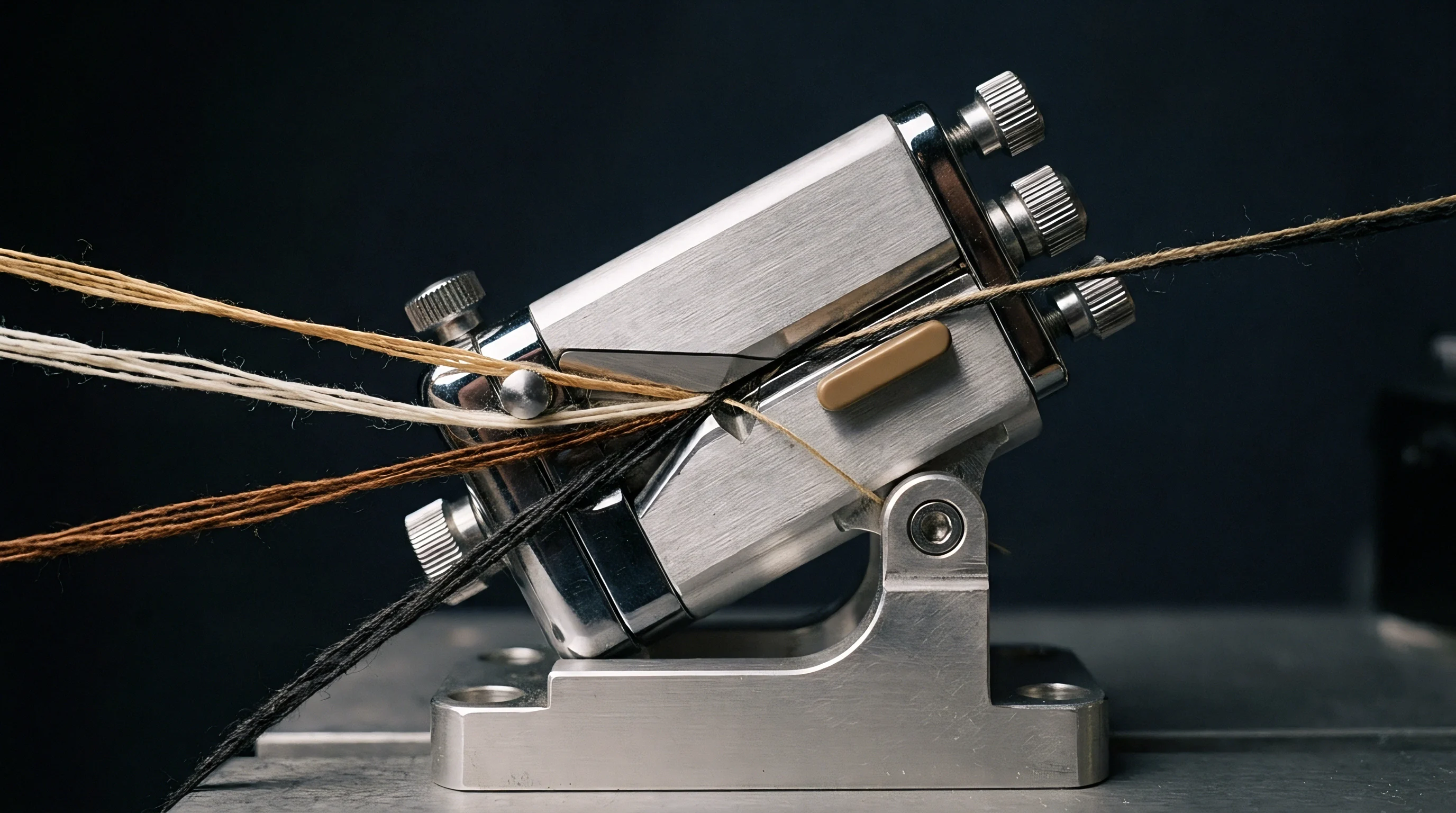
Refraction
In continuous wet processing, inline optical concentration measurement relies on Snellius refraction across an artificial sapphire interface. A process refractometer directs light through the sapphire prism into the caustic soda stream, reading the shadow edge formed at the critical angle of total internal reflection. Pure water at 20 degrees Celsius sits at 1.3330 RIU, while a 30 percent mercerization lye shifts the refractive index up to 1.4350 RIU.
Because this optical response follows dissolved solids directly, the measurement remains unaffected by suspended cotton fibers, textile lint, or surface aeration bubbles that blind transmission turbidimeters.
Thermal expansion changes liquid density, and with it the refractive index, completely apart from chemical addition. As temperature rises, greater molecular spacing lowers polarizability per unit volume and pulls the measured refractive index downward. In a 25 percent industrial caustic soda solution, heating the liquor from 20 degrees Celsius to 65 degrees Celsius drops the index by roughly 0.0162 RIU ~ an optical shift that mimics a 3.4 weight percent loss in caustic concentration if left uncorrected.
Dosing controllers operating on raw refractive index will overfeed concentrated stock into hot saturators, weakening cellulosic tensile strength and running up neutralization costs in downstream wash boxes.
Under steady 28 percent caustic concentration, an uncompensated thermal shift of 15 degrees Celsius alters measured concentration values by 1.8 weight percent.
Precision dosing systems normalize readings against standard reference points, usually 20 degrees Celsius or 25 degrees Celsius. The raw signal from the optical head has to be translated continuously to this baseline before the controller calculates mass flow additions. Without mathematically verified temperature coefficients tailored to the working concentration range, the sensor introduces a steady, systematic offset into the dosing loop.
An incorrect thermal coefficient leads to persistent over-dosing, which weakens fibers in continuous mercerizers and adds thousands of dollars per quarter in wastewater acid neutralization surcharges.

Prism
How the optical sensing surface is mechanically mounted determines how closely its temperature reading matches the bulk liquor. In mercerizing saturators and continuous bleaching lines, the optical window is mounted flush with the pipe wall or immersion cell to keep stagnant boundary layers from developing. Sapphire is used for the window because it resists abrasion from silicate stabilizers and grit washed off greige fabric.
Its thermal conductivity of 35 watts per meter-kelvin also allows the inner face of the prism to track process liquid temperature with minimal delay.
Tracking errors become significant whenever the temperature transducer is mounted away from the optical interface. The refractive measurement samples a fluid layer extending only several hundred nanometers into the caustic stream, whereas thermowells typically sit millimeters out in the flow. Sudden temperature swings from steam injection or makeup water set up steep thermal gradients across the boundary layer.
Pt100 and Pt1000 resistance elements built directly into the prism flange provide the cleanest tracking, following liquid temperature changes with time constants under 1.5 seconds.
Optical sapphire windows maintain surface hardness under continuous hot alkaline exposure while transferring heat rapidly to internal resistance elements.
Fouling on the prism creates an insulating layer that uncouples the optical reading from the temperature sensor. Pectins, hemicelluloses, spin finishes, and paraffin waxes saponified during caustic scouring readily precipitate onto cooler metal and glass surfaces.
- Mineral scale encrusts the prism face when process dilution water carries calcium or magnesium hardness above 60 milligrams per liter, requiring automated periodic hot-acid flushes.
- Cotton wax residues solidify on the sapphire surface during low-temperature rinse-down cycles, causing the optical sensor to register false elevated concentration plateaus.
- Hydrodynamic shear across the optical face prevents boundary layer stagnant zones when process line velocity stays between 1.5 and 2.5 meters per second.
Factory-default water temperature curves are often assumed to cover industrial caustic lines, but uncalibrated runs drift significantly without chemical-specific compensation.

Algorithm
Converting raw refractive index to temperature-compensated concentration requires different equations depending on lye strength. Simple linear compensation assumes the temperature coefficient, dn/dT, remains constant across the operating range. That assumption holds over narrow thermal windows of five degrees Celsius, but breaks down during startup swings and cold shift changes.
Linear models adjust the reading through the relation n_ref equals n_T plus alpha times the quantity T minus T_ref, where alpha is the temperature coefficient in refractive index units per degree Celsius. For pure water at 20 degrees Celsius, alpha is negative 0.000100 RIU per degree Celsius. In caustic solutions between 20 and 32 percent sodium hydroxide by weight, alpha shifts substantially, falling between negative 0.000280 and negative 0.000360 RIU per degree Celsius.
| NaOH Concentration (% w/w) | Specific Gravity (20°C) | Refractive Index (nD20) | Linear dn/dT (RIU/°C) | Second-Order dn/dT² (RIU/°C²) |
|---|---|---|---|---|
| 4.0 | 1.043 | 1.3415 | -0.000145 | -0.0000012 |
| 10.0 | 1.109 | 1.3570 | -0.000195 | -0.0000015 |
| 18.0 | 1.197 | 1.3812 | -0.000255 | -0.0000021 |
| 24.0 | 1.263 | 1.4015 | -0.000305 | -0.0000026 |
| 30.0 | 1.328 | 1.4245 | -0.000355 | -0.0000032 |
| 50.0 | 1.524 | 1.4720 | -0.000430 | -0.0000041 |

What Governs Quadratic Temperature Compensation Accuracy?
Because refractive index response curves over wider thermal spans, higher-order terms become necessary. Second-order polynomial models add a beta coefficient to account for the change in dn/dT as temperature climbs. When caustic saturators ramp from a 25 degrees Celsius fill to 65 degrees Celsius during continuous scouring, relying on a linear alpha coefficient introduces an error greater than 0.6 percent sodium hydroxide by mass at top temperature.
A second-order model corrects for this by calculating n_ref as n_T plus alpha times the thermal difference plus beta times the square of that thermal difference.
Embedded transmitters often use two-dimensional matrix compensation instead. These arrays store concentration as an empirical grid indexed by measured refractive index and temperature. Interpolating across the grid avoids polynomial truncation errors and accommodates the non-linear density shifts that occur near the crystallization point of concentrated lye.
Consider an open-width mercerizing range preparing combed cotton sheeting. Target saturator concentration is 28.0 weight percent sodium hydroxide, with temperatures moving between 22 degrees Celsius at startup and 58 degrees Celsius at full running speed. If the controller runs a linear compensation routine using an alpha of negative 0.000180 RIU per degree Celsius ~ typical of weak caustic ~ while laboratory titration shows the actual bath coefficient is negative 0.000340 RIU per degree Celsius, the gap becomes apparent at 58 degrees Celsius, where the difference from reference temperature reaches 38 degrees Celsius.
At that operating point, the transmitter applies a thermal correction of negative 0.00684 RIU instead of the required negative 0.01292 RIU, underestimating thermal optical loss by 0.00608 RIU. At 28 percent caustic, roughly 0.00180 RIU corresponds to one weight percent sodium hydroxide. The instrument therefore overstates bath strength by 3.38 weight percent, prompting the dosing valve to choke feed flow until actual concentration drops to 24.62 weight percent.
Mercerizing luster falls off and dye uptake becomes uneven across the run.
Loading verified polynomial coefficients or two-dimensional matrix tables directly into transmitter memory eliminates that offset and stabilizes bath concentration.
Alkali
Caustic solutions on a finishing floor are rarely neat mixtures of sodium hydroxide and water. Contact with ambient air introduces carbon dioxide into open circulation tanks, where it reacts with hydroxide ions to form sodium carbonate. Each mole of carbon dioxide consumes two moles of sodium hydroxide and yields one mole of carbonate.
Sodium carbonate raises the refractive index of the bath, but provides none of the fiber-swelling power needed for mercerization.
Because refractometers measure total dissolved solids optically, they cannot tell sodium hydroxide from sodium carbonate. In an older mercerizing bath with heavy carbonate buildup, the optical reading will indicate proper chemical strength while active caustic is actually depleted. Periodic acid-base titration determines the true carbonate-to-hydroxide ratio so technicians can update compensation offsets or schedule a bath dump.
A production batch verified solely by optical density risks rejection during flammability or colorfastness testing when unmonitored carbonates displace active hydroxide ions.
Recycled caustic recovered from wash-water evaporators adds further background solids. Evaporator concentrates carry residual sizing agents, broken-down starches, spent surfactants, and short-chain hemicellulose fragments.
- Incoming analytical profiling quantifies total dissolved solids, active sodium hydroxide, and carbonate content using two-endpoint potentiometric acid-base titration.
- Matrix correlation offset adjustment recalculates the base refractive index baseline inside the transmitter software to align with actual chemical titration points.
- Verification of thermal slopes validates that background organic impurities do not alter the temperature coefficient across the 20 to 60 degrees Celsius operating span.
- Routine automated cross-checks identify contamination drift when daily titration records diverge from inline optical values by more than 0.3 weight percent.
The operational challenge lies in identifying the carbonate concentration threshold where optical compensation algorithms can no longer distinguish active caustic from dead-weight dissolved solids.
Loop
Closing the loop between a temperature-compensated refractometer and an automatic dosing system demands clean signal processing. Compensated concentration values are sent to the PLC over 4-20 milliamp loops or digital fieldbuses. Transmitting raw refractive index and delegating temperature compensation to the PLC introduces scan-cycle latency and phase lag into feedforward routines.
Fast-acting dosing valves need smoothed signals to avoid mechanical hunting. Process refractometers typically refresh at 1 to 5 hertz, while caustic supply lines rely on positive-displacement metering pumps or pneumatic control valves. Agitation in the bath generates surface ripple and turbulence across the prism face, showing up as high-frequency optical noise.
Transmitters need internal damping filters set between two and five seconds to stabilize the process variable before it reaches PID control loops.

Why Distinguish Process Transients from Thermal Lag?
Thermal and chemical disturbances move on very different schedules. Cold dilution water creates fast temperature gradients across the fluid boundary layer, whereas bath concentration shifts slowly given typical tank volumes. If the optical face and internal temperature sensor respond at different rates, a thermal surge produces a false concentration spike or dip in the compensated output.
The control loop reacts to the phantom error by dosing unneeded chemical stock.
| Processing Scenario | Thermal Rate (°C/min) | Compensation Mode | Dosing Loop Stability | Concentration Drift (% w/w) |
|---|---|---|---|---|
| Cold morning line startup | +4.5 | Factory default (water) | Unstable, valve cycling | -2.8 to +1.5 |
| Steady-state continuous run | +0.2 | Linear matched dn/dT | Stable | ±0.3 |
| Steam heat exchanger cycle | +8.0 | Linear matched dn/dT | Transient valve hunting | ±0.9 |
| Steam heat exchanger cycle | +8.0 | Matrix array, fast RTD | Stable, minimal ringing | ±0.15 |
| Recycled lye changeover | +1.0 | Matrix with carbonate offset | Stable | ±0.25 |
Aggressive integral tuning in the controller magnifies these thermal tracking artifacts. Caustic saturator baths typically have residence times of two to twelve minutes. Reset times need to reflect that holding capacity: longer integral times prevent the valve from chasing transient optical noise while maintaining steady correction against real chemical draw-down.
In feedforward setups, fabric mass flow measured at the entry roll pairs with inline refractometric feedback. The fabric weight meter estimates baseline caustic consumption, and the temperature-compensated refractometer trims chemical dosing to eliminate steady-state offset.
Fast temperature fluctuations demand matched sensor response times to keep control valves from hunting phantom concentration shifts.