Enforcing Joint Chemical Liability and Swatch Retention Escrow Protocols in Cross Border Textile Litigation
Enforcing chemical indemnity demands tripartite swatch escrow with nitrogen-sealed splits to withstand foreign judicial scrutiny and analytical retesting.

Joinder
Cross-border litigation over toxic dyestuffs breaks down when downstream retailers sue immediate importers while overseas dyehouses remain untouched behind corporate boundaries. Garment brands operating in European and North American markets face direct enforcement under REACH Annex XVII, the Consumer Product Safety Improvement Act, and California Proposition 65. The commercial entities manufacturing the finished yardage reside in jurisdictions thousands of kilometers away.
Importers commonly discover that standard purchase agreements fail to create procedural privity between domestic retail buyers and foreign wet processing units. Without explicit multilateral joinder stipulations, foreign chemical formulators and finishing mills escape discovery orders, depositions, and cost-shifting judgments.
Multi-tiered chemical liability structures require binding agreements that connect the ultimate apparel brand, the general trading vendor, the commission dyehouse, and the auxiliary chemical distributor. When customs authorities detain containers due to banned ortho-phthalates or extractable heavy metals, retail brands often absorb inventory write-offs alone. The immediate vendor frequently functions as an undercapitalized intermediary entity lacking balance-sheet depth.
Enforcing joint accountability demands pre-dispute contract structures that bind upstream processors as primary obligors rather than secondary indemnitors. These contractual mechanisms establish direct arbitration submission covenants, mutual indemnity cross-guarantees, and compulsory participation agreements in cross-border proceedings.
Article 39 of the CISG extinguishes all buyer defect remedies if written chemical failure notification fails to reach the overseas seller within two years of physical delivery.
Litigation defense begins by assessing the legal enforceability of flow-down warranties across every link of the manufacturing chain. Many procurement desks mistakenly rely on broad purchase order disclaimers declaring that delivered lots comply with all applicable global restricted substance lists. Such general language fails to survive judicial scrutiny in foreign commercial tribunals.
Enforceability demands identifying the exact chemical thresholds, analytical test protocols, and governing legal codes directly inside individual supply contracts.

Multi-Tier Supply Contracts
Purchase orders distributed across continental boundaries divide legal responsibility between the trading entity and the industrial finishing facility. A European importer issuing a garment production contract to an export house in Hong Kong rarely signs direct covenants with the underlying wet processing mill located in Guangdong or Chittagong. When an analytical laboratory detects branched alkylphenol ethoxylates exceeding the 100 milligram per kilogram limit established under REACH Annex XVII Entry 46a, the trading vendor routinely disclaims technical fault.
The intermediary points to the independent dyehouse, while the dyehouse claims complete reliance on raw dyestuff suppliers. Direct procedural joinder dissolves this buck-passing defense by consolidating every entity into a singular arbitration submission.
Joint and several liability clauses compel each participant to guarantee compliance for preceding inputs. The raw chemical manufacturer certifies auxiliary formulation purity. The commission finisher warrants bath processing integrity.
The garment vendor assumes overall assembly conformity. When an enforcement agency flags an infraction, the plaintiff initiates proceedings against all upstream entities simultaneously. The dyehouse signed the indemnity.
Enforcing these claims across diverse legal systems requires pre-agreed evidentiary rules and harmonized dispute mechanisms.

Flow-Down Warranty Enforceability
Importers draft restricted substance stipulations that bind apparel assemblers to European Union chemical thresholds. Enforcing those commitments upstream requires active flow-down clauses embedded in purchase contracts between garment makers and sub-tier wet processors. The terms must contain mandatory joinder consent where third-tier mills agree to enter ongoing litigation upon formal tender of defense.
- Direct Jurisdiction Submission binds foreign finishing mills to the dispute forum selected by the primary importer, precluding jurisdictional dismissal motions.
- Secondary Processor Covenants mandate immediate disclosure of all auxiliary chemical formulators, batch numbers, and technical data sheets upon regulatory query.
- Liquidated Recourse Obligations shift regulatory recall penalties, inventory destruction costs, and legal representation expenses directly to the non-compliant wet processor.
- Evidentiary Estoppel Clauses prevent offshore suppliers from challenging independent laboratory findings when certified sampling procedures were executed at origin.
Standard purchase terms incorporating Clause 14.2 compel the upstream chemical compounder to submit directly to the jurisdiction of the buyer’s domestic courts, converting an unreachable foreign subcontractor into a named co-defendant.


Bolt
Physical evidence in chemical disputes originates at the finishing mill inspection table before packaging. Post-shipment testing conducted months after port arrival leaves open arguments regarding transit contamination, warehouse humidity exposure, or shipping container fumigation. Maintaining clear proof requires taking reference swatches directly from individual production rolls as yardage exits final stenter drying frames.
An established retention protocol secures verifiable physical evidence before goods enter international transport routes.
A retain swatch escrow program establishes neutral physical archives of manufactured production lots. When customs regulators identify an illegal substance within retail garments, the retained origin swatches serve as definitive baseline material for forensic retesting. Establishing clear custody demands strict adherence to documented cutting protocols, tamper-proof container seals, and independent third-party depository administration.
Swatches cut without documented witness signatures possess minimal value before international arbitration panels.
Retained swatches cut from the center of a production roll provide stronger evidentiary defense than edge cuttings susceptible to stenter frame chemical concentration gradients.
The container remained under detention. Establishing an unassailable custodial trail neutralizes arguments claiming that samples underwent tampering or substitution. Independent escrow agents verify that swatches originate from the precise lot referenced on bills of lading and transaction certificates.

Tripartite Sample Partitioning
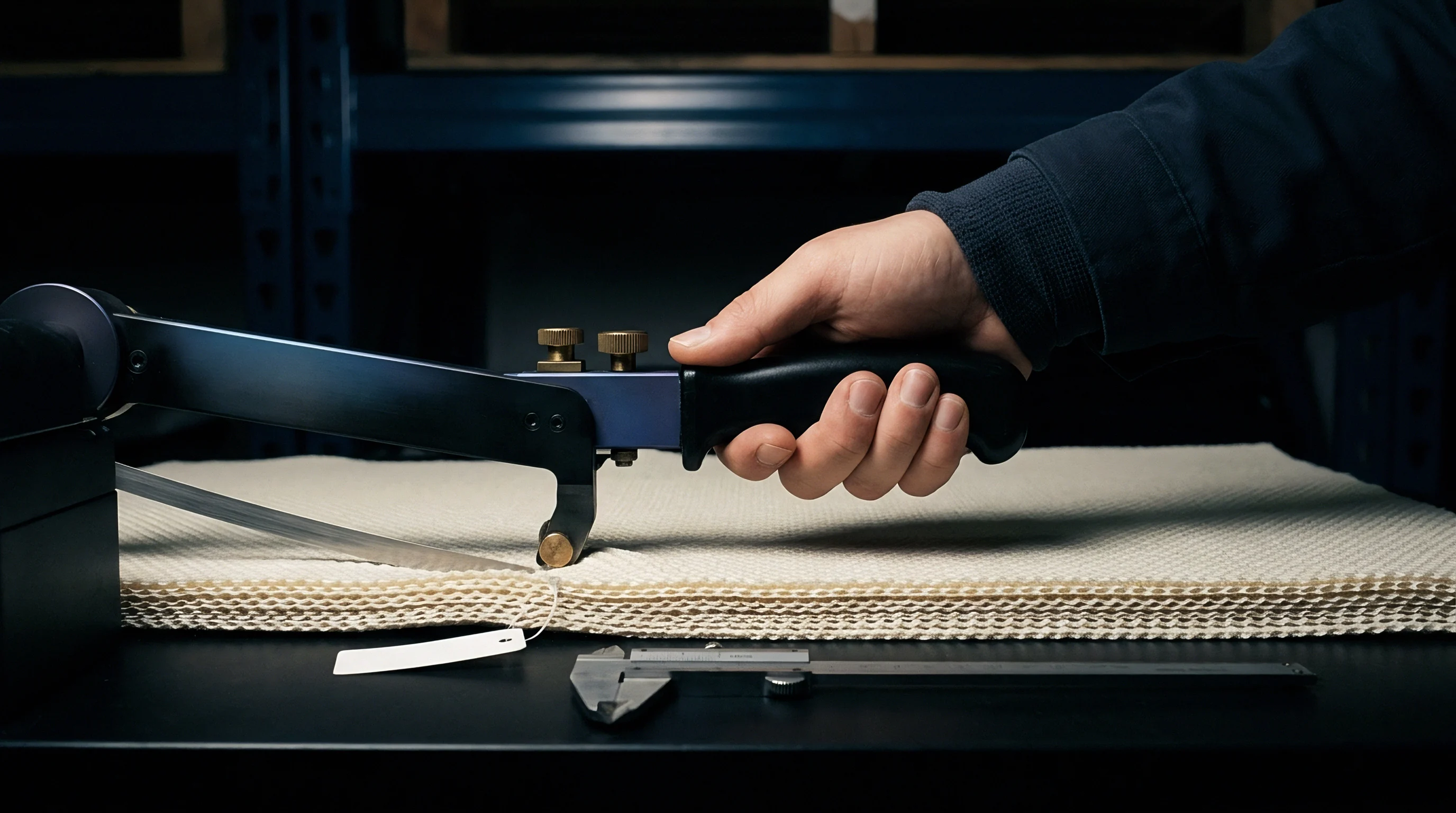
Technicians sever thirty linear centimeters across the entire finished width to create three identical test specimens. One cut remains in the finishing mill archive for internal quality defense. The second cut ships to the buyer or domestic importing house for immediate entry clearance testing.
The final cut transfers to an independent, accredited escrow depository located either in the manufacturing country or within an internationally recognized neutral legal hub. This tripartite distribution guarantees that neither party holds unilateral control over evidentiary retains.
The physical retain package must contain sufficient yardage to conduct multiple destructive analytical extractions. Gas chromatography mass spectrometry and liquid chromatography procedures consume several grams of textile substrate per test cycle. Splitting the retention cut into three identical 500-gram portions ensures that confirmatory testing, referee analysis, and judicial demonstration remain technically feasible without compromising sample integrity.
Customs rejected the paper declaration. Retained physical specimens provide the sole empirical counter-evidence against border enforcement findings.

Custodial Documentation Requirements
Each cut specimen receives a barcoded synthetic security label applied across its outer boundary. The documentation bundle attached to the escrow package requires specific production identifiers that link the retain directly to the commercial invoice and export manifest.
- Mill Floor Witness Protocol records linear meter stamps, production machine numbers, stenter operator identifications, and batch mix references signed by an independent certified quality inspector.
- Tamper-Evident Bag Sealing encloses the specimen in heat-sealed multi-layer barrier foil with serialized tamper-detection tapes whose numerical sequence enters the export dossier.
- Chain of Custody Manifestation logs temperature, humidity, freight handoffs, and transit waybills during sample movement between the finishing plant and the escrow repository.
- Depository Intake Verification registers incoming package integrity, weighing the specimen to within 0.01 grams to verify that no moisture loss or material diversion occurred.
An evidentiary seal broken outside the presence of an independent witness renders the retained yardage legally worthless.


Decay
Chemical residues embedded within finished polymers experience degradation under storage. Unlike solid metallic products, treated textile goods undergo physical and chemical transformations driven by temperature shifts, ultraviolet radiation, atmospheric moisture, and ambient volatile compounds. Retained swatches held in escrow repositories are vulnerable to these ambient degradation pathways.
If an escrow facility stores swatches under variable climate conditions, subsequent referee analysis produces skewed data that fails to reflect the chemical profile present at manufacturing completion.
Evaluating chemical compliance across eighteen months of litigation requires understanding the degradation kinetics of specific restricted substances. Formaldehyde, volatile solvent residues like dimethylformamide, organotin stabilizers, and specific azo cleavable amines exhibit distinct degradation rates. When legal disputes unfold, defendants frequently argue that low analytical test values obtained from aging retains demonstrate compliance, or that excessive levels resulted from ambient migration within storage facilities.
Analytical defenses collapse unless the escrow protocol controls for chemical degradation kinetics.

Can Retained Swatches Withstand Volatile Analyte Loss?
Free formaldehyde undergoes sublimation into ambient air when warehouse temperatures exceed twenty-five degrees Celsius. Cotton fabrics finished with dimethyloldihydroxyethyleneurea resins release free formaldehyde continuously through equilibrium hydrolysis. An unsealed retain swatch stored in standard kraft paper envelopes loses substantial formaldehyde content within ninety days.
When an importer relies on an aged retain to prove compliance with EN ISO 14184-1 thresholds, the laboratory records an artificially depressed value. Conversely, goods packaged in unvented polyolefin bags accumulate free formaldehyde vapors, generating false non-compliance spikes during retesting.
The retention seals remained unbroken. Solvent extraction isolates the target esters. Certain chemical species remain exceptionally stable over extended timelines, while volatile organic finishes disperse rapidly.
Organophosphorus flame retardants and long-chain per- and polyfluoroalkyl substances resist ambient decomposition, maintaining persistent chemical fingerprints within preserved yarn structures. Residual short-chain phthalate plasticizers and volatile carrier solvents like trichlorobenzene migrate out of synthetic polyester coatings. Preserving analytical integrity mandates temperature-controlled, inert storage environments.
Formaldehyde concentrations in cotton specimens drop by forty percent after six months of storage at thirty degrees Celsius without barrier film isolation.
Similar physical preservation demands occur in aerospace sealant testing and active pharmaceutical ingredient stability archiving, where multi-layer foil lamination and dry nitrogen flushes shield fragile molecular chains against ambient decomposition throughout long regulatory review cycles. Textile escrow protocols must deploy comparable physical protection measures to maintain sample admissibility in formal legal disputes.

Preserving Labile Compounds
Vacuum-sealed multi-layer aluminum barrier bags protect sensitive organic residues against atmospheric photo-oxidation. Escrow archives must operate continuous environmental controls maintaining storage temperatures between four and eight degrees Celsius with relative humidity held below forty percent. Flushing packaging interiors with ultra-high-purity nitrogen gas eliminates atmospheric oxygen, halting oxidative degradation of arylamine precursors.
Technicians apply dark, light-impermeable secondary wrappers to neutralize ultraviolet cleavage of conjugated dye structures.
The analytical chemistry community recognizes established reporting limits and degradation baselines for standard regulatory analytes. Under REACH Annex XVII Entry 43, the legal limit for aromatic amines derived from azo colourants stands at 30 milligrams per kilogram, analyzed via EN 14362-1 and EN 14362-3. This threshold rests upon gas chromatography mass spectrometry detection capabilities with standard reporting limits calibrated to 5 milligrams per kilogram.
This threshold shifts if analytical laboratories alter the extraction solvent from t-butyl methyl ether or fail to maintain cleavage bath temperatures at seventy degrees Celsius during chemical reduction. Orthophthalates regulated under REACH Annex XVII Entries 51 and 52 carry a cumulative threshold of 0.1 percent by weight, quantified via GC-MS after ultrasonic extraction. This figure shifts if thermal desorption techniques bypass complete polymer dissolution.
The laboratory blank showed zero contamination. Secondary finishing introduces unmonitored plasticizers. Estimating the exact environmental half-life of residual alkylphenol ethoxylates in commercial knit goods held under uncontrolled warehouse environments remains subject to scientific variation, with empirical estimates spanning 400 to 900 days.
This analytical uncertainty prevents expert witnesses from establishing definitive decay curves for aging textiles. Careful buyers avoid this uncertainty by mandating cold-chain nitrogen-sealed retain escrow vaults that halt biochemical transformation completely.
| Analyte Class | Standard Test Method | Regulatory Threshold | Ambient Half-Life | Optimal Escrow Packaging |
|---|---|---|---|---|
| Free Formaldehyde | EN ISO 14184-1 | 16 to 75 mg/kg | 60 to 90 Days | Hermetic aluminum foil, vacuum, 4°C |
| Azo Cleavage Amines | EN 14362-1 / 3 | 30 mg/kg | 180 to 360 Days | Nitrogen-purged foil, dark storage, 4°C |
| Ortho-Phthalates | CPSC-CH-C1001-09.4 | 1000 mg/kg | 700+ Days | Fluoropolymer-lined pouches, ambient |
| Organotin Compounds | ISO 22744-1 | 1 mg/kg | 120 to 240 Days | Amber glass or PTFE sheets, sealed, 4°C |
| Extractable Heavy Metals | EN 16711-2 | 0.2 to 50 mg/kg | 1000+ Days | Polyethylene sleeves, desiccated, ambient |

Analytical Degradation Variance Modeling
Consider a constructed scenario featuring a twenty-metric-ton production lot of dyed woven cotton twill subject to a contract limit of twenty milligrams per kilogram for formaldehyde under ISO 14184-1. The primary mill floor certificate records an initial compliant measurement of twelve milligrams per kilogram upon stenter exit. Assume the goods ship overseas, experience four weeks of tropical ocean transit, and sit in a domestic distribution center for six months before border surveillance authorities pull retail samples.
Testing by customs enforcement yields forty-five milligrams per kilogram, prompting an immediate sales ban and recall threat.
The importer draws the neutral tripartite escrow retain for referee retesting. The analytical laboratory measures eighteen milligrams per kilogram. Expanded measurement uncertainty under ISO/IEC 17025 testing protocols introduces an uncertainty coefficient (U) of fifteen percent with a coverage factor of k = 2 at a ninety-five percent confidence interval.
Applying this uncertainty band yields a possible true value between 15.3 and 20.7 milligrams per kilogram. The third swatch split broke the tie. Because the retain swatch was stored in an inert barrier bag at four degrees Celsius, the referee laboratory rules that the production lot met the specification upon export.
The spike observed in the retail garments derived from contact with acidic cardboard cartons inside distribution warehouse racking.
International tribunals continue to debate whether analytical recovery drops in aging organotins reflect natural substrate degradation or improper original chemical application by the finisher.


Forum
International commercial dispute resolution demands establishing venue authority before launching analytical challenges. In cross-border textile sales, buyers and sellers reside in divergent jurisdictions with conflicting legal traditions regarding discovery, physical evidence preservation, and expert testimony. Cross-border contracts commonly default to international arbitration under rules established by the International Chamber of Commerce, the Singapore International Arbitration Centre, or the United Nations Commission on International Trade Law.
Litigating chemical non-compliance in foreign national courts introduces systemic procedural delays that destroy the evidentiary relevance of physical retain swatches.
The seller contested the sampling method. Evidentiary rules governing chemical contamination claims require precise alignment with the United Nations Convention on Contracts for the International Sale of Goods. Importers pursuing claims against Asian, European, or Latin American textile manufacturers must establish that their inspection and notification timelines comply strictly with international commercial standards.
Failure to follow codified notification sequences terminates legal remedies, regardless of how severe the chemical breach appears under consumer safety regulations.
State courts routinely refuse judicial notice for foreign laboratory credentials that lack signatory status under the International Laboratory Accreditation Cooperation Mutual Recognition Arrangement.
The test report arrived twenty days late. Retain escrow protocols solve jurisdictional evidentiary challenges by removing sample handling from the partisan control of either litigant. When parties contractually designate an independent depository, the resulting analytical certificates benefit from clear rebuttable presumptions of authenticity inside international tribunals.

Will Foreign Courts Enforce Retain Escrow Agreements?
Judges presiding in major manufacturing export jurisdictions evaluate whether neutral third-party holding agreements violate local procedural codes. Civil law jurisdictions in mainland China, Vietnam, and Turkey maintain strict limitations on pre-trial evidence preservation. Without explicit contractual consent, local courts frequently reject testing certificates produced from foreign retains, characterizing unilateral sample archives as unauthenticated private hearsay.
Drafting agreements with mandatory arbitral clauses overcomes this barrier because international arbitrators possess wide procedural discretion to admit independent escrow evidence.
Bilateral judicial assistance through the Hague Evidence Convention requires cumbersome letters rogatory that can take over twelve months to execute across borders. By the time a foreign court commissions an official judicial expert to extract samples from a warehouse, volatile residues have dissipated or goods have cleared distribution channels. Incorporating independent escrow depositories directly into commercial contracts bypasses formal diplomatic channels.
Parties establish private evidentiary covenants that bind arbitral tribunals to accept retain test records as authoritative representations of delivered quality.

Cross-Border Evidentiary Barriers under the CISG
Article 38 of the United Nations Convention on Contracts for the International Sale of Goods directs buyers to examine incoming goods within the shortest practicable period. Article 39 bars buyers from relying on a lack of conformity if notice specifying the nature of the defect is not given to the seller within a reasonable time, with an absolute cut-off at two years. When toxic chemical contamination remains hidden within fiber matrices, buyers argue that standard visual receiving audits cannot uncover complex molecular violations.
- Notice Timing Lapses occur when importers fail to commission laboratory gas chromatography tests immediately upon container arrival, exceeding the CISG reasonable examination window.
- Sample Extraction Irregularities emerge when factory representatives are excluded from destination sampling procedures, creating claims of sample contamination or mix-ups.
- Accreditation Credential Deficits arise when domestic testing houses lack ISO/IEC 17025 certification covering the exact matrix extraction techniques mandated in supply agreements.
- Secondary Packaging Breaches invalidate evidence when retained swatches arrive at laboratory facilities inside punctured or unsealed transit containers.
| Jurisdiction | Evidentiary Standard | Pre-Trial Retain Discovery | Third-Party Lab Standing |
|---|---|---|---|
| United States Federal Courts | Federal Rules of Evidence 702 (Daubert) | Broad mandatory production | Court evaluates individual chemist credentials |
| England and Wales Commercial Court | Civil Procedure Rules Part 35 | Managed disclosure regimes | Single joint expert preference |
| People’s Republic of China | PRC Civil Procedure Law Article 63 | Court-appointed appraisal systems | Strict reliance on domestic CMA/CNAS credentials |
| ICC International Arbitration | IBA Rules on the Taking of Evidence | Party-directed submission protocols | Tribunal weighs accreditation scope directly |
The overseas mill argued that foreign customs inspectors contaminated the container by slicing open interior polybags during an unauthorized transit search.


Levy
Financial recoupment proceeds through pre-established liquidated damages tied directly to certified restricted substance infractions. Winning an analytical dispute before an international arbitration panel represents only half the legal battle. If the non-compliant dyehouse or chemical supplier holds no attachable assets within the buyer’s home jurisdiction, a multimillion-dollar arbitral award remains an uncollectable paper judgment.
Cross-border sourcing requires commercial security mechanisms that convert liability findings into immediate liquid recovery.
The buyer drew down the letter. Importers establish chemical indemnity security through standby letters of credit, contractual escrow retention funds, and specialized product contamination insurance policies. Sourcing contracts allocate all analytical testing fees, customs demurrage bills, product recall expenses, and hazardous waste disposal tariffs directly to the offending manufacturing tier.
When chemical non-compliance is confirmed on retained escrow swatches, financial instruments execute automatically without awaiting appeals.
Liquidated damages covered all warehouse losses. The importer absorbed the demurrage penalty. Commercial contracts must explicitly stipulate fee-shifting clauses that force non-compliant mills to reimburse all expenses associated with tripartite retain maintenance, international shipping, and certified retesting.
Without pre-funded financial escrow accounts, brands absorb the full landed cost of chemical contamination while foreign suppliers dissolve corporate entities to evade enforcement.

Escrow Drawdown Mechanics
Third-party escrow holders release cash collateral upon receipt of an accredited laboratory failure report. Commercial agreements establish a formal drawdown process that prevents foreign suppliers from issuing bad-faith legal injunctions to freeze deposited funds. When an independent test confirms restricted substances exceeding contractual parts-per-million limits, the depository bank transfers compensatory balances directly to the importing brand.
Suppliers frequently demand ninety-day cure periods or independent referee testing before funds release. Sourcing contracts restrict these stalling tactics by mandating immediate financial drawdown upon the first certified failure, holding the recovered funds in a secondary legal escrow pending referee swatch analysis. If the referee retain confirms compliance, the funds return to the mill.
If the retain fails, the capital covers immediate inventory write-offs, consumer recall notices, and industrial incineration fees.

Remediation Cost Allocations
Commercial port authorities bill customs clearance brokers for hazardous container quarantine when unauthorized plasticizers exceed regulatory thresholds. When border agencies detect regulated perfluorooctanoic acid or hazardous dimethyl fumarate sachets, port authorities impose demurrage, specialized handling, and certified environmental destruction tariffs. Contractual liability models must allocate these ancillary costs across each participating supply chain entity.
| Cost Component | Initial Payor | Contractual Allocation | Recovery Mechanism |
|---|---|---|---|
| Port Demurrage and Storage | Importer of Record | Primary Garment Vendor | Automatic deduction from open invoices |
| Accredited Lab Retesting | Disputing Party | Non-Compliant Wet Processor | Escrow deposit drawdown |
| Hazardous Inventory Incineration | Importer of Record | Joint: Vendor and Chemical Supplier | Standby Letter of Credit liquidation |
| Consumer Product Recalls | Retail Brand | Primary Vendor with Cross-Guarantees | Commercial litigation and insurance claims |
| Regulatory Compliance Fines | Importer of Record | Finishing Mill | Direct contractual indemnification |
| All recovery mechanisms depend upon valid tripartite retain evidence verifying manufacturing-stage chemical contamination. | |||
The arbitration panel awarded full damages. Testing confirmed perfluorooctanoic acid presence. Enforcing joint liability across borders requires aligning analytical test protocols with aggressive commercial recovery instruments.
Retain escrow systems provide the load-bearing evidentiary foundation that empowers legal teams to penetrate offshore supply chains, hold negligent processors accountable, and protect importing brands from devastating regulatory penalties.
Omitting third-party escrow accounts leaves the brand bearing hundred-thousand-dollar toxic disposal invoices when foreign mills dissolve corporate entities overnight.