Establishing Conversion Coefficients for Tensile Strength Equivalence across International Garment Regulations
Cross-border textile regulations demand empirical conversion ratios between 1.15 and 1.42 for grab-to-strip tensile strength based on structural yarn mobility.

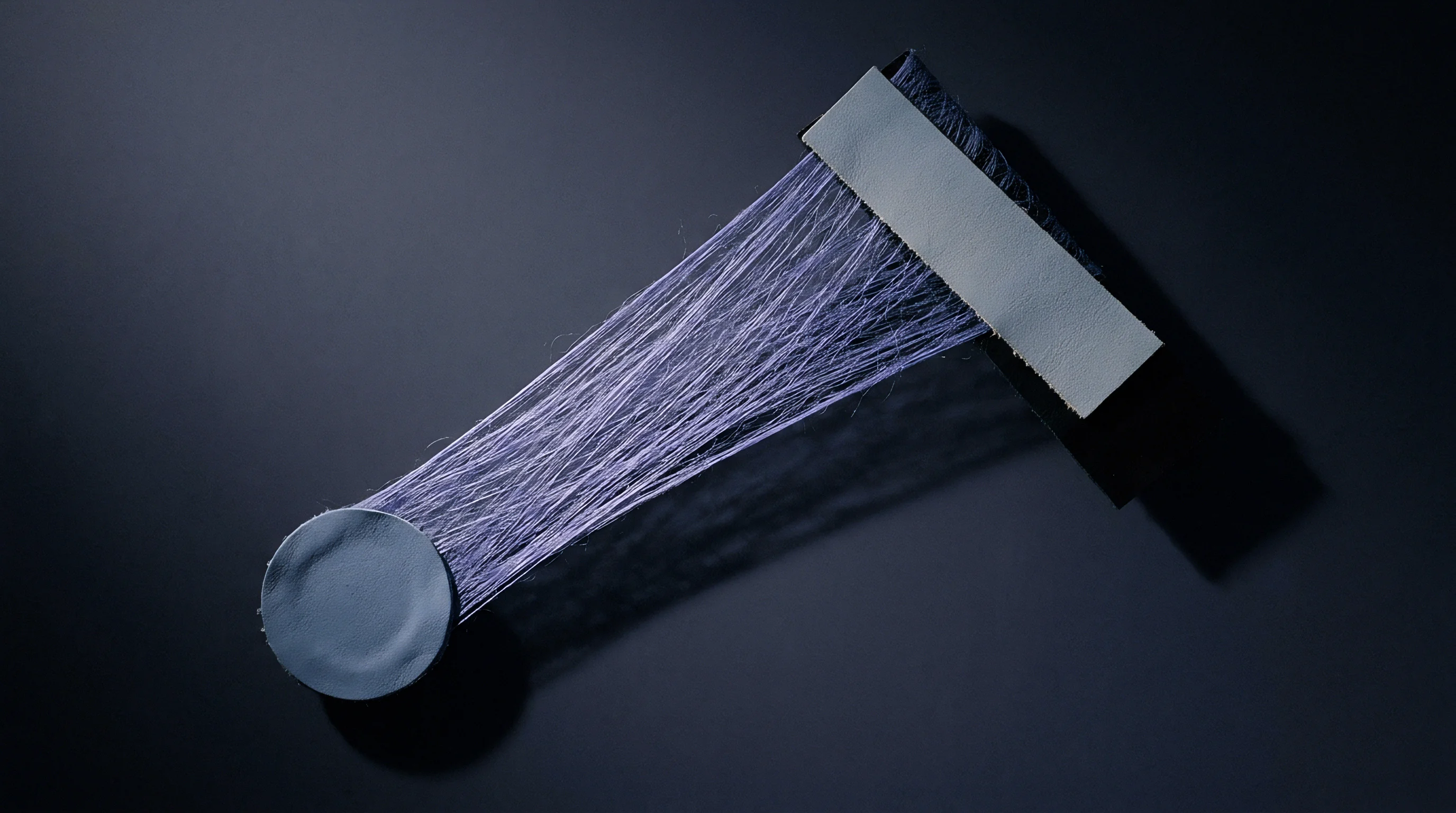
Geometry
Tensile testing standards in garment procurement diverge across two mechanical arrangements: the cut strip method and the grab method. Under ISO 13934-1, ASTM D5035, and GB/T 3923.1, technicians mount a 50 mm strip of cloth between wide grips, isolating a rectangular column of warp or weft yarns. Every longitudinal strand gripped at the upper clamp extends through to the lower clamp.
ISO 13934-2, ASTM D5034, and GB/T 3923.2 position a 100 mm wide textile specimen within narrower 25 mm by 25 mm clamps. The central 25 mm column bears direct tensile displacement, while adjacent material hanging outside the clamping perimeter restricts lateral contraction through yarn-to-yarn shear friction.
Lateral yarns absorb tension. This shear interaction creates the grab test reinforcement effect. The specimen yields an apparent breaking force substantially higher than the load sustained by a 25 mm cut strip excised from the identical roll.
When testing a 220 g/m² cotton twill, an operator pulling a 25 mm strip records roughly half the force of a 50 mm strip. Subjecting that same twill to an ASTM D5034 grab setup produces a breaking force between 120 percent and 145 percent of the 50 mm cut strip value, despite the clamp faces gripping only 25 mm of width.
A contract written without a designated test geometry exposes the importer to rejection across borders enforcing national standards.
International authorities do not recognize interchangeable equivalence between these two physical dimensions. The Chinese market surveillance administration, under GB 18401 and relevant apparel product benchmarks like GB/T 2660 for shirts or GB/T 22700 for trousers, penalizes goods that fall below strip test thresholds even when foreign suppliers supply passing grab test documentation. Yarns pull free along edges.
Cut strip methods eliminate peripheral friction, whereas grab methods incorporate substantial lateral shear resistance.
| Standard Designation | Test Configuration | Specimen Width | Clamp Dimensions | Gauge Length | Rate of Extension |
|---|---|---|---|---|---|
| ISO 13934-1 | Cut Strip | 50 mm | Width 60 mm min | 200 mm | 100 mm/min |
| ISO 13934-2 | Grab | 100 mm | 25 mm x 25 mm | 100 mm | 50 mm/min |
| ASTM D5034 | Grab | 100 mm | 25 mm x 25 mm | 75 mm | 300 mm/min |
| ASTM D5035 | Cut Strip | 50 mm | Width 60 mm min | 75 mm | 300 mm/min |
| GB/T 3923.1 | Cut Strip | 50 mm | Width 60 mm min | 200 mm | 100 mm/min |
| GB/T 3923.2 | Grab | 100 mm | 25 mm x 25 mm | 100 mm | 100 mm/min |

Crosshead Displacement and Specimen Width Mechanics
Tensile apparatuses pull samples at contrasting crosshead velocities depending on the governing body. ASTM standards specify high displacement rates of 300 mm per minute over shorter gauge lengths of 75 mm. European and Chinese specifications dictate lower rates of 100 mm per minute across 200 mm spans for strip assessments.
Higher extension rates compress the timeline of polymeric chain relaxation within synthetic fibers, elevating recorded peak rupture loads by 4 to 8 percent on continuous polyester filaments. Conversely, natural cellulosic fibers exhibit lower sensitivity to displacement speed but react aggressively to relative humidity variations during conditioning.
Discrepancies in load transfer stem from three primary physical variables:
- Yarn Mobility Within The Interlacement Pattern governs the volume of lateral cloth drawn into tension during a grab test, raising the measured force on looser structures.
- Crimp Differential Between Warp And Weft alters the initial take-up slack, causing the crosshead to travel further prior to real structural loading on high-crimp yarns.
- Edge Fraying Susceptibility reduces effective strip width during cut strip preparation, dropping measured rupture force when loose yarns shed from the specimen borders.
Importers transposing ASTM D5034 grab results into European or Chinese strip compliance declarations encounter immediate customs seizures when market surveillance laboratories re-test lots using cut strips, resulting in destruction orders, re-export mandates, and commercial inventory write-downs.
Jaw
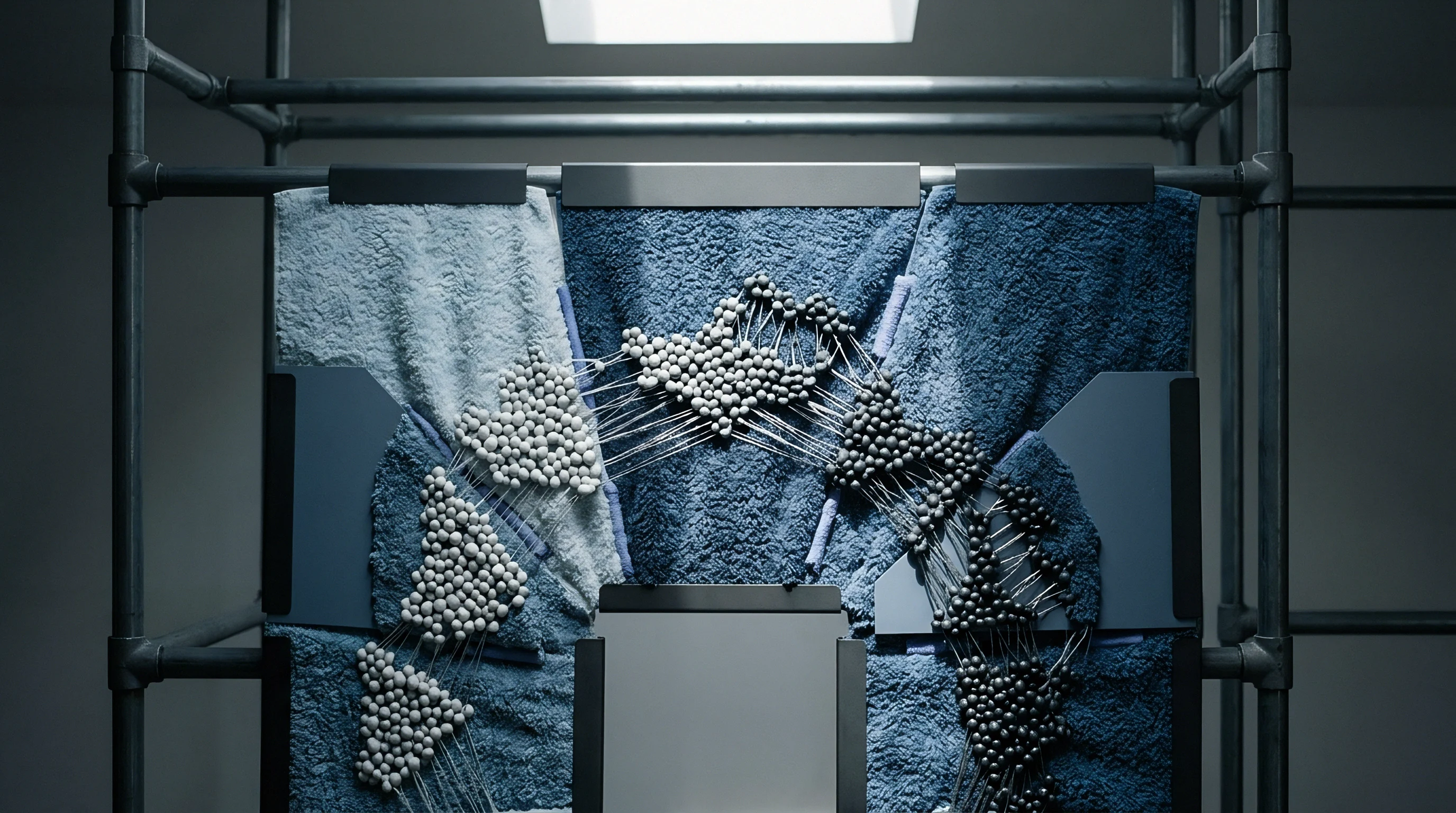
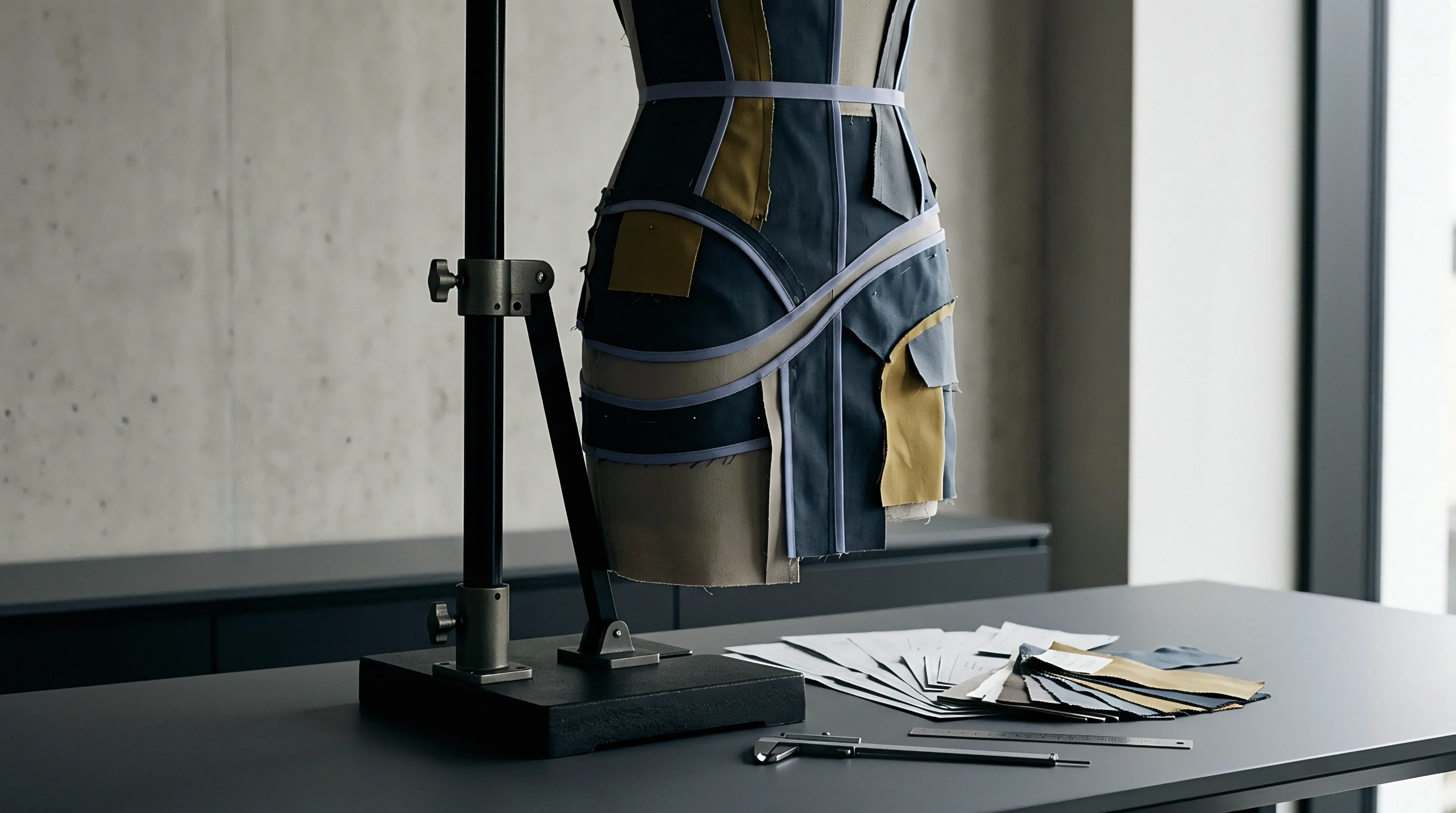
Clamp mechanics dictate the validity of tensile test curves across all standard testing machines. When clamping pressure drops below the friction threshold of the textile surface, specimens slip outward from the grip zone. Slippage stretches the apparent elongation curve, creating artificial displacement values while blunting peak breaking force.
Conversely, over-torquing mechanical clamps or applying excessive pneumatic line pressure cuts individual surface yarns directly along the metal collar.
Clamps slip under load. Testing technicians counter this slippage by selecting jaw faces matched to the substrate weight. Smooth flat steel faces secure lightweight shirting goods without crushing yarn cores.
Polyurethane-coated inserts dampen contact stress on slick continuous filament synthetics like nylon taffeta. Serrated wave faces grip heavy twills, canvas, and outerwear drill cloths, preventing draw-in under loads exceeding 600 Newtons. Friction distorts jaw pressure.
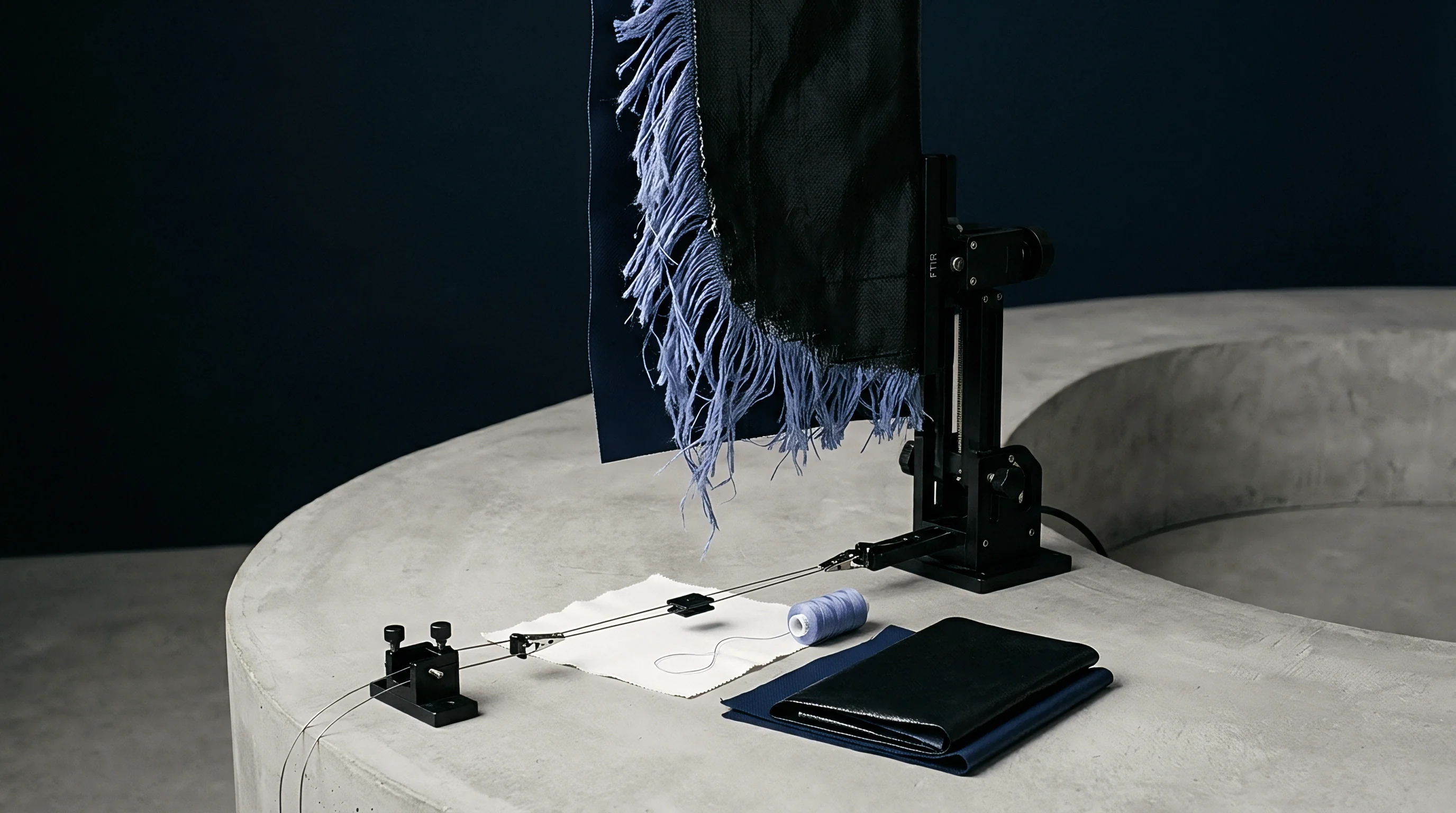
Can Jaw Face Serration Invalidate Linear Correlation?
Surface profiling on serrated grip faces introduces localized stress concentrations that alter rupture mechanics across different standard protocols. A 25 mm serrated jaw face tearing into a grab test sample pinches warp strands while micro-shearing transverse weft strands along the teeth ridges. When testing the identical roll under a 50 mm strip standard using flat rubberized grips, the stress distributes evenly across the entire yarn set.
The resulting numerical correlation breaks down, generating false rupture locations situated within 5 mm of the grip contact zone.
Verifying clamp integrity requires a disciplined, four-stage bench routine:
- Line Pressure Calibration checks pneumatic actuators against an external analog gauge weekly, confirming system pressure maintains between 0.45 and 0.60 MPa without line drop under cyclic testing.
- Carbon Transfer Verification involves clamping white bond paper over carbon paper to record contact uniformity across the upper and lower 25 mm square steel faces.
- Contact Edge Alignment inspects the front horizontal lines of both upper and lower clamps with a machinists square, eliminating angled jaw contact that tears specimens asymmetrically.
- Rupture Site Triage tabulates jaw breaks against gauge breaks, automatically voiding any five-specimen batch where more than one sample ruptures within 5 mm of the clamp perimeter.
Calibration logs expire quickly. When clamp faces wear smooth through continuous testing, technicians must replace jaw sets before empirical tests drift from historic baselines. Clean gripping faces hold cloth through friction without severing the surface strands.


Equation
Converting grab strength to cut strip strength involves empirical coefficients derived from systematic regression across specific constructions. No universal conversion factor exists across the entire domain of woven textiles. Mathematical equivalence between grab breaking force and strip breaking force functions as a structural ratio, denoted as the grab-to-strip coefficient (Gb/St).
This multiplier depends directly on the structural cohesion, cover factor, and yarn-to-yarn friction coefficient of the specific cloth.
Crimp ratios shift break profiles. Plain poplin fabrics with balanced yarn counts exhibit stable, tightly bounded conversion multipliers. Satin and loose twill constructions display volatile ratios due to high yarn floating lengths that reduce lateral engagement during grab displacement.
The multiplier fails on satin.
A 2/1 cotton twill tested at 200 mm gauge length yields a median grab-to-strip coefficient of 1.28 under 65 percent relative humidity.
| Substrate Construction | Areal Weight | Warp Coefficient (Gb/St) | Weft Coefficient (Gb/St) | Standard Deviation | 95% Confidence Band |
|---|---|---|---|---|---|
| Plain Sheeting (Cotton) | 120 g/m² | 1.18 | 1.15 | 0.04 | 1.12 – 1.22 |
| Poplin Shirting (CVC) | 145 g/m² | 1.22 | 1.19 | 0.05 | 1.14 – 1.27 |
| Twill Chino (Cotton 3/1) | 240 g/m² | 1.34 | 1.28 | 0.06 | 1.24 – 1.41 |
| Denim (Cotton 3/1) | 380 g/m² | 1.41 | 1.35 | 0.07 | 1.31 – 1.48 |
| Satin Lining (Polyester) | 95 g/m² | 1.12 | 1.08 | 0.08 | 0.98 – 1.21 |
| Oxford Cloth (Cotton) | 160 g/m² | 1.27 | 1.21 | 0.05 | 1.18 – 1.32 |
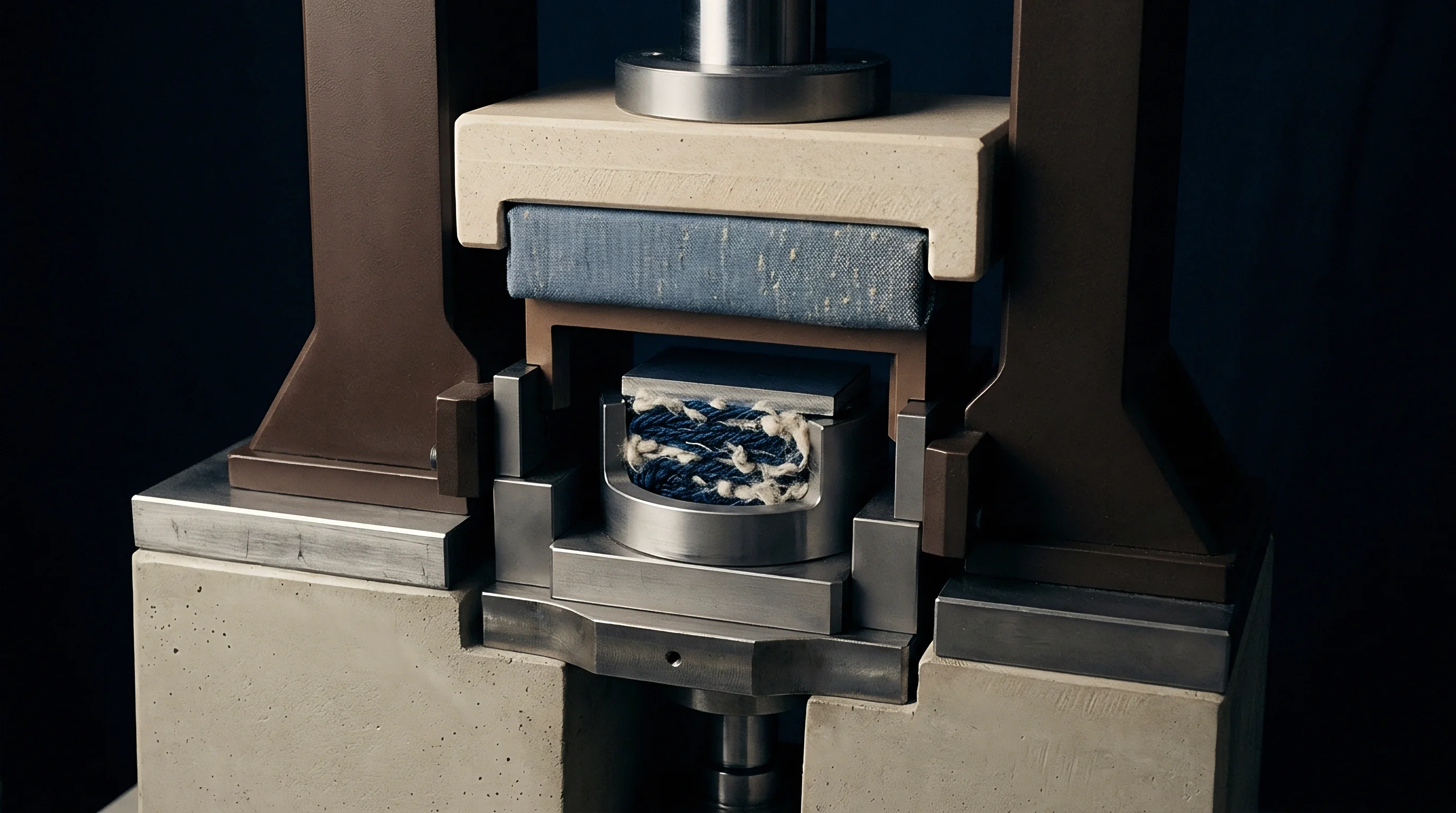
Derivation Mechanics for Regulated Export Shipments
Calculating equivalence across differing national test mandates requires adjustments for both grip geometry and gauge displacement length. The mathematical derivation separates the raw grab value into its baseline 25 mm strip component, adds the lateral load-transfer factor, and applies the length correction factor. Consider a standard mathematical model:
Tensile_Strip_50mm = (Tensile_Grab_25mm / Coefficient_GbSt) (Length_Factor)
The Length Factor accounts for the probability of weak yarn links across extended spans, defined by weakest-link statistical mechanics. Doubling the gauge length from 100 mm to 200 mm reduces the observed tensile force of staple spun cotton yarns by roughly 6 to 9 percent. When transposing an ASTM D5034 grab result (75 mm gauge length) into a GB/T 3923.1 strip value (200 mm gauge length), a dual deduction applies.
A typical scenario clarifies the calculation sequence. An overseas testing facility evaluates a 3/1 cotton twill trouser cloth using ASTM D5034 grab testing, recording a warp breaking force of 310 Newtons. The buyer seeks delivery into an Asian market governed by GB/T 3923.1, which mandates a minimum warp strip breaking force of 220 Newtons at a 200 mm gauge length.
The technical team applies the empirical coefficient of 1.34 for 3/1 cotton twill and an empirical gauge length adjustment factor of 0.93:
Tensile_Strip_Estimated = (310 N / 1.34) 0.93 = 215.1 Newtons
The calculated value yields 215.1 Newtons. This projected result falls 4.9 Newtons below the regulatory cutoff. Despite the raw laboratory certificate presenting a passing grab value of 310 Newtons against a domestic baseline of 200 Newtons, the lot fails the foreign regulatory requirement upon conversion.
Applying conversion multipliers across production lots demands explicit checks:
- Areal Weight Consistency Verification confirms the bulk batch weight matches the pilot specification within 3 percent, as denser yarn packs heighten lateral grab resistance.
- Finishing Chemical Review identifies resin treatments, liquid ammonia processing, or elastomeric coatings that modify yarn slippage dynamics and distort the empirical ratio.
- Confidence Interval Application applies the lower limit of the 95 percent confidence band during regulatory risk modeling rather than utilizing the mean coefficient.
Our mill standard always delivered above three hundred Newtons on grab tests without commercial complaints from foreign accounts.

Variance
Test outcomes fluctuate across international testing houses due to environmental control, mechanical calibration, and specimen conditioning. Standard atmospheres dictate 20.0 degrees Celsius with 65.0 percent relative humidity under ISO 139, compared to 21.0 degrees Celsius with 65.0 percent relative humidity under ASTM D1776. Cellulosic fibers absorb airborne moisture aggressively, altering hydrogen bonding networks between cellulose microfibrils.
A dry cotton twill tested at 45 percent relative humidity drops 12 percent of its tensile strength relative to the identical sample conditioned at 65 percent relative humidity. Synthetic polymers like polyester remain unaffected by humidity swings, while polyamides lose modulus and gain break elongation as water molecules plasticize the amide groups.
Wet tests lower the ceiling. Certain performance apparel classifications require wet tensile verification, immersing specimens in distilled water for one hour prior to clamping. Cotton gains up to 15 percent tensile strength when thoroughly wetted out, driven by structural swelling that relieves internal stress points within the spiral fibril matrix.
Rayon and modal fibers collapse under wet conditions, losing up to 40 percent of their dry tensile strength due to severe matrix plasticization.
Atmospheric conditioning deviations exceeding five percent relative humidity shift cellulosic break loads beyond standard laboratory tolerance limits.
Why Do Gauge Length Variations Skew Break Strength?
Tensile load values decline as the length of cloth suspended between jaws increases. This physical behavior follows the Peirce weakest-link distribution model. As an operator mounts a specimen across a 200 mm span rather than a 75 mm span, the probability of encountering an uneven yarn cross-section, a spinning thin spot, or a fiber splicing flaw within the stressed area rises exponentially.
The break initiates at the single weakest cross-section within that span. Consequently, tests conducted under ASTM D5034 (75 mm gauge) systematically record higher breaking points than tests conducted under ISO 13934-2 (100 mm gauge), even when utilizing identical jaw faces and pull velocities.
Cross-disciplinary statistical quality control reveals that tensile data distribution mirrors reliability engineering in metallic wire drawing. When yarn sets endure linear tension, load transfers via interlacing contact points. A tighter interlacing structure dampens local flaw propagation by distributing local stress across adjacent yarns.
A loose satin construction isolates flaws, causing premature rupture along unconstrained yarn channels. Tensile minimums stand without adjustment.
How do micro-denier synthetic blends alter yarn shear distribution under non-standard extension rates?
Settlement
Customs officials and border inspection agents hold regulatory authority to evaluate physical compliance based exclusively on referenced national testing standards. When market surveillance agencies draw swatches from inbound shipping containers, their accredited laboratories run the exact test method stipulated in the national product standard. Mathematical conversions, regression charts, and theoretical equivalence tables submitted by the brand do not overturn a physical failure on an official accredited test report.
Regulators reject mathematical conversions. Port laboratories enforce written thresholds. An importer asserting that an ASTM D5034 grab test result of 300 Newtons mathematically equates to an ISO 13934-1 strip value of 230 Newtons faces immediate bureaucratic dismissal if the port lab cuts a 50 mm strip and records 210 Newtons.
The testing officer logs the physical break, signs the failure dossier, and notifies trade compliance authorities. Border officers seize unverified lots. Importers absorb the penalty.
A physical test report issued by an accredited laboratory overrides every theoretical conversion formula during port-of-entry audits.
Commercial protection requires alignment between supplier purchase orders, product specifications, and target market regulations. When sourcing apparel destined for distribution in multiple global markets, technical teams write procurement specifications to the most stringent physical standard among the destination territories. If a jacket style sells concurrently in North America and mainland China, the procurement dossier specifies physical testing under GB/T 3923.1 strip parameters alongside ASTM D5034 grab methods before approving bulk cutting.
Mills contest the deduction. Raw test records decide admissibility.
Vendor supply contracts that incorporate explicit language establishing test method precedence eliminate financial friction when goods face testing disputes: All apparel deliveries must demonstrate compliance under both ISO 13934-1 strip and ASTM D5034 grab methods executed by an ISO 17025 accredited laboratory, with physical strip values governing final batch acceptance regardless of calculated grab equivalents.