Potentiometric Sensor Temperature Compensation in High Ionic Strength Dye Liquor
Potentiometric pH measurement in high-ionic strength dye liquor demands dual correction for Nernst slope scaling and non-ideality ion activity shifts.

Slope
Temperature shifts alter the electrical conversion factor of glass combination electrodes during industrial dyeing. In high-temperature dye baths, potentiometric sensors measure the potential difference between an internal sensing element and an external reference electrode. This potential follows Nernstian electrochemistry, scaling directly with thermodynamic temperature.
Theoretical sensor response moves from 59.16 millivolts per pH unit at 25 degrees Celsius up to 70.07 millivolts per pH unit at 80 degrees Celsius, a mathematical slope that process transmitters rely on to convert raw millivolt signals into indicated pH values.
Signal conversion relies entirely on this Nernstian slope scaling.
Commercial transmitters use embedded probe sensors to track physical liquor temperature and recalculate the Nernstian multiplier in real time. Standard compensation software assumes temperature alters sensor output only through this slope shift. But dye liquor carries heavy loads of auxiliary chemicals, levelling agents, and inorganic salts.
Concentrated sodium sulfate or sodium chloride solutions disrupt that core assumption by shifting chemical equilibria at the same time the sensor slope changes.
Nernstian slope expansion adds 0.1984 millivolts per pH unit for every single degree Celsius rise in dye liquor temperature.
Standard transmitter algorithms calculate pH under the assumption that sample chemical activity stays constant as temperatures rise. Dyeing processes break this assumption. Between 30 and 90 degrees Celsius, water autoprotolysis accelerates, hydrogen ion activity shifts, and background electrolytes dissociate differently.
Signal compensation corrects for sensor slope expansion, but it cannot account for actual chemical pH changes driven by thermal shifts in concentrated liquor. Mistaking sensor signal adjustments for thermodynamic stability introduces systematic errors into automated dosing systems.
Running a dye bath with flawed slope conversion leads to uncorrected alkali additions, causing fiber damage, spotty dye fixation, and rejected batches at inspection.
Activity
As dissolved ion counts rise, concentrated aqueous solutions stray from ideal thermodynamic behavior. Potentiometric glass electrodes respond strictly to hydrogen ion activity rather than total concentration. In pure or dilute solutions, the single-ion activity coefficient sits near unity, so control systems can treat concentration and activity as equivalent.
Dye liquor, however, requires electrolyte additions between 30 and 100 grams per liter to drive reactive or direct dyes onto the fabric. This heavy electrolyte loading drives up ionic strength, suppressing hydrogen’s single-ion activity coefficient through electrostatic screening.
Dense electrolyte loads directly alter these activity coefficients.
Calculating ionic strength means summing the molar concentration of every ionic species multiplied by the square of its valence charge. In reactive dyeing, sodium sulfate concentrations of 60 grams per liter push ionic strength beyond 1.2 moles per liter ~ well past the 0.1 moles per liter limit where extended Debye-Huckel equations break down. Controllers relying on standard Debye-Huckel compensation calculate activity coefficients that deviate sharply from bench measurements.
Modeling single-ion hydrogen activity accurately in dense dye matrices requires higher-order virial expansions like the Pitzer ion-interaction model.
| Sodium Sulfate (g/L) | Ionic Strength (mol/L) | Temperature (°C) | Pitzer Activity Coefficient | Apparent pH Error (pH units) |
|---|---|---|---|---|
| 10.0 | 0.211 | 25 | 0.742 | +0.13 |
| 10.0 | 0.211 | 80 | 0.718 | +0.14 |
| 50.0 | 1.056 | 25 | 0.589 | +0.23 |
| 50.0 | 1.056 | 80 | 0.541 | +0.27 |
| 100.0 | 2.112 | 25 | 0.495 | +0.31 |
| 100.0 | 2.112 | 80 | 0.432 | +0.36 |
High salt concentrations change the thermodynamic activity of water and hydrogen ions regardless of sensor hardware, and rising temperatures widen the gap. As heat climbs in a high-salinity bath, shifting ion-pairing dynamics reduce hydrogen ion activity while total molar concentration stays constant. Standard temperature compensation algorithms misread this suppressed activity as a shift in probe voltage.
The transmitter then displays a steady pH even as real chemical activity drops, prompting automated dosing units to add unneeded alkali or acid and pushing actual hydrogen ion concentrations out of spec.
Once electrolyte concentration passes fifty grams per liter, effective compensation algorithms must treat physical sensor response and solution chemical equilibrium as separate factors.

Probe
Immersing hardware in hot, salty dye liquor causes harsh mechanical and electrochemical wear. Potentiometric measurement depends on a complete electrical circuit running through the glass membrane, the sample, and the porous reference diaphragm. High ionic strength creates steep osmotic pressure gradients across that diaphragm.
Standard reference electrodes use a 3.0 molar potassium chloride internal fill, but when submerged in liquor heavy with sodium salts, osmotic pressure drives background ions into the ceramic junction, crystallizing salt inside the pores.
Ceramic liquid junctions quickly clog in dense process liquor.
Salt precipitation inside the diaphragm alters the liquid junction potential. Under the Henderson equation, this potential depends on the concentration gradients and mobilities of every ion crossing the diaphragm. Potassium and chloride ions move at nearly identical speeds in pure water, keeping junction potential low.
In dense dye liquor, however, sodium, sulfate, and hydrolyzed dye macromolecules force their way into the ceramic. The unequal diffusion rates of these foreign ions create a fluctuating junction potential that moves with temperature, adding uncompensated offset voltages directly to the sensor circuit.
Physical Degradation Mechanisms in Potentiometric Sensors
- Diaphragm Clogging occurs when hydrolyzed reactive dye aggregates and inorganic salt crystals precipitate within the porous ceramic junction, raising electrical resistance across the reference path.
- Sodium Error Shift manifests at high temperatures and pH levels above 10.0, where sodium ions substitute for hydrogen ions within the hydrated glass gel layer, generating falsely low pH readings.
- Electrolyte Dilution arises from thermal expansion and osmotic outflow of internal potassium chloride reference solution into high-density external process liquors over extended dye cycles.
- Asymmetry Potential Drift develops as high-temperature alkali exposure leaches outer glass membrane layers, creating structural differences between the inner and outer membrane surfaces.
Thermal gradients across the sensor disrupt potential equilibrium.
Glass membrane impedance drops exponentially as bath temperatures rise. Lower glass resistance quickens probe response, but high heat accelerates alkali ion exchange on the outer glass surface. Above 70 degrees Celsius and pH 10.5, sodium ions in the bath penetrate the hydrated layer of the glass.
Sensor electronics read this sodium exchange as hydrogen ion activity, yielding a falsely low pH reading. Standard transmitters have no parameters to adjust for sodium interference, so these uncorrected chemical errors pass right into automation logs.
Liquid junction potential shifts across a clogged ceramic diaphragm generate uncompensated measurement errors exceeding zero point three pH units in dense salt matrices.
Measurement drift is often attributed to improper cleaning cycles when the true cause is reference diaphragm impedance failure under high electrolyte osmotic pressure.


Isopotential
Process transmitters rely on a fixed zero-voltage intersection to calculate temperature adjustments. Theoretically, this isopotential point is the exact pH and potential where sensor electromotive force remains unchanged across temperatures. Commercial combination electrodes are designed around pH 7.00 and zero millivolts, and factory firmware hardcodes these coordinates into compensation routines.
In real dye liquor, physical glass degradation, asymmetric membrane aging, and temperature-driven reference potential shifts drag the actual operational isopotential point away from that theoretical baseline.
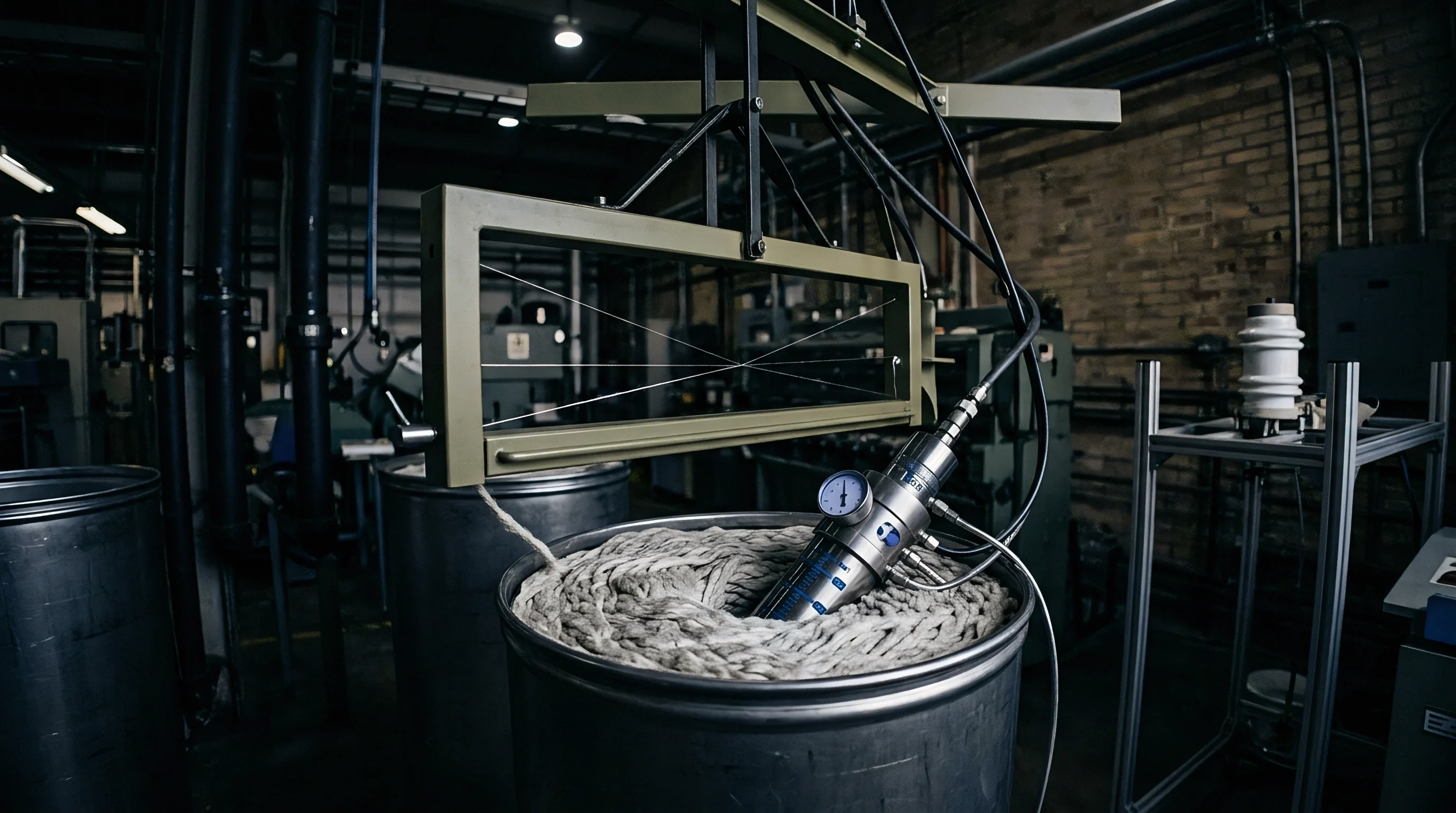
Which Compensation Algorithm Prevents Batch Drift in Reactive Dye Baths?
Temperature algorithms must account for matrix-specific shifts in the operational isopotential point. Operating a probe in alkaline reactive dye liquor at pH 11.2 and 80 degrees Celsius with an uncorrected isopotential shift creates severe error. If thermal reference drift shifts the true isopotential point to pH 6.4 and minus 35 millivolts, standard transmitter calculations produce invalid slope corrections.
The further the operating pH sits from the true isopotential point, the larger the algorithm error becomes.
- Perform two-point calibration using standard aqueous buffers at 25 degrees Celsius to establish initial sensor slope and offset.
- Re-calibrate the sensor assembly in high-temperature reference buffers matching the operating temperature of the dye cycle.
- Calculate the real-time thermal offset voltage by measuring sensor potential shift between room temperature and target process temperature.
- Input the calculated custom isopotential coordinates into process transmitter calibration menus.
- Verify online sensor performance by cross-sampling dye liquor into a temperature-controlled benchtop cell operating at process temperature.
Uncorrected coordinates cause transmitters to miscalculate slope offsets.
Isothermal calibration routines mitigate calculation errors. Non-isothermal setups ~ where the reference electrode remains at ambient temperature while the glass membrane touches hot liquor ~ undermine compensation accuracy. Thermal gradients along the probe body create parasitic thermoelectric voltages that add directly to the measured electromotive force, bypassing standard compensation routines entirely.
Predicting real-time isopotential shifts across complex electrolyte mixtures through secondary algorithm modeling remains an ongoing challenge for control engineers.


Arithmetic
Total measurement uncertainty during reactive dyeing carries significant financial risk. Minor sensor errors skew alkali dosing, pushing bath pH outside the narrow window needed for optimal covalent bonding between reactive dye and cellulosic fibers. Below pH 10.8 during fixation, dye hydrolysis speeds up while fiber reaction slows.
Above pH 11.6, fiber degradation accelerates and dye levelness suffers, leaving shade streaks across fabric rolls.
Standard reference buffers fail at elevated temperatures.
| Error Source | Uncorrected Voltage (mV) | Equivalent pH Error | Correction Method |
|---|---|---|---|
| Uncompensated Nernst Slope Shift | +23.4 | +0.33 | Standard Automatic Temperature Compensation |
| Pitzer Ion Activity Suppression | +19.2 | +0.27 | Matrix-Specific Activity Algorithm |
| Liquid Junction Potential Drift | +14.8 | +0.21 | Pressurized Double-Junction Reference Probe |
| Sodium Ion Glass Interference | -12.1 | -0.17 | High-Alkali Glass Formulation Selection |
| Isopotential Coordinate Drift | +10.5 | +0.15 | Isothermal Custom Calibration Protocol |
Consider a 5,000-liter jet dyeing machine processing a 1,000-kilogram batch of cotton knit fabric using Reactive Blue 19 with 50 grams per liter of background sodium sulfate. Target specs require maintaining pH 11.20 at 80 degrees Celsius during alkali fixation. Relying on standard temperature compensation without accounting for ionic strength activity suppression introduces an error of plus 0.27 pH units.
As a result, the controller reads pH 11.20 when true chemical activity sits at 10.93.
Uncompensated drift directly ruins shade levelness.
Tricked by the inflated pH reading, the automated dosing system shuts off alkali addition too early. Dye fixation efficiency drops from a target 78 percent down to 61 percent. The remaining unfixed dye stays in solution, forcing two extra high-temperature wash cycles to clear it out.
Those extra washes burn through 10,000 additional liters of water and 450 kilowatt-hours of thermal energy; without them, the finished fabric fails ISO 105-C06 wash fastness testing during brand audits.
A systematic drift of zero point two pH units during reactive dye fixation alters dye yield by up to twelve percent on cotton knit goods.
Uncorrected shade variations trigger costly commercial penalties.

Audit Verification and Control Checklist
- Transmitter Algorithm Configuration requires verifying that temperature compensation software incorporates ionic strength activity corrections alongside Nernstian slope adjustments.
- Reference Junction Selection demands specifying pressurized, dual-junction reference electrodes filled with gelled polymer electrolytes to block salt ingress.
- Isothermal Verification Records require logging ambient and process probe temperatures to prevent parasitic thermoelectric potential errors.
- Matrix-Matched Calibration mandates validating online sensors against reference buffers spiked with background electrolyte concentrations equivalent to production liquor.
Commercial contracts place liability for off-shade rejections squarely on the dyehouse. When a brand audit traces shade variations to process control failure, claims cover wasted dye, re-dyeing labor, and air freight for delayed shipments. Implementing rigorous temperature compensation protocols provides the verified batch records needed to prove process integrity in compliance disputes.
Purchase specifications with strict colorfastness tolerances require documented pH calibration logs covering bath temperature and background salt corrections for every dyed lot.