Real Time Dynamic Tension Compensation across Asymmetric Dual Beam High Gauge Tricot Systems
Dynamic tension compensation decouples beam inertia from asymmetric stitch kinematics in high gauge tricot, preventing barre and width-wise shade bands.
Gauge
Setting up an E32 or E36 high gauge tricot machine with asymmetric yarn systems creates an immediate mechanical conflict at the needle bar. A front beam carrying 22 dtex / 7 filament continuous polyamide filament running a 1-0 / 1-2 closed pillar stitch operates under completely different delivery conditions than a back beam carrying 44 dtex / 34 filament textured polyester running a 1-0 / 2-3 or 1-0 / 3-4 underlap. The front guide bar consumes roughly 1,400 to 1,600 mm of yarn per rack of 480 courses.
The back guide bar pulls between 2,200 and 2,800 mm per rack depending on the runner ratio. When machine speeds hit 2,200 to 2,800 courses per minute on modern carbon-fiber needle bed frames, tension differentials between these two beams do not stay isolated. The higher tension of the tight pillar stitch deflects the composite needle beard or spring-beard closure, causing micro-misalignment across the knock-over bar.
The result on the greige cloth shows up as barre, pinholes, course-wise shade bands, and cyclic elastane or multifilament drop stitches. Standard open-loop mechanical letoff drives rely on spring-loaded dancer arms linked to friction brakes or simple reduction gears. These mechanical assemblies fail to respond to high-frequency transients occurring within a single machine revolution of 25 milliseconds.
The back beam holds significantly higher rotational mass than the front beam, especially when warped on 21-inch or 32-inch diameter forged aluminum sectional spools. As spool diameter drops from full package down to empty core, rotational inertia decays non-linearly. Without active dynamic intervention, the tension ratio between front and back beams drifts, leading to continuous dimensional and weight variations throughout the run.
Dynamic closed loop compensation must hold peak-to-peak tension fluctuations below 0.15 centinewtons per decitex across the entire beam package decay.
A warp knitting engineer addresses this imbalance by separating structural load from geometric yarn feed. The guide bar carrying the heavier yarn or executing the longer underlap creates variable peak drag during the swing phase, whereas the pillar bar exerts sharp shock loads during loop pull-through. In an E32 gauge tricot machine, needle spacing is precisely 0.794 mm.
In an E36 setup, needle clearance drops to 0.706 mm. At these tolerances, needle hook deflection exceeding 0.04 mm induces structural loop distortions and yarn shearing against the knock-over sinkers. Dynamic tension compensation synchronizes variable-frequency servo motors directly with the main drive encoder.
This electronic gear system alters instantaneous yarn delivery to match the kinematic requirements of the stitch cycle.
Mills running fine denier synthetic activewear or intimate apparel substrates face severe shade rejections if tension drifts across beams. When the tension of the front filament increases relative to the back yarn, the structural ground shifts. Polyamide yarns pull forward while polyester yarns get buried in the technical back.
During subsequent wet processing, jet dyeing machines expose this imbalance. Acid dyes pick up on the exposed face nylon, while disperse dyes stain the polyester underlaps. A tension drift of 0.8 centinewtons per end between beams alters the face-to-back visual coverage.
This structural distortion manifests as edge-to-center shading, even when the dye bath chemistry, liquor ratio, and temperature curves remain fully compliant.
Correcting this fault at the machine requires calculating the instantaneous mechanical load generated by each warp sheet during the three critical phases of loop formation: guide swing, overlap (shogging), and return swing knock-over. Closed loop digital systems integrate load cells directly under the tension rail segments. These sensors read high-frequency variations and feed position correction values to the servo-driven electronic beam letoff system within sub-millisecond response windows.
The operational standard demands decoupling the physical mass of the supply spools from the micro-demands of the loop cycle.
Skipping this calibration causes massive reject rates during four-point fabric inspection. Lengthwise streaks and warp-direction tightness variations produce variable elongation across the usable cut width. When such goods reach the spreading table in a garment factory, the asymmetric residual stresses relax unevenly.
Cut pattern pieces distort, and side seams twist after laundering. The technical manager who sets beam delivery rates using static runner estimates guarantees subsequent downstream manufacturing claims.
Kinematics
Loop architecture in two-bar tricot knitting depends entirely on the spatial coordination of needles, sinkers, and guide bars. When running high gauge equipment at speeds exceeding 2,400 courses per minute, the needle bar moves through its vertical and horizontal cycle in less than 25 milliseconds. During this tiny time slice, yarn path lengths from the tension rail to the needle eye shift dynamically.
As the guide bar swings through the needle spaces to lay the overlap, path length extends by 1.8 to 3.2 mm depending on underlap depth. When the guide bar returns, path length collapses, requiring immediate yarn take-up or a compliant tension rail to prevent yarn slack.
Asymmetric yarn pairings compound this movement exponentially. Take an E32 machine running 22 dtex flat nylon on the front bar (Bar 1) with a 1-0 / 1-2 lapping motion, alongside 55 dtex / 48 filament drawn textured polyester on the back bar (Bar 2) executing a 1-0 / 3-4 underlap. The Bar 2 guide bar traverses four needle spaces during the underlap shog.
This lateral movement introduces severe kinetic frictional drag across the guide eyes. Guide Bar 2 yarn undergoes rapid acceleration over an extended displacement path, while Bar 1 moves only one needle space.
| Guide Bar Allocation | Yarn Type & Linear Density | Lapping Pattern | Runner Target (mm/rack) | Peak Dynamic Force (cN/end) | Path Length Delta (mm/rev) |
|---|---|---|---|---|---|
| Bar 1 (Front) | Polyamide 6.6 22dtex/7f Flat | 1-0 / 1-2 Closed Pillar | 1,480 ± 15 | 2.8 to 3.4 | 1.85 |
| Bar 2 (Back) | Polyester 55dtex/48f DTY | 1-0 / 3-4 Underlap | 2,640 ± 25 | 6.2 to 8.1 | 4.92 |
| Bar 1 (Alternative) | Polyamide 6 33dtex/10f Flat | 1-0 / 2-3 Tricot Lap | 1,850 ± 20 | 3.6 to 4.2 | 2.45 |
| Bar 2 (Alternative) | Polyamide 6.6 17dtex/5f Flat | 1-0 / 0-1 Open Pillar | 1,320 ± 12 | 2.1 to 2.7 | 1.40 |
Frictional drag through the yarn guides increases as the square of machine velocity. At 2,400 RPM, the kinetic energy of the traversing yarn generates local heat and spikes instant tension values. For Bar 2, tension shoots up during the shogging stroke, reaching peak values precisely when the needles descend to knock over the previous loop.
If this tension peak exceeds the elastic recovery limit of the polyester yarn, plastic deformation occurs. The filament cross-section thins locally, altering light refraction in the finished fabric.
Carbon-fiber reinforced plastic guide bars minimize mechanical deflection during high-speed shogging, but they do not alter yarn dynamics. The yarn itself acts as a viscoelastic spring. In an asymmetric dual beam configuration, Bar 1 and Bar 2 form two spring systems operating in parallel with drastically mismatched spring constants.
The 22 dtex flat yarn exhibits a high initial modulus (roughly 350 to 450 cN/tex), while the 55 dtex textured yarn exhibits an initial modulus below 180 cN/tex due to its crimp geometry. When the needle bar captures both yarns simultaneously into the loop hook, the stiffer yarn absorbs a disproportionate share of the closing force.
The stiffer component of an asymmetric warp always carries the peak closure load regardless of its nominal denier.
To prevent hook deflection and subsequent dropped stitches, the tension control system must dynamically counter this kinematic imbalance. Traditional mechanical tension bars utilize torsion springs that cannot adjust their natural frequency. When the machine cycle frequency approaches the resonant frequency of the torsion bar, the bar enters harmonic oscillation.
This phenomenon, known on the mill floor as rail bounce, introduces periodic tension waves into the warp sheet. Rail bounce generates visible horizontal banding in the greige fabric repeating every 12 to 24 courses.
Modern electronic dynamic tension systems address rail bounce by using low-inertia carbon-composite sensor rods suspended on piezoelectric or strain-gauge load cells. These sensors sample warp sheet tension at rates exceeding 10 kilohertz. The high sampling frequency allows the controller to map tension across each micro-segment of the 360-degree machine cycle.
Instead of maintaining an average, flat tension value, the system establishes a dynamic profile: it permits calculated tension peaks during guide bar shogging, then instantly accelerates beam rotation to supply slack before the needles enter the knock-over plane.
A supplier who blames barre on incoming filament batch variance frequently masks poorly tuned kinematic tension profiling on their knitting machines.
Actuation
Modern high-speed tricot machinery demands electronic beam letoff systems that operate with deterministic response times under two milliseconds. Legacy worm-gear drives and DC brush motors are incapable of managing the instantaneous torque adjustments needed to control fine filament yarns. Current production configurations rely on direct-drive, high-torque synchronous AC permanent magnet servomotors coupled directly to the beam shafts or through zero-backlash planetary reducers.
These motors operate under field-oriented vector control to govern both velocity and position profiles down to fractions of an angular degree.
Controlling beam rotation becomes mechanically demanding as package diameter decreases. A standard 21-inch by 21-inch tricot beam spool begins with an outer flange diameter of roughly 533 mm and winds down to an empty core diameter of 114 mm. The mass of the beam assembly drops from approximately 140 kilograms down to the bare spool weight of 22 kilograms.
Over the duration of the beam run, rotational inertia drops by more than 90 percent. As the beam diameter shrinks, the motor must spin faster to deliver an equivalent length of yarn per rack. Specifically, an empty beam rotates 4.67 times faster than a full beam to maintain the same linear warp velocity.
Under these conditions, a constant servo gain configuration fails. When the beam is full, high inertia dampens mechanical response, requiring high integral and proportional gain values to overcome initial mass resistance. As the spool depletes, those same high gains cause severe hunting, torque ripple, and mechanical resonance.
Modern dynamic control algorithms employ real-time inertia estimators that adjust proportional-integral-derivative parameters on the fly as the system tracks beam radius.
Diameter tracking occurs via dual-redundancy monitoring. High-precision laser displacement sensors measure package surface distance continuously across the beam barrel. Concurrently, the central automation unit cross-calculates beam decay by comparing the angular displacement pulses of the beam encoder against the main machine encoder pulses.
This calculated value protects the drive logic from erroneous optical readings caused by surface unevenness, tape tabs, or operator intrusion across the laser beam plane.
Tension sensing takes place through split-segment carbon fiber tension rails. In asymmetric knitting, a continuous, full-width tension bar cannot isolate differential tension loads between the front and back warp sheets. Each guide bar requires its own completely independent tension rail system positioned along the yarn feed plane.
These rails rest on multiple hermetically sealed beam-load cells, typically configured in full Wheatstone bridge arrangements to eliminate temperature-induced voltage drift. When the warp sheet traverses the rail, vertical force vectors are measured without mechanical friction interference.
Signal acquisition uses high-speed analog-to-digital converters running at 24-bit resolution, filtering electrical noise generated by adjacent servomotors through hardware-level anti-aliasing filters. The conditioned sensor signal feeds directly into a real-time motion controller running on an industrial Ethernet fieldbus system like EtherCAT or PROFINET IRT, operating with deterministic cycle times under 250 microseconds. The closed loop control structure coordinates three operational layers:
- Inner Current Loops resolve instantaneous electromagnetic torque demands within 50 microseconds, suppressing torque ripples that induce barre streaks across fine gauge panels.
- Intermediate Velocity Loops adjust rotational speed profiles to synchronize linear yarn feed with the cyclical demands of the knitting elements throughout each individual needle bar rotation.
- Outer Position Loops track overall runner consumption per rack of 480 courses, correcting cumulative yarn delivery against the structural parameters dictated by the fabric specification.
If an actuator develops positional hunting exceeding 0.05 percent of rotational command, local tension spikes immediately snap delicate 22 dtex filaments. Filament breakages force machine stops, leaving start-up stop marks that permanently down-grade fabric rolls from first-quality to mill seconds. In high gauge production, zero-backlash drive compliance remains non-negotiable.
The entire control infrastructure depends on perfect synchronization with the main machine shaft. An absolute optical rotary encoder mounted directly to the main drive provides high-resolution position tracking up to 16,384 pulses per revolution. This real-time angular position data informs the letoff controllers precisely when the needle bar reaches top dead center, when the guides pass through the needles, and when the knock-over sinkers push down.
This precise timing ensures instantaneous yarn feeding aligns with mechanical demand.
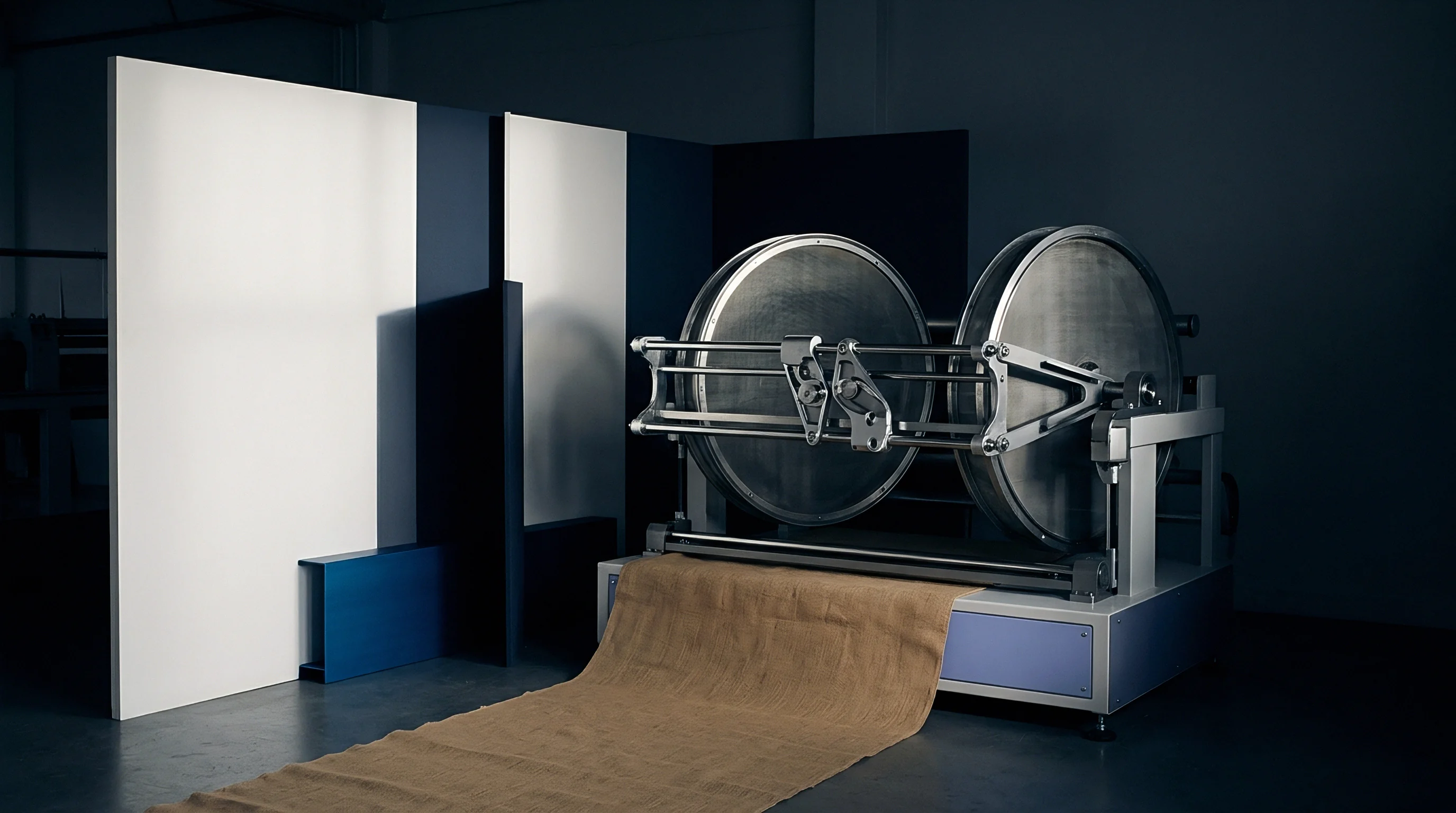
Distortion
Asymmetric high gauge tricot goods develop a specific set of physical faults when dynamic tension compensation drifts out of compliance. In an E36 warp-knit structure, the clearance between adjacent needles is approximately 0.706 mm, while the sinker thickness occupies roughly 0.2 mm. This leaves less than 0.5 mm of operational clearance for two yarn paths, the guide eyes, and the closing needle beard.
Minor shifts in warp delivery tension alter the geometry of the loop overlap, transforming intended stitch architecture into visible defect patterns.
The primary structural defect is yarn robbery. During loop formation, the needle pulls yarn from both the supply warp and the previously formed adjacent loop. If back beam tension spikes during needle descent, the needle cannot pull its full allocation of polyester from the supply beam.
Instead, it robs yarn from the underlap of the preceding course. This shortens the previous loop, distorting its inclination angle and pulling the adjacent front-bar nylon loop out of alignment. The finished fabric displays randomized surface refraction known as moiré-type barre, which remains visible across every lighting angle.
A second major structural failure is edge curl and fabric skewing. In an asymmetric build where the front bar knits an open or closed pillar stitch (1-0 / 0-1 or 1-0 / 1-2) and the back bar executes an extended underlap (1-0 / 3-4 or 1-0 / 4-5), unbalanced yarn tension generates severe internal transverse shear stresses. The technical face loops, composed of nylon, stand vertically, while the technical back loops, composed of polyester, lie horizontally at an angle.
If the back beam operates with insufficient dynamic tension, its long underlaps go slack, floating loosely on the technical back.
Excessive underlap slack causes loose yarn loops to catch on downstream processing stenter pins and processing rollers.
Conversely, excessive back beam tension compresses the width-wise grain of the fabric right at the needle bed. When the greige cloth rolls off the take-up unit, it experiences immediate width collapse. An E36 greige fabric designed to finish at 160 cm usable width may drop to 110 cm off the machine if back beam tension is excessively high.
Forcing this over-compacted fabric back out to 160 cm on a finishing stenter frame overstretches the technical face pillar loops. This structural overextension results in catastrophic dimensional instability after standard laundry cycles.
A further defect unique to asymmetric configurations is filament stripping, commonly called fuzzing or snow. High-tenacity multifilament yarns, such as 22 dtex / 7 filament polyamide, feature individual filaments with diameters around 6 to 7 microns. When asymmetric tension imbalances force the guide bar out of precise alignment, the yarn rubs hard against the sides of the sinkers or needle hooks.
Instead of breaking the entire thread, friction shears individual microfilaments. The broken fibrils ball up at the needle guides, forming lint clusters that knit directly into the fabric ground. These trapped clusters cause dark, resinous specks to appear during piece dyeing.
Distortion also strikes elastane components when run on back beams for technical stretch textiles. Elastane draft ratios must remain completely flat from beam start to empty core. Dynamic tension drift alters the internal draft percentage of the elastane yarn, modifying recovery force and module consistency across the fabric bolt.
A tension drift of merely 0.05 cN/tex in the elastane warp creates marked modulus variations between the beginning and the end of a single 500-meter cloth roll.
When tension imbalances exceed structural thresholds, the needle bed sustains irreversible physical damage. If the front bar experiences a severe, instantaneous tension spike caused by an electronic letoff freeze, the warp sheet exerts high lateral force on the needles. High-speed deflection pushes the steel needles directly into the bronze trick plates or sinker edges.
At 2,400 RPM, this collision shears hundreds of needles within fractions of a second, causing costly machine downtime and extensive tooling loss.
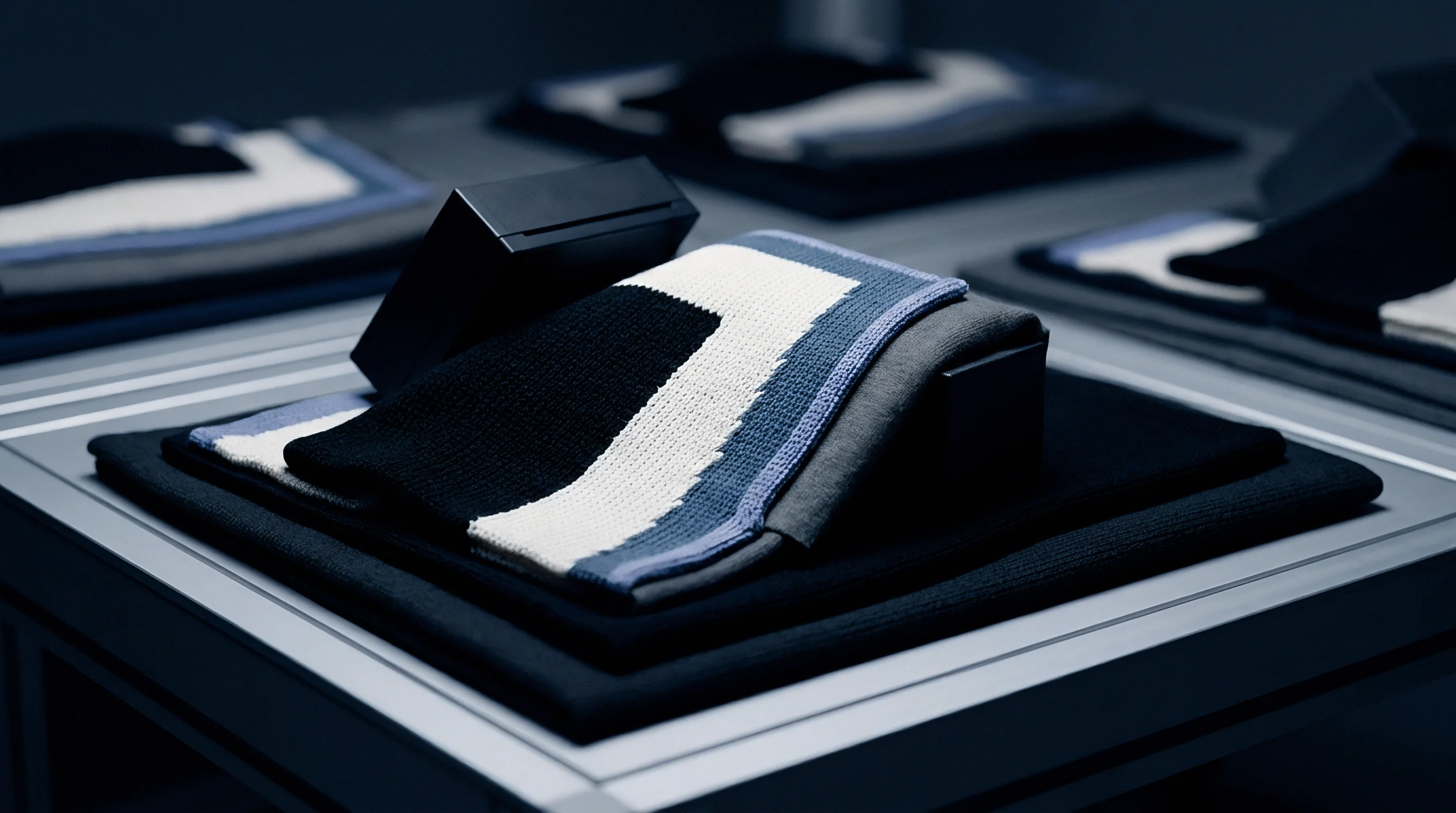
Qualification
Accepting a lot of asymmetric high gauge tricot requires rigorous testing protocols. Swatch inspection or basic weight checks are inadequate for catching structural imbalances. Qualification requires testing physical properties across three distinct process stages: on-machine greige measurement, post-finishing dimensional stability, and multi-illuminant color assessment.
Fabric specifications must detail measurable values, reference methods, and allowable tolerances.
The standard verification framework evaluates six core fabric parameters, checking for structural integrity, dynamic stability, and performance repeatability across the roll:
- Runner Length per Rack ~ Verified through physical rack-mark counting using contrasting water-soluble trace yarns during setup, ensuring delivery rates match specification within a hard tolerance of ± 1.0 percent.
- Greige Mass per Unit Area ~ Measured under standard conditions according to ISO 3801 after full relaxation, requiring roll variance to stay within ± 2.5 percent from core to outer flange.
- Dimensional Stability to Laundering ~ Evaluated via ISO 5077 across five standard wash cycles at 40 degrees Celsius per ISO 6330, limiting maximum dimensional shrinkage to 2.0 percent in the warp and 2.0 percent in the weft.
- Spirality and Course Skew ~ Tested according to ISO 16322-2, establishing that asymmetric underlap forces must not generate course skew exceeding 1.5 degrees off the perpendicular axis.
- Bursting Strength and Modulus ~ Quantified with a pneumatic diaphragm burst tester using ISO 13938-2, ensuring that hydraulic bursting pressure exceeds 450 kPa without premature rupture of the weaker asymmetric component.
- Martindale Abrasion Resistance ~ Run to failure per ISO 12947-2 under a 9 kPa pressure load, requiring that no broken loops appear before completing 40,000 continuous abrasion cycles.
To inspect greige rolls for yarn robbery and barre, fabrics are mounted on an inspection frame with both transmitted through-lighting and low-angle incident surface lighting. Rolls move at speeds under 12 meters per minute. The inspector watches for cyclic light variations that correspond with the beam rotation frequency.
In asymmetric goods, optical barre repeats every 1.2 to 3.5 meters depending on beam diameter and runner ratios.
Dye-strike verification tests confirm that front-to-back loop ratios remain consistent across the machine width. A ten-meter production cut undergoes jet dyeing using an intentional contrast-shade bath: acid red for polyamide face yarns and disperse blue for polyester back underlaps. Spectrophotometric readings, measured with a 10-degree observer under D65, A, and TL84 illuminants per ISO 105-J01, are taken at nine distinct points across the fabric width: three at the left edge, three at the center, and three at the right edge.
The total color difference, expressed as CIELAB Delta E, must not exceed 0.6 between any of the nine points. If Delta E drifts above 0.8, the machine exhibits asymmetric tension skew across the bed. This indicates that one side of the tension rail is applying higher drag than the other.
The table below presents the qualification metrics for a standard activewear construction comprising an E32 warp-knit structure.
| Physical Property | Test Standard | Nominal Value | Tolerance Limit | Failure Action |
|---|---|---|---|---|
| Finished Fabric Weight | ISO 3801 | 140 g/m² | ± 3.0% | Hold batch; verify letoff log |
| Warp Wash Shrinkage | ISO 5077 (5x 40°C) | -1.2% | Max -2.0% | Adjust stenter overfeed |
| Weft Wash Shrinkage | ISO 5077 (5x 40°C) | -0.8% | Max -1.5% | Adjust stenter width setting |
| Cross-Roll Delta E (D65) | ISO 105-J03 | 0.00 | Max 0.60 | Reject lot; calibrate load cells |
| Warp Tensile Elongation | ISO 13934-1 | 115% | ± 5.0% abs | Hold batch; re-check beam draft |
| Weft Tensile Elongation | ISO 13934-1 | 160% | ± 6.0% abs | Hold batch; verify underlap tension |
A qualification dossier must include timestamped electronic letoff logs exported directly from the machine controller. These files capture motor current, average load cell tension, and instantaneous runner delivery for every rack produced. Reviewing these digital records confirms that the machine operated within programmed limits throughout the run, rather than relying solely on post-production visual inspection.
A purchasing contract missing strict Delta E tolerances across the roll width leaves the buyer legally exposed to accepting edge-shaded yardage that cannot be cut into garments.
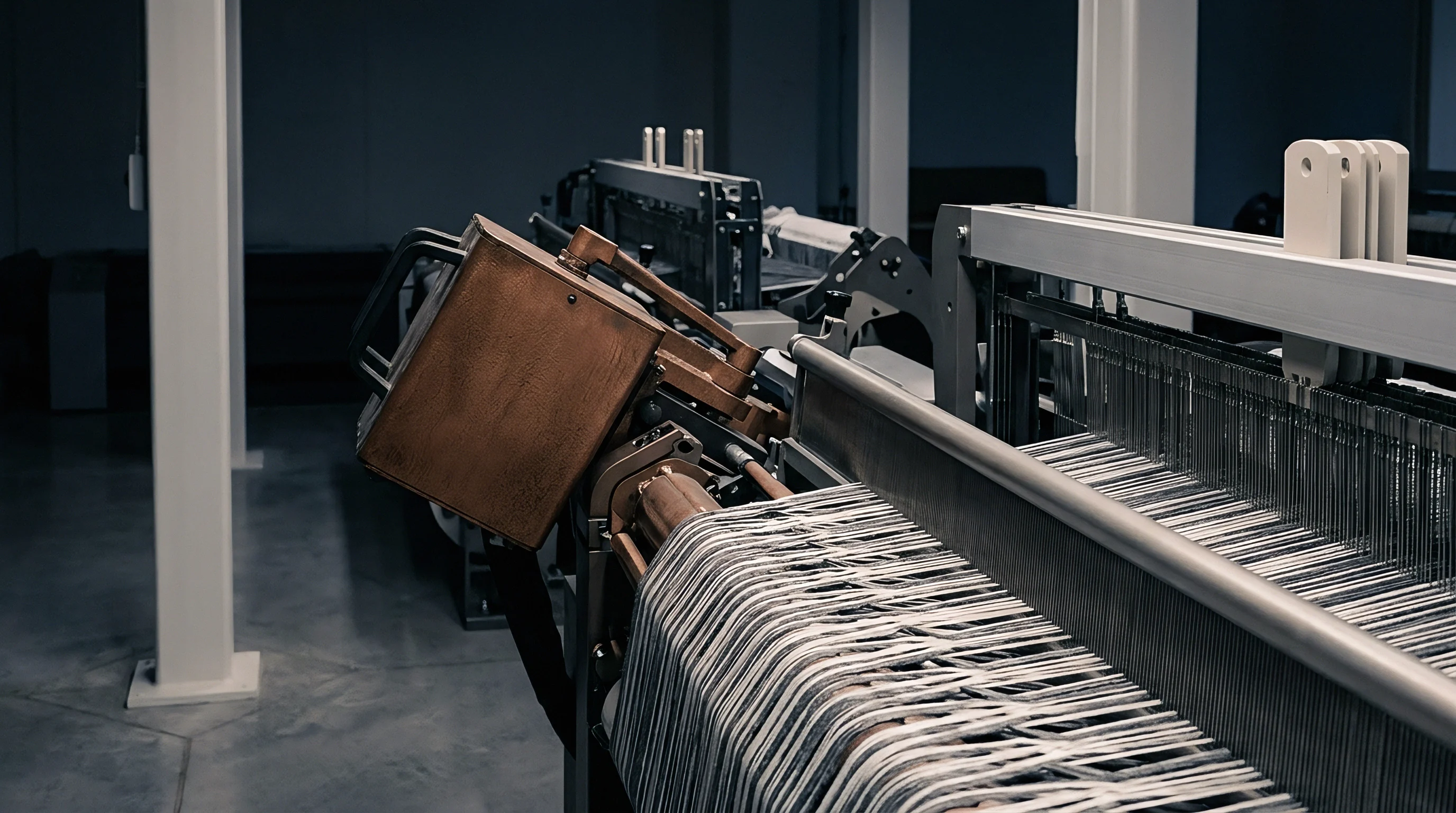
Economics
Deploying real-time dynamic tension compensation across high gauge tricot production lines demands substantial capital commitment. Retrofitting an operational E32 or E36 tricot machine with multi-axis synchronous servo letoffs, split carbon-composite tension rails, and real-time industrial Ethernet controls costs roughly 18,000 to 24,000 USD per machine. For an export-oriented knitting plant with 40 knitting beds, modernizing the entire shed requires an upfront capital investment of 720,000 to 960,000 USD, before accounting for lost machine time during installation.
This capital outlay is quickly justified by analyzing operational efficiency and waste reduction. Consider a representative knitting plant operating 40 tricot machines at 2,200 courses per minute, running an asymmetric activewear fabric (22 dtex PA6.6 + 55 dtex PES, 140 g/m²). The shed operates 300 days per year on three shifts, producing approximately 4,200,000 linear meters of greige goods annually.
The raw greige manufacturing cost sits at 1.45 USD per meter, while the finished dyed textile sells for 3.10 USD per meter.
On legacy mechanical or uncompensated electronic letoff equipment, asymmetric warp tension variance generates an average first-pass reject rate of 4.5 percent. The defects appear as barré, irregular stretch modulus, and width-wise shade variations. This scrap rate represents 189,000 meters of degraded production every year.
These goods are downgraded to mill seconds, selling at salvage prices around 0.90 USD per meter, which translates to a direct annual salvage loss of 415,800 USD. Implementing dynamic tension compensation slashes this reject rate down to 0.8 percent, recovering 341,880 USD in scrap value every year.
Efficiency gains extend beyond direct waste reduction. Dynamic tension tracking protects warp yarn integrity, sharply lowering break frequencies across the machine floor. On E36 high gauge machines running fine microfibers, mechanical tension spikes cause roughly 1.8 yarn breaks per 100,000 courses.
Each break stops the machine for an average of 4.5 minutes, during which an operator must re-thread the yarn, re-align the guide bar, and burnish out any contact marks. At 2,200 RPM, this failure rate robs the machine of roughly 8.5 percent of its theoretical operating capacity.
Active closed loop compensation eliminates peak tension transients, reducing break frequency to roughly 0.4 stops per 100,000 courses. This stability boosts machine operational efficiency from 86 percent up to 96 percent. The knitting plant harvests 420,000 additional linear meters of output annually without adding floor space, increasing labor headcount, or raising facility power consumption.
This efficiency surge lowers fixed overhead costs by 0.08 USD per linear meter produced.
Downstream converters and dyehouses benefit immediately from run consistency. When greige rolls arrive with controlled, repeatable loop architectures, dyeing failures drop precipitously. Beam tension variations on legacy machines lead to erratic water absorbency and dye uptake rates.
This forces the dyehouse to strip and re-dye problematic lots, which degrades yarn hand and consumes costly auxiliary chemicals. Re-dyeing an activewear tricot costs an extra 0.45 USD per meter and delays production timelines by 10 to 14 business days.
When sourcing asymmetric high gauge knits, evaluating equipment infrastructure is as critical as inspecting greige swatch cards. Sourcing managers who negotiate lower initial fabric prices from mills with obsolete letoff systems absorb heavy penalties down the line. Hidden costs arrive via shipment delays, inconsistent pattern yields, elevated cutting room waste, and high post-laundry consumer returns.
Securing dependable fabric yardage requires placing orders with manufacturers who run modern, fully monitored dynamic compensation platforms.