Quantifying Dyehouse Carrier Residuals Using Nonparametric Dirichlet Mixture Partitioning
Nonparametric Dirichlet mixture models isolate unrecorded dyehouse carrier residuals by clustering multi-analyte extraction data into latent machine regimes.

Bath
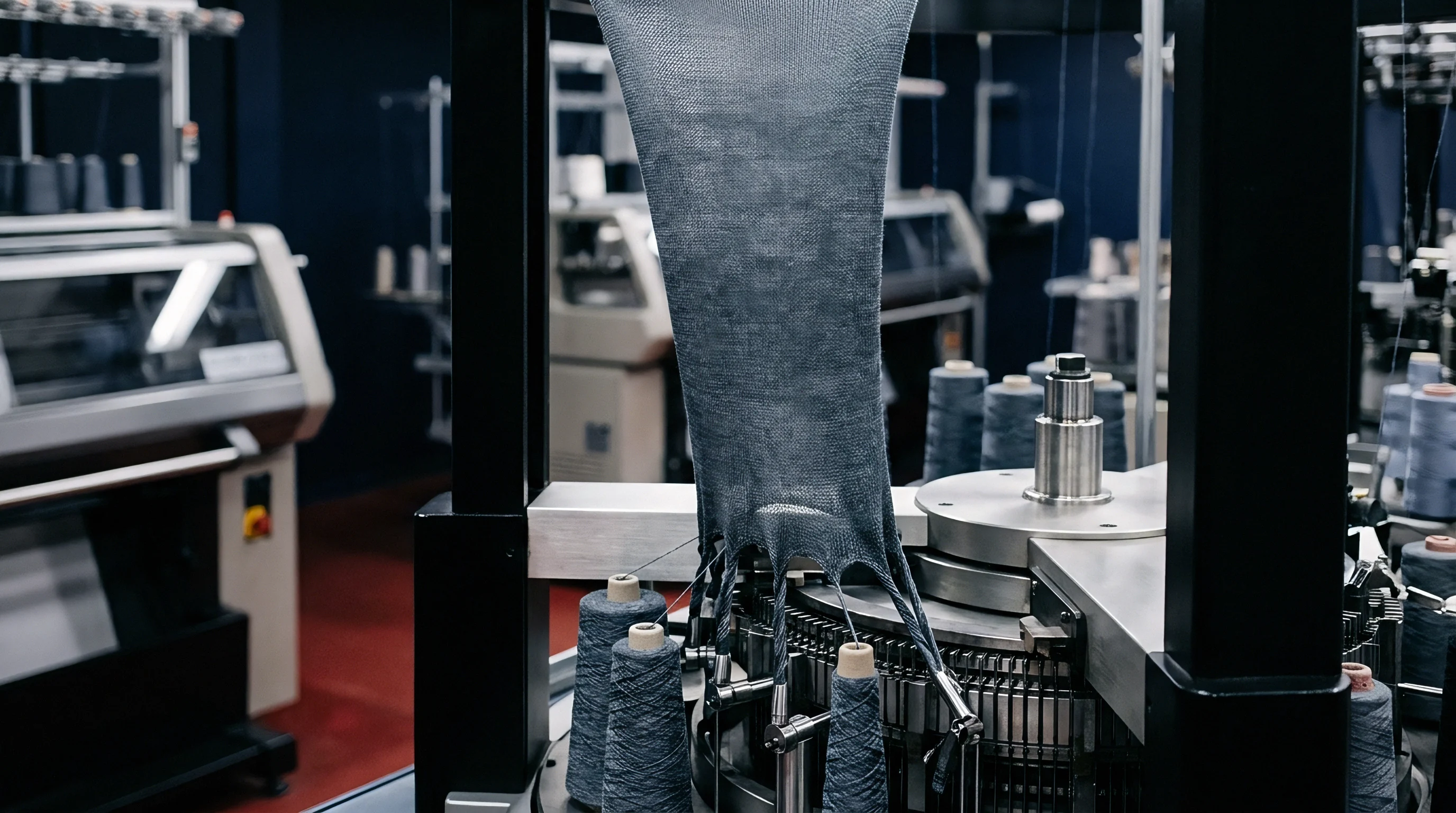
Atmospheric dyeing of tight polyester filaments relies on chemical accelerants to loosen the crystalline boundaries of polyethylene terephthalate. When liquor temperatures remain below one hundred thirty degrees Celsius, the glass transition zone resists disperse dye penetration unless swelling chemicals swell the polymer chains. Mill operators introduce aromatic compounds directly into the formulation to increase molecular chain mobility, permitting large dye molecules to diffuse into the core of the filament.
These compounds, historically dominated by chlorinated benzenes, chlorotoluenes, ortho-phenylphenol, and methylnaphthalenes, lower the thermal energy barrier for exhaustion. Secondary rinsing removes surface chlorotoluenes. The core retention behaves differently.
High-affinity aromatics do not leave the fiber interior during standard reductive scouring with sodium hydrosulfite and caustic soda. The carrier molecules remain trapped within the amorphous domains as the polymer cools and recrystallizes. Residual quantities migrate slowly toward the filament exterior across finished fabric storage, garment conversion, and shelf life.
Subsequent heat-setting operations in the stenter frame volatilize only a fraction of these chemicals, transferring portions to machine exhaust ducts while baking the remaining fraction into the synthetic substrate.
Residual ortho-phenylphenol exceeding ten milligrams per kilogram triggers immediate failure under OEKO-TEX Standard 100 Class I testing after eighty hours of conditioning.
Chemical control programs encounter significant blind spots because carrier additions are frequently unrecorded on dyehouse recipe sheets. Subcontracted commission dyers treat proprietary levelling and carrier blends as trade secrets, masking restricted chlorobenzenes behind general emulsifier trade names. Textile purchasers ordering piece-dyed polyester-wool or polyester-viscose fabrics face acute exposure here.
Wool blends cannot tolerate the high temperatures of pressure jet dyeing without fiber degradation, which incentivizes dyehouses to rely on atmospheric carrier chemistry to achieve dark shades. Thermal fixation drives carriers deeper. The resulting contamination enters downstream supply chains without disclosure.
- Halogenated aromatic carriers include 1,2-dichlorobenzene, 1,2,4-trichlorobenzene, and monochlorotoluenes that provide high swelling efficiency but carry strict regulatory bans under global chemical frameworks.
- Phenolic swelling agents center on 2-phenylphenol and its sodium salts, which impart excellent leveling on synthetic blends while resisting alkaline reduction clearing cycles.
- Hydrocarbon aryl carriers comprise diphenyl, biphenyl derivatives, and 1-methylnaphthalene, compounds that emit intense odors and exhibit high persistence within finished polyester filaments.
- Ester based accelerators utilize butyl benzoate, benzyl benzoate, or methyl salicylate as lower-toxicity replacements, yet these chemicals generate persistent background signals in chromatographic screening.
The dyehouse absorbs the charge. When challenged on residual aromatic levels, the mill manager stated that the boiling vessel had been flushed three times with clean water and could not possibly retain carrier traces from the previous production shift.


Extract
Quantifying carrier residues within synthetic yarns depends upon complete solvent penetration into the polyester matrix without degrading the polymer backbone. Conventional ultrasonic agitation in methanol or hexane recovers only surface deposits, leaving the encapsulated internal fraction unmeasured. Standard analytical workflows under DIN 54231 specify accelerated solvent extraction or pressurized fluid extraction using dichloromethane, tetrahydrofuran, or acetone-methanol mixtures at elevated temperatures.
The solvent dissolves the oligomeric boundary layers, freeing trapped chlorobenzenes and phenolics into the liquid phase for gas chromatography coupled with mass spectrometry. Dichlorobenzene remains volatile at room temperature.
Instrumental calibration curves must account for matrix interference caused by low-molecular-weight polyester cyclic trimers that co-extract with target analytes. These oligomers precipitate upon cooling, fouling chromatographic injection liners and suppressing analyte ionization inside the mass spectrometer detector. Gas chromatography with triple quadrupole mass spectrometry operating in multiple reaction monitoring mode isolates chlorinated aromatics from oligomer fragments through specific precursor-to-product ion transitions.
Solvent extraction strips the fiber matrix. The detection limit stands at one.
| Chemical Compound | CAS Registry Number | Standard Test Method | Extraction Solvent System | Regulatory or Standard Limit |
|---|---|---|---|---|
| 1,2-Dichlorobenzene | 95-50-1 | DIN 54231 / GC-MS | Dichloromethane (ASE, 100 °C) | 1.0 mg/kg (OEKO-TEX Annex 4) |
| 1,2,4-Trichlorobenzene | 120-82-1 | ISO 16373-2 / GC-MS | Dichloromethane (Ultrasonic, 60 °C) | 1.0 mg/kg (REACH Annex XVII) |
| 2-Phenylphenol (OPP) | 90-43-7 | ISO 16373-3 / LC-MS | Methanol / Acetonitrile (ASE) | 10.0 mg/kg (OEKO-TEX Class I) |
| Chlorotoluenes (All Isomers) | Various | DIN 54231 / GC-MS-MS | Acetone:Hexane 1:1 (Soxhlet) | 1.0 mg/kg (ZDHC MRSL Level 3) |
| Biphenyl | 92-52-4 | EPA 3550C / GC-MS | Dichloromethane (ASE, 80 °C) | 25.0 mg/kg (Brand Restricted List) |
Where Does Latent Residual Density Escape Standard Screening?
Composite sampling procedures across commercial textile consignments frequently obscure carrier hot spots through physical dilution. Inspection agencies routinely clip swatches from ten distinct rolls and blend them into a single representative composite before solvent maceration. If one fabric roll contains two hundred milligrams per kilogram of 1,2,4-trichlorobenzene from an unvented dyehouse lot while nine companion rolls contain zero, the composite sample measures twenty milligrams per kilogram.
In cases where the initial contamination sits near twenty milligrams per kilogram, composite testing dilutes the analytical signal below the laboratory reporting threshold. The test report lists zero. trichlorethylene fractions evaporate during stenter drying, but chlorinated benzenes lock into the core.
Article 67 restrictions under REACH Annex XVII render entire fabric shipments impoundable if any individual specimen exceeds the chlorobenzene action limit.
Analytical variation between testing houses further complicates compliance verification. Laboratories employing open-bath Soxhlet extraction lose substantial quantities of volatile monochlorotoluenes through condensing chimneys, whereas automated pressurized solvent extractors retain volatile fractions under closed conditions. Discrepancies between testing facilities frequently reach fifty percent relative standard deviation for identical fabric swatches.
When internal test values diverge from border surveillance reports, extraction temperature and solvent contact duration explain the gap.
A testing house that cuts extraction duration short guarantees an artificially clean report.

Kernel
Analytical concentrations of chemical residues across thousands of fabric bolts do not follow a unimodal Gaussian curve. Data gathered from industrial dyehouses reveal complex, multi-peaked distributions generated by varied machine operating cycles, liquor ratio fluctuations, dyestuff replacement lots, and irregular stenter exhaust speeds. Parametric statistical tools, including standard analysis of variance and fixed-component Gaussian mixture models, fail because they require analysts to declare the number of latent clusters prior to viewing the dataset.
Selecting an arbitrary cluster count forces unrelated contamination events into shared statistical bins or splits true manufacturing abnormalities across artificial categories. The algorithm converges after five iterations.
Nonparametric Bayesian modeling via Dirichlet Process Mixture Models resolves this limitation by treating the number of clusters as an infinite-dimensional random variable that adjusts to sample complexity. Under this formulation, each fabric roll residue measurement originates from a distribution whose parameters are drawn from a random measure distributed according to a Dirichlet process. The Dirichlet process features a base distribution defining the underlying parameter space and a positive scaling parameter determining the probability of creating new clusters as fresh analytical data arrive.
Partitioning occurs without imposing external bounds on cluster counts.
| Model Component | Mathematical Formulation | Prior Specification | Physical Process Representation |
|---|---|---|---|
| Base Distribution | G_0 = Normal-Inverse-Wishart(μ_0, κ_0, Λ_0, ν_0) | μ_0 = 0.5 mg/kg, ν_0 = 4 degrees | Background baseline contamination across clean dyehouse equipment |
| Scaling Parameter | α ~ Gamma(shape = 1.0, rate = 1.0) | Diffuse hyperprior over positive real line | Tendency of new dye lots to display unique carrier residual signatures |
| Cluster Likelihood | Y_i | θ_k ~ Multivariate Normal(μ_k, Σ_k) | Empirical covariance across analytes | Specific chemical recipe and stenter drying condition for lot k |
| Mixing Weights | π_k = V_k Π_{j<k} (1 – V_j), V_k ~ Beta(1, α) | Stick-breaking construction | Relative production volume generated under distinct machine regimes |
Computational implementation relies on Markov Chain Monte Carlo sampling, specifically collapsed Gibbs sampling or the stick-breaking representation via slice sampling. In collapsed Gibbs sampling, the model integrates out cluster parameters analytically, sampling only the indicator variable that assigns each fabric roll to a specific process group. The probability that an unassigned roll joins an existing cluster depends directly on the number of rolls already assigned to that group and the likelihood of the new analytical values under that group’s covariance structure.
The probability that the roll spawns a completely new cluster depends on the scaling parameter and the marginal likelihood under the base distribution. Trichlorobenzene exceeds the five milligram cap.
- Assemble multi-analyte chromatogram peaks for 1,2-dichlorobenzene, 1,2,4-trichlorobenzene, and 2-phenylphenol from gas chromatography across all fabric lot samples into a log-transformed matrix.
- Establish hyperparameter values for the Normal-Inverse-Wishart base distribution using historical blank runs and baseline laboratory noise measurements to anchor uncontaminated production.
- Initialize cluster indicator states across all production lots using a random allocation draw or a coarse nearest-neighbor pass.
- Cycle through individual production lots via Gibbs sampling, drawing fresh cluster assignments conditional on the current states of all companion lots.
- Calculate cluster assignment probabilities using the stick-breaking construction to record the birth of isolated chemical contamination regimes.
- Monitor Markov Chain Monte Carlo convergence through split-chain potential scale reduction factors until parameter values stabilize below one point zero five.
- Extract posterior cluster membership matrices to partition clean yardage from contaminated machine runs.

Will Bayesian Partitioning Isolate Subcontracted Dye Batches?
Commission dyehouse networks often conceal secondary subcontracting when internal machine capacity overflows. A primary mill receives a purchase order for twenty metric tons of navy blue polyester fabric, dyes twelve metric tons internally in modern high-temperature jets, and quietly subcontracts eight metric tons to an older atmospheric dyehouse down the road. Standard lot testing that averages results across rolls misses this operational split.
Dirichlet Process Mixture Models separate the resulting analytical data into two distinct clusters. One cluster displays zero chlorobenzene content with trace ester carrier traces, while the second cluster displays heavy 1,2-dichlorobenzene loadings paired with unreacted ortho-phenylphenol residues. The model separates the lots into their respective manufacturing origins without prior knowledge of the subcontracting split.
Direct headspace analysis misses bound carriers. Synthetic yarns subjected to insufficient stenter aeration retain internal carrier reservoirs that skew empirical distributions away from normal profiles. When Dirichlet partitioning isolates a distinct cluster with extreme variance in ortho-phenylphenol concentrations, audit teams pinpoint the precise stenter machine line that ran with impaired exhaust air blowers.
Nonparametric partitioning links chemical concentrations on finished rolls directly to physical dyehouse machinery states. Polyester swelling collapses during scouring.
Whether unrecorded variations in incoming polyester chip crystallinity produce residual clusters that mimic intentional carrier additions remains an open technical dispute among testing laboratories.

Audit
Document trails presented during commercial audits must be scrutinized against the analytical clusters identified by nonparametric partitioning. Mill management routinely presents OEKO-TEX Standard 100 certificates or ZDHC conformance declarations that state compliance for general fabric categories. These certificates are frequently disconnected from the specific fabric lot loaded into the shipping container.
A certificate issued for one hundred percent disperse-dyed textured polyester does not cover polyester-wool piece-dyed articles processed with atmospheric carriers, even if the trading entity claims the products belong to the same article family. The laboratory invalidates the certificate.
Scope certificates establish operational capability rather than lot-specific conformity. When auditing high-risk synthetic goods, the verification file must contain transaction-specific records matching the exact yardage, colorway, and dye vessel log. Dyehouse batch cards reveal chemical dosing that never appears on commercial invoices.
Auxiliary chemical charge sheets list commercial trade names that must be cross-referenced against Safety Data Sheets to verify that leveling agents, dispersants, and migration inhibitors contain no hidden alkylphenols, chlorotoluenes, or aromatic solvents.
Purchase order terms specifying compliance with restricted substance limits are legally toothless without explicit clauses granting the buyer unannounced sampling rights at the stenter frame.
Discrepancies identified between analytical mixture partitions and mill records point directly to falsified production documentation. If Bayesian partitioning indicates three separate operational regimes within a single production run of dyed yarn, yet the mill presents a single continuous production log, the records have been fabricated. Fabric inspection teams check the following operational documents against container loading plans:
- Machine loading logs show vessel allocation, temperature profiles, and hold times that indicate whether atmospheric carrier dyeing occurred in place of high-pressure processing.
- Chemical inventory ledgers document bulk purchases of proprietary leveling agents and carriers against recorded fabric yardage output across the billing cycle.
- Stenter heat setting logs record machine speeds, chamber temperatures, and exhaust damper settings that dictate whether volatile chemical residues were removed or baked into the substrate.
- Transaction certificates tie specific gross weights and raw material lots from the yarn spinner to the finished dyed lot listed on the export packing list.
Commercial contracts must incorporate standard testing clauses that override self-serving mill declarations. A contract line stating that all delivered yardage must conform to the ZDHC Manufacturing Restricted Substances List Wastewater and Finished Goods Guidelines shifts testing costs directly to the supplier whenever Bayesian mixture partitioning demonstrates multi-modal chemical carrier contamination across the lot.

Seizure
Customs authorities in importing jurisdictions enforce hazardous substance bans through targeted market surveillance and random container physical testing. When European Union customs inspectors pull swatches under REACH Annex XVII Entry 72, testing targets chlorinated toluenes and benzenes in synthetic garments destined for consumer markets. A single laboratory failure triggers immediate seizure of the entire container under customs control, stopping distribution and stranding inventory at the marine terminal.
The brand pays the detention demurrage.
Demurrage charges, storage fees, and laboratory retesting expenses accrue rapidly during customs detentions. Port storage for hazardous chemical quarantine routinely exceeds four hundred dollars per container per day. The commercial buyer cannot re-export the seized goods without regulatory authorization, which is rarely granted for textiles containing prohibited persistent organic pollutants or restricted carcinogenic compounds.
Customs rejects the entire container.
Supply chain contracts lacking strict indemnity provisions leave the importer of record carrying full financial liability. If an unmonitored atmospheric dyehouse introduces trichlorobenzene to meet a delivery deadline, the resulting border rejection destroys product margins across the entire seasonal line. Brand reputations collapse when government recall databases publish notifications naming the importer, the banned carrier chemical, and the measured toxic concentration.
Uncontrolled carrier chemistry turns cheap synthetic textiles into unsaleable hazardous waste at the border dock.