Quantifying Selective Fibre Extraction Rates in Short Staple Carding Machines
Selective fibre extraction efficiency in short staple carding balances wire clearance and airflow to purge short fragments while preserving spinnable staples.

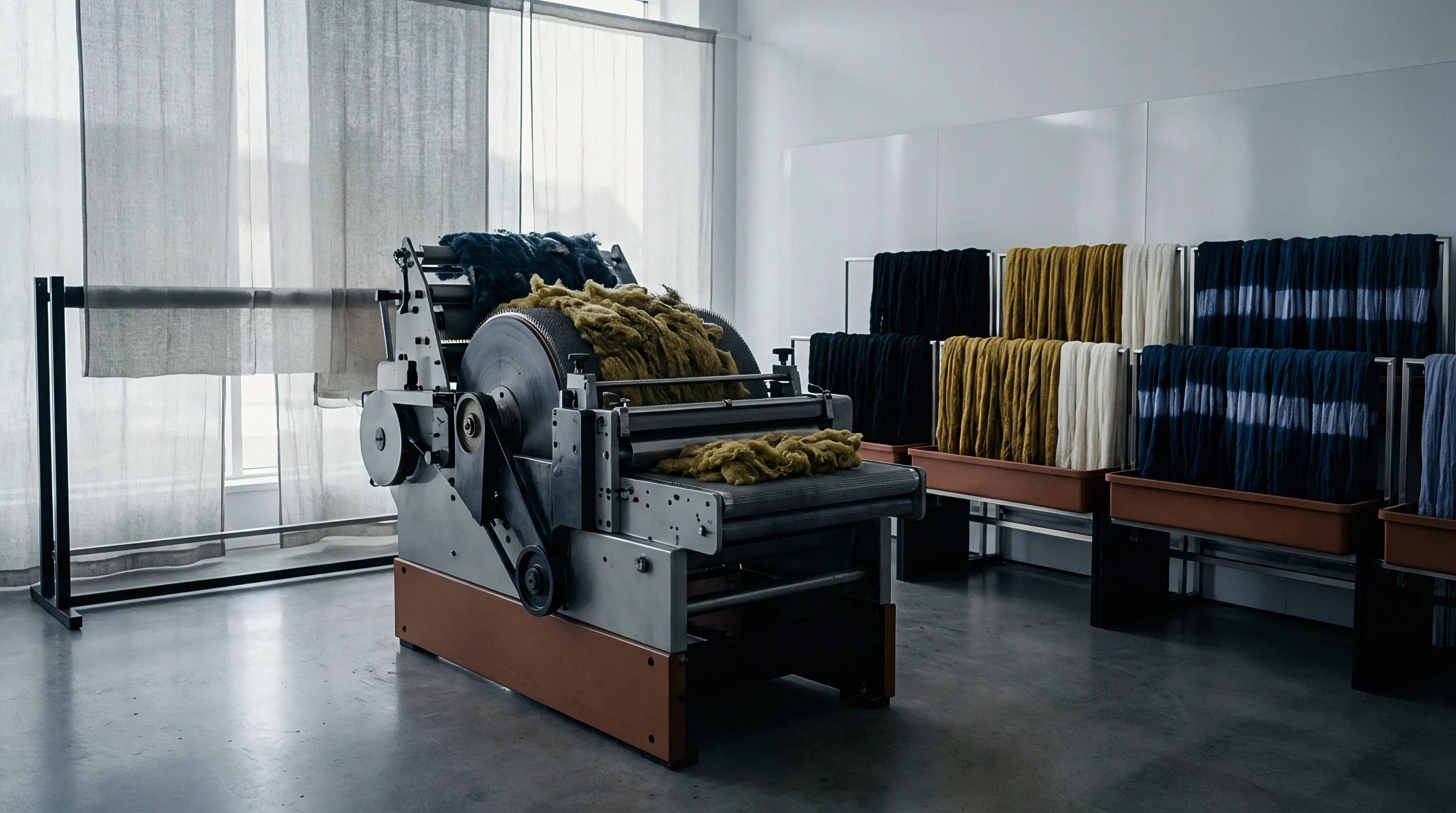
Gauge
Carding machinery strips short, broken fibres and trash particles while preserving longer load-bearing staples. In short staple processing, selective fibre extraction isolates shorter population fractions from a raw cotton or synthetic matrix without removing spinnable material. Mill technicians monitor this boundary by calculating the ratio between the mean fibre length of the extracted waste and the mean fibre length of the incoming card sliver.
High extraction selectivity means the licker-in and flats take out disproportionately short fibres and debris while leaving intact staples in the cylinder wire matrix. When that selectivity drops, the flat strips contain spinnable lint, driving clean mass loss into non-recoverable waste streams.
Selective extraction efficiency quantifies this mechanical action across carding zones. Setting mechanical clearances too tight fractures good cotton staples, whereas excessively wide settings allow trash particles and short fibre clumps to escape into the sliver. Precision clearance management keeps quality consistent.
Clearing flat strips with an upper quartile length above 22 millimetres shifts saleable yarn stock into low-value licker-in droppings.
A carding engineer monitors three active separation zones: the taker-in under-casing, the stationary carding flats, and the revolving flat strips. Each station extracts distinct material profiles. The taker-in relies on centrifugal acceleration and knife angles to peel heavy vegetable matter and dirt away from coarse wire points.
Revolving flats rely on opposing wire carding actions to pull entangled neps, seed-coat fragments, and short fibre aggregates from the main cylinder cloth. Evaluating these points demands testing methods that track length distributions rather than aggregate waste weights alone.
Mill laboratories determine selective extraction by comparing length-frequency arrays between input chute stock, delivery sliver, and waste collectors. Measuring the waste-to-feed short fibre content ratio yields a direct index of machine selectivity. An elevated index confirms that the extraction stream carries mostly damaged, non-spinnable fragments.
A depressed index reveals process damage where the main cylinder and flats break long fibres, generating artificial short fragments while letting heavy trash ride into the finished sliver. Setting specifications on these distributions locks the spinning line into predictable yield boundaries before production lots reach the spinning floor.
Card setting alterations adjust these extraction boundaries within minutes of mechanical re-gauging. Moving the front plate higher or lower shifts flat strip weight without altering the underlying fibre length distribution. True selectivity demands adjusting cylinder speeds, flat velocities, and wire point profiles rather than relying on knife gaps alone.

Fractions
Individual fibre distribution arrays map the carding engine’s true mechanical efficiency. Standard length classifications evaluate short staple cotton across three distinct boundary cut-offs: fibres shorter than 12.7 millimetres (0.5 inches), fibres spanning 12.7 to 25.4 millimetres, and fibres exceeding 25.4 millimetres (1.0 inch). The shortest fraction comprises non-spinning lint that weakens yarn structure, increases hairiness, and generates excessive fly during downstream ring spinning or air-jet operations.
High-volume instrumentation provides mean length and upper-half mean length metrics, but fails to isolate specific extract percentages in extraction points. Advanced array testing methods, particularly the comb sorter method under ASTM D1440 or automated single-fibre testing systems, supply individual length distributions. The Advanced Fiber Information System processes thousands of individual fibres sequentially, generating precise frequency distributions of short fibre content by number and by weight.
| Sample Stream | Mean Length by Weight (mm) | Short Fiber Content by Number (% <12.7mm) | Nep Count (per gram) | Extraction Share of Input Mass (%) |
|---|---|---|---|---|
| Chute Feed Cotton | 27.8 | 22.4 | 280 | 100.0 |
| Taker-in Droppings | 14.2 | 64.8 | 45 | 2.1 |
| Stationary Flat Waste | 18.1 | 46.2 | 520 | 0.8 |
| Revolving Flat Strips | 21.5 | 38.5 | 1150 | 1.4 |
| Card Delivery Sliver | 28.6 | 18.1 | 65 | 95.7 |
Carding actions alter these proportions. The taker-in assembly operates at surface speeds between 10 and 15 metres per second, stripping mass from the feed roller and casting coarse debris across mote knives. Centrifugal force and aggressive wire angles eject heavy particles, motes, and short fibres.
Revolving flat waste shows a higher mean length than taker-in droppings because the flats disentangle neps and pluck short fibres from the cylinder’s wire tips. Card cylinder teeth operate at peripheral velocities from 30 to 45 metres per second, generating air currents that float longer fibres within the wire base while presenting free ends to revolving flat teeth.
Systemic fibre breakage occurs when wire geometry deteriorates or settings pinch staple lengths. If aggressive card clothing breaks a 30-millimetre combed fibre into two 15-millimetre segments, the carding engine creates the exact material it aims to clear. When sliver short fibre content climbs above chute stock values, mechanical breakdown overrides selective extraction.
Pinched feed roller grips, damaged mote knives, or excessive cylinder-to-flat wire populations crush staples instead of combing them. Quantifying these distinct fractions isolates true debris extraction from equipment-induced damage.

Teeth
Metallic card clothing controls the grip, transfer, and release of staple matrices throughout the machine cycle. The front angle, tooth depth, point population, and wire hardening define how fibres seat in the wire foundations. Coarse wire clothing with heavy rake angles holds fibres firmly against the cylinder face, reducing the rate at which flat teeth pull fragments away.
Open wire tooth populations allow loose, unoriented fibres to project into the stripping zone where flat heels catch and extract them.

Front Angle Variations and Web Cleanness
Front wire rake angles establish working penetration into incoming fibre bundles. Taker-in wire typically features an aggressive forward rake ranging from positive 5 degrees to negative 10 degrees depending on fibre linear density and staple configuration. Negative angles release fibres cleanly under centrifugal forces over the extraction grids.
Positive angles retain fibres, driving them past trash separation grids directly onto the main cylinder. Cylinder clothing uses acute angles between 15 and 30 degrees to hold fibres against air turbulence created by 40-metre-per-second cylinder surface speeds.
Dull wire profiles lose the mechanical purchase necessary to separate individual fibres from entangled aggregates. Worn wire points drag across bundles rather than parting them. The resulting friction forms mechanical neps while shearing long fibres across worn margins.
Card technicians track wire life in cumulative production tonnage, re-grinding cylinder surfaces at 50 to 100 metric ton intervals and replacing wires after 300 to 500 tons. Bypassing grinding intervals reduces trash separation selectivity by shifting high-grade mass into the under-card collection bins.

Point Density Impacts on Extraction Balance
Card clothing specifications balance point density across interacting surfaces. The main cylinder contains between 700 and 1000 points per square inch for fine short-staple cotton, while the mating revolving flats run between 350 and 600 points per square inch. Point population ratios determine the transfer coefficient between surfaces.
- Cylinder Point Density governs the spacing of single fibres across the machine width, keeping individual filaments isolated so flat teeth catch tangled neps without dragging clean long staples into the waste channels.
- Flat Point Spacing controls penetration into the cylinder clothing boundary, gathering trash specks, seed skins, and short fragments within open gaps between knee wire bends.
- Inter-Wire Clearances dictate the shearing forces applied to fibre bundles, requiring uniform clearances from 0.125 to 0.200 millimetres across the full working width of the card.
- Wire Surface Finish prevents micro-roughness from binding raw lint, allowing clean fibre release off the cylinder to the doffer without recycling tangled fragments into subsequent cycles.
Improper matching of cylinder clothing to flat point geometry changes the carding action into a grinding mechanism. If the flat wire population exceeds cylinder density during coarse cotton processing, incoming fibre locks overload flat teeth, choking open spaces and halting trash extraction entirely. Mechanical loading occurs rapidly.
When wire spaces pack with compacted lint, carding action ceases and incoming fibre webs pass uncleaned directly into the delivery trumpet.
Under-casing clearance divergence greater than 0.05 millimetres across card width causes uneven lateral air loss and dumps spinnable fibre into mote boxes.
Card flat speed settings dictate extraction dwell time. Increasing flat speeds from 100 millimetres per minute to 300 millimetres per minute exposes fresh, empty wire points to the cylinder web more frequently. This adjustment accelerates total waste removal, pulling out higher gross percentages of flat strips.
However, the selective extraction ratio drops if flat speeds run too high, because clean flats strip unoriented long fibres along with entangled neps, inflating clean fibre loss without improving sliver purity.

Air
Aerodynamic control inside card enclosures governs whether loose fibres remain pinned to the cylinder wire or discharge through waste chutes. A cylinder spinning at 500 revolutions per minute creates a rotating boundary layer of high-speed air that generates immense pressure differentials across machine stations. Internal air currents interact with stationary extraction knives, carding elements, and under-screens.
When boundary pressures remain balanced, air holds long fibres against cylinder teeth while casting heavy trash fragments through extraction knife gaps.

Boundary Layers and Knife Positioning
Stationary deflector knives peel air away from the cylinder perimeter before incoming fibres reach the flats. Knife distance to cylinder wire directly alters waste composition. Setting a knife edge 0.25 millimetres from the cylinder strips turbulent boundary air, capturing dense seed fragments and high-velocity short fibres trapped within the external slipstream.
Widening this clearance to 0.50 millimetres drops air diversion efficiency, allowing trash particles to circulate repeatedly around the cylinder wire.
Repeated circulation increases the probability of fibre entanglement. Each extra cycle around the cylinder forces debris to strike wire teeth, breaking staples and generating secondary neps. Regulating air pressures across stationary carding elements avoids turbulence that pulls long staples away from cylinder points into collection ducts.
Suction Manifolds and Evacuation Air
Continuous suction duct networks vacuum away extracted waste from the taker-in zone, revolving flats, and under-screen stations. Negative static pressure must remain steady across every exhaust hood. Unstable exhaust pressure causes surging inside the carding zone, altering boundary layers over the cylinder and causing erratic extraction volumes.
- Licker-in Collection Suction operates at negative 600 to 800 Pascals, drawing heavy dust, gravel, and crushed hulls into under-card collection bins without lifting staple fibers off incoming feeds.
- Revolving Flat Extraction Ducts require negative 400 to 550 Pascals to pull stripped waste off the cleaning brush, preventing loose fly from recirculating into incoming lap streams.
- Doffer Take-off Pressure requires negative 300 to 450 Pascals to clear flying lint during web condensation, preventing web breakage and maintaining silver count uniformity.
Unequal suction airflow leads directly to localized fibre shedding. If a central vacuum line drops below nominal static pressure levels, flat strip waste accumulates along clearing brushes. Packed waste bridges the clearance between flats and back hoods, redepositing extracted short fibres directly back into the card sliver web.

Tally
Selective extraction efficiency quantifies machine precision across production cycles. Raw waste percentages alone do not measure selectivity. Carding technicians must calculate the Selective Waste Index to confirm that extracted waste contains predominantly short, damaged fibres rather than merchantable staples.
The Selective Waste Index links waste extraction mass to length distribution arrays between raw feed and extracted streams:
Selective Waste Index = (Short Fiber Content in Extracted Waste / Short Fiber Content in Card Delivery Sliver) (Upper Half Mean Length of Sliver / Upper Half Mean Length of Waste)
Higher index numbers indicate greater extraction selectivity. An index below 1.8 indicates process failure where cards extract high percentages of prime spinnable lint. An index between 2.2 and 3.2 indicates balanced extraction, removing foreign debris and non-spinnable fragments while keeping long fibres in the sliver stream.
Worked Calculation of Waste Selectivity
Consider a carding machine operating on standard upland short staple cotton. Chute feed stock arrives with an upper half mean length of 28.0 millimetres and a short fibre content by weight of 12.0 percent. The machine produces card sliver at an upper half mean length of 28.8 millimetres with a short fibre content of 8.5 percent.
Total card waste extraction averages 4.5 percent by weight across all collection points. Revolving flat strips account for 1.5 percent waste, while licker-in droppings account for 2.2 percent, and auxiliary suction catches the remaining 0.8 percent.
Laboratory testing of collected flat strips reveals an upper half mean length of 21.0 millimetres and a short fibre content by weight of 32.0 percent. Taker-in droppings show an upper half mean length of 13.5 millimetres with a short fibre content of 65.0 percent.
Calculating the index for revolving flat strips:
Length Ratio = 28.8 mm / 21.0 mm = 1.371
Short Fiber Ratio = 32.0% / 8.5% = 3.765
Flat Strip Selective Index = 3.765 1.371 = 5.16
Calculating the index for taker-in droppings:
Length Ratio = 28.8 mm / 13.5 mm = 2.133
Short Fiber Ratio = 65.0% / 8.5% = 7.647
Taker-in Selective Index = 7.647 2.133 = 16.31
Combining all waste streams based on mass extraction shares gives an aggregate waste upper half mean length of 16.8 millimetres and an aggregate waste short fibre content of 50.2 percent:
Total Waste Length Ratio = 28.8 mm / 16.8 mm = 1.714
Total Waste Short Fiber Ratio = 50.2% / 8.5% = 5.906
Overall Machine Selective Waste Index = 5.906 1.714 = 10.12
This high aggregate selectivity confirms that the card settings successfully strip short fractions while leaving long staples in the delivered sliver.
| Trial Case Parameter | Case A: Baseline | Case B: Tight Flats | Case C: Wide Knives |
|---|---|---|---|
| Cylinder-to-Flat Setting (mm) | 0.175 | 0.125 | 0.175 |
| Mote Knife Clearance (mm) | 0.250 | 0.250 | 0.500 |
| Flat Speed (mm/min) | 180 | 240 | 180 |
| Flat Strip Extraction Rate (%) | 1.5 | 2.4 | 1.4 |
| Flat Strip Mean Length (mm) | 21.0 | 24.5 | 21.2 |
| Sliver Short Fiber Content (%) | 8.5 | 9.8 | 11.2 |
| Selective Waste Index (Flats) | 5.16 | 2.84 | 3.95 |
Case B shows the clear hazard of setting revolving flat clearances too tight. The 0.125-millimetre setting increases mechanical carding stress, breaking longer staples directly on the cylinder wire. Consequently, flat strip mean length rises to 24.5 millimetres, flat strip waste jumps to 2.4 percent, and the selective index falls to 2.84.
Saleable lint ends up in the waste house, and damaged fibres escape into the sliver. Case C shows that wider knife settings let short fibres and debris bypass collection zones, leaving short fibre content high in the finished card sliver.
Machinery operators must weigh waste percentage changes against fiber distribution impacts before adjusting settings. Chasing lower total waste rates often forces short fibers into the card sliver, degrading yarn uniformity. Maintaining rigorous indexing protocols protects yarn yield and protects downstream process efficiency.

Balance
Every kilogram of fibre pulled into card waste streams directly changes yarn production cost. Raw fibre costs account for 50 to 70 percent of ring-spun yarn manufacturing expenses. Mill management must monitor waste extraction selectivity to protect spinning profitability.
Card waste sells to open-end spinners, nonwoven plants, or stuffing operations at deep discounts below raw cotton purchase prices. Dumping merchantable staples into waste containers destroys spinning margins.

Can Altered Waste Ratios Offset Raw Cotton Costs?
Sourcing lower-grade cotton with higher initial trash levels to cut input costs requires more aggressive card extraction to meet sliver cleanliness targets. Adjusting cards to strip 7 percent total waste instead of 4.5 percent increases raw material consumption per kilogram of yarn produced. If a spinning mill processes 1,000 kilograms of raw cotton per hour at 2.10 dollars per kilogram, raising card extraction from 4.5 percent to 7.0 percent discards an extra 25 kilograms of mass per hour.
At an 8,000-hour annual operating scale, this 2.5 percent extraction increase routes 200,000 kilograms of cotton into the waste house.
Selling card waste at a typical salvage rate of 0.75 dollars per kilogram yields 150,000 dollars in gross revenue against an initial purchase cost of 420,000 dollars. The resulting net raw material loss totals 270,000 dollars annually. This loss erases the raw-material cost savings from purchasing cheaper raw cotton bales.
If poor extraction selectivity drives this waste increase, the card sliver still carries unacceptable short fibre levels, depressing yarn strength and triggering costly yarn breaks on downstream spinning frames.

Landed Specifications and Customs Clearance Risks
Fiber lengths delivered in the card sliver establish yarn linear density limits and yarn tenacity boundaries. Yarn spinners specifying delivery contracts under commercial arbitration rules require rigid adherence to staple classifications. Delivering yarns spun from slivers with inflated short fibre content causes frequent yarn breaks, uneven dyeing, and low bursting strength in finished jersey knits.
- Raw Bale Inspection Protocols verify that incoming cotton meets base staple length contracts, tracking short fibre content by weight below 12 percent under ASTM D5867 testing before bale ties are cut.
- Card Waste Sampling Sequences demand daily collections across individual card delivery points, evaluating flat strip Upper Quartile Length by weight to prevent extraction of spinnable staples.
- Sliver Uniformity Testing measures mass variations along yardage lengths via capacitive evenness testing under ISO 2649, confirming that selective extraction preserves sliver coefficient of variation values below 3.5 percent.
- Yarn Tenacity Verification confirms that finished ring-spun counts hit target tenacity thresholds under ISO 2060 testing, documenting that high short fibre fractions did not escape card extraction zones.
Commercial contracts routinely establish penalty thresholds based on yarn imperfections and neps per thousand metres. When poorly configured cards break fibres and fail to extract neps, downstream thin places, thick places, and neps escalate beyond standard tolerances. Mills face steep deductions or batch rejections if delivery parameters fall outside agreed quality bands.
Delivery sliver containing short fibre content above 10.5 percent increases downstream yarn thin places by more than 40 percent in combed counts.
Customs declarations depend on fiber length parameters under specific Harmonized Tariff Schedule headings. Cotton yarns classified under tariff headings 5205 and 5206 carry import duties linked directly to average staple lengths, combed classifications, and metric yarn numbers. Inaccurate selective card extraction can degrade staple configurations, altering combed-to-carded ratios or failing to meet minimum length requirements for duty-preferred tariff subheadings.
Mischaracterizing processing paths when clearing customs risks penalty audits, reclassification fees, and back-duty liabilities on finished yarn containers.
Card technicians and sourcing managers must align mechanical card settings directly with target yarn counts and duty classifications. Running card machinery without tracking the Selective Waste Index leaves extraction efficiency to chance. Controlling cylinder wire sharpness, flat speeds, and aerodynamic boundary pressures ensures that carding engines pull only non-spinnable debris, preserving prime staple mass for the spinning frame and maximizing yarn sales margins.
The unresolved engineering challenge remains whether automated, real-time optical sensors can continuously measure waste short-fibre fractions within operating collection ducts to adjust flat speeds on the fly without halting card production.