Quantifying Digital Textile Ink Viscosity Requirements and Fabric Pretreatment Chemical Pad Pick-Up Effects
Matching digital ink shear viscosity with controlled pad pick-up targets optimizes optical density and suppresses edge bleeding in high-speed printing.
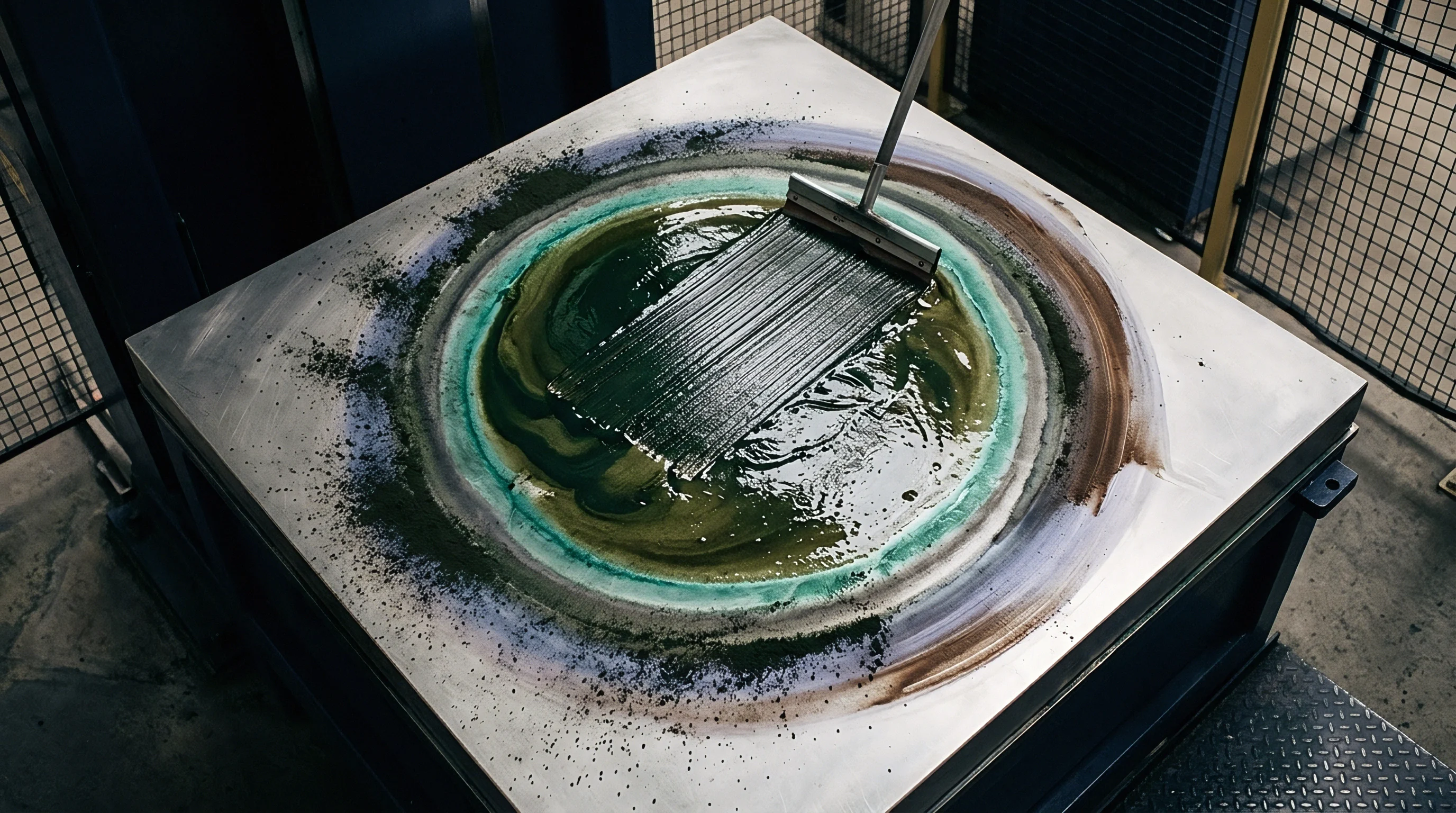

Rheology
Industrial drop-on-demand inkjet systems force fluid through microscopic channels measuring between fifteen and thirty micrometres in diameter. Inside these micro-fluidic chambers, high-frequency piezoelectric actuators fire at frequencies reaching forty kilohertz. This action induces transient shear rates that range from 100,000 to over 1,000,000 reciprocal seconds.
Fluid dynamic viscosity measured under static bench conditions rarely predicts performance at these extreme mechanical limits.
Inks formulated for industrial textile printheads require precise dynamic viscosity boundaries, typically holding between 3.0 and 12.0 millipascal-seconds at operating temperatures ranging from 30 to 45 degrees Celsius. Viscosity dictates drop ejection. When fluid viscosity drops below 2.5 millipascal-seconds, acoustic energy within the channel dissipates into structural splash, yielding unstable acoustic wave reflection and uncontrolled fluid weeping at the orifice face.
Conversely, dynamic viscosity exceeding 14.0 millipascal-seconds dampens acoustic pressure pulses, causing jetting failure, incomplete drop detachment, or complete ejection stalling.
Temperature control directly governs jetting behavior because aqueous digital textile inks exhibit pronounced temperature sensitivity following Arrhenius fluid dynamics models. A temperature shift of a single degree Celsius alters fluid viscosity by approximately 2.1 percent to 2.8 percent. Printhead manifolds incorporate integrated heating elements to stabilize fluid temperature within a tight window of plus or minus 0.5 degrees Celsius during continuous operation.
A reactive digital ink jetting at 35 degrees Celsius maintains an operational dynamic viscosity between 5.2 and 5.8 millipascal-seconds under a high shear rate of 100000 reciprocal seconds.
Fluid behavior under shear defines jetting reliability. Non-Newtonian formulations that exhibit strong pseudoplastic shear-thinning behavior drop their apparent viscosity under printhead passage, aiding initial orifice transit. However, excessive structural thixotropy retards viscosity recovery during drop flight, impairing droplet cohesion and increasing trailing ligament length.
Newtonian or weakly shear-thinning fluids provide stable acoustic energy transfer within printhead channels, minimizing jetting velocity variance across high-density nozzle arrays.
| Printhead Architecture | Operating Temperature (°C) | Target Viscosity (mPa·s) | Max Shear Rate (s⁻¹) | Native Drop Volume (pL) |
|---|---|---|---|---|
| Kyocera KJ4B-QA | 32 to 38 | 5.0 to 6.0 | 1,000,000 | 5 to 18 |
| Fuji Dimatix Samba GMA | 35 to 40 | 4.5 to 5.5 | 800,000 | 2.4 to 5.0 |
| Epson S3200-A1 | 30 to 35 | 3.5 to 4.5 | 600,000 | 3.2 to 12.5 |
| Konica Minolta KM1024i | 40 to 45 | 8.0 to 10.5 | 500,000 | 6 to 30 |
Viscosity measurement protocols demand rigorous shear control. Rotational rheometers utilizing cone-and-plate geometry measuring at a fixed temperature of 25 degrees Celsius fail to capture fluid dynamics inside an operational nozzle cavity. Valid testing protocol specifies continuous rotational shear sweeps up to 100,000 reciprocal seconds coupled with capillary rheometry to replicate short-duration pressure pulses.
Rheological qualification ensures that batch-to-batch fluid consistency prevents ink jetting deflection across multi-head print bars.
Whether dynamic ink formulations can maintain shear stability over three thousand hours of continuous jetting without polymer degradation remains an open technical challenge across commercial printrooms.

Shear
Piezoelectric actuator deformation within nozzle cavities generates transient pressure waves that eject distinct fluid columns. The detachment of these fluid columns into stable primary droplets depends on the physical balance between viscous drag, surface tension forces, and inertial velocity. Fluid dynamicists quantify this physical relationship through dimensionless numbers, primarily the Ohnesorge number, which relates viscous forces to inertial and surface tension forces within small fluid volumes.
Droplets detach cleanly. When the Ohnesorge number falls between 0.1 and 1.0, ink filaments collapse cleanly behind the primary droplet without breaking into secondary micro-droplets. Surface tension values maintained between 25.0 and 38.0 millinewtons per metre supply the necessary contractile force to pull trailing ink filaments into the primary drop body before impact with the substrate surface.
Shear rates peak rapidly. Excessive fluid elasticity prevents filament pinch-off, generating elongated fluid threads that extend several millimetres beyond the printhead faceplate. These long filaments break asynchronously, creating low-mass satellite droplets that drift away from intended dot placement vectors due to aerodynamic drag inside the print gap.
- Satellite Droplet Formation occurs when fluid surface tension drops below twenty-four millinewtons per metre, causing trailing filaments to break into secondary micro-droplets that mist across unprinted fabric ground.
- Nozzle Face Plate Wetting results from inadequate viscous damping, allowing liquid to pool around nozzle orifices and deflect primary drop trajectories by up to three degrees.
- Decap Time Failure stems from rapid solvent evaporation at idle orifices, forming a high-viscosity surface skin that blocks initial ejection pulses after short machine pauses.
- Micro Cavitation Bubble Ingestion triggers when negative meniscus pressure draws air into nozzle chambers during high-frequency firing cycles above thirty kilohertz.
Defected drop trajectories cause visible banding in solid print fills. When satellite misting accumulates on nozzle plates, liquid droplets pool, altering the meniscus pinning location at the orifice edge. This meniscus displacement alters ejection angles, producing high-frequency spatial distortion on moving fabric substrates.
When satellite droplets mist the unprinted margin, lowering printhead operating temperature stabilizes fluid ligament detachment.

Foulard
Industrial pad application units transmit liquid chemical formulations into porous textile structures through mechanical squeeze nips. Pretreatment chemical uniform distribution establishes the chemical background required to anchor jetted dyes, control capillary wicking, and enforce fixed dot formation. The mechanical performance of the foulard pad mangle determines the wet pick-up percentage achieved by the fabric substrate prior to drying.
Pad pressure alters liquid depth. Squeeze rolls remove excess liquid. Wet pick-up percentage measures the mass of chemical liquor retained by dry fabric relative to its initial dry mass, calculated directly through standardized gravimetric analysis.
Fabric construction parameters, including yarn linear density, twist factor, fiber cross-sectional shape, and surface hairiness, dictate initial liquor retention limits under high-speed padding conditions.
Higher nip pressure drives chemical liquor deeper into the core of hydrophobic yarns while lower pressure leaves active chemistry concentrated on surface fibers.
Padder mechanical variables include roller hardness, expressed in Shore A durometer values typically ranging from 60 to 80, applied pneumatic nip pressure measured in bar or linear force in newtons per centimetre, and line speed measured in metres per minute. Squeeze roll deflection under pressure creates an uneven pressure profile across the working width of the machine, yielding higher wet pick-up percentages along fabric selvedges compared to the center line.
- Measure dry fabric weight per unit area on a calibrated electronic balance after conditioning substrate samples at sixty-five percent relative humidity for four hours.
- Set stenter padder squeeze rolls to a baseline linear nip pressure of two bar and measure liquid trough temperature to verify it remains at twenty degrees Celsius.
- Run a ten-metre test length of fabric through the immersion trough and squeeze rolls at a continuous line speed of twenty metres per minute.
- Cut a one-square-metre sample from the centre of the wet fabric roll immediately upon exit from the squeeze nip and record the wet mass.
- Calculate wet pick-up percentage and adjust linear pneumatic pressure until target fluid retention reaches the engineered specification within a two percent tolerance band.
High line speeds shorten immersion residence time inside the pad trough. At speeds exceeding 40 metres per minute, air boundary layers trapped within yarn interstices fail to escape during immersion, resisting chemical liquor displacement. Controlled wetting agents within pad chemistry reduce liquid surface tension below 25 millinewtons per metre, accelerating air displacement and ensuring full yarn bundle saturation before entering the squeeze nip.
Inconsistent squeeze pressure across the roll face creates localized wet pick-up variations that generate irreversible left-to-right color shade banding across the finished fabric batch.
Pretreatment
Chemical preparation baths deposit divalent salts and polymeric anti-migration agents onto substrate surfaces prior to digital jetting. The dry add-on weight of these active chemicals controls the chemical immobilisation of ink droplets upon impact. Calculating dry add-on weight combines the measured wet pick-up percentage with the precise mass concentration of individual active ingredients dissolved in the padding bath.
Fabric weight dictates absorption. Chemical concentration determines salt mass. Reactive ink pretreatment chemistry relies on divalent metal salts, such as calcium nitrate or magnesium sulphate, to ionicly coalesce negatively charged dye particles and anionic thickeners present in the ink.
Polymeric thickeners, including sodium alginate, medium-viscosity carboxymethyl cellulose, or synthetic acrylic polymers, build localized viscosity barriers that prevent capillary spreading along fiber axes.

How Does Wet Pick up Alter Dye Fixation Depth?
Low wet pick-up targets with high chemical concentration leave active salts concentrated on surface fibers. When digital ink strikes this surface-loaded layer, dye molecules instantly crosslink and immobilize within the top ten micrometres of the fabric face. This concentration maximizes color yield and optical density.
However, low liquid volume penetration restricts dye migration into the yarn core, reducing wash fastness and rub fastness ratings under heavy abrasion conditions.
High wet pick-up targets with lower chemical concentration drive active chemistry into yarn core structures. Ink drops penetrate deeper into the weave structure before encountering sufficient salt concentrations to trigger ionic coagulation. Color yield decreases as dyes sink beneath surface fibers, but cross-sectional dye distribution becomes uniform, improving wash fastness on dense heavy-weight substrates.
| Wet Pick-Up (%) | Calcium Nitrate (g/L) | Sodium Alginate (g/L) | Sodium Carbonate (g/L) | Total Dry Add-On (g/m²) |
|---|---|---|---|---|
| 50 | 80 | 20 | 30 | 11.70 |
| 65 | 61.5 | 15.4 | 23.1 | 11.70 |
| 80 | 50 | 12.5 | 18.75 | 11.70 |
| 95 | 42.1 | 10.5 | 15.8 | 11.70 |
Substrate composition dictates pretreatment formulation strategies. Cellulosic fibers require alkaline agents, primarily sodium carbonate, to create the hydroxyl ion conditions necessary for reactive dye covalent bond formation during subsequent steam fixation. Synthetic substrates like polyester require specialized cationic fixing polymers applied alongside anti-static agents to offset synthetic fiber static accumulation during jetting.
- High Density Cotton Knits require a seventy-five percent wet pick-up target paired with forty grams per litre divalent salt concentration to prevent fiber core starvation.
- Low Weight Polyester Wovens demand a fifty-five percent wet pick-up limit with high-viscosity acrylic thickeners to prevent liquid striking through to the backside.
- Viscose Filament Fabrics call for sixty-five percent wet pick-up containing elevated humectant levels to offset rapid core absorption during stenter drying.
- Blended Cellulosic Fabrics depend on a dual cationic polymer and calcium salt system applied at seventy percent wet pick-up to crosslink contrasting fiber types.
Stenter drying parameters following pad application must preserve chemical uniformity. Excessive air velocity or harsh thermal ramp rates during drying induce moisture migration toward fabric faces, pulling water-soluble salts and thickeners out of core fibers and depositing them as an uneven surface crust.
Chemical vendors frequently attribute poor color yield to inadequate stenter drying temperatures rather than acknowledging chemical concentration decay within pad troughs.

Penetration
Liquid ink droplets landing on pretreated textiles undergo rapid capillary migration governed by pore structure and surface energy. Fluid movement through yarn bundles obeys Washburn capillary dynamics, where penetration depth scales directly with pore radius, surface tension, and time, while inversely matching effective liquid viscosity. Dynamic chemical dissolution alters these fluid factors within milliseconds of impact.
Salts arrest ink migration. Capillary forces drive surface spreading. Thickeners limit lateral ink flow.
When jetted ink droplets containing three to eight millipascal-seconds dynamic viscosity strike dried pretreatment chemicals, dissolved surface salts instantly increase local ionic strength. This chemical transition destabilizes dispersed pigment particles or solubilized reactive dyes, precipitating active colorants out of solution while water and co-solvents continue migrating into fiber pores.
High viscosity prevents bleed. Bleed suppression maintains vector edge acuity. Optical color yield, expressed as K/S values calculated via Kubelka-Munk spectrocolorimetric equations, reaches its peak when colorants remain anchored near top fiber surfaces.
Excessive fluid penetration drives color deeper into fabric structures, lowering face reflectance density and generating visible strike-through on fabric undersides.
| Ink Viscosity (mPa·s) | Pad Wet Pick-Up (%) | K/S Value (D65/10°) | Line Bleed Spread (µm) | Strike-Through Ratio (%) |
|---|---|---|---|---|
| 3.5 | 50 | 14.2 | 32.5 | 8.4 |
| 3.5 | 80 | 11.8 | 48.0 | 14.2 |
| 5.5 | 50 | 18.6 | 11.0 | 3.1 |
| 5.5 | 80 | 15.4 | 21.5 | 6.8 |
| 8.0 | 50 | 17.1 | 8.5 | 2.0 |
| 8.0 | 80 | 14.9 | 15.0 | 4.5 |
Quantifying edge acuity requires high-resolution image analysis measuring fine vector printed line boundaries. Feathering metrics calculate deviation between actual printed line edges and perfect mathematical vector lines. Inadequate pretreatment thickener mass permits fluid to follow directional capillary channels aligned with warp or weft yarn orientations, yielding jagged line boundaries and distorted graphic detail.
Substrates evaluated under ISO 105-J03 that show a color difference exceeding Delta E CMC one point zero fail commercial shade acceptance limits for multi-panel garment assembly.
- Optical Density Target achieves a minimum K/S value of sixteen point five measured under D65 illuminant at ten degrees observer angle.
- Bleed Control Tolerance limits lateral line spread to less than fifteen micrometres from the engineered vector edge on fine-count cotton poplin.
- Color Fastness Rating delivers a minimum grade four wash fastness rating under ISO 105-C06 test conditions without shade alteration.
- Backside Strike Through Ratio keeps reverse-side reflectance within five percent of unprinted fabric ground color to ensure clean single-sided printing.
Managing the interaction between ink viscosity and pretreatment chemical density forms the primary technical pathway for optimizing digital color reproduction. Finely tuned dynamic viscosity keeps ink droplets cohesive during jetting flight, while controlled pad pick-up guarantees precise dye precipitation upon surface contact.
Standard mill specifications require incoming pretreated fabric lots to maintain a wet pick-up uniformity within plus or minus two percent across the entire usable width or face rejection at the cutting table.

Outlay
Financial loss in digital print production accumulates rapidly when fluid viscosity deviations cause printhead failure or wet pick-up drift ruins bulk fabric batches. Modern industrial digital printing lines house up to sixty high-density printhead assemblies on fixed print bars. Jetting uncalibrated ink formulations accelerates mechanical damage, causing nozzle faceplate corrosion, micro-channel blockages, and piezo element burnouts.
Printhead damage inflates unit costs. Rejection rates ruin profit margins. Consistent padding saves chemical costs.
Replacing a damaged multi-channel industrial printhead assembly incurs direct hardware costs ranging from three thousand to eight thousand US dollars, excluding lost production revenue during unscheduled machine downtime.
Pretreatment chemical misapplication generates severe operational losses downstream. Under-application of pretreatment chemistry causes widespread dye feathering, rendering entire production runs unsalable due to soft edge definition and low color density. Over-application wastes expensive chemical concentrates, stiffens fabric hand feel, and increases stenter drying energy consumption by up to twenty-five percent.
Color shade variance across bulk fabric lots triggers commercial claims under standard international buyer agreements. When pad pick-up varies by more than three percent across a single mill roll, K/S values shift noticeably, producing color batch variances that fail visual light box inspections under standardized illuminants. Re-dyeing or stripping digitally printed goods remains technically impossible, forcing mills to scrap off-spec pretreated inventory at full landed cost.
When finishing mills control pad pick-up tolerances within tight engineered limits and match ink viscosity profiles to specific thermal printhead windows, bulk production achieves consistent color yield, sharp graphic definition, and predictable landed fabric costs.