Standard Potentiometric Methods for Active Alkali Control in Textile Dyeing
Active alkali control in dye baths relies on potentiometric activity measurement over total chemical dosing to optimize dye fixation and prevent hydrolysis.


Equilibrium
Cellulosic fibers require an alkaline medium for nucleophilic substitution or addition with reactive dyes. Deprotonating hydroxyl groups on the cellobiose unit generates cellulosate anions, which compete with liquor hydroxyl ions to attack reactive sites on the dye molecule. Dosing calculations that rely on simple concentrations of added sodium carbonate or sodium hydroxide consistently fail to predict reaction rates, because they assume complete dissociation and stable activity.
Actual fixation rates depend strictly on the thermodynamic activity of the hydroxide ion.
Potentiometric sensors measure this activity directly through the electromotive force across an ion-selective glass membrane. While concentration approximates activity in dilute solutions, industrial dye baths regularly carry salt concentrations above one mole per liter, usually from sodium sulfate or sodium chloride added to force exhaustion. This heavy ionic background suppresses the hydroxide activity coefficient, creating a substantial split between the mass of alkali dosed into the machine and the active alkali free to drive fixation.
| Sodium Sulfate Concentration (g/L) | Bath Ionic Strength (mol/kg) | Nominal NaOH Charge (g/L) | Measured pH at 60°C | Mean Hydroxide Activity Coefficient | Effective Active Alkali (g/L equivalent) |
|---|---|---|---|---|---|
| 0 | 0.05 | 2.00 | 11.52 | 0.82 | 1.64 |
| 30 | 0.68 | 2.00 | 11.28 | 0.58 | 1.16 |
| 60 | 1.32 | 2.00 | 11.10 | 0.44 | 0.88 |
| 90 | 1.95 | 2.00 | 10.98 | 0.37 | 0.74 |
Temperature changes shift the ionic product of water (Kw) and simultaneously alter dissociation constants for weak buffers like carbonate and phosphate. In a bath set with sodium carbonate at 25°C, active hydroxide drops substantially as the vessel climbs toward a 60°C or 80°C fixation hold. Without real-time potentiometric tracking calibrated for these thermal shifts, fixation rates drift unpredictably during the cycle.
An electrolyte concentration of 80 grams per liter of sodium sulfate reduces the active hydroxide activity coefficient by more than fifty percent compared to dilute calibration standards.
Fixation operates within tight chemical limits. Under-dosing leaves cellulosate formation sluggish, stranding unreacted dye in the bath and yielding weak, off-shade fabric. Over-dosing pushes hydroxide activity past the optimum, favoring hydrolysis over fixation.
Once hydrolyzed, dye molecules cannot bond covalently with the cellulose. The unattached dye washes out during soaping, dragging down wet-fastness ratings, flattening depth, and loading the wastewater stream with expensive color.
The precise thermodynamic point where hydroxide activity tips from promoting covalent dye-fiber coupling to driving water hydrolysis across modified cellulosics remains an active area of empirical investigation for high-salinity dyeing systems.

Glass
Primary monitoring in alkaline dye baths depends on combination potentiometric probes built to handle aggressive thermal and chemical cycling. Standard laboratory glass degrades quickly under production conditions because of alkaline error. At pH levels above 10, conventional silanol formulations exchange hydrogen ions for sodium or potassium cations, generating a falsely low potential that prompts automated dosing systems to dump excess alkali.
Electrodes designed for industrial alkali control incorporate synthetic membrane glasses doped with lithium, titanium, and zirconium oxides. These additives stabilize the silicate network against sodium penetration while letting hydronium pass freely across temperatures from 15°C to 130°C. Maintaining a linear response across that span requires matching the glass composition to the bath’s specific electrolyte profile.
Reference half-cells introduce their own failure modes. Conventional silver/silver chloride designs rely on saturated potassium chloride gels. When this gel meets a bath heavy with sodium sulfate or processing auxiliaries, salts crystallize right at the porous junction.
The blocked junction spikes electrical resistance, causing erratic drift, signal noise, and loss of calibration within a few hours of operation.
Double-junction reference electrodes built with polymer gel electrolytes and hydrophobic Teflon diaphragms extend probe service life past three hundred thermal cycles in saturated salt baths.
Chemical fouling accelerates mechanical wear. Residual dye, defoamers, lubricants, and sizing products settle onto the bulb during circulation. This organic film forms a diffusion barrier that retards ion transfer to the active membrane, introducing damaging lag into automated control loops.
- Alkaline membrane poisoning occurs when sodium ions permanently displace lithium ions within the outer hydrated gel layer of the glass bulb during prolonged exposure to solutions exceeding pH 12 at elevated temperatures.
- Liquid junction occlusion results from the crystallization of insoluble salt complexes inside the pores of ceramic frits when internal bridge solutions mix with concentrated bath electrolytes.
- Thermal glass fatigue develops when rapid heating and cooling cycles create micro-fractures in the thin-walled sensing bulb, altering the cell constant and destroying measurement repeatability.
- Organic surface blinding occurs when hydrolyzed dye aggregates and fatty surfactant preparations form an oil-hydrophobic coating over the hydrated silicate layer, dampening potential response times.
Consistent maintenance largely dictates sensor lifespan. Automated wash stations flush the probe chamber with dilute acid or solvent blends between dyeing lots. Sensors recalibrated against hot, matrix-matched buffer standards maintain dependable stability, whereas calibrations run strictly in ambient, dilute buffers introduce systematic offsets into production dosing.
Electrode calibration performed at ambient room temperature offers no reliable prediction of potentiometric performance once the sensing probe enters a high-density dye liquor operating at industrial temperatures.


Titration
Potentiometric end-point titration remains the benchmark for distinguishing active from latent alkali in production baths. Direct electromotive force measurements give instantaneous operational activity, but acidimetric titrations are what determine total buffering capacity. This distinction is indispensable when running multi-tier dosing profiles that blend sodium hydroxide, sodium carbonate, and sodium bicarbonate.

Can Direct Ph Measurements Replace Acidimetric Titrations?
Direct pH captures free hydronium activity at a single moment. It reveals nothing about the reservoir of un-dissociated alkaline species that replenish active hydroxide as the dye reacts with the fiber. Automated potentiometric titration doses a liquor sample with standardized hydrochloric or sulfuric acid, plotting the derivative of potential change (fracdEdV) against titrant volume to reveal distinct equivalence breaks.
| Measurement Technique | Measured Parameter | Sensitivity to High Salt | Response Time | Ability to Resolve Buffer Species | Suitability for Closed-Loop Dosing |
|---|---|---|---|---|---|
| Direct Potentiometry | Hydroxide Ion Activity (aOH-) | High (Requires activity correction) | Under 5 seconds | None (Measures single state) | Excellent for real-time monitoring |
| Potentiometric Titration | Free and Total Alkalinity (g/L equivalent) | Low (Neutralized during titration) | 3 to 5 minutes | High (Resolves OH-, CO32-, HCO3-) | Optimal for bath charge verification |
| Gran Plot Potentiometry | Low-Level Equivalence Points | Very Low (Linear mathematical extrapolation) | 5 to 8 minutes | Very High (Isolates weak base end-points) | Ideal for complex auxiliary matrices |
Liquors prepared with sodium carbonate display two distinct inflection points under titration. The first inflection, near pH 8.3, marks the complete neutralization of free hydroxide to water and carbonate to bicarbonate. The second, near pH 4.5, reflects the conversion of bicarbonate into carbonic acid.
Measuring the volume delivered between these inflections allows direct calculation of both active caustic and reserve carbonate in the machine.
Gran plot transformations improve accuracy around inflection points where glass response tends to flatten. Converting non-linear potential data into linear functions of titrant volume lets the technician pinpoint equivalence points without leaning on sharp potential drops that salt content or bath temperature easily distort.
Acidimetric potentiometric titrations resolving dual inflection points allow process controllers to differentiate active caustic alkali from buffered carbonate reserves in high-volume dyeing liquor.
Factory titrators automate this routine through a fixed sampling sequence.
- An automated sampling loop extracts a precise twenty-milliliter aliquot of dye liquor directly from the main circulation line of the dyeing vessel.
- The sample enters an isolated, thermal-jacketed titration cell where cold cooling water rapidly brings the fluid to a standardized measurement temperature of 25°C.
- An integrated high-torque stirrer homogenizes the sample while an automated burette dispenses zero-point-one molar hydrochloric acid in dynamic, dose-controlled increments.
- The internal potentiometric probe records stable electromotive force values following each acid addition, transmitting data points to an analytical processor.
- Mathematical first and second derivative algorithms pinpoint the inflection volumes, calculating active sodium hydroxide and sodium carbonate concentrations in grams per liter.
- The titration vessel automatically flushes with deionized water and executes a hot detergent wash cycle to clear dye residues before the next sampling event.
Conflating active hydroxide with total carbonate capacity leads straight to chemical over-dosing. In a typical five-thousand-liter jet running knitgoods, an error of zero-point-five grams per liter in active alkali translates to two-point-five kilograms of unneeded sodium hydroxide. The resulting pH jump past 12.2 can drive vinyl sulfone hydrolysis over fifty percent, collapsing color yield and forcing costly re-dyes that burn through water, steam, and machine time.
Feedback
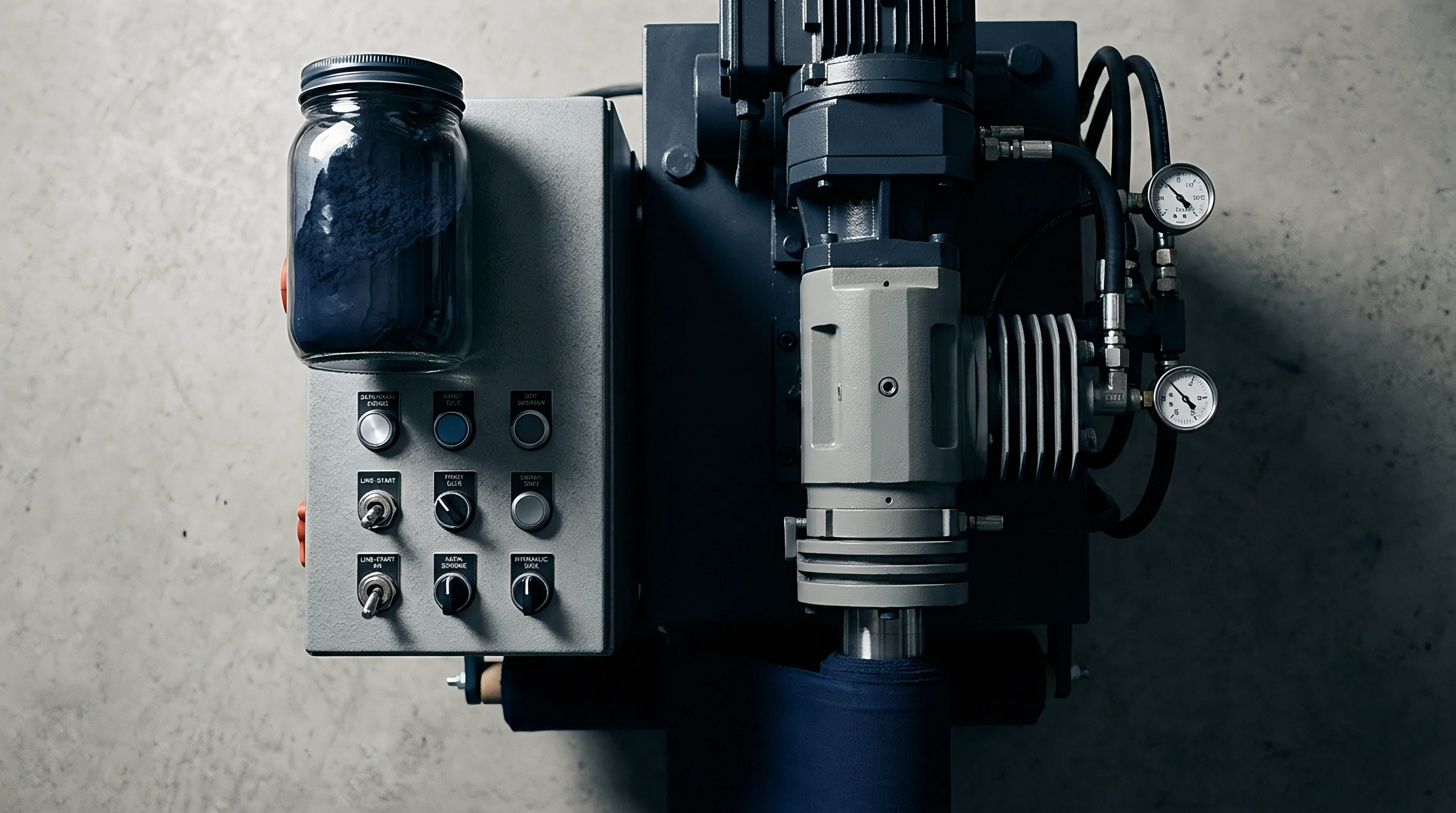
Modern dyehouses rely on closed-loop alkali regulation rather than manual or reactive dosing. High-speed jet machines require controlled dosing along linear or exponential profiles. Dumping chemicals in coarse steps triggers local concentration spikes across the liquor, producing uneven uptake and unlevel lengths along the rope.
A continuous potentiometric loop set on a circulation bypass provides the feedback signal for metering pumps. The controller tracks live electromotive force against a target curve calculated for the specific dye recipe. As active alkali drops from fiber uptake or buffer consumption, variable-speed pumps ramp up to hold the required hydroxide activity trajectory.
Installing sensors directly into high-pressure circulation lines exposes fragile glass membranes to violent shear, pressure pulses, and cavitation bubbles. Plants instead route flow through thermally insulated bypass loops. Bath liquor passes through a lint filter, crosses the electrode chamber at a regulated zero-point-three meters per second, and returns straight to the main circulation line.
- Sampling loop velocity limits must maintain sufficient fluid movement to prevent dye deposition while staying below scour thresholds that create micro-cavitation across the glass bulb.
- Thermal regulation assemblies cool high-temperature exhaust samples down to safe sensor operating limits without dropping temperature so rapidly that dissolved salts crystallize inside the bypass pipe.
- Chemical injection point spacing places alkali feed lines downstream of the sensor loop return, preventing unmixed chemical slugs from creating false feedback spikes in the control algorithm.
- Automatic zero-point validation uses multi-way solenoid valves to isolate the probe and introduce standardized reference buffers into the measuring cell at pre-set process intervals.
Dosing algorithms have to account for non-linear buffer behavior. Near the pKa of sodium carbonate, substantial chemical additions barely move the electrode potential. Once past this buffered zone, small chemical inputs cause steep spikes in hydroxide activity.
Standard Proportional-Integral-Derivative loops cannot cope with this variation and slip into continuous hunting.
Digital controllers handle this non-linearity through gain scheduling. By continually calculating differential buffer capacity (fracdβdpH) from incoming potentiometric data, the controller throttles pump output dynamically to prevent overshoot in unbuffered zones.
Non-linear gain scheduling algorithms adjust dosing pump sensitivity dynamically to prevent catastrophic pH overshoot when chemical additions cross the unbuffered operational threshold.
Fast liquor turnover in modern jet dyeing machines is sometimes assumed to deliver instantaneous mixing on its own, rendering dynamic alkali feedback redundant. Yet micro-sampling across multi-nozzle manifolds shows that localized pH differences up to zero-point-eight units linger along heavy fabric ropes during rapid alkali additions, producing shade variations that inline potentiometric control prevents.
Yield
Accurate alkali regulation feeds directly into dyehouse margins. The primary operational goal is maximizing the proportion of dye covalently fixed relative to the total dyestuff loaded into the machine. Achieving that attachment depends on balancing bath temperature, salt exhaustion, and active alkali dosing.
During fixation, the rate of dye-fiber bonding (rf) competes directly with dye hydrolysis (rh). Hydroxide ions accelerate both reactions, but the rate constants (kf and kh) diverge sharply at higher pH. Running unmonitored at pH 12.5 shifts the reaction heavily toward hydrolysis.
Hydrolyzed dye loses all affinity for cellulose in low-salt baths but stays physically caught within the yarn structure, requiring multiple boiling wash-off cycles to strip out.
Holding active alkali within a narrow, potentiometrically managed band suppresses hydrolysis while keeping fixation brisk. This control cuts wash-off water usage by up to thirty percent and shaves forty minutes off batch run times. Shorter cycles mean measurable savings in steam consumption and pump power.
Environmental standards introduce further constraints. Programs like GOTS and OEKO-TEX Standard 100 enforce strict limits on both effluent discharge chemistry and extractable residues in finished fabric. Excessive alkali loading inflates total dissolved solids and drives up wastewater pH, requiring substantial acid dosing with sulfuric acid or carbon dioxide sparging before effluent can enter treatment basins.
Fabric testing under ISO 3071 requires the pH of aqueous textile extracts to fall within a tight band, typically 4.0 to 7.5 depending on the intended skin-contact category. Poorly controlled fixation leaves heavy salt and alkali residues trapped inside fiber lumens. Acid neutralization on the stenter frame rarely reaches these deep alkaline pockets evenly, leading to yellowing during heat setting and immediate commercial rejection during brand audits.
Commercial contracts increasingly incorporate explicit technical requirements governing batch uniformity and process verification records.
Under standard buyer quality specifications, a delivery lot exhibiting shade variation across rolls exceeding an ISO gray scale rating of 4 is subject to immediate batch rejection and mandatory re-testing at the converter’s expense. When potentiometric execution logs show uncompensated pH drifts exceeding zero-point-three units during the fixation window, liability for color correction, re-dyeing chemical costs, and delayed shipment penalties rests entirely with the dyehouse operator.