Instability Phenomenon
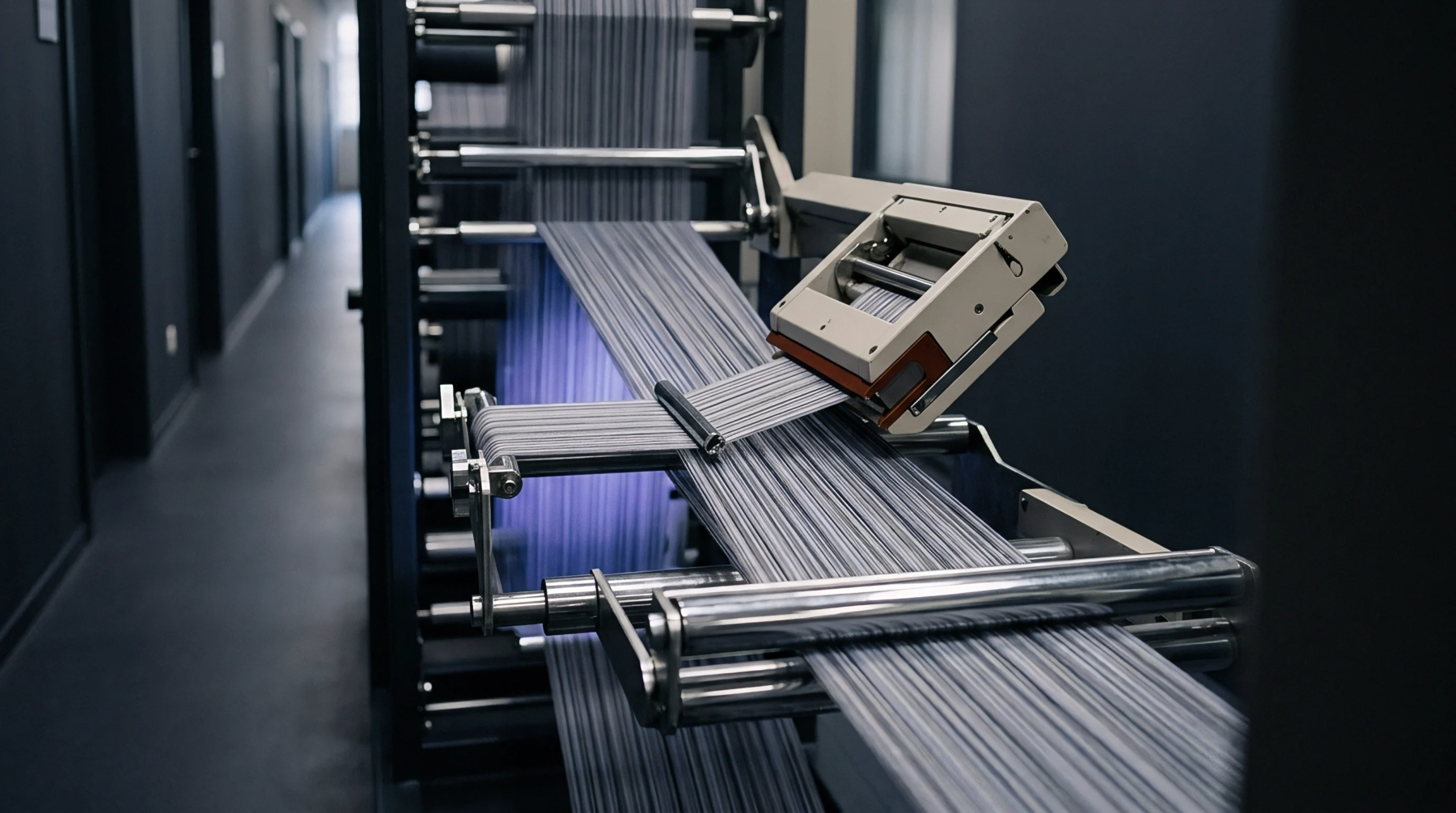
Rotational strand dynamics in staple yarn spinning depend on an equilibrium between centrifugal acceleration and axial withdrawal resistance. Sudden rupture of this force balance triggers balloon collapse, an operational failure wherein the whirling envelope of yarn between the pigtail guide and the ring traveler contracts abruptly onto the spindle assembly. The yarn envelope loses its stable outward curve, causing the strand to whip uncontrollably against the separator plates or wrap around the rotating bobbin neck.
Mill technicians classify this breakdown as a primary source of spinning ends down and localized yarn abrasion. The phenomenon occurs exclusively in twisting and spinning machines that guide yarn through a free centrifugal loop.
Aerodynamic Drag
Atmospheric friction and yarn count govern the aerodynamic drag generated along the outer boundary of the spinning balloon. Fine count combed cotton spun at eighteen thousand revolutions per minute cuts through ambient air at linear speeds exceeding thirty meters per second. This air drag opposes the traveler movement, raising tensile pull at the pigtail guide while dampening centrifugal expansion.
If yarn tension drops because of traveler wear or improper ring lubrication, the aerodynamic drag overcomes the remaining centrifugal force, driving the outward yarn arc inward toward the spindle axis. The collapsed yarn loop strikes adjacent steel separator plates, abrading surface fibers and generating severe mass irregularities. Ring frame operators adjust traveler weights by quarter-grain increments to keep balloon geometry centered between the separators.
Bulk spinning efficiency plummets when humidity variations alter air density and trigger widespread collapse across a ring frame.
Centrifugal Equilibrium
Mathematical modeling balances yarn tension against spindle angular velocity and linear package mass to define the stable operating envelope. Centrifugal force pushes the spinning strand outward into a convex profile, whereas traveler friction and winding resistance draw the strand inward toward the bobbin center. When these forces diverge beyond allowable limits, the rotating yarn strand undergoes multi-node oscillation that terminates in collapse.
The dynamic boundary depends on package diameter, traveler mass, ring diameter, and lift height.
Spindle Clearance
Mechanical design limits for ring frames determine the physical boundary where balloon collapse converts from continuous strand vibration into catastrophic yarn severance. Clearance distances between the spindle blade and the inner ring wall prevent package scuffing during nominal running. Balloon collapse nullifies this protective separation, forcing active yarn onto static frame elements.