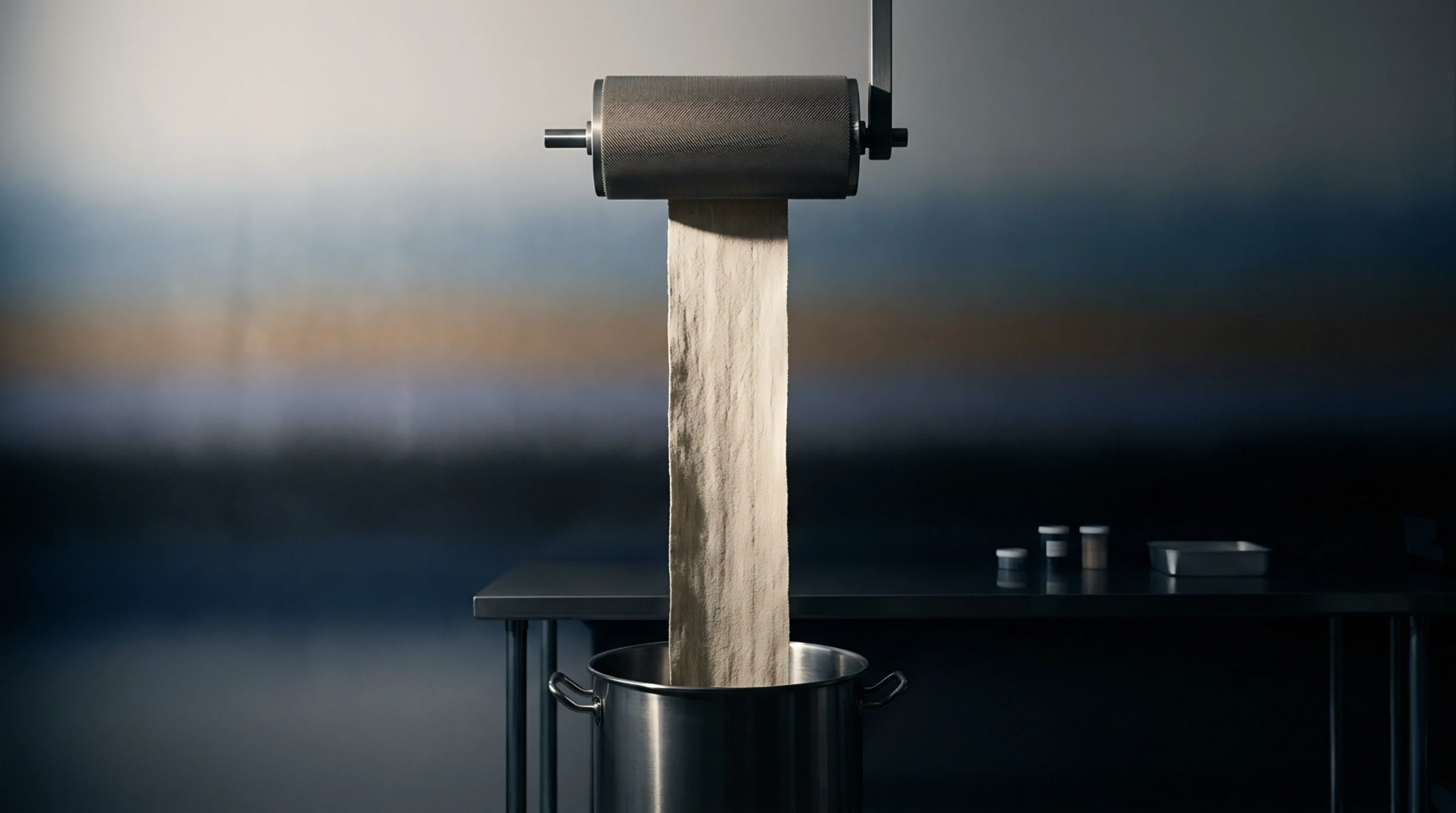
Duct Design
Air transport architecture defines the heated passage system designed to circulate drying gas across moving open-width textiles. Within dye and finishing ranges, the convective air flue removes moisture from padded textiles prior to mechanical tentering or heat-setting stages. Symmetrical jet fields deliver conditioned air evenly to both fabric faces to suppress surface water variation.
Open-loop steam heated rooms and loose unguided yarn paths fall outside the engineering boundaries of this guided continuous drying conduit.
Drying Dynamics
Regulated airflow prevents liquid dye movement toward the outer boundaries of moving fabrics during early evaporation phases. When heated gas flows across wet fabric inside a convective air flue, water evaporates uniformly from the capillary structure between warp and weft yarns. Blower dampers regulate volume velocities from five to thirty meters per second, balancing evaporation speed against structural displacement.
Imbalanced air delivery pushes unfixed dye droplets to the outer face, generating two-sidedness or listing across selvages. Operating temperatures range from one hundred and twenty to one hundred and sixty degrees Celsius based on fabric weight and blend composition. The removal of moisture without mechanical contact ensures delicate pile textures and soft yarn finishes escape compressive damage during transport.
Migration Hazard
Capillary liquid transport poses the primary defect risk across intermediate continuous drying sequences. As water molecules travel from core yarn voids toward exterior fabric faces, dissolved finishing agents and suspended pigment particles travel toward the hottest exposure zones. Unequal air discharge within the chamber amplifies this migration phenomenon, producing blotchy shades or irregular resin distribution.
A convective air flue stabilizes water loss rates before thermal curing locks chemicals into position.
Airflow Regulation
Differential pressure transmitters track volume distribution across upper and lower nozzle banks to guarantee balanced aerodynamic forces on the moving fabric plane. Routine maintenance schedules require exhaust damper balancing, filter lint extraction and heat exchanger cleansing to preserve thermal equilibrium across the chamber volume. Technicians inspect temperature profiles using multi-point pyrometers positioned at chamber entrances and exits.
A convective air flue maintains the drying uniformity required to deliver streak-free yardage to subsequent curing ovens.