Selecting Loom Reed Wire Thickness and Air Space Ratios for Downproof Taffetas
Downproof taffeta requires reed air space ratios between 48% and 52% with wire thickness above 0.14 mm to prevent beat-up deflection and reed marks.

Pitch
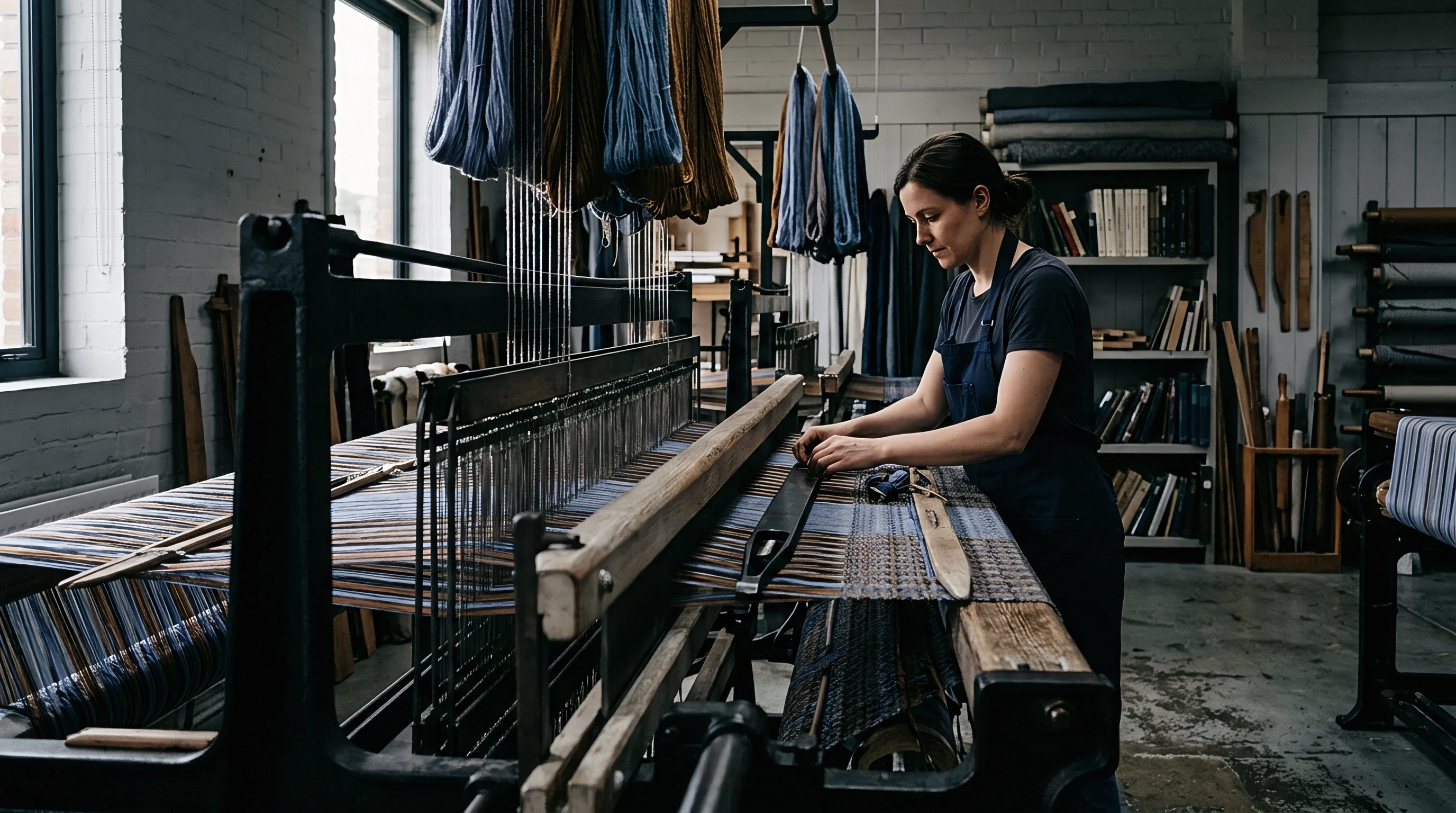
Downproof taffetas constructed from micro-denier synthetic filament yarns demand extreme thread counts to contain down feathers and synthetic insulation microfibers. Achieving greige densities exceeding 160 ends per inch and 130 picks per inch requires careful selection of the loom reed. The reed governs warp end spacing, controls warp tension uniformity across the fell, and withstands the mechanical force delivered by the sley during beat-up.
Selecting reed wire thickness and air space ratio establishes the physical baseline for greige cloth uniformity long before wet finishing or calendering takes place.
Reed pitch equals the sum of the wire thickness and the denter gap width. The air space ratio represents the proportion of open space within a single reed dent relative to the total dent pitch. Standard filament fabrics frequently utilize air space ratios between 55 percent and 65 percent.
High-density downproof taffetas force a departure from these standard geometries. High warp end counts per dent require precise channel widths to allow node passages during shedding while preventing excessive friction on delicate micro-filaments.
| Yarn Count (Duster/Filament) | Greige Density (EPI x PPI) | Reed Count (Dents/cm) | Ends per Dent | Wire Thickness (mm) | Air Space Ratio (%) |
|---|---|---|---|---|---|
| 15D / 14f Nylon 6,6 | 190 x 148 | 23.6 (60/inch) | 3 | 0.14 | 48.0 |
| 20D / 24f Nylon 6,6 | 172 x 135 | 21.6 (55/inch) | 3 | 0.16 | 51.5 |
| 30D / 34f Polyester | 155 x 120 | 19.7 (50/inch) | 3 | 0.18 | 53.8 |
| 40D / 34f Polyester | 140 x 110 | 17.7 (45/inch) | 3 or 4 | 0.20 | 52.6 |
Calculating the correct air space ratio balances structural rigidity against yarn clearance. Thin reed wire increases the available open area for warp ends. However, ultra-thin wires below 0.12 mm flex under the heavy beat-up force required to pack high pick densities into downproof greige.
Flexible wires bow laterally under tension. This deflection creates localized density fluctuations known as reed marks, which persist through scouring, dyeing, and calendering.
Increasing wire thickness preserves dimensional rigidity across wide air-jet looms, whereas reducing thickness preserves the clearance channel needed for low-friction shedding.
Thicker reed wires provide structural resistance against fell displacement. When wire thickness reaches 0.22 mm on high-dent reeds, the available air space collapses. Narrow gaps compress the grouped warp ends within each dent during shed opening.
The resulting mechanical chafing shears individual micro-filaments, generating broken filament clusters that stop air-jet looms. Optimizing geometry involves selecting the thickest wire that maintains an air space ratio above 48 percent without crowding warp ends beyond two-thirds of the available gap width during maximum shed angle opening.
Wire selection requires evaluating the physical wire profile. Flexible flat wire reeds deflect under heavy beat-up force, while conical or double-tapered wires provide higher beam stiffness at the root while maintaining clearance at the warp line. High-density downproof builds perform best with precision-ground stainless steel wires possessing polished, rounded edges.
Sharp wire edges slice through light size coatings on 15D and 20D warp yarns. Edge radius specifications must remain under tight tolerances across the full reed length.
High air space ratios reduce yarn friction but demand higher reed counts to maintain warp distribution. Low air space ratios increase structural stability at the cost of elevated warp end abrasion. Matching wire thickness to the mechanical force of the loom beat-up cycle prevents lateral wire movement.
Beat
Beat-up mechanics in ultra-dense taffetas present unique physical challenges on high-speed air-jet and water-jet looms. When the sley drives the reed forward to press the newly inserted pick into the fabric fell, the fabric resists insertion. Downproof constructions require extreme pick packing, generating high beat-up resistance.
The reed faces immense back-pressure from the compressed yarn matrix at the fell line.
Under heavy beat-up forces, structural deflection of the reed wire occurs. If the chosen wire thickness lacks flexural rigidity, individual dent wires bend backward during contact with the fell. This bending is rarely uniform across the weaving width.
Wires near the sley drive arms remain rigid, while wires at the center of the loom bay deform. Variable wire displacement alters the spacing between ends at the exact instant of pick locking, introducing subtle, recurring light lines along the warp length.
Grouping multiple warp ends per dent alters beat-up behavior. Downproof taffetas typically run with three, four, or five ends per dent to achieve total end counts exceeding 10,000 ends across a standard loom width. Higher end counts per dent concentrate yarn density within localized channels.
During the beat-up stroke, these grouped ends spread laterally inside the dent space.
Structural defects emerging from unoptimized reed setups include:
- Persistent reed striping appears as longitudinal density bands across the finished cloth, caused by non-uniform air space ratios following wire displacement under beat-up loads.
- Filament shear stress manifests as localized fuzzing on the greige surface, resulting from sharp dent entrance angles combined with insufficient channel clearance during shed closure.
- Fell bounceback occurs when flexible wires fail to drive the pick to its fully locked position, allowing elastic yarn recovery to kick the pick backward before the shed crosses.
- Warp end rolled pairs develop when high yarn crowding inside narrow denter gaps forces adjacent filaments to twist over one another during high-frequency shedding.
Sley dwell angle and beat-up timing directly interact with reed wire choices. Eccentric sley motions that accelerate rapidly into the fell amplify wire impact forces. Longer dwell times allow yarn relaxation, but increase the duration of peak frictional contact between wire surfaces and warp yarns.
Fine-tuning the eccentric ratio of the sley drive mitigates peak mechanical stress, permitting thin-wire reeds to operate without structural deformation.
Air-jet weaving of fine-denier nylon downproof cloth requires stable air flow through the reed channel. Profile reeds feature a recessed channel cut into the front face of the dent wires to guide the main air nozzle blast. The wall thickness of this profile channel dictates structural strength.
Cutting a profile into an already thin reed wire reduces its resistance to bending. Profile wire depth must be coordinated with overall wire thickness to prevent localized structural collapse during high-speed insertion cycles exceeding 800 picks per minute.
Looms operating with improper wire selection yield uneven greige fabric densities that fail downproof air permeability testing. Weaving mills frequently attribute these density variations to irregular synthetic yarn shrinkage rather than reed wire deflection under load.

Friction
Micro-denier synthetic yarns contain dozens of individual filaments bundled into fine denier threads. A 20D yarn carrying 24 or 72 filaments consists of individual fiber diameters under 10 micrometers. These fine filaments possess low mechanical shear resistance.
Friction generated between reed wire walls and yarn surfaces during high-frequency shedding degrades filament integrity rapidly if clearances are incorrectly calculated.
Which Reed Wire Profile Minimizes Filament Fuzzing during High-Speed Weaving?
Fully rounded, mirror-polished wire edges minimize abrasive shear during shed opening. Flat wire edges with minimal corner radii scrape size chemistry off the warp ends. Accumulation of size debris inside reed dents narrows the functional air space ratio, escalating friction exponentially as weaving progresses.
Continuous air-jet blast dries out residual lubricant coatings on warp yarns, compounding dry friction inside the dent channel.
Frictional breakdown follows a distinct, destructive sequence on high-speed weaving equipment:
- Excessive end crowding inside narrow reed gaps initiates micro-abrasion of protective surface size coatings during the continuous movement of shed opening and closing.
- Exposed micro-filaments make direct mechanical contact with the metallic reed wire surface, causing static charge build-up on non-conductive synthetic yarns like nylon and polyester.
- Frictional heating and static forces cause individual broken filaments to peel away from the yarn core, creating microscopic loops along the warp thread path.
- Accumulated filament loops merge into fiber clusters at the entry side of the reed dent, forming dense fluff balls that catch adjacent warp ends.
- Trapped fluff balls block the free passage of warp ends during shed crossing, leading to false warp stop signals, yarn snap-offs, and severe weaving defects.
Standard ISO 9237 air permeability limits for downproof fabrics mandate values below 1.5 cm3/cm2/s, a target rendered unachievable when surface filament abrasion disturbs structural yarn packing.
Warp tension control modulates the impact of reed friction. Low warp tension allows yarns to sag, increasing the contact angle against the upper and lower edges of the reed dent during shedding. High warp tension reduces contact angles but increases the normal force pressed against the wire face during beat-up.
Dynamic tension control systems must hold peak shedding tension within a narrow window. Operating outside this window accelerates filament wear and generates micro-snarls that compromise the smooth face of downproof taffeta.
Static electricity generated within the reed bank poses a severe operational threat during low-humidity conditions. Nylon 6,6 accumulates positive static charges rapidly under high-frequency sliding friction. Charged filaments repel one another within the dent, expanding the effective yarn diameter and forcing ends against the metal wire walls.
Active ionic static bars mounted directly behind the back reed face dissipate charges before yarns enter the denter gaps, preserving open clearance paths.
Inadequate air space ratios and rough wire surface finishes double warp end break rates on the loom floor. Higher break rates force frequent operator interventions, leaving start marks and pick bars across the roll length that lead to full greige roll rejections at the inspection table.

Cover
Downproof performance depends on achieving minimal air permeability and mechanical barrier integrity against feather quill penetration. Standard downproof specifications demand compliance with standards such as EN 12132-1 for rubbing resistance or EN 12132-2 for impact resistance, combined with air permeability ratings below 1.0 cm3/cm2/s under ISO 9237 at 100 Pa pressure drop. The primary structural foundation for these values rests in the greige cover factor, which is governed by thread count and thread spacing uniformity.
Greige fabric leaving the loom carries the imprint of the reed geometry. Regions where warp ends were grouped inside dent gaps exhibit tiny structural channels separated by the space where the reed wire passed. These channels are known as reed lines or dent marks.
In standard apparel fabrics, wet finishing, scouring, and dyeing allow yarns to relax, shrink, and migrate laterally, effectively closing reed lines. In ultra-dense downproof taffetas, warp density is so high that yarn migration during wet processing is severely constrained.
| Reed Air Space Ratio (%) | Wire Thickness (mm) | Air Permeability (ISO 9237, cm3/cm2/s) | Down Penetration Count (EN 12132-1, Pass | Tongue Tear Strength Warp/Weft (ISO 13937-2, N) |
|---|---|---|---|---|
| 42.0 (Over-crowded) | 0.22 | 1.85 | 22 (Fail) | 8.2 / 7.1 |
| 48.5 (Optimized) | 0.16 | 0.42 | 2 (Pass) | 11.5 / 10.2 |
| 52.0 (Optimized) | 0.14 | 0.58 | 4 (Pass) | 12.1 / 10.8 |
| 60.0 (Under-guided) | 0.10 (Flexing) | 2.40 | 31 (Fail) | 9.0 / 8.0 |
Calendering acts as the primary mechanical finishing step to achieve downproof performance. Passing dyed taffeta through hot metal rollers at temperatures between 160°C and 190°C under heavy hydraulic nip pressure flattens synthetic filaments, fusing them slightly to seal remaining micro-interstices. However, calendering cannot eliminate deep density variations caused by improper reed wire selection.
When reed wire thickness is too large relative to dent pitch, the resulting gap between warp groupings exceeds the plastic flow capability of the synthetic filaments during calendering. Roller pressure flattens the yarn clusters within the dent zone, but leaves the wide inter-dent gap partially open. Air and fine feather down barbs stream through these microscopic, linear passages under pressure, causing down leakage along clean, parallel lines corresponding to greige dent spacing.
Excessive air space ratios create a different failure mode. When thin wires flex during beat-up, variable warp spacing produces irregular grouping across the cloth width. During calendering, high-density yarn clusters absorb the bulk of the roller pressure, leaving adjacent low-density areas under-compacted.
Air permeability testing reveals extreme variance across the roll width, with readings fluctuating between 0.3 cm3/cm2/s in compacted zones to over 2.5 cm3/cm2/s in uncompacted bands.
Tear strength also correlates directly with reed wire choices. Oversized air space ratios that crowd warp ends into tight groupings force filaments into dense bundles. Compressed bundles reduce individual yarn movement within the fabric matrix.
When a tear force is applied under ISO 13937-2 testing, warp yarns cannot group together to share the mechanical load, resulting in significantly lower tongue tear values compared to fabrics woven with uniform yarn distribution.
A standard quality specification clause for downproof apparel fabric typically defines exact physical thresholds:
Air permeability measured across ten random points per roll according to ISO 9237 at 100 Pa must not exceed 0.8 cm3/cm2/s, with individual readings varying by no more than 15 percent from the mean; failure to meet this limit across three consecutive rolls permits the buyer to reject the entire dye lot without compensation for converter processing costs.
Balancing wire thickness and air space ratio ensures that warp ends exit the loom in a highly uniform spatial array. This uniformity enables mild, energy-efficient calendering conditions that achieve downproof air tightness while preserving a soft hand feel and acceptable tear strength.
Dossier
Translating technical reed selections into enforceable commercial procurement terms requires structured mill qualification protocols. Sourcing high-density downproof taffeta based solely on finished weight and nominal thread count exposes buyers to severe performance risks. Mills frequently optimize weaving speed and loom efficiency by selecting off-the-shelf reeds with thick wires and high air space ratios, sacrificing structural uniformity to reduce warp break rates.
Contractual agreements with greige mills must define full loom setup details alongside conventional fabric parameters. A precise technical specification dossier locks in the precise machinery configurations required to maintain consistent quality across long bulk runs.
To qualify a supplier for high-density downproof production, technical sourcing teams execute a standardized audit protocol:
- Request a complete reed inventory audit from the mill, verifying wire thickness, dent count, air space ratio, and edge polishing certifications for all looms allocated to the purchase order.
- Measure greige fabric density directly off the loom using a digital thread counter to confirm uniform warp end distribution across the left, center, and right sections of the reed width.
- Perform an uncalendered air permeability profile across a full width greige swath to detect systematic reed marking before fabric enters wet finishing.
- Inspect dyed and uncalendered trial swaths under transmitted light frames to evaluate linear density variations caused by wire flexure or warp end crowding.
- Execute pilot calendering runs across three temperature and pressure profiles to establish the minimum finishing force required to meet target downproof standards.
Reeds wear continuously during operation. Running micro-denier synthetic yarns under high tension erodes metallic dent surfaces over time, forming sharp micro-grooves that damage subsequent warp lots. A comprehensive maintenance dossier specifies maximum reed service hours, mandatory ultrasonic cleaning cycles, and periodic optical edge inspection before a reed can be mounted on a loom for downproof production.
Tooling investments and lead times represent substantial commercial factors. Precision stainless steel profile reeds designed for high-density 15D or 20D downproof taffetas carry high unit costs and requires four to six weeks for custom fabrication. Mills operating on tight margins may attempt to substitute standard apparel reeds to avoid tooling costs, promising to correct structural defects during calendering.
Sourcing teams must audit loom sheds directly to confirm that approved custom reeds are installed on active machines.
Fixing reed geometry specs inside the procurement contract shifts risk back to the weaver, ensuring that bulk cloth arrives with the baseline structural integrity needed to achieve technical featherproof barrier performance across every meter shipped.
Whether advances in high-frequency ultrasonic reed cleaning and optical wire mapping will enable lower air space ratios without increasing warp end maintenance costs remains a critical operational evaluation for next-generation micro-denier weaving plants.