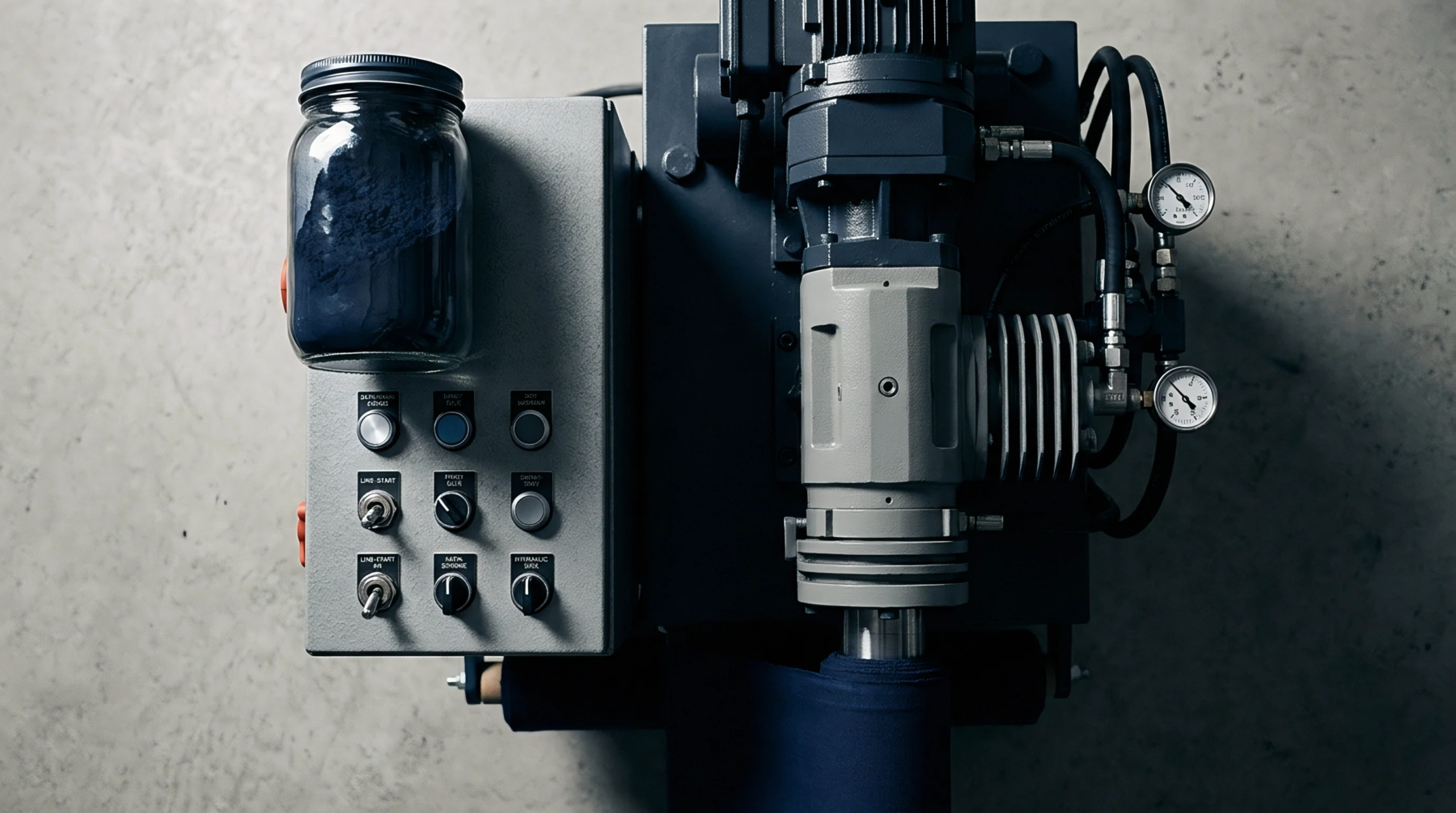
Mechanical Configuration
Air-jet spinning frames employ tandem pneumatic chambers positioned sequentially along the yarn formation path to draft and wrap staple fibres. Within this arrangement, the dual nozzle system combines a primary nozzle that inserts initial false twist with a secondary nozzle that generates counter-rotation. The first nozzle detaches peripheral fibre ends from the main bundle while the second chamber wraps those loose ends around the central core.
Separating drafting and wrapping functions into distinct fluid zones allows precise control over strand compaction. Production units adjust spacing between nozzles to optimize yarn hairiness and tensile strength.
Fluid Behavior
Differential air pressures between sequential jet units establish stable vortex patterns necessary for structural integrity. Applying higher compressed air pressure in the second chamber of the dual nozzle system drives rapid peripheral helical wrapping. Balanced mass airflow prevents strand instability and minimizes compressed air consumption during high speed drafting operations.
Yarn Structure
Physical attributes of air-spun yarn depend directly on the mechanical torque imparted by sequential fluid vortexes. Utilizing a dual nozzle system produces yarn with a parallel core bounded by tight surface wraps. High wrapper density improves fabric pill resistance and dimensional stability during wet finishing.
Inspection Standard
Mill quality control audits measure cross-sectional wrapper uniformity and hairiness index values. Non-uniform nozzle air pressure results in weak spots that cause end breaks during high-speed weaving.