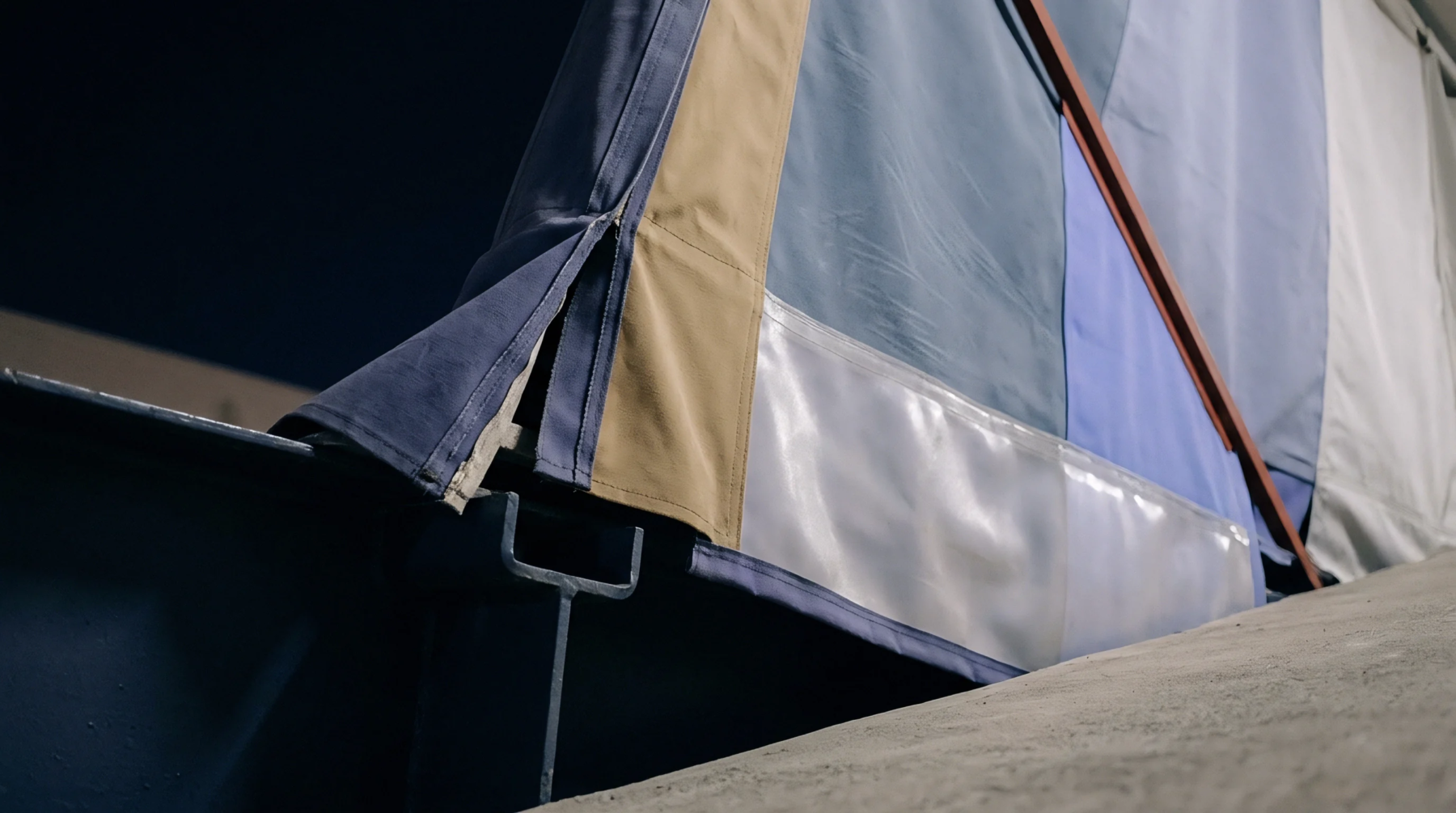
Woven Class
Heavyweight, tightly constructed plain-weave textile materials made from carded cotton or synthetic staple yarns withstand severe mechanical shear, abrasion, and tension forces. Classified globally under broad industrial trade schedules, duck canvas exhibits high pick density, high mass per unit area, and balanced tensile resistance across both warp and weft axes. The traditional category relies on two-ply or multi-ply yarns woven into plain patterns, distinct from looser basket-weave structures or softer decorative canvas draperies.
Commercial applications include marine covers, luggage, outdoor workwear, filtration membranes, and conveyor belting fabrics. Fabric weights span a standardized range between 7 and 30 ounces per square yard, verified on an unbleached or dyed basis.
Yarn Morphology
Ring-spun yarn processing provides the structural strength required for raw canvas performance. Mills twist coarse-count cotton fibers into tight ply structures, often twisting two single yarns into a 10/2, 12/2, or 8/3 plied construction to guarantee tensile strength. Plied yarns limit thin spots, providing high uniformity that seals up under yarn swelling conditions.
Weaving occurs on heavy-duty projectile or rapier looms equipped with amplified beat-up mechanisms, cramming warp and filling yarns into intimate physical contact. Balanced constructions match warp and filling yarn densities closely, limiting structural skew when fabrics encounter high multi-directional mechanical strains. Synthetic variations incorporate high-tenacity polyester or nylon filaments in core-spun formats, wrapping synthetic filament centres inside cotton sheaths to combine mechanical strength with natural dye affinity.
Performance Verification
Quality assessment teams test baseline canvas samples through standardized laboratory methods to evaluate physical parameters before finishing. Mass determinations follow ASTM D3776, measuring square yard weights to verify declared product categories. Grab tensile assessments under ASTM D5034 evaluate warp and fill breaking loads, demanding values surpassing 150 pounds for utility outerwear weights and up to 400 pounds for technical marine grades.
Tear strengths measured via the tongue tear protocol under ASTM D2261 prevent sudden seam tear failures under continuous service stress. Air permeability testing per ASTM D737 tracks fabric porosity, yielding figures between 5 and 25 cubic feet per minute per square foot based on weave compactness. Water spray ratings, hydrostatic head tests, and stiffness evaluations confirm whether protective finishes survive without degrading underlying mechanical integrity.
Commercial Utilization
Procurement contracts for workwear fabrics specify rigorous dimensional stability tolerances to prevent garment deformation across repeat laundering cycles. Unsanforized duck canvas undergoes substantial warp shrinkage up to 12 percent, requiring compressive shrinkage processing to lower residual shrinkage beneath 3 percent. Mills apply specialized chemical formulations, including wax emulsions, paraffin coatings, and fluorochemical repellents, to improve weatherproofing while maintaining breathability.
Inspection personnel check fabric bolts for weaving flaws like dropped picks, uneven selvedges, and contamination from oil slubs that compromise coating adhesion. Rejection thresholds strictly limit visible slub frequency on face sides, ensuring smooth finishes for work apparel and safety applications. Shipped yardage must carry stable lot-to-lot colorfastness ratings under dry and wet crocking tests, protecting finished consumer gear from color transfer.