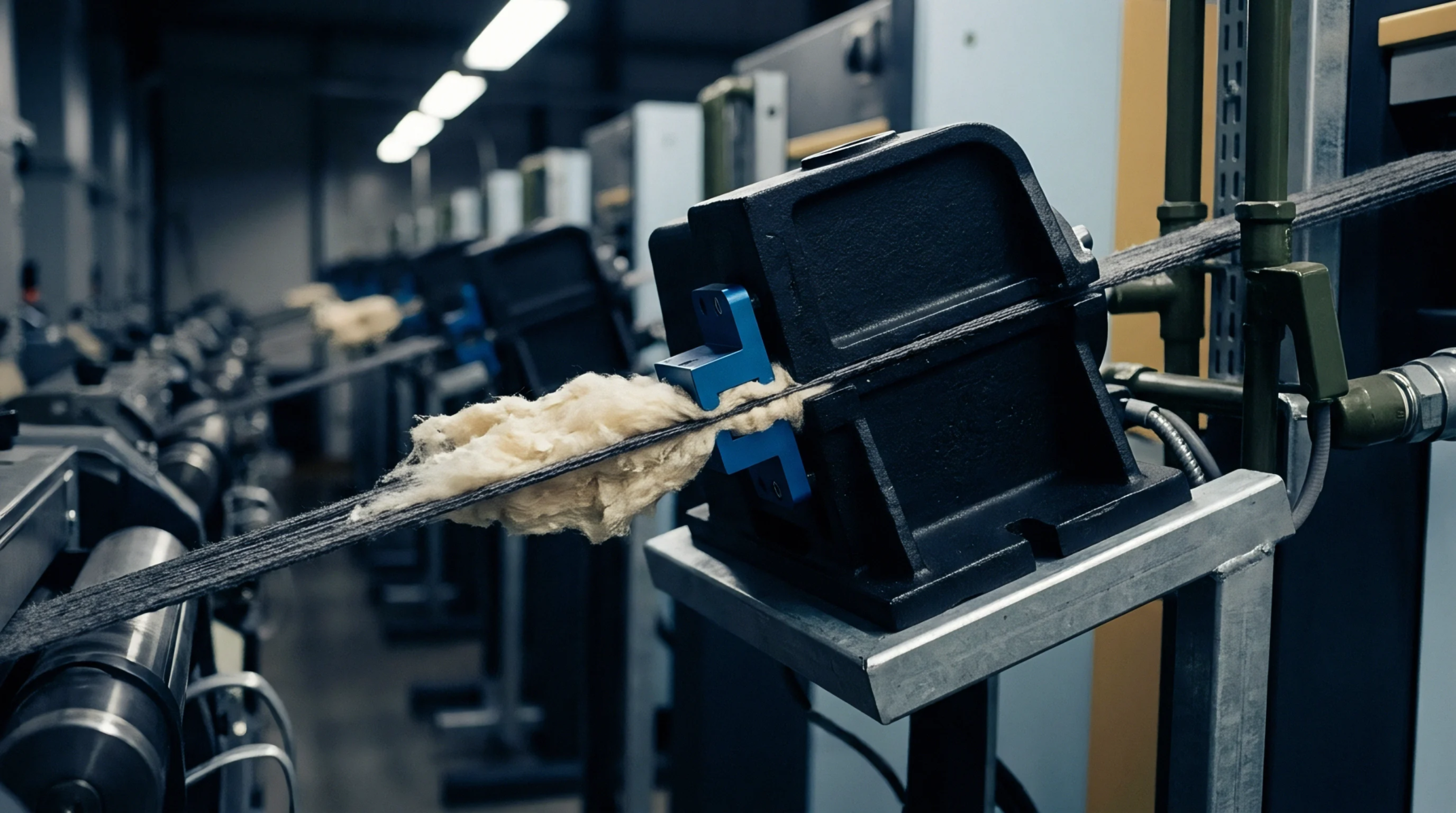
Drafting Point
Spinning frame draft relies on a mechanical boundary formed by two rollers in compressed contact to lock the position of fibres during attenuation. At this juncture, the front roller nip determines the final linear density of the yarn by gripping the cotton or synthetic strand as it exits the drafting zone. Pressure here prevents slippage, which would otherwise introduce mass variation into the drawn strand.
If the grip is insufficient, fibres are pulled through irregularly, creating thick and thin places.
Clamping Force
Mechanical load must exceed the resistance of the fibre mass to maintain a uniform drafting line. Heavy pressure from the weighted top roller against the driven bottom roller establishes the front roller nip, securing the fibres as they transition from the slower apron zone. Variations in this force lead directly to yarn unevenness.
Fibre Dispersion
Uncontrolled movement of short fibres in the drafting zone causes structural irregularities in the output strand. The front roller nip acts as the final terminal point where floating fibres are caught and incorporated into the delivery stream. Precise positioning minimizes the drafting wave.
Velocity Boundary
Delivery speed differs from feeding speed by a factor equal to the mechanical draft of the system. The front roller nip operates at the highest surface speed in the drafting arrangement, pulling the strand forward at several hundred metres per minute to establish the final yarn count. Heat generated at this high-speed boundary requires resilient roller cots.