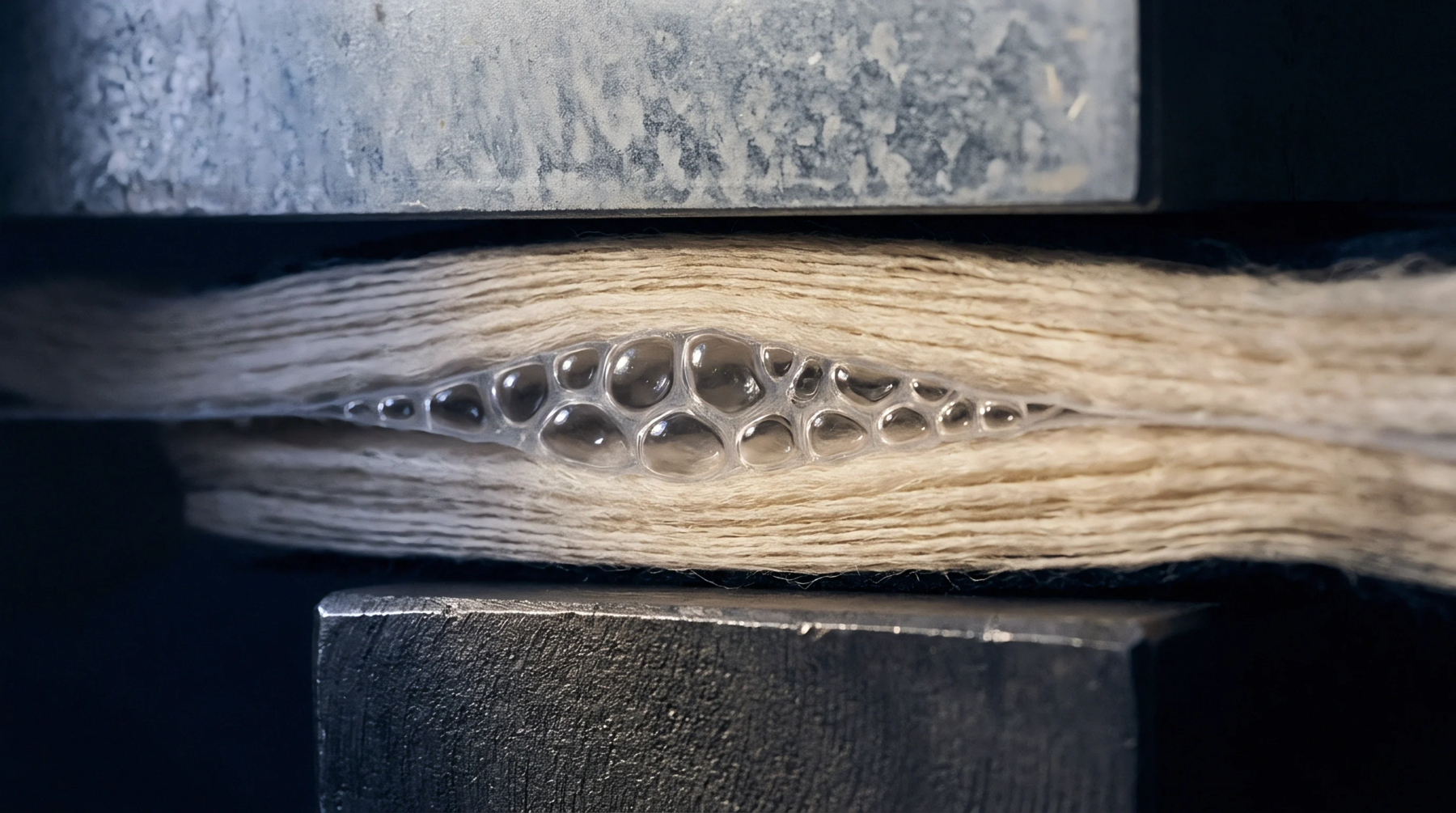
Tunnel Guide Separation
Measured spatial distance between the internal metallic contour of a profiled weaving reed and the surrounding warp sheet or traversing weft yarn maintains an uninhibited air-jet guiding corridor across the loom width. In industrial air-jet weaving, reed profile clearance guarantees that the compressed air stream and the carried filling yarn traverse the warp shed without mechanical abrasion or turbulence. The parameter governs loom shedding geometry, warp break frequencies, and weft insertion stability, stopping its mechanical role once the reed moves forward to the cloth fell for weft beat-up.
Aerodynamic Tunnel Confinement
Profiled reed dents are stamped with an indented concave channel that aligns across the full width of the reed to form a continuous air-guiding tunnel. Warp yarns forming the upper and lower sheds must clear the outer shoulders of this profile during the insertion phase to prevent filament clipping or yarn entanglement. Sufficient reed profile clearance prevents the moving warp threads from intruding into the air stream, where they would otherwise disperse the pneumatic jet and cause insertion failure.
When the loom reaches the beat-up phase, the reed swings forward, closing this operational clearance to compress the inserted weft yarn firmly against the newly formed fabric border.
Mechanical Alignment Sequence
Precise alignment of the reed relative to the loom sley, yarn catchers, and sub-nozzles determines the functional tunnel clearance. Technicians employ specialized thickness feeler gauges and optical depth sensors during reed mounting to confirm that the profile sits exactly parallel to the path of the relay nozzle discharge points. Insufficient mechanical clearance between the reed tunnel and the relay nozzle tips causes metallic strike damage during high-speed sley oscillation.
Conversely, excessive clearance allows the propellant air stream to escape laterally, reducing aerodynamic carrying velocity and creating short-pick defects in the woven structure.
Fabric Defect Prevention
Improper clearances generate severe warp abrasion defects, manifested as broken filaments, fluff accumulation, and loom stops on dense, high-sett weaves. When processing delicate filament warps, such as microdenier polyester or fine silk yarns, excessive contact with the reed profile edge shreds the outer fiber layers, degrading final fabric tensile properties. Careful calibration of reed profile clearance balances the conflicting demands of tight pneumatic air containment and non-abrasive warp yarn separation.
Continuous monitoring of this physical dimension ensures uniform cloth formation across the entire width of industrial looms.